
Vernor Vinge (1944–2024)
Author of A Fire upon the Deep
About the Author
Image credit: By Mark Pellegrini, at ACM CFP-2006 (L'Enfant Plaza Hotel, Washington DC), May 5, 2006.
Series
Works by Vernor Vinge
The Coming Technological Singularity - New Century Edition with DirectLink Technology 15 copies, 1 review
The Tor SF Sampler: 1993 Hugo Nominees (A Fire upon the Deep / China Mountain Zhang) (1993) — Contributor — 10 copies
Synthetic Serendipity 4 copies
2 3 copies
2003 2 copies
A Dry Martini 1 copy
Associated Works
The Year's Best Science Fiction: Twenty-Second Annual Collection (2005) — Contributor — 578 copies, 11 reviews
The Year's Best Science Fiction: Twenty-First Annual Collection (2004) — Contributor — 572 copies, 6 reviews
The Year's Best Science Fiction: First Annual Collection (1984) — Contributor — 148 copies, 1 review
Gateways: A Feast of Great New Science Fiction Honoring Grand Master Frederik Pohl (2010) — Contributor — 113 copies, 2 reviews
Best Science Fiction Stories of the Year Fifth Annual Collection (1976) — Contributor — 107 copies, 1 review
Best Science Fiction Stories of the Year Second Annual Collection (1973) — Contributor — 68 copies, 1 review
Great Science Fiction Stories By the World's Greatest Scientists (1985) — Author — 56 copies, 2 reviews
Analog Science Fiction/Science Fact: Vol. XC, No. 4 (December 1972) (1972) — Contributor — 26 copies
Analog Science Fiction/Science Fact: Vol. LXXXIX, No. 6 (August 1972) (1972) — Contributor — 24 copies
Analog Science Fiction/Science Fact: Vol. LXXXVIII, No. 4 (December 1971) (1971) — Contributor — 22 copies
Singularity Hypotheses: A Scientific and Philosophical Assessment (The Frontiers Collection) (2013) — Contributor — 19 copies, 1 review
Robotics Through Science Fiction: Artificial Intelligence Explained Through Six Classic Robot Short Stories (2018) — Contributor — 9 copies
Monolith 003 : Almanah Znanstveno-fantasticne Knjizevnosti (Monolith, No. 003) (2000) — Contributor — 3 copies
Tagged
Common Knowledge
- Legal name
- Vinge, Vernor Steffen
- Birthdate
- 1944-10-02
- Date of death
- 2024-03-20
- Gender
- male
- Occupations
- mathematician
computer scientist
university professor
science fiction writer - Organizations
- Science Fiction and Fantasy Writers of America
San Diego State University - Awards and honors
- Guest of Honour, Eastercon, UK (1996)
- Relationships
- Vinge, Joan D. (former spouse)
- Nationality
- USA
- Birthplace
- Waukesha, Wisconsin, USA
- Places of residence
- Waukesha, Wisconsin, USA
San Diego, California, USA - Associated Place (for map)
- USA
Members
Discussions
JUNE READ - SPOILERS - A Fire Upon the Deep in The Green Dragon (June 2013)
JUNE READ - NO SPOILERS - A Fire Upon the Deep in The Green Dragon (May 2013)
"A Fire Upon the Deep" Group Discussion in Group Reads - Sci-Fi (March 2009)
Reviews
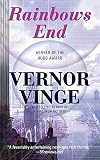
Rereading Rainbows End has been an unexpected pleasure. I remember its satire of Google Books taking paper copies apart for scanning. (By the way, in Service Model, Adrian Tchaikovsky goes Vinge one better on that score.) This time, I noticed his updating of Aldous Huxley’s Brave New World. His hero, Robert Gu, is a retired literature professor and poet from the University of California at San Diego, where Vinge taught. When he wakes from the mental fog of years of Alzheimer’s disease, show more cured by some post-singularity medicine, he finds himself in a brave new world where he doesn’t fit. Poetry has been supplanted by multimedia creations that augment reality. He must return to high school to learn the computer skills every kid now knows. He is as much a displaced person as Huxley’s John Savage. He is finally saved from the tragedy that ends Brave New World by becoming a new man who can connect with others in ways that have nothing to do with technology.
Vinge bought into the idea of a rapid, near-future technological singularity that strains credulity. If you grant him his premise, Vinge writes a good story. show less
Vinge bought into the idea of a rapid, near-future technological singularity that strains credulity. If you grant him his premise, Vinge writes a good story. show less

I am reading Vernor Vinge's Zones of Thought novels in publication order. This second book is set earlier than the first. It does not engage the "Zonological" ideas introduced in A Fire Upon the Deep. It is structured very similarly however, with two parallel and converging narratives, one of which is cutting-edge space drama featuring (the original, in this case) Pham Nuwen, and the other of which takes place in a radically non-human planet-bound society.
The space story involves grappling show more between two human spacefaring societies. The Qeng Ho are Nuwen's mature interstellar mercantile culture, while the Emergents are the totalitarian development of a more local society whose hypostasized Emergency has resulted in an innovative form of enslavement. Simultaneous missions to contact the nascently industrializing aliens of Arachna erupt into catastrophic conflict, leaving the two competitors in a lopsided symbiosis full of intrigue.
The business on the world of Arachna is translated for the reader using conventions later rationalized as the work of the humans surveilling the planet from space. Although the denizens are quasi-arthropod "Spiders," they are characterized with Hobbitsy sorts of English names and traits, such as Sherkaner Underhill and Victory Smith. Since their technological level and social challenges better match our own, these creatures actually come off as more "human" than the either of the human cultures, at least during the first three-quarters of the book before the first in-person meetings between humans and Spiders.
I found it interesting what a mature figure Pham Nuwen is in this book, "resurrected" at its start in a more figurative manner than in A Fire Upon the Deep, but still with an enormous prior history. Despite a serious developmental arc within the scope of the current story, and some significant retrospectives to flesh out his character and motivation, Vinge has left many centuries to play with if he should ever want to compose a pre-prequel using Nuwen as the connective thread.
Big ideas that are central to this book include the coercive management of human attention, and the epistemological weaponization of networked information technology. These both feel more topical now than they would have been when the book was first published in 1999. Vinge also seems to have put a new turn on Ibn Khaldūn's theories of civilizational growth and decay, and the practical superiority of organized merchants to wealthy despots. These notions become intrinsic to the premise that a sufficient "industrial ecology" is needed to support productive interaction with interstellar travelers, who cannot carry such an ecology themselves even at the scale of a fleet. But the industrialized civilizations are necessarily finite in duration, acquiring vulnerabilities with their efficiencies.
Like the previous Zones of Thought book, A Deepness in the Sky is long--eventful, characterful, and thoughtful--and it took all my reading attention for a couple of weeks in order to get through it. Looking back at my review of A Fire Upon the Deep, I find myself in the same position of being glad to have read it and being unwilling to charge on to the next one without a significant pause to recover. And I already own a copy of The Children of the Sky. show less
The space story involves grappling show more between two human spacefaring societies. The Qeng Ho are Nuwen's mature interstellar mercantile culture, while the Emergents are the totalitarian development of a more local society whose hypostasized Emergency has resulted in an innovative form of enslavement. Simultaneous missions to contact the nascently industrializing aliens of Arachna erupt into catastrophic conflict, leaving the two competitors in a lopsided symbiosis full of intrigue.
The business on the world of Arachna is translated for the reader using conventions later rationalized as the work of the humans surveilling the planet from space. Although the denizens are quasi-arthropod "Spiders," they are characterized with Hobbitsy sorts of English names and traits, such as Sherkaner Underhill and Victory Smith. Since their technological level and social challenges better match our own, these creatures actually come off as more "human" than the either of the human cultures, at least during the first three-quarters of the book before the first in-person meetings between humans and Spiders.
I found it interesting what a mature figure Pham Nuwen is in this book, "resurrected" at its start in a more figurative manner than in A Fire Upon the Deep, but still with an enormous prior history. Despite a serious developmental arc within the scope of the current story, and some significant retrospectives to flesh out his character and motivation, Vinge has left many centuries to play with if he should ever want to compose a pre-prequel using Nuwen as the connective thread.
Big ideas that are central to this book include the coercive management of human attention, and the epistemological weaponization of networked information technology. These both feel more topical now than they would have been when the book was first published in 1999. Vinge also seems to have put a new turn on Ibn Khaldūn's theories of civilizational growth and decay, and the practical superiority of organized merchants to wealthy despots. These notions become intrinsic to the premise that a sufficient "industrial ecology" is needed to support productive interaction with interstellar travelers, who cannot carry such an ecology themselves even at the scale of a fleet. But the industrialized civilizations are necessarily finite in duration, acquiring vulnerabilities with their efficiencies.
Like the previous Zones of Thought book, A Deepness in the Sky is long--eventful, characterful, and thoughtful--and it took all my reading attention for a couple of weeks in order to get through it. Looking back at my review of A Fire Upon the Deep, I find myself in the same position of being glad to have read it and being unwilling to charge on to the next one without a significant pause to recover. And I already own a copy of The Children of the Sky. show less

Not since reading Hyperion have I felt this divided about a work of SF. There's no way that I would be able to cover the plot of A Fire Upon the Deep in an appropriate amount of time, but I'll cover the basics for posterity's sake.
The Milky Way is split up into concentric rings radiating out from the galactic center that define the upper limit of thought and technology. At the core, in the Unthinking Depths, there is no rational thinking, no civilization, no sophonts of any kind. On the show more outskirts of the galaxy, in the Transcend, intelligent species become what essentially amount to gods. It is here, at the edge of the Transcend, that a group of human researchers discover an ancient, forgotten data archive. It is here that they unknowingly awaken something called the Blight, a virus in the data that is capable of spreading and assimilating all life into a corrupted hive mind. Some of these researchers escape with a potential antidote to the Blight, and flee to the lower levels of the galaxy in an effort to escape it. Their shuttle crashes on a world of medieval technology inhabited by the Tines, a species of intelligent weasels/dogs that function as a collective intelligence; 4-8 individual members that are otherwise only semi-conscious combining to create one whole individual. The plot centers around these humans as they struggle to survive and understand the Tines, and another group's desperate attempt to find and recover the antidote; to prevent the destruction of the galaxy.
Like I said, it's a lot. That's just the bare bones of it. And what sweet, delicious, dopamine filled bones they are. A significant portion of Vinge's ideas give me the adrenaline rush of creativity and newness that I think is stereotypically associated with SF. I love the Zones of Thought. I love the Tines, their collective intelligence, the philosophical questions about the soul that they raise. I love the skroderiders and their adaptation to long-term versus short-time memory. I love that the galaxy feels vast and unknowable in the quantity of intelligent species. I love the implied billions of years in history that sits under these transient cultures. The richness and sheer quantity of ideas in A Fire Upon the Deep make it super memorable.
Surprisingly enough, I even enjoyed the ending, which is not something I can say about many of these sweeping space operas (or to be frank SF in general). The motif of oceans, waves, the inter-tidal space was quite striking. It is often in the messy and violent spaces between two disparate things, where they meet and cohabitate, that some of the most unique creatures and ideas can come from. As this is true of the ocean and the shore, such is true of the contact points between layers of the galaxy. Much like the ocean, the galaxy also follows a cyclical pattern of events, like the tides or the discrete repetition of an individual wave on the shore, that have massive effects on the species that call that place home. Even though the effects may indeed be world ending on a small scale, the system as whole continues to function, and will provide refuge for new individuals, species, and ideas in the future. I enjoyed how Vinge tied the Skroderiders and Tines into this broader analogy.
Where Vinge fails miserably is in the details: in the moment by moment execution of these ideas and the plot that holds it together. Battle sequences are often muddled, confusing, and poorly drawn. The plot follows several side tangents for far too long, which is ultimately one of the factors leading to its undeniable bloat. The actions of the Blight always happen the background; we barely get to see one of the coolest things in the whole book. Most of the characters are tossed off and shallow in their portrayal. The main Tinish villain is not just intellectually stupid, but cartoonishy so. The love interest between Pham and Ravna was completely unnecessary. Too often Vinge's writing is amateurish and beneath his true capabilities, because infrequently he throws in a line or two that actually have some artistry to them.
None of these flaws are a death sentence on their own, but totaled together they make for a nasty quagmire of quicksand that Vinge frequently dives headfirst into. There's also the dated idea of the Net, that all intelligent species communicate on. Perhaps in 1992 this was forward looking, but today it's a hunk of limestone amongst glittering diamonds. Are we really meant to believable that the best communication that the galaxy can muster is a 4chan forum?
Unfortunately, what I am left feeling is that; had these concepts and ideas been given to a better writer, this could've easily been one of the best books I've ever read. Vinge's capabilities as a writer acted as an anchor dragging everything down. I also fear that much of my enjoyment derived from the novelty and unknown of the zones of thought. Were I to re-read this novel, I wouldn't have the newness to balance out the drudgery. More than most books, A Fire Upon the Deep benefits from a blind reading. Even though the first hundred pages were by far my favorite, I still understand why it has the massive reputation it does. show less
The Milky Way is split up into concentric rings radiating out from the galactic center that define the upper limit of thought and technology. At the core, in the Unthinking Depths, there is no rational thinking, no civilization, no sophonts of any kind. On the show more outskirts of the galaxy, in the Transcend, intelligent species become what essentially amount to gods. It is here, at the edge of the Transcend, that a group of human researchers discover an ancient, forgotten data archive. It is here that they unknowingly awaken something called the Blight, a virus in the data that is capable of spreading and assimilating all life into a corrupted hive mind. Some of these researchers escape with a potential antidote to the Blight, and flee to the lower levels of the galaxy in an effort to escape it. Their shuttle crashes on a world of medieval technology inhabited by the Tines, a species of intelligent weasels/dogs that function as a collective intelligence; 4-8 individual members that are otherwise only semi-conscious combining to create one whole individual. The plot centers around these humans as they struggle to survive and understand the Tines, and another group's desperate attempt to find and recover the antidote; to prevent the destruction of the galaxy.
Like I said, it's a lot. That's just the bare bones of it. And what sweet, delicious, dopamine filled bones they are. A significant portion of Vinge's ideas give me the adrenaline rush of creativity and newness that I think is stereotypically associated with SF. I love the Zones of Thought. I love the Tines, their collective intelligence, the philosophical questions about the soul that they raise. I love the skroderiders and their adaptation to long-term versus short-time memory. I love that the galaxy feels vast and unknowable in the quantity of intelligent species. I love the implied billions of years in history that sits under these transient cultures. The richness and sheer quantity of ideas in A Fire Upon the Deep make it super memorable.
Surprisingly enough, I even enjoyed the ending, which is not something I can say about many of these sweeping space operas (or to be frank SF in general). The motif of oceans, waves, the inter-tidal space was quite striking. It is often in the messy and violent spaces between two disparate things, where they meet and cohabitate, that some of the most unique creatures and ideas can come from. As this is true of the ocean and the shore, such is true of the contact points between layers of the galaxy. Much like the ocean, the galaxy also follows a cyclical pattern of events, like the tides or the discrete repetition of an individual wave on the shore, that have massive effects on the species that call that place home. Even though the effects may indeed be world ending on a small scale, the system as whole continues to function, and will provide refuge for new individuals, species, and ideas in the future. I enjoyed how Vinge tied the Skroderiders and Tines into this broader analogy.
Where Vinge fails miserably is in the details: in the moment by moment execution of these ideas and the plot that holds it together. Battle sequences are often muddled, confusing, and poorly drawn. The plot follows several side tangents for far too long, which is ultimately one of the factors leading to its undeniable bloat. The actions of the Blight always happen the background; we barely get to see one of the coolest things in the whole book. Most of the characters are tossed off and shallow in their portrayal. The main Tinish villain is not just intellectually stupid, but cartoonishy so. The love interest between Pham and Ravna was completely unnecessary. Too often Vinge's writing is amateurish and beneath his true capabilities, because infrequently he throws in a line or two that actually have some artistry to them.
None of these flaws are a death sentence on their own, but totaled together they make for a nasty quagmire of quicksand that Vinge frequently dives headfirst into. There's also the dated idea of the Net, that all intelligent species communicate on. Perhaps in 1992 this was forward looking, but today it's a hunk of limestone amongst glittering diamonds. Are we really meant to believable that the best communication that the galaxy can muster is a 4chan forum?
Unfortunately, what I am left feeling is that; had these concepts and ideas been given to a better writer, this could've easily been one of the best books I've ever read. Vinge's capabilities as a writer acted as an anchor dragging everything down. I also fear that much of my enjoyment derived from the novelty and unknown of the zones of thought. Were I to re-read this novel, I wouldn't have the newness to balance out the drudgery. More than most books, A Fire Upon the Deep benefits from a blind reading. Even though the first hundred pages were by far my favorite, I still understand why it has the massive reputation it does. show less
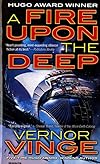
Hard to overstate how wild and fresh and breathtaking this was when it first came out. Also hard to overstate that decades later it is still one of, if not the, towering works of space opera. Not only does it situate itself in a vast teeming galactic stage, it also manages to encompass that setting from its top to its lower depths with gripping drama and amazing vistas, and even if part of that setting is medieval, undeveloped cultures beingg changed through meeting a more advanced culture show more is a staple of space opera, it still manages to strike awe in its alien group-mind species, the Tines, to say nothing of the Skroderiders.
Ambitious humans venture into the edge of space known as the Transcend and awaken a Blight, a terrifying threat that immediately overwhems them. An escaping family make it to a distant uncharted planet, carrying with them something that the Blight either fears or needs. A rescue attempt is dispatched, pursued by at least three fleets, so while the ship races against time, the survivors on the planet are trapped in the politics and machinations of the native Tines.
Honestly as fresh and exciting and mindbending as when I first read it way back when. show less
Ambitious humans venture into the edge of space known as the Transcend and awaken a Blight, a terrifying threat that immediately overwhems them. An escaping family make it to a distant uncharted planet, carrying with them something that the Blight either fears or needs. A rescue attempt is dispatched, pursued by at least three fleets, so while the ship races against time, the survivors on the planet are trapped in the politics and machinations of the native Tines.
Honestly as fresh and exciting and mindbending as when I first read it way back when. show less
Lists
Best Cyberpunk (1)
Future Visions (1)
Favourite Books (1)
Wishlist (1)
Gaming Bookclub (1)
Singularity (2)
Unread books (2)
SF Masterworks (2)
Five star books (1)
Forced Exposure (2)
Awards


You May Also Like


Associated Authors
Statistics
- Works
- 55
- Also by
- 43
- Members
- 23,157
- Popularity
- #911
- Rating
- 3.9
- Reviews
- 521
- ISBNs
- 185
- Languages
- 17
- Favorited
- 163

