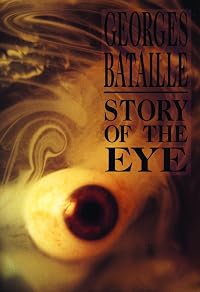
Story of the Eye
by Georges Bataille
On This Page
Description
In 1928, Georges Bataille published this first novel under a pseudonym, a legendary shocker that uncovers the dark side of the erotic by means of forbidden obsessive fantasies of excess and sexual extremes. A classic of pornographic literature, Story of the Eye finds the parallels in Sade and Nietzsche and in the investigations of contemporary psychology; it also forecasts Bataille's own theories of ecstasy, death and transgression which he developed in later work.Tags
Recommendations









Member Recommendations
Member Reviews
Wow. This story hits fast and hard, being very short (between a short story and a novella) and directly written. It is all action, much of it graphic and brutal. At the end the narrator sees Marcelle's eye peering at him from out of Simone's vagina "through tears of urine" with streaks of semen giving the eye a "dreamy vision of disastrous sadness." It's this brief but powerful image that raises this up to the level of true art. The surreal imagery makes it closer to a pornographic prose poem than a true novel, as there really isn't any true plot or character development. This is a book that will always be shocking, much like Dali and Bunuel's Un chien andalou, which this reminds me of.
Honestly, you might want to strike me from your contacts list after I say this but I thought this book was ridiculous. It is essentially a collection of increasingly twisted and violent sexual exploits of two teenage lovers narrated with restrained enthusiasm by the male of the pair. They piss and cum with abandon all over each other and most of the pages of the book as they engage in exhibitionism and violent sex. Their overwhelming sexual aggression drives a pious girl they have fetishized to madness and suicide, gains them the support of an older pervert that likes to watch them fuck shit up and masturbate from a discreet distance and ultimately concludes in a brilliantly fucked up scene with a priest. It's not pretty...
It is show more literally a collection of the most horrifying and disgusting sexual scenarios the author could imagine. It's the Aristocrats played straight. And that's why rather than being emotionally beat like I was after reading [Story of O] I found this amusing and ridiculous. This isn't about believable characters exacting their terrible fantasies on hapless bystanders. This is the porn equivalent of a child banging two dolls together to simulate a bloodthirsty battle. It's enthusiastic, and satisfying to the child, but one thing it will never be mistaken for is the real thing.
Now, you could certainly get upset about what fantasies these represent, and that's valid, but unlike [Story of O] I think the sexual appeal here is less about the actions of the characters and more about the appeal of dreaming up the extreme and shocking. Bastaille would have grown up with all the Victorian sexual oppression we're told about, and frankly, this book is strike back. Is it so odd that in a culture that demonized sex the embrace of sexuality could result in a kink that conflates sex and other socially maligned activities?
Also there is some surrealistic/Freudian thing with the fetishization of eggs and eyeballs. It made me imagine what it would be like if this story was filmed with the style and technology of Un Chien Andalou. I really think that would be the way to go if you were to adapt it to screen. show less
It is show more literally a collection of the most horrifying and disgusting sexual scenarios the author could imagine. It's the Aristocrats played straight. And that's why rather than being emotionally beat like I was after reading [Story of O] I found this amusing and ridiculous. This isn't about believable characters exacting their terrible fantasies on hapless bystanders. This is the porn equivalent of a child banging two dolls together to simulate a bloodthirsty battle. It's enthusiastic, and satisfying to the child, but one thing it will never be mistaken for is the real thing.
Now, you could certainly get upset about what fantasies these represent, and that's valid, but unlike [Story of O] I think the sexual appeal here is less about the actions of the characters and more about the appeal of dreaming up the extreme and shocking. Bastaille would have grown up with all the Victorian sexual oppression we're told about, and frankly, this book is strike back. Is it so odd that in a culture that demonized sex the embrace of sexuality could result in a kink that conflates sex and other socially maligned activities?
Also there is some surrealistic/Freudian thing with the fetishization of eggs and eyeballs. It made me imagine what it would be like if this story was filmed with the style and technology of Un Chien Andalou. I really think that would be the way to go if you were to adapt it to screen. show less
Gorgeously disgusting, showing Bataille's transgressive mind to its fullest. I read this book twice because there was just so much to analyze.
Before I read this work, I'd already read Bataille's "Erotism Death and Sensuality" (1957) ("EDAS") which amazed and confounded me. "Story of The Eye" ("SOTE") was written twenty-nine years before EDAS and yet the link between the two works is obvious. As other reviewers / critics have noted, it appears that Bataille ultimately derived his fully fleshed-out concepts (pun intended) from the ideas that are present in SOTE. This book ends up resembling a satire of pornography; it's so extreme as to be ridiculous. The reader is introduced to vaguely-sketched characters whose participation in drastic objectification overtakes their respective personalities. All of these "non-characters" are very young, precocious and seemingly lacking in show more innocence. They use each to other live out their fantasies, by means of bizarre fetishes, that fuel an ongoing excitement that inevitably doubles as torment. By doing so, the main players melt and meld into a Dionysian "oneness" where personality disappears and the reptile brain takes over. Within SOTE, the characters break away from the confines of any previous social conditioning. Nothing herein is appropriate; the artifice of civilized decorum plays no part in this work. The reader immediately becomes the "voyeur" in a world where behavior resulting from uninhibited sexual appetite can result in grave consequences -- Particularly within the context of transgression. In Closing: the moral of this story is: Since sexuality is amoral -- Anything goes. Although hopefully one can accept the fact that "anything goes" can be disgusting as well as inhuman. But to each his own: One man's / woman's revulsion is another's stimulation. show less
This is a book that I sat down and read in one sitting, I was so engrossed. That being said, this book is not for the squeamish, and if you're looking for steamy erotic scenes, again, not for you. However, if you're interested in the study of psychosexuality and Freudian psychoanalysis, then I would take a gander at Bataille's fantasy on the constellation of sex and violence. The imagery is both wonderful and disturbing--perhaps more frequently the latter--but in all cases vivid, which makes Bataille, for me, one of the more interesting (and often maligned or neglected) intellects to come out of 20th century France. He definitely would need less Prozac than Sartre or Camus would were they all living in today's world. ;-)
Georges Bataille’s infamous book “The Story of the Eye” always poses before me a difficult question—what is the difference between pornography and a normal work of fiction suffused with sexual elements? Or, to be more precise, should we call this book pornographic?
Like any pornographic narrative, “The Story of the Eye” follows the sexual adventures of an unnamed late adolescent narrator and Simone, his female partner, in short episodic vignettes. It describes their activities in great details, ranging from orgy to necrophilia accompanied by sheer violence.
But at the same time, another aspect of the novel starts haunting us, thereby prohibiting us to arrive at a straightforward answer to the initial question. Rather than show more being content with the sexual experimentation of the couple, the narrative seems to become more and more preoccupied with an object, tracing its origin, development and subsequent transformation. The object is, as the title of the book suggests, the eye. Roland Barthes, in his essay “Metaphor of the Eye” (1962), rightfully says,
"What happens to the Eye (and no longer to Marcelle, Simone, or the narrator) cannot be identified with ordinary fiction.”
He further argues that instead of working within a partial imaginary world where author’s imagination is bounded by the limitations of reality, Bataille straightaway creates a completely imaginary paradigm which lies far beyond reality. Barthes calls this poetic imagination. In this imaginary realm, the object, namely, the Eye, shifts paradigmatically from one substitutive object to another (eggs, testicles and other ovular objects) retaining its geometrical identity, but, at the same time, losing its functional one, behaving as a pure metaphor. There runs another stream, similar in nature and parallel to the aforementioned one. This is a series of liquid metaphors within the text, which flow through tears, cat's milk, egg yolks, frequent urination scenes, blood and semen. These two parallel streams are interdependent and interacts with each other as well.
According to Barthes, the narrative element of the novel, the story of the narrator and Simone, is just a literary mechanism to facilitate this smooth shifting of the underlying objects. As Barthes says in his essay—
“The narrative is only a kind of flowing matter, a vehicle for the precious metaphoric substance; if we are in a park at night, it is so that a thread of moonlight can turn translucent the moist patch of Marcelle’s sheet, which floats out the window of her room; if we are in Madrid, it is so that there can be a corrida, an offering of the bull’s testicles, the enucleation of Granero’s eye, and if in Seville, it is so that the sky there can express that yellowish liquid luminosity whose metaphoric nature we know by the rest of the chain…”
But, this analysis, though rigorous, doesn’t answer a rather simple question—why has such overtly sexual, if not pornographic, narrative been chosen as the carrier of the underlying metaphors? Or, rather, are we doing justice to the book by completely negating its narrative structure? What is the role of these erotic elements within the text?
If we closely follow the story, we’ll soon find out that, throughout the novel, sex and death, Eros and Thanatos, are irrevocably intertwined. Almost all the sexual encounters in the story culminate in either death or utter violence, be it Marcelle’s suicide, Granero’s death or strangulation of Don Aminado. The desperation of the couple to break free from their puritan parents, or at least to completely ignore them, quite categorically hints at the subversive urge of upturning the social taboos and stigmas, and also initiates a process of self-annihilation, the process of estranging oneself from his surroundings and coiling into a never-ending coition. It is far too similar to the state of ultimate bliss, or Nirvana, as prophesied by almost all the religions. But, this is only the beginning. Gradually, it dawns upon the reader that the entire erotic system established in the narrative, with all its rituals, fetishes and practices, is nothing but a primordial religion in itself. So, when the denouement comes with a blasphemous parody of the Catholic Eucharist involving desecration of the bread and wine using a dead priest’s urine and semen, it simply manifests the substitution of one fetishist system with another, substitution of Eucharist and consecrated hosts with eye, blood and semen. Therefore, the Barthesian shift of underlying metaphors finally surfaces and, in the process, engulfs those real metaphors (Eucharistic bread and wine), held so dear to Christianity.
Now, let us go back to our original question about the identity of “The Story of the Eye” as a pornographic fiction.
A truly great work of fiction always has the tendency to transgress. By transgression, I’m referring not only to transgressing the social norms, but also to transgressing the immediate literary genre within which it is operating. For example, Borges’ short story “Death and the Compass” apparently assumes the air of a detective fiction, but at the end, the story levitates to a metaphysical plane breaking loose from the confines of its immediate genre (i.e., detective fiction).
True, that Bataille works within the genre of pornography, utilising almost all of its tools (necrophilia, fetish, orgy etc.), but he also, at the same time, subverts it by the underlying maze of metaphors. The so-called pornographic infrastructure is necessary for him to explore the social taboos (also, the interrelation of sexual and religious fanaticism) and thereby transgressing them, but he never allows his readers to become too much engrossed in those superficialities, diverting their attention by the subliminal superstructure of metaphors and images. So, for Bataille, the use of pornography is, as Barthes suggests, a mere literary ploy, albeit a necessary one, but eventually his novel surpasses it. show less
Like any pornographic narrative, “The Story of the Eye” follows the sexual adventures of an unnamed late adolescent narrator and Simone, his female partner, in short episodic vignettes. It describes their activities in great details, ranging from orgy to necrophilia accompanied by sheer violence.
But at the same time, another aspect of the novel starts haunting us, thereby prohibiting us to arrive at a straightforward answer to the initial question. Rather than show more being content with the sexual experimentation of the couple, the narrative seems to become more and more preoccupied with an object, tracing its origin, development and subsequent transformation. The object is, as the title of the book suggests, the eye. Roland Barthes, in his essay “Metaphor of the Eye” (1962), rightfully says,
"What happens to the Eye (and no longer to Marcelle, Simone, or the narrator) cannot be identified with ordinary fiction.”
He further argues that instead of working within a partial imaginary world where author’s imagination is bounded by the limitations of reality, Bataille straightaway creates a completely imaginary paradigm which lies far beyond reality. Barthes calls this poetic imagination. In this imaginary realm, the object, namely, the Eye, shifts paradigmatically from one substitutive object to another (eggs, testicles and other ovular objects) retaining its geometrical identity, but, at the same time, losing its functional one, behaving as a pure metaphor. There runs another stream, similar in nature and parallel to the aforementioned one. This is a series of liquid metaphors within the text, which flow through tears, cat's milk, egg yolks, frequent urination scenes, blood and semen. These two parallel streams are interdependent and interacts with each other as well.
According to Barthes, the narrative element of the novel, the story of the narrator and Simone, is just a literary mechanism to facilitate this smooth shifting of the underlying objects. As Barthes says in his essay—
“The narrative is only a kind of flowing matter, a vehicle for the precious metaphoric substance; if we are in a park at night, it is so that a thread of moonlight can turn translucent the moist patch of Marcelle’s sheet, which floats out the window of her room; if we are in Madrid, it is so that there can be a corrida, an offering of the bull’s testicles, the enucleation of Granero’s eye, and if in Seville, it is so that the sky there can express that yellowish liquid luminosity whose metaphoric nature we know by the rest of the chain…”
But, this analysis, though rigorous, doesn’t answer a rather simple question—why has such overtly sexual, if not pornographic, narrative been chosen as the carrier of the underlying metaphors? Or, rather, are we doing justice to the book by completely negating its narrative structure? What is the role of these erotic elements within the text?
If we closely follow the story, we’ll soon find out that, throughout the novel, sex and death, Eros and Thanatos, are irrevocably intertwined. Almost all the sexual encounters in the story culminate in either death or utter violence, be it Marcelle’s suicide, Granero’s death or strangulation of Don Aminado. The desperation of the couple to break free from their puritan parents, or at least to completely ignore them, quite categorically hints at the subversive urge of upturning the social taboos and stigmas, and also initiates a process of self-annihilation, the process of estranging oneself from his surroundings and coiling into a never-ending coition. It is far too similar to the state of ultimate bliss, or Nirvana, as prophesied by almost all the religions. But, this is only the beginning. Gradually, it dawns upon the reader that the entire erotic system established in the narrative, with all its rituals, fetishes and practices, is nothing but a primordial religion in itself. So, when the denouement comes with a blasphemous parody of the Catholic Eucharist involving desecration of the bread and wine using a dead priest’s urine and semen, it simply manifests the substitution of one fetishist system with another, substitution of Eucharist and consecrated hosts with eye, blood and semen. Therefore, the Barthesian shift of underlying metaphors finally surfaces and, in the process, engulfs those real metaphors (Eucharistic bread and wine), held so dear to Christianity.
Now, let us go back to our original question about the identity of “The Story of the Eye” as a pornographic fiction.
A truly great work of fiction always has the tendency to transgress. By transgression, I’m referring not only to transgressing the social norms, but also to transgressing the immediate literary genre within which it is operating. For example, Borges’ short story “Death and the Compass” apparently assumes the air of a detective fiction, but at the end, the story levitates to a metaphysical plane breaking loose from the confines of its immediate genre (i.e., detective fiction).
True, that Bataille works within the genre of pornography, utilising almost all of its tools (necrophilia, fetish, orgy etc.), but he also, at the same time, subverts it by the underlying maze of metaphors. The so-called pornographic infrastructure is necessary for him to explore the social taboos (also, the interrelation of sexual and religious fanaticism) and thereby transgressing them, but he never allows his readers to become too much engrossed in those superficialities, diverting their attention by the subliminal superstructure of metaphors and images. So, for Bataille, the use of pornography is, as Barthes suggests, a mere literary ploy, albeit a necessary one, but eventually his novel surpasses it. show less
It seems unfair for me to completely dismiss Story of the Eye as an enormous turd polished to a sheen by specious intellectualism. I loathe the inverse of this attitude when applied to the books I love. For example, I frequently get a DIAF feeling when I think of Harold Bloom’s contemptuous and elitist dismissal of Stephen King and J.K. Rowling, the latter whom he seems to dislike simply because of what he considers her overuse of em-dashes. But it is my opinion that only a critic could find much to love in this odd book, because the subject matter is so repellent, the narrative so useless in terms of depth of story-telling, the plot so outrageous and the character development non-existent. In order to find any connection to the book, show more one has to downshift into sheer critical analysis, refusing to answer questions of whether or not one considers a book good versus whether or not one simply finds a book relevant to a certain critical way of thinking.
In certain respects, it all boils down to personal taste, even amongst true critics. My personal tastes rebelled against Story of the Eye because it seemed to me to be an exploitative, meaningless look into perverse sexuality that, while it may have explored elements of rebellion, was just a puerile examination of the disgusting, pushing limits just to push them, telling a pointless story in order to shock. After reading a bit about Georges Bataille’s childhood, the whys and wherefores of the book make a bit more sense to me, but just understanding the author’s motivations does not, in any way, ensure the content can connect with a reader.
Read the rest of the review here: http://ireadoddbooks.com/?p=135 show less
In certain respects, it all boils down to personal taste, even amongst true critics. My personal tastes rebelled against Story of the Eye because it seemed to me to be an exploitative, meaningless look into perverse sexuality that, while it may have explored elements of rebellion, was just a puerile examination of the disgusting, pushing limits just to push them, telling a pointless story in order to shock. After reading a bit about Georges Bataille’s childhood, the whys and wherefores of the book make a bit more sense to me, but just understanding the author’s motivations does not, in any way, ensure the content can connect with a reader.
Read the rest of the review here: http://ireadoddbooks.com/?p=135 show less
Members
- Recently Added By
Lists

1001 Books You Must Read Before You Die
1,448 works; 1,137 members

In and About the 1920s
181 works; 31 members

Canon de la narrativa universal del siglo XX
254 works; 6 members

Best books read in 2011
200 works; 50 members
1,001 BYMRBYD Concensus
723 works; 27 members

Kink Classics
15 works; 3 members
Shaking a Leg
111 works; 3 members

Cooper
79 works; 1 member

50 Tough Books for Extreme Readers
71 works; 39 members

My TBR
371 works; 3 members

Books
85 works; 1 member
Canon de la narrativa universal del s. XX (cicutadry)
499 works; 3 members

Guilty Pleasures
223 works; 87 members
Author Information

243+ Works 12,447 Members
Georges Bataille was a French poet, novelist, and philosopher. He was born in Billon, Puy-de-Dome, in central France on September 10, 1897. His father was already blind and paralyzed from syphilis when Bataille was born. In 1915, Bataille's father died, his mind destroyed by his illness. The death marked his son for life. While working at the show more Bibliotheque National in Paris during the 1920s, Bataille underwent psychoanalysis and became involved with some of the intellectuals in the Surrealist movement, from whom he learned the concept of incongruous imagery in art. In 1946 he founded the journal Critique, which published the early work of some of his contemporaries in French intellectual life, including Roland Barthes and Jacques Derrida. Bataille believed that in the darkest moments of human existence-in orgiastic sex and terrible death-lay ultimate reality. By observing them and even by experiencing them, actually in sex and vicariously in death, he felt that one could come as close as possible to fully experiencing life in all its dimensions. Bataille's works include The Naked Beast at Heaven's Gate (1956), A Tale of Satisfied Desire (1953), Death and Sensuality: A Study of Eroticism and the Taboo (1962), and The Birth of Art: Prehistoric Painting (1955). Bataille died in Paris on July 8, 1962. (Bowker Author Biography) show less
Some Editions
Awards and Honors
Series
Belongs to Publisher Series
Work Relationships
Is contained in
Has as a commentary on the text
Common Knowledge
- Canonical title*
- Histoire de l'Oeil
- Original title
- Histoire de l'Oeil; Histoire de l'oeil
- Original publication date
- 1928; 1940 (revised) (revised)
- People/Characters
- Simone; Marcella
- Related movies*
- Simona (1974 | IMDb)
- First words
- I grew up very much alone, and as far back as I recall I was frightened of anything sexual.
- Publisher's editor*
- Société Nouvelle des Éditions Jean-Jacques Pauvert
- Original language
- French
*Some information comes from Common Knowledge in other languages. Click "Edit" for more information.
Classifications
Statistics
- Members
- 2,797
- Popularity
- 6,557
- Reviews
- 57
- Rating
- (3.54)
- Languages
- 15 — Danish, Dutch, English, Finnish, French, Greek, Hebrew, Italian, Japanese, Lithuanian, Norwegian (Bokmål), Spanish, Swedish, Turkish, Portuguese (Portugal)
- Media
- Paper, Ebook
- ISBNs
- 43
- ASINs
- 20