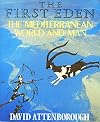
The First Eden: The Mediterranean World and Man
by David Attenborough
On This Page
Description
Explores the history and current state of the Mediterranean region which became a cradle of civilization.Tags
Recommendations
























Member Reviews
This is a bit of a potboiler from the estimable David Attenborough - a classic tie-in to a short BBC documentary series that shows all the strengths and weaknesses of the genre: clarity of detail in an excessively simplistic and episodic narrative.
It is a fairly quick-run-through of the natural history, archaeology, history and ecology of the Mediterrnean centred largely on humanity's largely deleterious impact on its environment, although, to be fair, not presented until the very last page with now standard religious fervour.
The truth is that Attenborough does make a very good point but he perhaps misses another one. It is all very well implicitly condemning humanity for its effects but only if you face the fundamental fact that large show more populations mean miserable poverty for most without economic development.
The Mediterranean is (or was when Attenborough produced the series) an utter polluted mess and the book can be seen as an appropriate attempt to get the countries of Europe and the Arab World to co-operate in a clean-up, to stop slaughter of birds and fish and to secure nature reserves.
This was in 1987 and perhaps someone else can tell us how much we have succeeded in the last quarter of a century but the tension between the aesthetic and long term desire for 'Eden' and the continued reality of poverty and expectation remains - the more so in the current economic crisis.
The book is well illustrated and undoubtedly informative with a nice balance between describing nature and man's activity on nature. And, to be fair, as one would expect from Attenborough, it informs to educate and lacks the off-putting hysteria of the green believer. show less
It is a fairly quick-run-through of the natural history, archaeology, history and ecology of the Mediterrnean centred largely on humanity's largely deleterious impact on its environment, although, to be fair, not presented until the very last page with now standard religious fervour.
The truth is that Attenborough does make a very good point but he perhaps misses another one. It is all very well implicitly condemning humanity for its effects but only if you face the fundamental fact that large show more populations mean miserable poverty for most without economic development.
The Mediterranean is (or was when Attenborough produced the series) an utter polluted mess and the book can be seen as an appropriate attempt to get the countries of Europe and the Arab World to co-operate in a clean-up, to stop slaughter of birds and fish and to secure nature reserves.
This was in 1987 and perhaps someone else can tell us how much we have succeeded in the last quarter of a century but the tension between the aesthetic and long term desire for 'Eden' and the continued reality of poverty and expectation remains - the more so in the current economic crisis.
The book is well illustrated and undoubtedly informative with a nice balance between describing nature and man's activity on nature. And, to be fair, as one would expect from Attenborough, it informs to educate and lacks the off-putting hysteria of the green believer. show less
An interesting and enjoyable book that is quick to read because it is a very visual book full of photos, drawings, and maps. There was a great deal of new to me info as well. For example the origin of the sea and the fact that there were periods when its floor was at the bottom of a vast (dry) chasm which then refilled. Also I never knew about the pygmy elephants and hippos of Malta, Sicily, etc.
I feel sure I read this is my teen years; the bit about the straits of Gibraltar being broken open multiple times really rings a bell. Seems like Attenborough was in apocalyptic mode even back then.
NO OF PAGES: 240 SUB CAT I: Middle East SUB CAT II: Middle Eastern Culture SUB CAT III: DESCRIPTION: The author not only describes the natural history of the Mediterranean, but also tells the fascinating story of mankind's changing attitudes toward and relationship with the natural world.NOTES: SUBTITLE: The Mediterranean World and Man
Ratings
Members
- Recently Added By
Author Information

Some Editions
Work Relationships
Is a supplement to
Common Knowledge
- Original publication date
- 1987
- Important places
- Mediterranean Region; Lascaux, Montignac, Nouvelle-Aquitaine, France; Egypt (ancient); Venice, Veneto, Italy; Plitvice Lakes National Park, Croatia; Camargue, Provence-Alpes-Côte d'Azur, France (show all 9); Nestos River, Greece; Mallorca, Balearic Islands, Spain; Doñana National Park, Andalusia, Spain
- Important events
- First Crusade (1096-99); Battle of Lepanto (1571); Moorish conquest of Spain
- Related movies
- The First Eden (1987 | IMDb)
- First words
- Eden, some will argue, must have had a precise geographical location, and it was probably a small, sandy island somewhere in the Red Sea.
- Last words
- (Click to show. Warning: May contain spoilers.)It is the planet.
- Original language
- English
Classifications
Statistics
- Members
- 548
- Popularity
- 54,356
- Reviews
- 4
- Rating
- (3.90)
- Languages
- 5 — English, German, Hungarian, Portuguese, Swedish
- Media
- Paper
- ISBNs
- 13
- ASINs
- 10