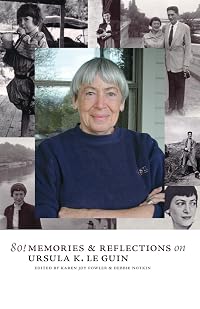
80! Memories and Reflections on Ursula K. Le Guin
by Karen Joy Fowler (Editor), Debbie Notkin (Editor)
On This Page
Description
What can you give a writer who has everything? In 2009, Ursula K. Le Guin turned 80. For decades, she has shared with all her readers the gift of her writing. In return, Kim Stanley Robinson wanted to give her a very special present: a "Festschrift," a privately commissioned, sumptuously bound anthology of pieces written in her honor. Karen Joy Fowler and Debbie Notkin gathered personal essays, poems, stories, and academic articles from readers and writers who love Le Guin's work. The show more presentation copy of this book, hand-bound in rich green leather, was given to Le Guin for her eightieth birthday. What can you give the reader who has everything Le Guin wrote? Ursula K. Le Guin generously agreed to the wider publication of this book. Now you can read her birthday present. Among many other pieces, the volume includes: Personal Essays by Eileen Gunn, Ellen Kushner, Kim Stanley Robinson, and Nisi Shawl Fiction by Andrea Hairston, John Kessel, and Sheree Renée Thomas Poetry by Richard Chwedyk and Karen Joy Fowler Thoughtful discussions of individual works by Gwyneth Jones, Lisa Tuttle, and Jo Walton A private gift to Ursula K. Le Guin becomes a gift to all readers, an exciting chance to enjoy someone else's birthday present! Book jacket. show lessTags
Recommendations








Member Reviews
Ursula K. Le Guin, some seven years after I fell in love with her by reading half of The Left Hand of Darkness in one terrible night, remains one of my favorite authors. And I'm barely into her oeuvre, having read just the Hainish novels and scattered short stories. But I couldn't resist picking up this, a festschrift published in honor of her 80th birthday. It's a mix of essays, both personal and more academic, fiction, and poetry. It's taken me a bit to get around to writing this review, unfortunately, so my memory is fading, but I'll do my best.
The personal essays are kinda mixed, but inevitably so. Many of them are about people hanging out, ho-hum, and then bam! Ursula K. Le Guin shows them a whole different kind of sci-fi and/or show more fantasy. Now, I can empathize because this was my own experience (she is probably the sf writer I wish I could write like more than any other), but to read this repeatedly got a little repetitive. But there are still some gems sprinkled into these essays, such as how Kim Stanley Robinson took her class, or Brian Atterby's very interesting tale of how he, Le Guin, and Karen Joy Fowler edited The Norton Book of Science Fiction. (I've had that thing in my library for years, and it honestly doesn't look too great, but now I've very curious about it.)
Of the less personal essays, Jo Walton's "A New Island of Stability: Annals of the Western Shore" made me really interested in reading those books someday (my wife liked them), as did Una McCormack's "The Exercise of Vital Powers," which discusses the role of history in Le Guin's work. (I've always found this an interesting theme; I loved the line from Four Ways to Forgiveness that ends with "There is a great river, and it flows through this land, and we have named it History.") And Julie Phillips's mini-biography is excellent, though it makes me want a full one! (I imagine there is one out there, actually; I should go looking.)
There's five stories, four from members of a "wimmin's" collective called "Beyon'Dusa," who apparently deem Le Guin an inspiration. Tributes in this form get tricky, I think. The Asimov festschrift, Foundation's Friends, did by having the writers set their stories in Asimov's different fictional universes, but none of these stories take that form; rather, they ostensibly "honor a great artist who has sustained and transformed a tradition by adding to it." But this tradition just seems to be sf/fantasy stories about women, because that's about as Le Guinian as most of them feel. Andrea Hairston's "Will Do Magic For Small Change," the first chapter of a novel, is interesting, but unfulfilling for obvious reasons. Neither Sheree Renée Thomas's "Touch" nor Ama Patterson's "Seamonsters" interested me; when picking up a book on Le Guin, I just didn't want to be reading some stories that virtually had nothing to do with her that I could see.
I did really like the last one, though, Pan Morigan's "The Heart of the Song," a fantasy myth with an interest in storytelling that resonated with many of the themes Le Guin has employed. (The only non-Beyon'Dusa story, "The Closet" by John Kessel, doesn't even come close to feeling like a Le Guin story, and would be trite even if it wasn't in this book.)
The bibliography is excellently thorough, too. I have lots to read yet, is what I realized. Which is good, as this book reminded me (though I shouldn't've needed reminding) about what was great about Le Guin, and that reading her is always worthwhile.
There's also poems. show less
The personal essays are kinda mixed, but inevitably so. Many of them are about people hanging out, ho-hum, and then bam! Ursula K. Le Guin shows them a whole different kind of sci-fi and/or show more fantasy. Now, I can empathize because this was my own experience (she is probably the sf writer I wish I could write like more than any other), but to read this repeatedly got a little repetitive. But there are still some gems sprinkled into these essays, such as how Kim Stanley Robinson took her class, or Brian Atterby's very interesting tale of how he, Le Guin, and Karen Joy Fowler edited The Norton Book of Science Fiction. (I've had that thing in my library for years, and it honestly doesn't look too great, but now I've very curious about it.)
Of the less personal essays, Jo Walton's "A New Island of Stability: Annals of the Western Shore" made me really interested in reading those books someday (my wife liked them), as did Una McCormack's "The Exercise of Vital Powers," which discusses the role of history in Le Guin's work. (I've always found this an interesting theme; I loved the line from Four Ways to Forgiveness that ends with "There is a great river, and it flows through this land, and we have named it History.") And Julie Phillips's mini-biography is excellent, though it makes me want a full one! (I imagine there is one out there, actually; I should go looking.)
There's five stories, four from members of a "wimmin's" collective called "Beyon'Dusa," who apparently deem Le Guin an inspiration. Tributes in this form get tricky, I think. The Asimov festschrift, Foundation's Friends, did by having the writers set their stories in Asimov's different fictional universes, but none of these stories take that form; rather, they ostensibly "honor a great artist who has sustained and transformed a tradition by adding to it." But this tradition just seems to be sf/fantasy stories about women, because that's about as Le Guinian as most of them feel. Andrea Hairston's "Will Do Magic For Small Change," the first chapter of a novel, is interesting, but unfulfilling for obvious reasons. Neither Sheree Renée Thomas's "Touch" nor Ama Patterson's "Seamonsters" interested me; when picking up a book on Le Guin, I just didn't want to be reading some stories that virtually had nothing to do with her that I could see.
I did really like the last one, though, Pan Morigan's "The Heart of the Song," a fantasy myth with an interest in storytelling that resonated with many of the themes Le Guin has employed. (The only non-Beyon'Dusa story, "The Closet" by John Kessel, doesn't even come close to feeling like a Le Guin story, and would be trite even if it wasn't in this book.)
The bibliography is excellently thorough, too. I have lots to read yet, is what I realized. Which is good, as this book reminded me (though I shouldn't've needed reminding) about what was great about Le Guin, and that reading her is always worthwhile.
There's also poems. show less
Ratings
Members
- Recently Added By
Published Reviews
ThingScore 75
It's as much a delight as you might expect....T]he most evident recurring theme is a rediscovery of one's own passion for reading, and the realization that one of the main sources of that passion is someone you can still talk to. As impressed as we are at these heartfelt tributes from names as resonant as [Pat] Murphy, [Nancy] Kress, [John] Kessel, Eileen Gunn, Karen Joy Fowler, Molly Gloss, show more Sarah Le Fanu, Ellen Kushner, Jo Walton, Lisa Tuttle, Patrick O'Leary, Eleanor Arnason, and others, what this book finally reminds us of, and what it finally celebrates, is our own discovery of Le Guin's fiction, and if we're lucky, our own meetings with Le Guin herself...Le Guin is one of the few writers in our field about whom it might be said that discovering her is discovering parts of ourselves, and 80! is a wonderful and convincing testimony to that. show less
added by Stevil2001
Author Information

Karen Joy Fowler is the author of several novels and short story collections. Her works include Sarah Canary, The Sweetheart Season, Sister Noon, and The Jane Austen Book Club. She has received numerous awards including the World Fantasy Award in 1999 for Black Glass, the World Fantasy Award in 2011 for What I Didn't See, and the 2014 PEN/Faulkner show more Award for Fiction for We Are All Completely Beside Ourselves. This same title was nominated for The Man Booker Prize for Best Novel in 2014. (Bowker Author Biography) show less

All Editions
Awards and Honors
Awards
Distinctions
Work Relationships
Common Knowledge
- Canonical title
- 80! Memories and Reflections on Ursula K. Le Guin
- Original publication date
- 2010-10-21
- People/Characters
- Ursula K. Le Guin
- First words
- The room has changed so many times
but it is always the same room. - Last words
- (Click to show. Warning: May contain spoilers.)Let pages turn as they may and locks come undone;
Let one world unravel, as another's begun.
Classifications
Statistics
- Members
- 39
- Popularity
- 744,764
- Reviews
- 1
- Rating
- (3.50)
- Languages
- English
- Media
- Paper, Ebook
- ISBNs
- 1
- ASINs
- 1