On This Page
Description
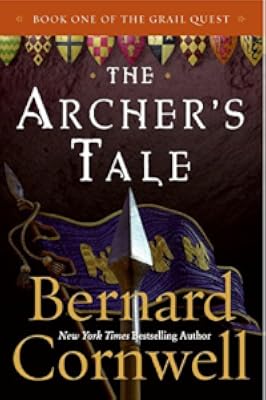
From New York Times bestselling author Bernard Cornwell, the first book in the Grail Series—the spellbinding tale of a young man, a fearless archer, who sets out wanting to avenge his family's honor and winds up on a quest for the Holy Grail.A brutal raid on the quiet coastal English village of Hookton in 1342 leaves but one survivor: a young archer named Thomas. On this terrible dawn, his purpose becomes clear—to recover a stolen sacred relic and pursue to the ends of the earth the show more murderous black-clad knight bearing a blue-and-yellow standard, a journey that leads him to the courageous rescue of a beautiful French woman, and sets him on his ultimate quest: the search for the Holy Grail.
. show less
Tags
Recommendations







Member Recommendations
Member Reviews
This is my first time reading Cornwell. I don't generally like so much telling in place of showing, but he moves his story more quickly this way and I'm impressed with the degree of historical detail. There's lots to learn about the 14th century in northern France, especially military history, in the context of a fast-paced adventure structured around historical incidents. I've gathered the primary reason to read Cornwell is for a boots-on-the-ground viewpoint during whatever battles he's covering. The Battle of Caen (1346), for example, is much more visceral here than reading dry Wikipedia facts.
It took me a while to warm up to Thomas of Hookton, since he's not exactly a standup guy. When his initial love interest gets kidnapped, our show more hero only feels relief that he need no longer worry about her pregnancy. Cornwell doesn't sugarcoat it when Thomas' band is roaming the French countryside, destroying lives and livlihoods; it's dirty work, not heroic thrills. As an English archer Thomas is feared and hated by his enemies, for killing from a distance and being heedless of chivalry. Character growth eventually kicks in, and he's aided by contrast with others in the story of similar rank. The plot is more impressive than Thomas. Considering it's "on rails" - forced to fit with actual historical events - Cornwell is surprisingly creative. It took a few turns that I didn't anticipate, and drew in a broader cross-section of society than just army ranks. This promises to be a good series for anyone welcoming (or who can abide) an extra dose of military in their historical fiction. show less
It took me a while to warm up to Thomas of Hookton, since he's not exactly a standup guy. When his initial love interest gets kidnapped, our show more hero only feels relief that he need no longer worry about her pregnancy. Cornwell doesn't sugarcoat it when Thomas' band is roaming the French countryside, destroying lives and livlihoods; it's dirty work, not heroic thrills. As an English archer Thomas is feared and hated by his enemies, for killing from a distance and being heedless of chivalry. Character growth eventually kicks in, and he's aided by contrast with others in the story of similar rank. The plot is more impressive than Thomas. Considering it's "on rails" - forced to fit with actual historical events - Cornwell is surprisingly creative. It took a few turns that I didn't anticipate, and drew in a broader cross-section of society than just army ranks. This promises to be a good series for anyone welcoming (or who can abide) an extra dose of military in their historical fiction. show less
Cornwell has a bit of a formula, and you recognize bits from Sharpe and Last kingdom, and one-offs like Azincourt. Which isn't to say it's bad, it's a very good formula. But this book feels less inspired than his others and is very clearly just part one of a trilogy rather than a self contained story in a larger series.
I wasn't sure if I was going to like this book, as battle descriptions aren't usually something I love. But I've read his Warlord series and loved it, so I was cautiously optimistic. I did really enjoy it. I think the good characters and the mystery around Thomas' family background helped a lot and that battle descriptions didn't dominate to storytelling until later on in the book and I didn't mind them at all once I got there. I liked that Thomas wasn't a flat character. He's got the "I'm not like other men/archers" vibe a lot, but also times, like after battles he's very typical. He also has some personal reflection after seeing how destroyed Jeanette was after her rape and wondered how many women he and his fellow archers had left in show more this state. I found the relationship between Thomas and Jeanette more natural/less forced than that of Thomas and Eleanor. How in love, not lust, could he really be with a 15 year old? I can believe them together as a couple due to circumstances but not really "in love" that fast. It feels like that should have been more of a slow burn. I can't wait to read the next book though. Starting right after I finished this review. show less
Cornwell slammed this one out of the park. One might expect a historical fiction title involving a quest to find the Holy Grail would be hokey, but Cornwell's gift for writing, strong characterization and knowledge of source material seamlessly weaves the Grail Quest into the larger historical narrative. The story involves Thomas of Hookton, archer and priest's bastard, whose village is wiped out by mercenaries searchinfg for the Grail. Swearing revenge and anxious for answers, he joins the forces of Edward III as they rampage through Northern France and Brittany during the Hundred Year's War. It's a great look at an army on the move, the devastation inflicted upon communities in wartime, and how cruelty can run wild if given an show more opportunity with no oversight. War can make beasts of us all unless we rise above ourselves. The book ends with the Battle of Crecy, and Cornwell does well in all areas, from the leadup to the cat and mouse game between the English and French forces, to the battle itself and its aftermath. Highly, highly recommended. show less
Bernard Cornwell has a gift -- not just of story-telling, but of conveying "realness" in his books. The Archer's Tale was no exception. Historical vibrancy, not just accuracy. The characters in this book become real individuals, the more you read. You befriend them, loathe them, root for them, mourn for them... At one point, when things looked particularly bleak for Thomas, I took a breath, and realized that if he died at this point in the book, Cornwell would have had to have cajones of steel to have called the book The Archer's Tale. I do have a word or two to say about Cornwell's treatment of one of my favorite characters in the book near the end (no spoiler here) and am debating about reading more in the series to see the outcome, show more which I don't think can be grand.
Cornwell also has a knack of writing battle scenes that are probably the most accurate and descriptive ones I have read. You can understand the battle as it plays out across the field, or ford or town walls, whatever, and you can also feel the bloodlust awakened in the participants. I did have a lot of trouble with one spot, describing a head wound, that was just a little too close to home for my comfort. (As I was listening to this on audio, I just drove down Calhoun Street saying "lalalala I can't hear you" and cringing/waving my hands to wave the images away when the words got through. )
This is the first book in the Grail Quest books, and I probably will read others in the series when I stumble upon them. As for Cornwell, he's on my favorite authors list. If you ever have a chance to go hear him speak, do so. Highly entertaining and informative (and lives part of the year here in Charleston.) show less
Cornwell also has a knack of writing battle scenes that are probably the most accurate and descriptive ones I have read. You can understand the battle as it plays out across the field, or ford or town walls, whatever, and you can also feel the bloodlust awakened in the participants. I did have a lot of trouble with one spot, describing a head wound, that was just a little too close to home for my comfort. (As I was listening to this on audio, I just drove down Calhoun Street saying "lalalala I can't hear you" and cringing/waving my hands to wave the images away when the words got through. )
This is the first book in the Grail Quest books, and I probably will read others in the series when I stumble upon them. As for Cornwell, he's on my favorite authors list. If you ever have a chance to go hear him speak, do so. Highly entertaining and informative (and lives part of the year here in Charleston.) show less
Cornwell, best known for his Sharpe series, which takes place during the Napoleonic Wars, has an interest in early Arthurian history as well and has written several books related to that legend (I haven’t read any yet). He has also written a book about Stonehenge, and his most recent, Archer’s Tale (I was able to snag an advanced reader’s copy) takes place during the 14th century. A young archer, son of a priest and a serving woman, is orphaned during a French raid on his father’s village. His father had brought a lance to the village where he was priest, and one of the reasons for the raid was to steal the lance, which reputedly had reliquary powers. Young Thomas swears revenge.
Off to France, Thomas becomes part of Edward show more III’s campaign against the French (this is the beginning of the Hundred Year’s War). He’s bright and an excellent archer, so he is soon part of the Earl of Northumberland’s retinue and plays an important part in the destruction of several French fortresses. He also gains Sir Simon Jekyll as an enemy. Cornwell has done his research and, in a historical note, states that all of the battles and events are real, as are a majority of the characters . For example, the battle and destruction of Caen took place exactly as it does in the novel. He’s also included lots of fascinating detail about medieval warfare, including this description of loading the earliest cannons: “[Gunpowder:] was made from saltpeter, sulfur and charcoal, but the saltpeter was heavier than the other ingredients and always settled to the bottom of the barrels while the charcoal rose to the top so the gunners had to stir the mix thoroughly before they ladled the deadly powder into the bellies of the jars. They placed a shovelful of loam, made from water and clay soil, in the narrow part of each gun’s neck before loading the crudely sculpted stone balls that were the missiles. The loam was to seal the firing chamber so that the power of the explosion did not leak away before the powder had caught fire. Still more loam was packed about the stone balls to fill the space between the missiles and the barrels, then the gunners had to wait while the loam hardened to make a firmer seal.”
During the destruction of Caen, Thomas has the good luck to save the life of Eleanor, who turns out to be the daughter of Sir Guillaume d’Eveque, the man whose herald Thomas had seen during the destruction of his village. D’Eveque then saves Thomas’s life and reveals to him that Thomas may be one of the Vexilles, supporters of the Cathars, heretics who believed that the church was unnecessary for salvation, which came from within. Thomas’s father, a priest, was in hiding from the rest of the Vexilles, but he had stolen the lance of St. George. So despite himself, Thomas's fate seems to be inexorably drawn to retrieval of the lance that also has a connection with the Holy Grail.
Cornwell is a master at conveying a sense of time and place. The importance of the longbow (called that only later — here it is properly called just the bow) and the advantage it gave to the English becomes clear. An archer could loose 3-4 arrows in the time one crossbow quarrel could be fired, and Cornwell quotes Benjamin Franklin in the epilogue as saying the American Revolution could have been won much faster had the Americans used the bow instead of the musket, but it was easier to train someone to use a musket than to learn the technique of the longbow. Its destructive power at Crecy, the denouement of The Archer’s Tale, is vividly recounted in as bloody a scene as you can imagine.
Sherman’s march to Atlanta pales by comparison to Edward’s chevauchee, the wastage of the French countryside. Everything was destroyed in the hope that the French would leave the security of their castles and come out to fight in order to prevent more destruction. You also get a real understanding of how miserable it was to be a peasant, a plaything for armies, subject to the wrath of soldiers and the whim of knights. It was not a pleasant time.
I have ordered several books related to the Hundred Year’s War and the Cathar inquisition. A short examination reveals that Cornwell’s view of the Cathars is fanciful at best. show less
Off to France, Thomas becomes part of Edward show more III’s campaign against the French (this is the beginning of the Hundred Year’s War). He’s bright and an excellent archer, so he is soon part of the Earl of Northumberland’s retinue and plays an important part in the destruction of several French fortresses. He also gains Sir Simon Jekyll as an enemy. Cornwell has done his research and, in a historical note, states that all of the battles and events are real, as are a majority of the characters . For example, the battle and destruction of Caen took place exactly as it does in the novel. He’s also included lots of fascinating detail about medieval warfare, including this description of loading the earliest cannons: “[Gunpowder:] was made from saltpeter, sulfur and charcoal, but the saltpeter was heavier than the other ingredients and always settled to the bottom of the barrels while the charcoal rose to the top so the gunners had to stir the mix thoroughly before they ladled the deadly powder into the bellies of the jars. They placed a shovelful of loam, made from water and clay soil, in the narrow part of each gun’s neck before loading the crudely sculpted stone balls that were the missiles. The loam was to seal the firing chamber so that the power of the explosion did not leak away before the powder had caught fire. Still more loam was packed about the stone balls to fill the space between the missiles and the barrels, then the gunners had to wait while the loam hardened to make a firmer seal.”
During the destruction of Caen, Thomas has the good luck to save the life of Eleanor, who turns out to be the daughter of Sir Guillaume d’Eveque, the man whose herald Thomas had seen during the destruction of his village. D’Eveque then saves Thomas’s life and reveals to him that Thomas may be one of the Vexilles, supporters of the Cathars, heretics who believed that the church was unnecessary for salvation, which came from within. Thomas’s father, a priest, was in hiding from the rest of the Vexilles, but he had stolen the lance of St. George. So despite himself, Thomas's fate seems to be inexorably drawn to retrieval of the lance that also has a connection with the Holy Grail.
Cornwell is a master at conveying a sense of time and place. The importance of the longbow (called that only later — here it is properly called just the bow) and the advantage it gave to the English becomes clear. An archer could loose 3-4 arrows in the time one crossbow quarrel could be fired, and Cornwell quotes Benjamin Franklin in the epilogue as saying the American Revolution could have been won much faster had the Americans used the bow instead of the musket, but it was easier to train someone to use a musket than to learn the technique of the longbow. Its destructive power at Crecy, the denouement of The Archer’s Tale, is vividly recounted in as bloody a scene as you can imagine.
Sherman’s march to Atlanta pales by comparison to Edward’s chevauchee, the wastage of the French countryside. Everything was destroyed in the hope that the French would leave the security of their castles and come out to fight in order to prevent more destruction. You also get a real understanding of how miserable it was to be a peasant, a plaything for armies, subject to the wrath of soldiers and the whim of knights. It was not a pleasant time.
I have ordered several books related to the Hundred Year’s War and the Cathar inquisition. A short examination reveals that Cornwell’s view of the Cathars is fanciful at best. show less
This book seems to be mostly about rape, and incidentally about an archer.
I just could not get past the way in which women appeared in the book only to be assaulted and carried off. I eventually gave up trying to read it halfway through because i didn't care what happened, and didn't want to subject myself to more of the violence.
There are plenty of books which manage to deal with the time period, and even raping and pillaging, in ways that don't turn my stomach. This was not one of them.
quite disappointing, because some of his other books are good.
I just could not get past the way in which women appeared in the book only to be assaulted and carried off. I eventually gave up trying to read it halfway through because i didn't care what happened, and didn't want to subject myself to more of the violence.
There are plenty of books which manage to deal with the time period, and even raping and pillaging, in ways that don't turn my stomach. This was not one of them.
quite disappointing, because some of his other books are good.
Members
- Recently Added By
Lists

Historical Fiction
889 works; 91 members

Books Read in 2015
3,299 works; 126 members

al.vick-wishlist-historical fiction
129 works; 1 member

al.vick-series
381 works; 2 members
Author Information

187+ Works 94,203 Members
Bernard Cornwell was born in London, England, on February 23, 1944, and came to the United States in 1980. He received a B.A. from the University of London in 1967. Cornwell served as producer of the British Broadcasting Corporation from 1969-1976. After this he was head of current affairs for BBC-TV in Belfast, Northern Ireland. In 1979 he became show more editor of television news for Thames Television of London. Since 1980 he has been a freelance writer. he lives with his wife on Cape Cod. Cornwell's Sharpe series, adventure stories about a British soldier set in the Peninsula War of 1808-1814, are built on the author's interest in the Duke of Wellington's army. Titles include Sharpe's Rifles, Sharpe's Revenge, Sharpe's Siege, Sharpe's Regiment, and Sharpe's Waterloo. The Last Kingdom series has ten books. Book ten, The Flame Bearer is on the bestsellers list. He has also written other works including Wildtrack, Killer's Wake, Sea Lord, Stormchild, Rebel, Copperhead, and Battle Flag. His title Death of Kings made The New York Times Best Seller List in 2012 and In 2014 his title The Pagan Lord made the list again. (Bowker Author Biography) show less
Some Editions
Awards and Honors
Distinctions
Series

Work Relationships
Common Knowledge
- Canonical title
- The Archer's Tale
- Original title
- Harlequin
- Original publication date
- 2000-10-16
- People/Characters
- Thomas of Hookton; Guy Vexille; Father Hobbe; Will Skeat; Jeanette, Countess of Amorica; Sir Guillaume d'Evecque (show all 10); Eleanor; Sir Simon Jekyll; Edward, the Black Prince (of Woodstock, Prince of Wales and Aquitaine); Robbie
- Important places
- La Roche-Derrien, Brittany, France; Caen, Calvados, Normandy, France; Crécy-en-Ponthieu, Hauts-de-France, France (a.k.a. Crécy or Cressy); York, Yorkshire, England; Hookton, Dorset, England, UK (fictional)
- Important events
- Hundred Years' War (1337 | 1453); Battle of Crécy (1346-08-26)
- Epigraph
- "... many deadly battles have been fought, people slaughtered, churches robbed, souls destroyed, young women and virgins deflowered, respectable wives and widows dishonoured; towns, manors and building burned, and robberies, ... (show all)cruelties and ambushes committed on the highways. Justice has failed because of these things. The Christian faith has withered and commerce has perished and so many other wickednesses and horrid things have followed from these wars that they cannot be spoken, numbered or written down." - Jean II, King of France, 1360
- Dedication
- HARLEQUIN is for Richard and Julie Rutherford-Moore
- First words
- The treasure of Hookton was stolen on Easter morning 1342.
- Last words
- (Click to show. Warning: May contain spoilers.)And that Hookton was avenged.
- Original language
- English UK
- Disambiguation notice
- Was published as The Archer's Tale in the US.
Classifications
Statistics
- Members
- 3,167
- Popularity
- 5,535
- Reviews
- 62
- Rating
- (3.83)
- Languages
- 10 — Czech, English, French, German, Hungarian, Italian, Croatian, Spanish, Turkish, Portuguese (Brazil)
- Media
- Paper, Audiobook, Ebook
- ISBNs
- 55
- ASINs
- 31