
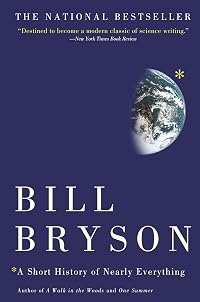
A Short History of Nearly Everything
by Bill Bryson
On This Page
Description
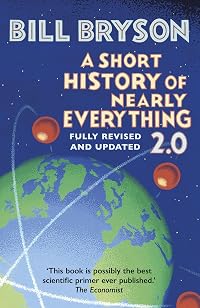
In this book Bill Bryson explores the most intriguing and consequential questions that science seeks to answer and attempts to understand everything that has transpired from the Big Bang to the rise of civilization. To that end, Bill Bryson apprenticed himself to a host of the world's most profound scientific minds, living and dead. His challenge is to take subjects like geology, chemistry, paleontology, astronomy, and particle physics and see if there isn't some way to render them show more comprehensible to people, like himself, made bored (or scared) stiff of science by school. His interest is not simply to discover what we know but to find out how we know it. How do we know what is in the center of the earth, thousands of miles beneath the surface? How can we know the extent and the composition of the universe, or what a black hole is? How can we know where the continents were 600 million years ago? How did anyone ever figure these things out? On his travels through space and time, Bill Bryson encounters a splendid gallery of the most fascinating, eccentric, competitive, and foolish personalities ever to ask a hard question. In their company, he undertakes a sometimes profound, sometimes funny, and always supremely clear and entertaining adventure in the realms of human knowledge. show lessTags
Recommendations
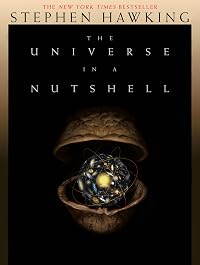
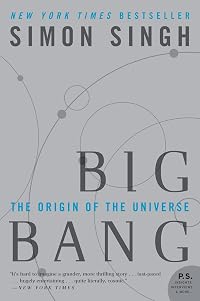
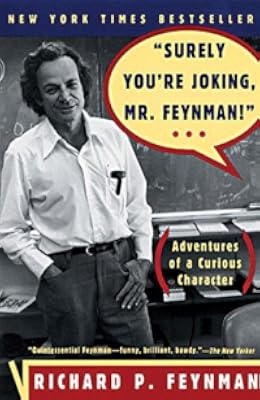
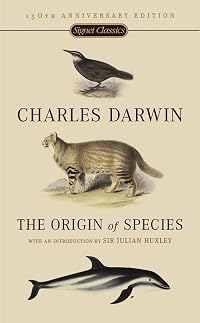

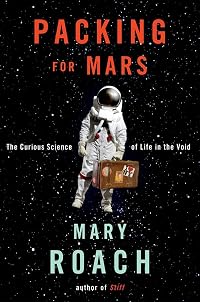
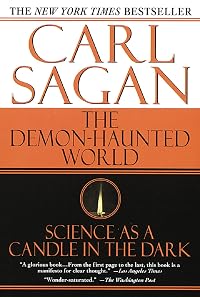
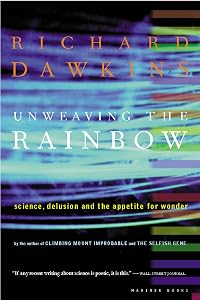
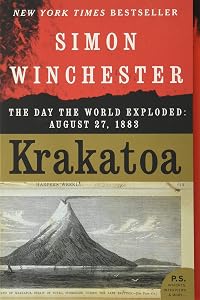

Member Recommendations

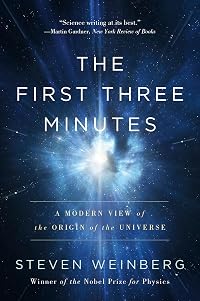
erik_galicki Weisskopf is more concise, more cohesive, and less anecdotal than Bryson. I consider Weisskopf a more enlightening but less entertaining alternate.
22
by anonymous user
11
Noisy If you find Bryson too lightweight, then the next step is to Gribbin. Gribbin goes all the way from the smallest scale (sub-atomic particles) to the largest (the universe).
12

themulhern Both books stick to the science adventure, and go rather light on the actual science. "Chasing Venus" is about the decade long effort to calculate the value of the astronomical unit; Bryson's book is more shallow and broad.
themulhern The same sort of rollicking verve about science in "A Short History of Nearly Everything" as in the essay 'Mother Earth; Mother Board".
Member Reviews
There's no reason this book should be as enjoyable as it is. It's a slightly hodge-podgey account of various discoveries of (mostly) Western science; looking at the list of chapters, you'll probably think there's nothing new you could read on any of these topics. But you'll be wrong. Bryson manages to find interesting details and insights on nearly every subject, and he writes with a dry, likable wit that should draw you in from the first page.
I picked this book up at the airport, thinking at first that it was a book about human history. I confess I did not know at the time who Bill Bryson is and was blissfully unaware of his widely acclaimed writing record. Obviously, the book turned out to be completely different from what I had expected. Bryson wrote a book about "how we went from there being nothing at all to there being something, and then how a little of that something turned into us, and also what happened in between and since." In short, a story about the natural history of the world and much more.
Bryson's accomplishment inspires awe and envy. Here is a person with no scientific background who, driven by an insatiable desire to learn, has mastered biology, astronomy, show more paleontology, geology, chemistry and much much more, and then translated this knowledge into a readable account of "nearly everything". The New York Times Book Review wrote that A Short History of Nearly Everything "is destined to become a modern classic of science writing" and I fully agree. Bryson succeeds to explain where we came from and how our world works in terms that every person can understand, while at the same time peppering his tale with humouristic anecdotes about the greatest scientists in history: their lives, their mistakes and their feuds.
This book is a journey in space and time. It takes the reader from the core of the Earth to the infinite reaches of outer space, and from the beginning of time to the future outlook for our planet. In this journey, Bryson brings home two messages, over and over again. First, how insignificant our lives are in comparison with the age of the world and the forces of nature, especially when we take into account the improbable odds of our very existence. Second, how little we know and understand about how we came about, how our planet works or indeed who and what inhabits it besides us. The book is full of facts which leave the reader open-mouthed; several times I had to re-read a sentence just to make sure I understood the full implication of the facts presented in it.
The first thing I did today after finishing the book was to log on to amazon.com to search for other Bryson books and order them. I am looking forward to getting more acquainted with this wonderful writer in the very near future. show less
Bryson's accomplishment inspires awe and envy. Here is a person with no scientific background who, driven by an insatiable desire to learn, has mastered biology, astronomy, show more paleontology, geology, chemistry and much much more, and then translated this knowledge into a readable account of "nearly everything". The New York Times Book Review wrote that A Short History of Nearly Everything "is destined to become a modern classic of science writing" and I fully agree. Bryson succeeds to explain where we came from and how our world works in terms that every person can understand, while at the same time peppering his tale with humouristic anecdotes about the greatest scientists in history: their lives, their mistakes and their feuds.
This book is a journey in space and time. It takes the reader from the core of the Earth to the infinite reaches of outer space, and from the beginning of time to the future outlook for our planet. In this journey, Bryson brings home two messages, over and over again. First, how insignificant our lives are in comparison with the age of the world and the forces of nature, especially when we take into account the improbable odds of our very existence. Second, how little we know and understand about how we came about, how our planet works or indeed who and what inhabits it besides us. The book is full of facts which leave the reader open-mouthed; several times I had to re-read a sentence just to make sure I understood the full implication of the facts presented in it.
The first thing I did today after finishing the book was to log on to amazon.com to search for other Bryson books and order them. I am looking forward to getting more acquainted with this wonderful writer in the very near future. show less
When I first started reading A Short History of Nearly Everything I wanted to document every "history" Bryson exposed and explained. I thought it would be fun except for the fact I quickly lost track. Short History starts out simple enough: the history of the atom and an explanation of the inflation theory. In other words, the history of you and the universe respectively. Then there's a deeper dive into the question of space, the galaxy and our place in the solar system. Somehow we moved onto inverse square law and the weight (literally) of the world. We explore volcanoes and earthquakes and the (un)predictability of natural disasters. Then there are the disasters that are not so quite natural which man insists on taking part like free show more diving. Then there are the bugs and so on and so forth.
Probably one of the best sections was about the struggle to make Pluto a planet. We determined we had four rocky inner planets, four gassy outer planets...and one teeny, tiny lone ball of ice.
The obvious drawback to reading something out of date is the predictions for the future are now obsolete.
what I have learned from reading Short History is not the what Bryson explains but how it's explained. The telling is everything. show less
Probably one of the best sections was about the struggle to make Pluto a planet. We determined we had four rocky inner planets, four gassy outer planets...and one teeny, tiny lone ball of ice.
The obvious drawback to reading something out of date is the predictions for the future are now obsolete.
what I have learned from reading Short History is not the what Bryson explains but how it's explained. The telling is everything. show less
Space, Dinosaurs, Biology, Medicine, Plants, Microbiology, Geology. This book is quite literally a short history of nearly everything related to science.
I had been hearing about this book for a very long time but was always hesitant because I thought it was another book about space that I wouldn't understand. While the book does start off with the history and science of space and the big bang, Bill Bryson does a freaking amazing job about going into the history of nearly everything: almost every scientific field, the people involved in discoveries, the scandals surrounding them, and their personalities, what they actually did vs what people think they did. All of this is done in a very witty and entertaining language that breaks down show more educational concepts you can understand without feeling like an idiot. show less
I had been hearing about this book for a very long time but was always hesitant because I thought it was another book about space that I wouldn't understand. While the book does start off with the history and science of space and the big bang, Bill Bryson does a freaking amazing job about going into the history of nearly everything: almost every scientific field, the people involved in discoveries, the scandals surrounding them, and their personalities, what they actually did vs what people think they did. All of this is done in a very witty and entertaining language that breaks down show more educational concepts you can understand without feeling like an idiot. show less
I loved this. My interest level was engaged throughout; Bryson delivers a mountain of information in a lively manner, with a good dose of humour, and providing 'personality' and background information almost irrestibly. Whilst I'm sure purists would criticise aspects of this book, it opens the world of science, nature and the universe to those of us who have not continued in these studies but remain interested generally. I highly recommend this book. This would be the ideal audiobook for a long car journey, engaging all ages and maybe encouraging into this line of work future Nobel prize winners :)
This will definitely be a reread for me. There is so much information, I have no hope of retaining any decent percentage.
Audiobook: narrated show more excellently by William Roberts. 5 stars. show less
This will definitely be a reread for me. There is so much information, I have no hope of retaining any decent percentage.
Audiobook: narrated show more excellently by William Roberts. 5 stars. show less
“Sometimes the world just isn't ready for a good idea.” — Bill Bryson, “A Short History of Nearly Everything”
Reading Bill Bryson's “A Short History of Nearly Everything,” his 2003 history of science for readers who don't know beans about science, one gets the idea that the world isn't ready for a good idea not sometimes but rather most of the time. The science establishment was reluctant to accept the big bang theory, continental drift, evolution, the theory of relativity and just about every other major discovery in science you might think of. Scientists, like just about everyone else in the world, are slow to welcome change.
Those who propose new scientific theories often don't live long enough to see their theories show more accepted, and even then somebody else often gets the credit for them. Bryson does much to right some of these wrongs.
Much of his book is dated now. More than 15 years after its first publication, scientists have explored much deeper into the oceans and much farther into space than they had in 2003, to cite just two examples. But history books should be read more for what they say about the past than what they say about the present, and here the author excels even now.
The book covers just about every field of science you might think of, from astronomy to zoology, and does so with easy transitions from one to another. A background in any of these fields proves unnecessary to grasp what Bryson writes or to enjoy his narrative. As readers of his other books know well, he has gift for explaining things in a way that makes reading seem more like entertainment than work.
Again and again Bryson returns to what has been called the Goldilocks effect. That is, everything has been just right for life on Earth and for human existence. Not too close to the sun nor too far away. The right kind of orbit, the right kind of atmosphere, the right circumstances at just the right time. We are overdue for another ice age, he writes, and overdue for another catastrophic explosion of the Yellowstone volcano. You name it, we have been very fortunate, even blessed. Yet even in 2003 Bryson warned of negative human influences on the planet's climate and the survival of species. Such warnings have not been dated by the passage of time.
Reading “A Short History of Nearly Everything” proved to be a very good idea, even if it did take me a decade and a half to get around to it. show less
Reading Bill Bryson's “A Short History of Nearly Everything,” his 2003 history of science for readers who don't know beans about science, one gets the idea that the world isn't ready for a good idea not sometimes but rather most of the time. The science establishment was reluctant to accept the big bang theory, continental drift, evolution, the theory of relativity and just about every other major discovery in science you might think of. Scientists, like just about everyone else in the world, are slow to welcome change.
Those who propose new scientific theories often don't live long enough to see their theories show more accepted, and even then somebody else often gets the credit for them. Bryson does much to right some of these wrongs.
Much of his book is dated now. More than 15 years after its first publication, scientists have explored much deeper into the oceans and much farther into space than they had in 2003, to cite just two examples. But history books should be read more for what they say about the past than what they say about the present, and here the author excels even now.
The book covers just about every field of science you might think of, from astronomy to zoology, and does so with easy transitions from one to another. A background in any of these fields proves unnecessary to grasp what Bryson writes or to enjoy his narrative. As readers of his other books know well, he has gift for explaining things in a way that makes reading seem more like entertainment than work.
Again and again Bryson returns to what has been called the Goldilocks effect. That is, everything has been just right for life on Earth and for human existence. Not too close to the sun nor too far away. The right kind of orbit, the right kind of atmosphere, the right circumstances at just the right time. We are overdue for another ice age, he writes, and overdue for another catastrophic explosion of the Yellowstone volcano. You name it, we have been very fortunate, even blessed. Yet even in 2003 Bryson warned of negative human influences on the planet's climate and the survival of species. Such warnings have not been dated by the passage of time.
Reading “A Short History of Nearly Everything” proved to be a very good idea, even if it did take me a decade and a half to get around to it. show less
A Short History of Nearly Everything is an incredible literary and popular achievement introducing ordinary readers to all the major wonders of science. Such topics are usually rather daunting and difficult to understand, but author Bill Bryson explains them all with an easy eloquence, a warmth of humour and a keen eye for the right anecdote or analogy. Bryson also has an inexhaustible supply of infectious enthusiasm. This is not a cringeworthy hey kids, let's make learning fun!" sort of book, but rather just one man sharing his astonishment at the variety, scale and wonder of our universe.
And without meaning to diminish the kudos that are due to Bryson's writing, it should come as no surprise that these topics capture the reader's show more imagination. They are simply incredible. Covering everything from the origins of the universe and the formation of planets right down to biological life at the cellular level on this little blue planet of ours, many – no, scratch that, all – of the topics and facts that Bryson shares are just mind-boggling. The scale and complexity of our existence is staggering in itself, but Bryson's genius is in presenting such often-difficult concepts in an accessible and universally agreeable way. Early on, the writer tells us that his remit is "to see if it isn't possible to understand and appreciate – marvel at, enjoy even – the wonder and accomplishments of science at a level that isn't too technical or demanding, but isn't entirely superficial either." (pg. 24). I would wager that you won't find a single reviewer that would dispute that Bryson has achieved his goal. You certainly won't find such dissent in this review.
It is one of those few books for which the cliché is genuinely and indisputably warranted: this is a book that everyone should read. It reminds us that our own place in the universe is ridiculously insignificant, yet at the same time it is incredibly life-affirming by reminding us just how miraculous our own existence actually is. When you consider that the odds are massively stacked against anything happening, the fact that we have a species have not only come into existence but have also reached a stage where we can begin to understand things on a far more grand and impossible stage than ourselves should fill one with a real sense of pride, even those of us who haven't personally contributed to this advancement.
Another key achievement of Bryson's book is that he doesn't just tell us the facts, or even just tell us them in an approachable way. He also tells us how scientists came to work this sort of thing out, something which he admits early on that he had always been curious about (pg. 23). Some of these methods are ingenious (one relatively minor incident which nevertheless stood out for me was how scientists confirmed that the Earth's magnetic poles have switched ends throughout the ages. They did so by measuring the iron content in rocks of different ages: the iron in the loose sediment would have shifted to one end or the other before solidifying).
The book also impresses on the reader that however much we know, there is still so, so much that we don't (yet?) know. Every discovery brings new questions or, as Bryson phrases it, "every time we manage to unlock a box, we find that there is another locked box inside" (pg. 210). I was surprised how (relatively) recent many of our fundamental scientific discoveries actually are. For example, the confirmation that dinosaurs were wiped out by a meteorite belongs to the twentieth-century. The 20th century also gave us the 'Modern Synthesis', the theory that unified the celebrated work of Charles Darwin and the less-celebrated but no less important work on genetics by Gregor Mendel into the theory of evolution that we know and love (well, some of us) today. This is in itself a thought-provoking notion throwing into relief the pace of our species' achievements. As Bryson says: "It is fairly remarkable to think that Ford has been building cars and Nobel committees awarding prizes for longer than we have known that the Earth has a core." (pg. 261).
Perhaps some of the questions raised by science can never be answered; it certainly does seem like there are some insurmountable hurdles ahead. Even a genius like Einstein failed to make real headway on fitting his celebrated relativity theory into a grander unified theory, the so-called 'theory of everything' that would knit everything together. Even so, the fact that Bryson's book – written over a decade ago – writes non-committedly on such things as the Higgs boson, which has since been confirmed by the much-publicised work done by the Large Hadron Collider, shows us that science is still advancing full speed ahead into the questions of the future. And some of the puzzles which science has already solved would, no doubt, have seemed impossible to previous generations. Who knows what achievements the future may bring? Speaking as a relatively young man, it is entirely possible that, given the pace of scientific discovery, there will be at least one more high-profile discovery in my lifetime that will have important implications for our understanding of the universe and leave me shaking my head in wonder. (In fact, on the very day I wrote this review NASA announced they had discovered water on Mars, which may support alien life. This came less than twelve hours after I watched a once-in-a-generation supermoon lunar eclipse, or 'blood-moon', from my front garden. The universe is amazing.) We are living in an unprecedentedly exciting age, scientifically-speaking, and Bryson has invoked the wonder of this in an unprecedentedly accessible and engrossing science book." show less
And without meaning to diminish the kudos that are due to Bryson's writing, it should come as no surprise that these topics capture the reader's show more imagination. They are simply incredible. Covering everything from the origins of the universe and the formation of planets right down to biological life at the cellular level on this little blue planet of ours, many – no, scratch that, all – of the topics and facts that Bryson shares are just mind-boggling. The scale and complexity of our existence is staggering in itself, but Bryson's genius is in presenting such often-difficult concepts in an accessible and universally agreeable way. Early on, the writer tells us that his remit is "to see if it isn't possible to understand and appreciate – marvel at, enjoy even – the wonder and accomplishments of science at a level that isn't too technical or demanding, but isn't entirely superficial either." (pg. 24). I would wager that you won't find a single reviewer that would dispute that Bryson has achieved his goal. You certainly won't find such dissent in this review.
It is one of those few books for which the cliché is genuinely and indisputably warranted: this is a book that everyone should read. It reminds us that our own place in the universe is ridiculously insignificant, yet at the same time it is incredibly life-affirming by reminding us just how miraculous our own existence actually is. When you consider that the odds are massively stacked against anything happening, the fact that we have a species have not only come into existence but have also reached a stage where we can begin to understand things on a far more grand and impossible stage than ourselves should fill one with a real sense of pride, even those of us who haven't personally contributed to this advancement.
Another key achievement of Bryson's book is that he doesn't just tell us the facts, or even just tell us them in an approachable way. He also tells us how scientists came to work this sort of thing out, something which he admits early on that he had always been curious about (pg. 23). Some of these methods are ingenious (one relatively minor incident which nevertheless stood out for me was how scientists confirmed that the Earth's magnetic poles have switched ends throughout the ages. They did so by measuring the iron content in rocks of different ages: the iron in the loose sediment would have shifted to one end or the other before solidifying).
The book also impresses on the reader that however much we know, there is still so, so much that we don't (yet?) know. Every discovery brings new questions or, as Bryson phrases it, "every time we manage to unlock a box, we find that there is another locked box inside" (pg. 210). I was surprised how (relatively) recent many of our fundamental scientific discoveries actually are. For example, the confirmation that dinosaurs were wiped out by a meteorite belongs to the twentieth-century. The 20th century also gave us the 'Modern Synthesis', the theory that unified the celebrated work of Charles Darwin and the less-celebrated but no less important work on genetics by Gregor Mendel into the theory of evolution that we know and love (well, some of us) today. This is in itself a thought-provoking notion throwing into relief the pace of our species' achievements. As Bryson says: "It is fairly remarkable to think that Ford has been building cars and Nobel committees awarding prizes for longer than we have known that the Earth has a core." (pg. 261).
Perhaps some of the questions raised by science can never be answered; it certainly does seem like there are some insurmountable hurdles ahead. Even a genius like Einstein failed to make real headway on fitting his celebrated relativity theory into a grander unified theory, the so-called 'theory of everything' that would knit everything together. Even so, the fact that Bryson's book – written over a decade ago – writes non-committedly on such things as the Higgs boson, which has since been confirmed by the much-publicised work done by the Large Hadron Collider, shows us that science is still advancing full speed ahead into the questions of the future. And some of the puzzles which science has already solved would, no doubt, have seemed impossible to previous generations. Who knows what achievements the future may bring? Speaking as a relatively young man, it is entirely possible that, given the pace of scientific discovery, there will be at least one more high-profile discovery in my lifetime that will have important implications for our understanding of the universe and leave me shaking my head in wonder. (In fact, on the very day I wrote this review NASA announced they had discovered water on Mars, which may support alien life. This came less than twelve hours after I watched a once-in-a-generation supermoon lunar eclipse, or 'blood-moon', from my front garden. The universe is amazing.) We are living in an unprecedentedly exciting age, scientifically-speaking, and Bryson has invoked the wonder of this in an unprecedentedly accessible and engrossing science book." show less
Members
- Recently Added By
Published Reviews
ThingScore 75
The more I read of ''A Short History of Nearly Everything,'' the more I was convinced that Bryson had achieved exactly what he'd set out to do, and, moreover, that he'd done it in stylish, efficient, colloquial and stunningly accurate prose.
added by Shortride
"Una breve historia de casi todo" explica como ha evolucionado el mundo para acabar siendo lo que es hoy. Explica cualquier aspecto de nuestro universo, desde el más recóndito al más conocido.
added by Jaism94
The book's underlying strength lies in the fact that Bryson knows what it's like to find science dull or inscrutable. Unlike scientists who turn their hand to popular writing, he can claim to have spent the vast majority of his life to date knowing very little about how the universe works.
added by mikeg2
Lists

Best Science Books for Non-Scientists
113 works; 56 members

Non-Fiction Worth Reading
1,015 works; 261 members

Top Five Books of 2013
1,562 works; 721 members

Top Five Books of 2022
736 works; 272 members

Will Durant's 100 Books: An Update
46 works; 4 members

Fake Top 100 Nonfiction
79 works; 3 members

Top Five Books of 2016
795 works; 229 members

Big History
72 works; 1 member

History
37 works; 1 member

The r/AskScience Reading List
159 works; 3 members

r/History Recommended Reading List
603 works; 12 members

Books Read in 2022
5,166 works; 114 members

Pleasant Surprises: Books That Exceeded Our Expectations
418 works; 143 members

My List
302 works; 1 member

Books Read in 2023
5,547 works; 145 members

Books With the Most Memorable Titles
478 works; 158 members

Biblioteca de não ficção
41 works; 1 member

Books in English
14 works; 1 member

Read
27 works; 1 member

Wishlist
99 works; 1 member

My Favorite Books
26 works; 1 member

The Five Books That Represent Us
390 works; 147 members

Mind Expanding Books by hackerkid
581 works; 8 members

Books Read in 2018
4,360 works; 110 members

Books Read in 2020
4,379 works; 124 members

BBC Radio 4 Bookclub
340 works; 13 members

Books tagged favorites
390 works; 30 members

2000s (the decade, not the century)
184 works; 11 members

Favorite Long Books
330 works; 42 members

2000s decade
85 works; 7 members

Favourite Books
1,817 works; 316 members

Books to Reread Someday
53 works; 7 members

BingoDOG - Books About Scientists: Nonfiction
9 works; 5 members

I Can't Finish This Book
189 works; 22 members

Blue Pyramid 1,276 Best Books of All Time
1,248 works; 32 members

Books Read in 2011
684 works; 20 members

My E-Book Collection - Opinions Welcome
92 works; 10 members

Books I've read
87 works; 2 members

Adult Books for YA Readers
194 works; 6 members

Books on my Kindle
162 works; 3 members

Pageturners
40 works; 6 members

Books Read in 2005
174 works; 7 members

The Joe Rogan Experience Library
254 works; 3 members

Biggest Disappointments
606 works; 168 members

Social Sciences
2 works; 1 member
Author Information

70+ Works 136,293 Members
Bill Bryson was born in Des Moines, Iowa on December 8, 1951. In 1973, he went backpacking in England, where he eventually decided to settle. He wrote for the English newspapers The Times and The Independent, as well as supplementing his income by writing travel articles. He moved back to the United States in 1995. His first travel book, The Lost show more Continent: Travels in Small-Town America, was published in 1989. His other books include I'm a Stranger Here Myself, In a Sunburned Country, Bill Bryson's Dictionary of Troublesome Words, Neither Here nor There: Travels in Europe, Made in America, The Mother Tongue, Bill Bryson's African Diary, A Short History of Nearly Everything, At Home: A Short History of Private Life, Walk About, and Seeing Further: The Story of Science, Discovery, the Genius of the Royal Society. A Walk in the Woods was adapted into a movie starring Robert Redford and Nick Nolte. Bryson's titles, The Road to Little Dribbling: Adventures of an American in Britain, Notes from a Small Island and Neither Here Nor There made the New York Times bestseller list in 2016. (Bowker Author Biography) show less
All Editions
Some Editions
Awards and Honors
Awards
Distinctions
Notable Lists
Whitcoulls Top 100 Books (77 – 2008)
Whitcoulls Top 100 Books (43 – 2010)
Series
Belongs to Publisher Series
Work Relationships
Contains
Is abridged in
Has as a student's study guide
Common Knowledge
- Canonical title
- A Short History of Nearly Everything
- Original title
- A short history of nearly everything
- Original publication date
- 2003 (First edition published by Doubleday) (First edition published by Doubleday); 2005 (Illustrated edition published by Doubleday) (Illustrated edition published by Doubleday)
- People/Characters
- Robert Hooke; Albert Einstein; Marie Curie; Edwin Hubble; Johannes Kepler; Galileo Galilei (show all 9); Isaac Newton; Rosalind Franklin; Guillaume Le Gentil
- Epigraph
- The physicist Leo Szilard once announced to his friend Hans Bethe that he was thinking of keeping a diary: 'I don't intend to publish. I am merely going to record the facts for the information of God.' ''Don't you think God ... (show all)knows the facts?" Bethe asked. 'Yes,' said Szilard. 'He knows the facts, but He does not know this version of the facts.'
— Hans Christian von Baeyer, Taming the Atom - Dedication
- To Meghan and Chris. Welcome.
- First words
- No matter how hard you try you will never be able to grasp just how tiny, how spatially unassuming, is a proton.
- Quotations
- They're all in the same plane. They're all going around in the same direction. . . .It's perfect, you know. It's gorgeous. It's almost uncanny. - Astronomer Geoffrey Marcy describing the solar system
Nature and Nature's laws lay hid in night; / God said, Let Newton be! and all was light. - Alexander Pope
A physicist is the atoms' way of thinking about atoms. - Anonymous
The history of any one part of the Earth, like the life of a soldier, consists of long periods of boredom and short periods of terror. - British geologist Derek V. Ager
The more I examine the universe and study the details of its architecture, the more evidence I find that the universe in some sense must have known we were coming. - Freeman Dyson
Descended from the apes! My dear, let us hope that it is not true, but if it is, let us pray that it will not become generally known. - Remark attributed to the wife of the Bishop of Worcester after Darwin's theory of evoluti... (show all)on was explained to her
I had a dream, which was not all / a dream. / The bright sun was extinguish'd, / and the stars / Did wander . . . - Byron, "Darkness"
Because we can't see into the Earth, we have to use other interesting techniques, which mostly involve reading waves as they travel through the interior, to find out what is there. We know a little bit about the mantle from ... (show all)what are known as kimberlite pipes, where diamonds are formed. What happens is that deep in the Earth there is an explosion that fires, in effect, a cannonball of magma to the surface at supersonic speeds. It is a totally random event. A kimberlite pipe could explode in your back garden as you read this. Because they come up from such depths - up to 200 kilometres down - kimberlite pipes bring up all kinds of things not normally found on or near the surface: a rock called Peridotite, crystals of olivine and - just occasionally, in about one pipe in a hundred - diamonds. Lots of carbon comes up with kimberlite ejecta, but most is vaporized or turns to graphite. Only occasionally does a hunk of it shoot up at just the right speed and cool down with the necessary swiftness to become a diamond. It was such a pipe that made South Africa the most productive diamond-mining country in the world, but there may be others even bigger that we don't know about. Geologists know that somewhere in the vicinity of northeastern Indiana there is evidence of a pipe or group of pipes that may be truly colossal. Diamonds up to 20 carats or more have been found at scattered sites throughout the region. But no-one has ever found the source. As John McPhee notes, it may be buried under glacially deposited soil, like the Manson crater in Iowa, or under the Great Lakes.
(page 271)
As James Surowiecki noted in a New Yorker article, given a choice between developing antibiotics that people will take every day for two weeks and antidepressants that people will take every day for ever, drug companies not s... (show all)uprisingly opt for the latter. Although a few antibiotics have been toughened up a bit, the pharmaceutical industry hasn't given us an entirely new antibiotic since the 1970s. (page 396) - Last words
- (Click to show. Warning: May contain spoilers.)And that, almost certainly, will require a good deal more than lucky breaks.
- Blurbers
- Flannery, Tim
- Original language
- English
- Canonical DDC/MDS
- 500
- Canonical LCC
- Q162.B88
Classifications
Statistics
- Members
- 25,588
- Popularity
- 179
- Reviews
- 431
- Rating
- (4.17)
- Languages
- 27 — Basque, Chinese, Czech, Danish, Dutch, English, Estonian, Finnish, French, German, Greek, Hungarian, Italian, Japanese, Korean, Lithuanian, Norwegian (Bokmål), Norwegian, Polish, Portuguese, Romanian, Russian, Croatian, Slovenian, Spanish, Swedish, Turkish
- Media
- Paper, Audiobook, Ebook
- ISBNs
- 167
- ASINs
- 87