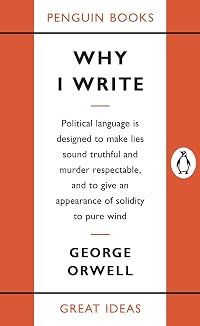
Why I Write
by George Orwell 
On This Page
Description
In Why I Write, Orwell describes his journey to becoming a writer, and his movement from writing poems to short stories to the works we remember him for. Why I Write is a unique opportunity to look into Orwell's mind, and it grants the reader an entirely different vantage point from which to consider the rest of the great writers' oeuvre.Tags
Recommendations






Member Recommendations



Member Reviews
An enjoyable, often witty book – particularly in his “Ten Rules for Writers"- that is an honest presentation of Orwell’s (in)famous “liberalism”. In fact in our current 21st century political climate with the adoration of exclusively extreme viewpoints Orwell would be described as a ‘Commie’. Orwell offers the reader an understanding of his own form of compassionate socialism, contrasting it with the then prevailing right-wing establishment - "Since about 1930 everyone describable as an ‘intellectual’ has lived in a state of chronic discontent with the existing order."
Of course, Orwell was actually a member of that order and his compassion was learned. He fought for a justice of fair equality of income whilst show more struggling endlessly with his own debts. Simon Leys, in a review of Orwell (www.nybooks.com/articles/archives/2011/may/26/intimate-orwell ) wrote; “In the end, Orwell seems to have essentially reverted to his original position of a “Tory Anarchist.” In a letter Orwell wrote to Malcolm Muggeridge, there is a statement that seems to me of fundamental importance: “The real division is not between conservatives and revolutionaries but between authoritarians and libertarians.”
This book displays why Orwell felt that division to be real. show less
Of course, Orwell was actually a member of that order and his compassion was learned. He fought for a justice of fair equality of income whilst show more struggling endlessly with his own debts. Simon Leys, in a review of Orwell (www.nybooks.com/articles/archives/2011/may/26/intimate-orwell ) wrote; “In the end, Orwell seems to have essentially reverted to his original position of a “Tory Anarchist.” In a letter Orwell wrote to Malcolm Muggeridge, there is a statement that seems to me of fundamental importance: “The real division is not between conservatives and revolutionaries but between authoritarians and libertarians.”
This book displays why Orwell felt that division to be real. show less
Orwell is a brilliantly acerbic writer. All the pieces in this anthology are beautifully crafted and interesting. The longest (which can be read here: http://orwell.ru/library/essays/lion/english/) provides a thought-provoking perspective on prospects for the future of Britain, written at the height of the Blitz. In it, Orwell muses on the characteristics of the English, some of which seem oddly familiar more than seventy years later. On the other hand, it's sad to contemplate the massive inequality still present in the 21st century, which Orwell was adamant could not survive the war. His condemnation of left wing party politics also seems oddly apposite today.
The highlight of the book, however, appears at the end. 'Politics and the show more English Language' is fantastic (and can be read here: https://www.mtholyoke.edu/acad/intrel/orwell46.htm). After reading it, I tried to continue with Judith Butler's 'Gender Trouble' and could not bear its dense academic style, which is peppered with words like cathexis, teleology, and semiotic. (I blame Lacan who, ironically, has much to say about language.) Orwell unequivocally condemns the rise of a writing style that I recognise, and am ashamed to have repeatedly used myself, which tries to occlude meaning in order to seem clever. See, I used the word occlude there for just such a purpose! It is so tempting to use long words, but unnecessary verbiage prevents understanding. In this essay can be seen the same preoccupation with how words shape our thoughts that Orwell illustrated so chillingly in '1984' with newspeak. I won't reproduce his main points of contention, as they can be quickly read at the link above. It's enough to say that I agree with him and now intend to try and write more clearly. Also, I must try to avoid the passive voice, which is endemic in academia.
...I can rarely resist an opportunity for pedantry, though. I was amused to spot that Orwell objects to the use of foreign words and little tags, then lists a few. One of these is 'mutatis mutandis' ('changing only what needs to be changed'), which he uses in the prior essay, 'The Lion and the Unicorn'. I felt a petty little thrill at spotting this, then was shamed by Orwell's self-deprecating concession later in the essay that he knows himself to be guilty of the rhetorical tricks he deplores. The point being, they are very hard to avoid, and their constant use has implications for society and politics. His warning about the reduction of communication to stock phrases, whose meaning erodes to practically nothing, is a worrying one. Clarifying your style of writing is a challenging, constant battle against conventional style. Thanks to his awareness of this, Orwell is admirably lucid, here and elsewhere. I was especially struck by this comment:
The highlight of the book, however, appears at the end. 'Politics and the show more English Language' is fantastic (and can be read here: https://www.mtholyoke.edu/acad/intrel/orwell46.htm). After reading it, I tried to continue with Judith Butler's 'Gender Trouble' and could not bear its dense academic style, which is peppered with words like cathexis, teleology, and semiotic. (I blame Lacan who, ironically, has much to say about language.) Orwell unequivocally condemns the rise of a writing style that I recognise, and am ashamed to have repeatedly used myself, which tries to occlude meaning in order to seem clever. See, I used the word occlude there for just such a purpose! It is so tempting to use long words, but unnecessary verbiage prevents understanding. In this essay can be seen the same preoccupation with how words shape our thoughts that Orwell illustrated so chillingly in '1984' with newspeak. I won't reproduce his main points of contention, as they can be quickly read at the link above. It's enough to say that I agree with him and now intend to try and write more clearly. Also, I must try to avoid the passive voice, which is endemic in academia.
...I can rarely resist an opportunity for pedantry, though. I was amused to spot that Orwell objects to the use of foreign words and little tags, then lists a few. One of these is 'mutatis mutandis' ('changing only what needs to be changed'), which he uses in the prior essay, 'The Lion and the Unicorn'. I felt a petty little thrill at spotting this, then was shamed by Orwell's self-deprecating concession later in the essay that he knows himself to be guilty of the rhetorical tricks he deplores. The point being, they are very hard to avoid, and their constant use has implications for society and politics. His warning about the reduction of communication to stock phrases, whose meaning erodes to practically nothing, is a worrying one. Clarifying your style of writing is a challenging, constant battle against conventional style. Thanks to his awareness of this, Orwell is admirably lucid, here and elsewhere. I was especially struck by this comment:
'In the case of a word like democracy, not only is there no agreed definition, but the attempt to make one is resisted from all sides. It is almost universally felt that when we call a country democratic we are praising it: consequently the defenders of every kind of regime claim that it is a democracy, and fear that they might have to stop using that word if it were tied down to any one meaning. Words of this kind are often used in a consciously dishonest way. That is, the person who uses them has his own private definition, but allows his hearer to think he means something quite different.'show less
I feel bad giving this three stars, since three of these essays are fabulous. Unfortunately, 84 pages of this short book are taken up with 'The Lion and the Unicorn,' which is borderline interesting for about 20 pages and wrong, poorly written, repetitive or dull for the rest of them.
Despite all that, it'd be a much better world if high school students were required to read these essays rather than a bad (atrocious, actually) novel about pigs, or 1984. Orwell is much, much better as an essayist and journalist than as a novelist. Just as importantly, if everyone read this instead of Animal Farm, we could avoid the impression that Orwell is a) a Cold Warrior writing in defense of democracy (that is, capitalism, as Orwell himself points show more out); b) a Cold Warrior writing against fascism. As 'Lion and Unicorn' makes quite clear, he's a socialist. As 'A Hanging' makes clear, he's a remarkable critic of inhumanity in general. And as the essays on writing suggest, he's very good at thinking about writing. That's what deserves celebration, not a half-baked pile of macaroni like Animal Farm.
He's not the greatest thinker in the world: on one page he'll point out the misuse of 'democracy' to mean capitalism; on the next page he'll act as if this has no impact on his own use of the term. But that's a small price to pay for the clarity of both his prose and his sentiment. show less
Despite all that, it'd be a much better world if high school students were required to read these essays rather than a bad (atrocious, actually) novel about pigs, or 1984. Orwell is much, much better as an essayist and journalist than as a novelist. Just as importantly, if everyone read this instead of Animal Farm, we could avoid the impression that Orwell is a) a Cold Warrior writing in defense of democracy (that is, capitalism, as Orwell himself points show more out); b) a Cold Warrior writing against fascism. As 'Lion and Unicorn' makes quite clear, he's a socialist. As 'A Hanging' makes clear, he's a remarkable critic of inhumanity in general. And as the essays on writing suggest, he's very good at thinking about writing. That's what deserves celebration, not a half-baked pile of macaroni like Animal Farm.
He's not the greatest thinker in the world: on one page he'll point out the misuse of 'democracy' to mean capitalism; on the next page he'll act as if this has no impact on his own use of the term. But that's a small price to pay for the clarity of both his prose and his sentiment. show less
It is interesting that I would read this book the day after reading Thomas Paine's Common Sense; nearly two-hundred-years separate both of these works, yet they both skewer the imperialistic island of England. Both encompass war - one brewing, the other under way. Each man drafts an outline of how best to change their circumstance: centuries ago, Mr. Paine provides a rough sketch of an American republic; just over half-century ago, Mr. Orwell attempts to solidify British socialism.
So many of Mr. Orwell's observations regarding the liberal of yesteryear aptly epitomize today's Leftist - in my estimation. George Orwell appears to be the hub of a wagon wheel of political philosophies he detests: the pseudo-capitalism of Great Britain; show more European watered down socialism; burgeoning national socialism (a.k.a. the Nazi Party); Italian Fascism; American influenced republican democracy; and imperial Britain. He can not be considered a moderate, exactly because he is clear and adamant about his desire - his ideal political situation is no hybrid of many systems, it is purely democratic socialism.
While I tend to subscribe to a completely opposite political philosophy, I still enjoy his writing. I find it informative and entertaining. Current history, at the time of his writing, is always instrumental in understanding his environment and how he arrives at his conclusions. show less
So many of Mr. Orwell's observations regarding the liberal of yesteryear aptly epitomize today's Leftist - in my estimation. George Orwell appears to be the hub of a wagon wheel of political philosophies he detests: the pseudo-capitalism of Great Britain; show more European watered down socialism; burgeoning national socialism (a.k.a. the Nazi Party); Italian Fascism; American influenced republican democracy; and imperial Britain. He can not be considered a moderate, exactly because he is clear and adamant about his desire - his ideal political situation is no hybrid of many systems, it is purely democratic socialism.
While I tend to subscribe to a completely opposite political philosophy, I still enjoy his writing. I find it informative and entertaining. Current history, at the time of his writing, is always instrumental in understanding his environment and how he arrives at his conclusions. show less
If you've only read Orwell's fiction, you are doing yourself a disservice. Homage to Catalonia and this slim collection of essays, Why I Write, offer--to use the circumlocutious writing Orwell finds most deplorable--pellucid accounts from the trenches of the Spanish Civil War and from the bombing of London respectively. It is though the "ruin of all space, shattering glass and toppling masonry" only serves to sharpen Orwell's political and cultural acuity. His full-throated support of democratic Socialism in the face of burgeoning Fascism is as inspiring today as it is relevant.
Everyone knows "Politics and the English Language" is good. Orwell's plan for a Socialist England is thorough, and more a snapshot than a map at this point. People will think this is a close parallel to the current situation but what he has written is so specific that to apply it to the current situation disrespects him. What he thought of the English national character is also clear, and useful and honest. In all his writing he sounds tired with everyone else which at least seems honest. "A Hanging" was lovely and terrifying but didn't fit at all with the rest of it.
I already had some idea from his other books as to how pretentious Orwell was, but if I was at all in doubt, this book displays Orwell's personality at its most elitist, arrogant and annoying. Here is a man who 'knows' how Great Britain should be responding to the events of WWII, and whose solution to everything is socialism, the sort that interestingly enough is fully realized in the current society of North Korea. With such an example as that for what Orwell's cherished system could look like in its full glory, I am glad he was not taken more seriously. His last essay in this book, from which the book gets its title, is possibly the worst writing advice I have read in a very long time. As an amusing look at a perspective that helped show more shape literature and society, this is an interesting book, but it is not one of Orwell's better books. show less
Members
- Recently Added By
Author Information

389+ Works 221,156 Members
George Orwell was born Eric Arthur Blair on June 25, 1903 in Motihari in Bengal, India and later studied at Eton College for four years. He was an assistant superintendent with the Indian Imperial Police in Burma. He left that position after five years and moved to Paris, where he wrote his first two books: Burmese Days and Down and Out in Paris show more and London. He then moved to Spain to write but decided to join the United Workers Marxist Party Militia. After being decidedly opposed to communism, he served in the British Home Guard and with the Indian Service of the BBC during World War II. After the war, he wrote for the Observer and was literary editor for the Tribune. His best known works are Animal Farm and 1984. His other works include A Clergyman's Daughter, Keep the Aspidistra Flying, The Road to Wigan Pier, Homage to Catalonia, and Coming Up for Air. He died on January 21, 1950 at the age of 46. (Bowker Author Biography) show less
George Orwell has a Legacy Library. Legacy libraries are the personal libraries of famous readers, entered by LibraryThing members from the Legacy Libraries group.
Some Editions
Awards and Honors
Notable Lists
Series
Belongs to Publisher Series
Penguin Great Ideas (20)
Work Relationships
Is contained in
Contains
Common Knowledge
- Canonical title
- Why I Write
- Original publication date
- 1946
- First words
- From a very early age, perhaps the age of five or six, I knew that when I grew up I should be a writer.
- Quotations
- Putting aside the need to earn a living, I think there are four great motives for writing, at any rate for writing prose. They exist in different degrees in every writer, and in any one writer the proportions will vary from t... (show all)ime to time, according to the atmosphere in which he is iving. They are:
1. Sheer egoism....
2. Aesthetic enthusiasm....
3. Historical impulse....
4. Political purpose.... Why I Write
Once again, no book is genuinely free of political bias. The opinion that art should have nothing to do with politics is itself a political attitude. Why I Write
The Spanish war and other events in 1936-7 turned the scale and thereafter I knew where I stood. Every line of serious work that I have written since 1936 has been written, directly or indirectly, against totalitaria... (show all)nism and for democratic Socialism, as I understand it. Why I Write
As I write, highly civilized human beings are fling overhead, trying to kill me. Socialism and the English Genius, Part I: England Your England - Last words
- (Click to show. Warning: May contain spoilers.)One cannot change this all in a moment, but one can at least change one's own habits, and from time to time one can even, if one jeers loudly enough, send some worn-out and useless phrase - some jackboot, Achilles' heel, hotbed, melting pot, acid test, veritable inferno or other lump of verbal refuse - into the dustbin where it belongs.
- Canonical DDC/MDS
- 828.91209; 824.912
- Canonical LCC
- PR6029.R8
- Disambiguation notice
- This is a collection of essays - please don't combine it with other collections of Orwell essays or with the listing of the individual 6 page essay.
Classifications
- Genres
- Nonfiction, Literature Studies and Criticism
- DDC/MDS
- 828.91209 — Literature & rhetoric English & Old English literatures English miscellaneous writings English miscellaneous writings 1900- English miscellaneous writings 1900-1999 English miscellaneous writings 1900-1945 Individual authors not limited to or chiefly identified with one specific form.
- LCC
- PR6029 .R8 — Language and Literature English English Literature 1900-1960
- BISAC
Statistics
- Members
- 2,217
- Popularity
- 9,088
- Reviews
- 22
- Rating
- (4.03)
- Languages
- 9 — Catalan, Dutch, English, French, German, Korean, Croatian, Turkish, Portuguese (Portugal)
- Media
- Paper, Ebook
- ISBNs
- 20
- ASINs
- 7