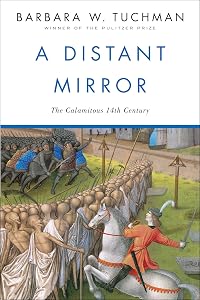
A Distant Mirror: The Calamitous 14th Century
by Barbara W. Tuchman
On This Page
Description
The fourteenth century reflects two contradictory images: on the one hand, a glittering time of crusades and castles, cathedrals and chivalry, and the exquisitely decorated "Books of hours"; and on the other, a time of ferocity and spiritual agony, a world of chaos and the plague. Barbara Tuchman reveals both the great rhythms of history and the grain and texture of domestic life as it was lived. Here are the guilty passions, loyalties and treacheries, political assassinations, sea battles show more and sieges, corruption in high places and a yearning for reform, satire and humor, sorcery and demonology, and lust and sadism on the stage. Here are proud cardinals, beggars, feminists, university scholars, grocers, bankers, mercenaries, mystics, lawyers and tax collectors, and, dominating all, the knight in his valor and "furious follies," a "terrible worm in an iron cocoon." show lessTags
Recommendations





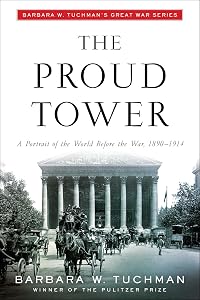

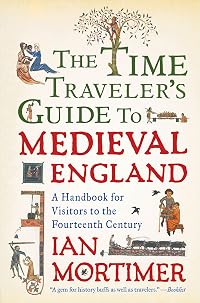
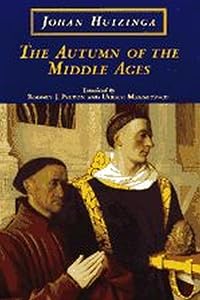



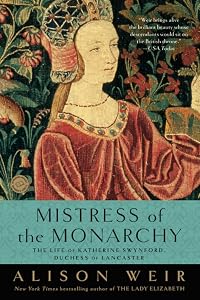


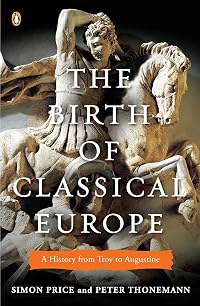
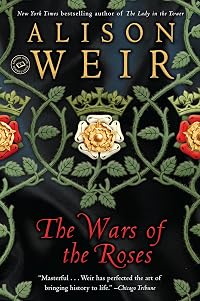
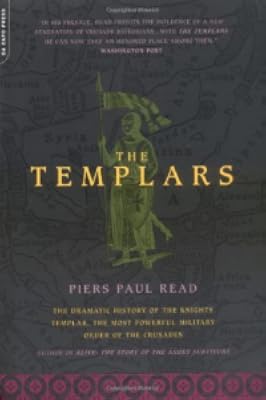
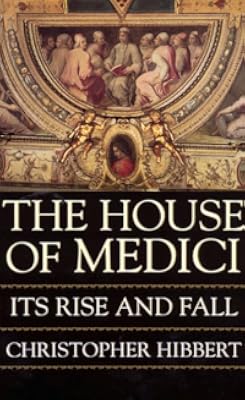
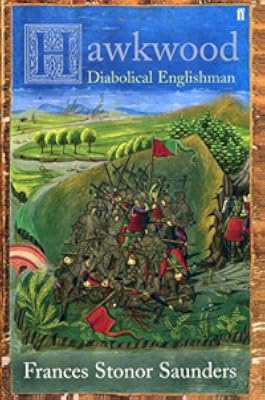


Member Recommendations
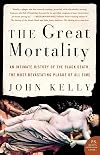
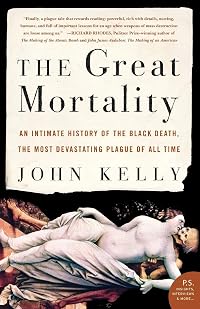
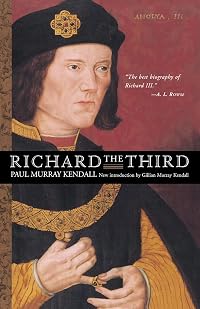
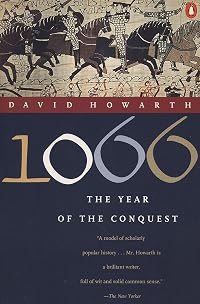
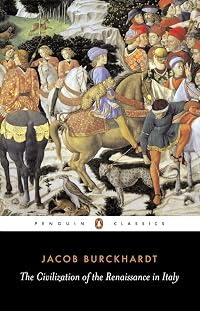
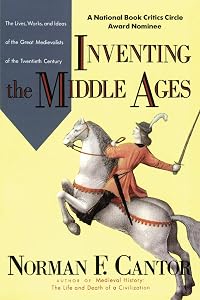
The Great Mortality: An Intimate History of the Black Death, the Most Devastating Plague of All Time by John Kelly
AnnaClaire 'The Great Mortality' focuses specifically on the Black Death, which is really only given one chapter in 'A Distant Mirror'. If you liked Tuchman's book but want more information on the plague, you might want to start with Kelly's book.
20


charlie68 Takes place at a similar time also in France.



charlie68 A book that would be a good introduction to this one.
Member Reviews
An amazing collecting of facts, figures and narrative, emphasized by the introduction that outlines the difficulty any researcher faces when looking into this era. Tuchman set out to write about the Black Plague but couldn't distinguish its effects from all the other calamities of the period, leading her to a broader study that centers on the latter half of the 14th century. In addition to the Black Plague and the Hundred Years War, these years also featured (among a multitude of other things) Chaucer and Boccaccio, the "hysterical mystic" Margery Kempe, Thomas Wyclif, Saint Catherine of Siena, the Dance Macabre, and concluded with the disaster at Nicopolis.
France is the setting for nearly all of the action of the Hundred Years War, an show more event which through its constancy remains the central focus. Tuchman selects a French knight who marries an English princess as an individual to structure her narrative around, since he is conveniently placed at all the major centres of action. She also uses events in the life of Enguerrand de Coucy to explore asides such as the lives of peasants, roles for women, etc. but it is the war's unfurling that primarily directs the action. Early, spectacular English victories created the perception of France as a land of spoils for the taking, while the French were consumed by internal disorders and too frequently prioritized glory over strategy. This war spelled the end for chivalry, Enguerrand arguably the last knight worthy of the name, as softness and immorality consumed it from within, tactics from without.
Tuchman does almost nothing explicit to draw the parallels between the 14th and 20th centuries that she proposes are there. She does not need to. The Hundred Years War contrasts with the World Wars, Black Plague with Spanish Flu (and Covid, if you stretch a bit). The 14th century had its own unpopular wars, political and religious scandals, and horrific acts of anti-Semitism. Should a time machine hurl you randomly into the past, pray you do not land here. A church fallen into usury and schism, random taxation to the point of starving its people and destroying their livelihoods, no recourse to justice or the law, no protection from attack by violent roving bands, unpredictable recursions of the plague, a dearth of heroes or hope ... The common people saw no ray of light in any direction, nor indication how one might come. If they rose up in violence, as they tried multiple times, they were put down like dogs or worse. In place of Cold War gloom they awaited the end times, but with the hope of something good to come afterwards. There was no other hope to cling to.
As always after reading a book like this, the details begin to fade. I'll retain my impression of an age of chaos, when Western civilization was at lowest tide since the fall of Rome. In her epilogue, Tuchman briefly covers the 15th century in as many pages to demonstrate how a stumbling end to the Hundred Years War, a resolution to the schism, the dawn of the printing press and the age of exploration slowly began to point the way out of these doldrums. I wish she'd had the lifetimes necessary to carry this on as a series, or that I could find a similar layperson's overview of every historical century. Perhaps there are for most, but I'd wager this one to be a standout entry. show less
France is the setting for nearly all of the action of the Hundred Years War, an show more event which through its constancy remains the central focus. Tuchman selects a French knight who marries an English princess as an individual to structure her narrative around, since he is conveniently placed at all the major centres of action. She also uses events in the life of Enguerrand de Coucy to explore asides such as the lives of peasants, roles for women, etc. but it is the war's unfurling that primarily directs the action. Early, spectacular English victories created the perception of France as a land of spoils for the taking, while the French were consumed by internal disorders and too frequently prioritized glory over strategy. This war spelled the end for chivalry, Enguerrand arguably the last knight worthy of the name, as softness and immorality consumed it from within, tactics from without.
Tuchman does almost nothing explicit to draw the parallels between the 14th and 20th centuries that she proposes are there. She does not need to. The Hundred Years War contrasts with the World Wars, Black Plague with Spanish Flu (and Covid, if you stretch a bit). The 14th century had its own unpopular wars, political and religious scandals, and horrific acts of anti-Semitism. Should a time machine hurl you randomly into the past, pray you do not land here. A church fallen into usury and schism, random taxation to the point of starving its people and destroying their livelihoods, no recourse to justice or the law, no protection from attack by violent roving bands, unpredictable recursions of the plague, a dearth of heroes or hope ... The common people saw no ray of light in any direction, nor indication how one might come. If they rose up in violence, as they tried multiple times, they were put down like dogs or worse. In place of Cold War gloom they awaited the end times, but with the hope of something good to come afterwards. There was no other hope to cling to.
As always after reading a book like this, the details begin to fade. I'll retain my impression of an age of chaos, when Western civilization was at lowest tide since the fall of Rome. In her epilogue, Tuchman briefly covers the 15th century in as many pages to demonstrate how a stumbling end to the Hundred Years War, a resolution to the schism, the dawn of the printing press and the age of exploration slowly began to point the way out of these doldrums. I wish she'd had the lifetimes necessary to carry this on as a series, or that I could find a similar layperson's overview of every historical century. Perhaps there are for most, but I'd wager this one to be a standout entry. show less
Finished! It took a whole month and I was not ready for it to end when it did. I've never studied history in depth, and so I'm not sure quite what to say about this, except that I was blown away and immediately submitted an AskMetafilter question so I could find more books like this, as well as lectures, podcasts, etc. Planning to read Tuchman's other books on other eras when I can.Can't say what part had the greatest effect on me - listening to this was like swimming in a deep, inexorable river of time, it just kept flowing. I was struck (cliche though this is) at how there is really not a thing new under the sun - the 100 Years War certainly puts current conflicts into some perspective. The epilogue actually made me a little teary, show more although it was sort of weirdly comforting, too. How easily the marks of individual humanity can be swept away to make way for something new. Nothing is ever really permanent. Great book. show less
A splendid book, without doubt. The action runs from London to Byzantium and somehow Tuchman keeps it comprehensible or anyway close.
Tuchman mentions at the beginning of her forward that the preceding two decades had uncomfortably collapsed assumptions: that would have been 1958 to 1978. Practically forty years later, has that trajectory of collapse been reversed? Gun violence is in the news - but it sure seems like our level of violence doesn't reach even close to that of the 14th Century!
The period covered in this book was the decline of chivalry, the mounted warrior. Our period of industrial warfare still seems solidly on its legs, but perhaps that will prove to be a view distorted by our perspective, with our blindness to our show more future. Will aircraft carriers soon become as useless as lances?
So much of our modern world was formed in response to the disintegration of the preceding world. As this modern world in turn disintegrates, again a new world will be patched together from the pieces, as a way to respond to the crises of our day. Tuchman provides a wonderful mirror in which to start to see the shape of such a trajectory. show less
Tuchman mentions at the beginning of her forward that the preceding two decades had uncomfortably collapsed assumptions: that would have been 1958 to 1978. Practically forty years later, has that trajectory of collapse been reversed? Gun violence is in the news - but it sure seems like our level of violence doesn't reach even close to that of the 14th Century!
The period covered in this book was the decline of chivalry, the mounted warrior. Our period of industrial warfare still seems solidly on its legs, but perhaps that will prove to be a view distorted by our perspective, with our blindness to our show more future. Will aircraft carriers soon become as useless as lances?
So much of our modern world was formed in response to the disintegration of the preceding world. As this modern world in turn disintegrates, again a new world will be patched together from the pieces, as a way to respond to the crises of our day. Tuchman provides a wonderful mirror in which to start to see the shape of such a trajectory. show less
This book is fantastic in its depth. The author did not come to fuck around, she came to murder - with precision - the fond notion of knighthood, kings, princesses, castles and any kind feelings you may have reserved for “the Church”.
When I began reading Dante’s Divine Comedy (not finished yet JEEZ), I realized how little I understood of 14th century western culture. For instance how the world of Dante reacted to his canticles - how his writings influenced culture. Anyway, I remembered to read this book. Which given the time we find ourselves in during a global pandemic .... this is triggering as fuck and also so goddamned well written. The parallels between then and now will ENRAGE you.
Anyway, the author’s writing is show more entertaining and everyone should read PARTS of this book. I get that 14th century plague and cultural commentary may not be for everyone, but if nothing else read the preface. show less
When I began reading Dante’s Divine Comedy (not finished yet JEEZ), I realized how little I understood of 14th century western culture. For instance how the world of Dante reacted to his canticles - how his writings influenced culture. Anyway, I remembered to read this book. Which given the time we find ourselves in during a global pandemic .... this is triggering as fuck and also so goddamned well written. The parallels between then and now will ENRAGE you.
Anyway, the author’s writing is show more entertaining and everyone should read PARTS of this book. I get that 14th century plague and cultural commentary may not be for everyone, but if nothing else read the preface. show less
A Distant Mirror is a fascinating study of the time and culture of chivalry, as seen through the life of Enguerrand de Coucy, a powerful French baron, and last of his line. de Coucy left a relatively light mark on the historical record (his face is turned away from the viewer in the only extant portrait, his castle was razed by the Nazis in WW2), but this book is more about the entire time, and that time was a shitshow.
The central event of the 14th century was the Black Death, a wave of plague which reduced the population of Europe by between 30% and 40%. War was almost constant, and the superiority of walled cities and castles over armies of the time meant that war was fought by mass destructive raids. Men-at-arms, called to fight for show more France or England or Burgundy, would transition almost effortless to brigands during periods of truce. The Catholic Church was at its lowest ebb, split in the Great Schism between rival popes in Rome and Avignon. Chivalry had degenerated to a parody of high culture, with knights lavish dandies and dancers by night, and incapable of even moderate tactics in battle.
Tuchman's book is a masterful survey of the glamour of life at the top of Medieval society, and the oppression and suffering that support that glittering top. show less
The central event of the 14th century was the Black Death, a wave of plague which reduced the population of Europe by between 30% and 40%. War was almost constant, and the superiority of walled cities and castles over armies of the time meant that war was fought by mass destructive raids. Men-at-arms, called to fight for show more France or England or Burgundy, would transition almost effortless to brigands during periods of truce. The Catholic Church was at its lowest ebb, split in the Great Schism between rival popes in Rome and Avignon. Chivalry had degenerated to a parody of high culture, with knights lavish dandies and dancers by night, and incapable of even moderate tactics in battle.
Tuchman's book is a masterful survey of the glamour of life at the top of Medieval society, and the oppression and suffering that support that glittering top. show less
I feel like I’ve been reading about the 14th century for months, although that’s an exaggeration. ‘A Distant Mirror’ covers an enormous amount of ground in an era about which I knew practically nothing before. It was therefore a more exacting read than I was expecting, although fully worth the effort. The subtitle is entirely accurate, as the 14th century appears to have been an unmitigated disaster for Europe. During that hundred years, the population fell by 50 or 60% thanks to plague, wars, excessive taxation, revolts, and brigandry. Meanwhile, support for the established institutions of the time was eroded by a papal schism, knights abandoning chivalry for theft and rapine, mad and bad kings, wasteful wars at home and show more abroad, and egregious financial mismanagement. Of particular interest to me in this litany of woe were the repeated revolts by peasants and the urban poor and/or bourgeois, on both sides of the channel. All were suppressed with appalling brutality after some initial successes, presaging the civil war and revolution that would follow in subsequent centuries. I’d assumed a more complaisant populace in Mediaeval times. Also extraordinary to me was the damage caused by unemployed knights, who pillaged their own countries when there was no war overseas to profit from. A repeated theme throughout the book is the need for wars, often crusades, to be started in order to get the destructive bands of knights out of France for a while. As Tuchman makes clear, much talk of chivalry translated into little in the way of chivalrous behaviour in most cases. Bands of knights would exort money from towns in return for not attacking them, then turn around and pillage the surrounding countryside.
The business of the papal schism was also incredibly destructive in its own way, but with the benefit of hindsight also has a profound ludicrousness about it. The schism had no theological basis at all, being entirely based in politics. The existence of a pope and anti-pope splitting the church brought it into disrepute, not least thanks to the behaviour of said popes. Benedict XIII is especially memorable. Formerly known as Cardinal de Luna, he was elected pope in his sixties after claiming to be eager for reunion of the church and saying he would unilaterally abdicate, ‘as easily as I take off my hat’ if necessary to achieve that end. He then proceeded to do absolutely nothing of the sort. As Tuchman puts it:
The book nominally centres on a prominent French noble named de Coucy, whose life regularly surfaces amongst its pages. There is much more to it than that, however, as de Coucy had dealings in many but not all of the important events of the century. At times the complexity of politics becomes challenging to follow, especially amid the squabbling city-states of Italy, but is remarkably clear considering the subject matter. Overall I found it a fascinating history, in particular as regards the Hundred Years War and the papal schism. The sheer number of disasters and the toll they took on the population is hard to grasp, though. It’s also striking to consider that while Europe was tearing itself apart, other continents were doing much better. Although the plague also struck there, I don’t think Asia found the 14th century calamitous to the same degree at all. show less
The business of the papal schism was also incredibly destructive in its own way, but with the benefit of hindsight also has a profound ludicrousness about it. The schism had no theological basis at all, being entirely based in politics. The existence of a pope and anti-pope splitting the church brought it into disrepute, not least thanks to the behaviour of said popes. Benedict XIII is especially memorable. Formerly known as Cardinal de Luna, he was elected pope in his sixties after claiming to be eager for reunion of the church and saying he would unilaterally abdicate, ‘as easily as I take off my hat’ if necessary to achieve that end. He then proceeded to do absolutely nothing of the sort. As Tuchman puts it:
‘Benedict XIII resisted every pressure. For nearly thirty years to come, despite French withdrawal of obedience, siege of Avignon, desertion by his cardinals, deposition by two Councils, and the rivalry of three other popes, he would not step down. Retreating to a Spanish fortress, he died in 1422 at the age of 94 still maintaining his claim.’
The book nominally centres on a prominent French noble named de Coucy, whose life regularly surfaces amongst its pages. There is much more to it than that, however, as de Coucy had dealings in many but not all of the important events of the century. At times the complexity of politics becomes challenging to follow, especially amid the squabbling city-states of Italy, but is remarkably clear considering the subject matter. Overall I found it a fascinating history, in particular as regards the Hundred Years War and the papal schism. The sheer number of disasters and the toll they took on the population is hard to grasp, though. It’s also striking to consider that while Europe was tearing itself apart, other continents were doing much better. Although the plague also struck there, I don’t think Asia found the 14th century calamitous to the same degree at all. show less
Most works of popular narrative history I've read in the last few years have succeeded in annoying me in various ways, but I ploughed through this one very happily, even though the middle ages are not a period I'm normally very interested in. It's a "popular" history in the sense that Tuchman doesn't get involved in detailed comparison of earlier academic research on the period in question, but she doesn't talk down to the reader, play silly games of reconstruction or tenuous connections, drift off into irrelevant anecdotes, or perpetrate gross errors and anachronisms. And she provides full references and a bibliography in case we want to follow anything up. Which is a rather backwards way of saying that she is a good writer who knows show more how to maintain the reader's interest in the subject. What more can you ask if you're reading history for pleasure? show less
Members
- Recently Added By
Lists

Non-Fiction Worth Reading
1,015 works; 254 members

501 Must-Read Books
529 works; 72 members

Top Five Books of 2020
982 works; 348 members

Reading Queue
15 works; 1 member

Books bought at library sales
98 works; 4 members

Ten books that most shaped your view of history
91 works; 12 members

The Well-Educated Mind Reading Challenge
75 works; 7 members

Well-Educated Mind
150 works; 3 members

Europe
205 works; 6 members

Edad Media
33 works; 1 member

Books Read in 2025
4,091 works; 97 members

2024-2025 Ezra Klein Guest Recommendations
213 works; 6 members

The Well-Educated Mind, Susan Wise Bauer, 2016
179 works; 3 members

Books We Love to Reread
688 works; 296 members

Club Read's Recommended Nonfiction Written by Women
618 works; 30 members

My List
302 works; 1 member

Favourite Books
1,819 works; 310 members

Books Read in 2004
200 works; 7 members

1970s
657 works; 23 members

National Book Award winners
65 works; 11 members

Changamire's Bookshelf
19 works; 1 member
500 Great Books by Women
507 works; 60 members

Read This Next
120 works; 3 members

Books We Resisted Reading
178 works; 110 members

Unread books
1,063 works; 83 members
Author Information

28+ Works 29,824 Members
Barbara W. Tuchman achieved prominence as a historian with The Zimmermann Telegram, and international fame with The Guns of August--a huge bestseller and winner of the Pulitzer Prize. There followed other successes, including The Proud Tower, Stilwell and the American Experience in China (also awarded the Pulitzer Prize), A Distant Mirror, The show more March of Folly, and The First Salute. show less
Some Editions
Awards and Honors
Awards
Distinctions
Notable Lists
Series
Belongs to Publisher Series
Work Relationships
Is contained in
Common Knowledge
- Canonical title
- A Distant Mirror: The Calamitous 14th Century
- Original title
- A Distant Mirror
- Alternate titles*
- 远方之镜 : 动荡不安的14世纪
- Original publication date
- 1978-09-21
- People/Characters
- Enguerrand VII de Coucy; Isabella Plantagenet; Joan I, Queen of Naples; Charles IV, Holy Roman Emperor; God; Philip the Fair, Duke of Burgundy (show all 122); Edward III, King of England; Geoffrey Chaucer; Charles of Navarre; Christine de Pizan; Sir John Chandos; Wat Tyler; Charles V, King of France; DeWitt Clinton; Etienne Marcel; Lisa; Gabrielle; Wenceslas; Thomas à Kempis; John of Burgundy; Jeanne d'Arc; Catherine of Siena; John Hawkwood; Boniface VIII, Pope (Benedetto Caetani, c. 1230 -1303); Marco Polo; Louis IX, King of France; Bertrand de Born; Francesco Petrarca; William of Ockham; Philip VI, King of France; Jacques de Molay; John XXII, Pope ( -1334); Jacques de Vitry; Philippe de Remi; Francesco Datini; Matteo Villani; Gauthier de Metz; Honore Bonet; Ramon Llull; Pero Niño; Charles de Blois; Jeanne de Penthièvre; Jacob van Artevelde; Thomas Becket (Thomas a Becket); Edward II, King of England; Jean Froissart; Clement or Clemens VI, Pope (Pierre Roger, 1291-1352); John Clyn; Guy de Chauliac; Jean de Venette; Gilles Li Muisis; Simon de Covino of Montpellier; John of Fordun; Henry Knighton; Alfonso XI, King of Castile, León and Galicia; John VI Kantakouzenos; Peter IV of Aragon; Giovanni Villani; Richard Rolle; John II, King of France; Henry of Grosmont, duke of Lancaster; Colin Doublel; John VI of Harcourt; Hélie de Talleyrand-Périgord; Robert le Coq; Ambrogio Lorenzetti; Cola di Rienzo; Fra Moriale; Arnaud de Cervole; Innocent VI, Pope; Robert Knolles; Eustache D'Abrichecourt; Jules Michelet; Jean III de Grailly, Captal de Buch; Gaston III, Count of Foix; Guillaume Cale; Gian Galeazzo Visconti; Urban V, Pope; Peter I of Cyprus; Amadeus VI, Count of Savoy; Bertrand du Guesclin; Pedro the Cruel, King of Castile; Don Enrique of Trastamare; Francesco Ordelaffi; Franco Sacchetti; Giovanni Agnello; Gregory XI, Pope; Brigitta of Sweden; Ambrosio Boccanegra; John of Gaunt, Duke of Lancaster; Alice Perrers; John Wycliffe; Marsilius of Padua; Marguerite Porete; Jeanne Dabenton; Nicole Oresme; Robert of Geneva; Ferndo Sanchez de Tovar; Sir John Arundel; Anne of Bohemia, Queen Consort of England; Clement or Clemens VII, Antipope (Robert of Geneva , 1342-1394); Urban VI, Pope; John Philton; Thomas of Buckingham; Olivier de Clisson; Philip van Artevelde; King Charles VI of France; Count Louis II of Flanders; Peter van den Bossche; Geert Groote; Benedict XIII, Antipope (Pedro Martí | nez de Luna y Pé | rez de Gotor, 1328&ndash | 1423); Leo V, King of Armenia; Claus Sluter; Niccolo Spinelli; Nicolas de Clamanges; Bayezid I; Sigismund, King of Hungary; Jacques de Helly; John the Fearless, Duke of Burgundy; Louis I, Duke of Orleans; Jan Hus; Eustache Deschamps
- Important places
- Europe
- Important events
- Black Death (1340s); Hundred Years' War (1337 | 1453); 14th century (1300s); Battle of Nicopolis
- Epigraph
- " For mankind is ever the same and nothing is lost out of nature, though everything is altered. "
John Dryden - First words
- The genesis of this book was a desire to find out what were the effects on society of the most lethal disaster of recorded history-that is to say, of the Black Death of 1348-50, which killed an estimated one third of the popu... (show all)lation living between India and Iceland.
- Last words
- (Click to show. Warning: May contain spoilers.)For 700 years the castle had witnessed cycles of human endeavor and failure, order and disorder, greatness and decline. Its ruins remain on the hilltop in Picardy, silent observers as history's wheel turns.
- Original language
- English
- Canonical DDC/MDS
- 944.02
- Canonical LCC
- DC97.5
*Some information comes from Common Knowledge in other languages. Click "Edit" for more information.
Classifications
- Genres
- History, General Nonfiction, Nonfiction
- DDC/MDS
- 944.02 — History & geography History of Europe France and Monaco France Capet and Valois 987-1589
- LCC
- DC97.5 — History of Europe, Asia, Africa and Oceania France – Andorra – Monaco History of France History By period Early and medieval to 1515 1328-1515 Hundred Years' War, 1339-1453
- BISAC
Statistics
- Members
- 8,060
- Popularity
- 1,391
- Reviews
- 135
- Rating
- (4.14)
- Languages
- 22 — Danish, Dutch, English, Estonian, French, German, Hebrew, Hungarian, Italian, Norwegian (Bokmål), Norwegian, Farsi/Persian, Polish, Romanian, Russian, Croatian, Spanish, Swedish, Portuguese (Portugal), Portuguese (Brazil), Chinese, traditional, Chinese, simplified
- Media
- Paper, Audiobook, Ebook
- ISBNs
- 76
- ASINs
- 64