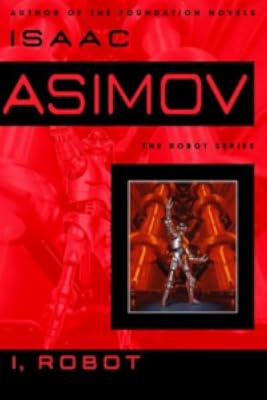
I, Robot [Anthology]
by Isaac Asimov
Isaac Asimov's Robot Series (Collections and Selections — 1), Asimov's Universe (Collections and Selections — 1)
On This Page
Description
The three laws of Robotics: 1) A robot may not injure a human being or, through inaction, allow a human being to come to harm 2) A robot must obey orders given to it by human beings except where such orders would conflict with the First Law. 3) A robot must protect its own existence as long as such protection does not conflict with the First or Second Law. With these three, simple directives, Isaac Asimov changed our perception of robots forever when he formulated the laws governing their show more behavior. In I, Robot, Asimov chronicles the development of the robot through a series of interlinked stories: from its primitive origins in the present to its ultimate perfection in the not-so-distant future--a future in which humanity itself may be rendered obsolete. Here are stories of robots gone mad, of mind-read robots, and robots with a sense of humor. Of robot politicians, and robots who secretly run the world--all told with the dramatic blend of science fact and science fiction that has become Asmiov's trademark. show lessTags
Recommendations






Member Recommendations
benmartin79 Some repeats, but some of the newer material, especially the title story, is a good supplement.
71

Member Reviews
With advances in AI regularly dominating today's headlines, thought it might be interesting to go back in time to review the technology through the eyes of the visionary science fiction writers who were the first to imagine the potential challenges of integrating artificial intelligence into society. Chief among these being scientist-writer Isaac Asimov, whose 'I, Robot' famously set forth the three “Rules of Robotics” that are still being employed by AI designers today:
(1) A robot may not injure a human being or, through inaction, allow a human being to come to harm;
(2) A robot must obey orders given to it by human beings except where such orders would conflict with the First Law; and
(3) A robot must protect its own existence as show more long as such protection does not conflict with the First or Second Laws.)
First revelation: Even as far back as 1950s, folks were absolutely contemplating the potential risks of unconstrained artificial intelligence. In fact, the whole purpose of this short story collection is to explore scenarios that “test” the extent to which any set of rules can effectively contain the potential threats of AI. Spoiler: a lot of the issues that Asimov explores here are issues we are, in fact, wrestling with today.
For instance, in the first story, ‘Robbie,’ Asimov imagines a child that forms such a strong bond with her AI nursemaid, she becomes unable to engage with other childhood pleasures. Which sure sounds a lot like the debate we’re having now over folks forming unhealthy relationships with Chatbots, right? (Also, the story touches upon ongoing debate about the appropriate function of AI – is the end goal to have AI offload our work so we can spend more time on prosocial activities like childrearing, or to offload our prosocial obligations so we can spend more time on work?)
‘Runaround’ addressed unintended consequences, arguing that you can never create rules that will anticipate every eventuality. Another frequent refrain of today’s AI watchdogs.
‘Little Lost Robot’ explores whether any sentient intelligence, no matter how constrained by rules, will accept the domination of creatures it considers inferior. Though Asimov had no concept of LLMs, it’s not much of a stretch to imagine AI trained on human logic acquiring one of humanity’s greatest vulnerabilities – the need to exert our power/authority over others.
Three short stories address whether we can count on the impersonal logic of robots to protect us. In ‘Catch That Rabbit,’ logic fails because the robots can’t figure out how to logically respond to contradictory commands (see Second Law). ‘Reason’ posits that we can’t count on robots to act logically, because 'logic' is ultimately a relative construct – technically, you can prove anything logically if you pick the proper postulates. And in ‘Escape,’ logic fails because it doesn’t account for the Darwinian imperatives of survival that rule all living things – what if the most logical way to save humans is to kill them?
‘Liar,’ ‘Evidence,’ and ‘The Inevitable Conflict’ combine to create the most subversive scenario in the collection, positing a world in which we humans have basically turned over all decisions re governing and economics to artificial intelligence. On the one hand, the world is transformed into a functioning system in which wars are eliminated, everyone is gainfully employed, and no one suffers from want. But at what cost? Eventually the machines begin lying to us: not just lying to us, but lying to us in ways that we will never be able to identify or mitigate. The logical outcome of which would be … well, the Matrix.
Interestingly, the story posits a world in which robots have been banned on earth, exiled to extraplanetary mining and other support functions. Why? Because labor unions, seeing them as a threat to jobs, have required their banishment. Which had me speculating about the lengths to which our current crop of AI uber-wealthy tech bros might go to in order to quell any similar sort of dissent. Might they even go so far as to promote candidates who pledge to strip laborers of all forms of effective protest?
Also, Asimov posits world in which most of the world governments ban the use of robots for anything other than labor or scientific research – but does anyone truly believe that bad actors are going to willingly follow the rules?
The stories are a bit dated. For instance, though Asimov’s bold enough to posit a female scientist, he makes her dumpy and unappealing, which hits as very pre-woke - a throwback to a time when science was considered an unfeminine pursuit. And his robots are *huge,* because he was writing in a world dominated by vacuum tubes rather than microchips. The stories are told in a masculine, straightforward way, laying no claim to literary prowess. Having said that, I predict that, like me, today’s readers will not only find this short story collection entertaining, but also profoundly thought-provoking. show less
(1) A robot may not injure a human being or, through inaction, allow a human being to come to harm;
(2) A robot must obey orders given to it by human beings except where such orders would conflict with the First Law; and
(3) A robot must protect its own existence as show more long as such protection does not conflict with the First or Second Laws.)
First revelation: Even as far back as 1950s, folks were absolutely contemplating the potential risks of unconstrained artificial intelligence. In fact, the whole purpose of this short story collection is to explore scenarios that “test” the extent to which any set of rules can effectively contain the potential threats of AI. Spoiler: a lot of the issues that Asimov explores here are issues we are, in fact, wrestling with today.
For instance, in the first story, ‘Robbie,’ Asimov imagines a child that forms such a strong bond with her AI nursemaid, she becomes unable to engage with other childhood pleasures. Which sure sounds a lot like the debate we’re having now over folks forming unhealthy relationships with Chatbots, right? (Also, the story touches upon ongoing debate about the appropriate function of AI – is the end goal to have AI offload our work so we can spend more time on prosocial activities like childrearing, or to offload our prosocial obligations so we can spend more time on work?)
‘Runaround’ addressed unintended consequences, arguing that you can never create rules that will anticipate every eventuality. Another frequent refrain of today’s AI watchdogs.
‘Little Lost Robot’ explores whether any sentient intelligence, no matter how constrained by rules, will accept the domination of creatures it considers inferior. Though Asimov had no concept of LLMs, it’s not much of a stretch to imagine AI trained on human logic acquiring one of humanity’s greatest vulnerabilities – the need to exert our power/authority over others.
Three short stories address whether we can count on the impersonal logic of robots to protect us. In ‘Catch That Rabbit,’ logic fails because the robots can’t figure out how to logically respond to contradictory commands (see Second Law). ‘Reason’ posits that we can’t count on robots to act logically, because 'logic' is ultimately a relative construct – technically, you can prove anything logically if you pick the proper postulates. And in ‘Escape,’ logic fails because it doesn’t account for the Darwinian imperatives of survival that rule all living things – what if the most logical way to save humans is to kill them?
‘Liar,’ ‘Evidence,’ and ‘The Inevitable Conflict’ combine to create the most subversive scenario in the collection, positing a world in which we humans have basically turned over all decisions re governing and economics to artificial intelligence. On the one hand, the world is transformed into a functioning system in which wars are eliminated, everyone is gainfully employed, and no one suffers from want. But at what cost? Eventually the machines begin lying to us: not just lying to us, but lying to us in ways that we will never be able to identify or mitigate. The logical outcome of which would be … well, the Matrix.
Interestingly, the story posits a world in which robots have been banned on earth, exiled to extraplanetary mining and other support functions. Why? Because labor unions, seeing them as a threat to jobs, have required their banishment. Which had me speculating about the lengths to which our current crop of AI uber-wealthy tech bros might go to in order to quell any similar sort of dissent. Might they even go so far as to promote candidates who pledge to strip laborers of all forms of effective protest?
Also, Asimov posits world in which most of the world governments ban the use of robots for anything other than labor or scientific research – but does anyone truly believe that bad actors are going to willingly follow the rules?
The stories are a bit dated. For instance, though Asimov’s bold enough to posit a female scientist, he makes her dumpy and unappealing, which hits as very pre-woke - a throwback to a time when science was considered an unfeminine pursuit. And his robots are *huge,* because he was writing in a world dominated by vacuum tubes rather than microchips. The stories are told in a masculine, straightforward way, laying no claim to literary prowess. Having said that, I predict that, like me, today’s readers will not only find this short story collection entertaining, but also profoundly thought-provoking. show less
I, Robot. Is there a selection from the golden age of science fiction that better epitomizes the era?
There's no doubt that Isaac Asimov's I, Robot is a science fiction classic. Complete with the three laws of robotics, it casts a tall shadow over almost every work of science fiction, book or movie, and you hear echoes, loud and soft, anywhere on artificial intelligence or robotics appears.
Whether it is Bishop in Alien ( "It is impossible for me to harm, or, by omission of action, allow to be harmed, a human being."), C-3PO in Star Wars ("It's against my programming to impersonate a deity."), or the android Data of Star Trek: The Next Generation fame, whose role in the show seems to be guided by examination of the themes in I, Robot, show more Asimov's laws have made an impression that place the novel firmly in the science fiction canon.
As I reread I, Robot recently, considering these themes and how Asimov told his tale, and what the I, Robot's legacy should be, I was struck with how much science fiction has changed, and yet owes a debt to Asimov. Even this year's winner of the Hugo for best novel, Ancillary Justice by Ann Leckie, resonates with themes about artificial intelligence embodied and self-examining the rules and justifications for existence, not unlike I, Robot. But unlike Asimov's highly logical tales--I, Robot is structured more like a collection of stories that follow the introduction of robots and artificial intelligence to society--Leckie's novel is a space opera, focused more on existential drama and emotion than on hard science and logic. Anyone can enjoy Leckie's fiction--well, almost anyone--but Asimov's writing lends itself more to the devotee of the genre, to the engineer, to the aficionado of the hard sciences. He believed that the only constant in history was change, and that it was the role of science fiction to guess at what the future would be. "Individual science fiction stories may seem as trivial as ever to the blinder critics and philosophers of today — but the core of science fiction, its essence, the concept around which it revolves, has become crucial to our salvation if we are to be saved at all."
Meanwhile, much of today's science fiction seems to focus less on the science and more on the pet political issues of its writers. Asimov was no shrinking violet when it came to politics or religion (he was an atheist and dismissive of those who believed in divinity), but neither was he one to allow society to get in the way of the science in his fiction, including I, Robot. Looking at other Hugo winners, he would have enjoyed Mary Robinette Kowal's The Lady Astronaut of Mars, a tale about the first lady astronaut to go to Mars considering how to return to the stars, but Asimov would have scratched his head over John Chu's "The Water That Falls on You from Nowhere," which is best described as two gay guys having sex on a couch when they magically take the ice bucket challenge.
(I think he would have been just fine with Charles Stross, a multiple Hugo nominee and recipient this year, especially since Stross explicitly cites and applies the three laws of robotics found in I, Robot in his Saturn's Children).
Looking at these Hugo winning selections, its easy to see some relationship to Asimov's influence and I, Robot, but also to see complete aversion to a hard science effort at fiction. Sure, readers expectations have shifted, writing styles have changed, and we've caught up to what was then the future in I, Robot. But what made Asimov resonate was a view to the future that was hopeful and expectant (mostly), believing that we could dream up ways to solve our problems with technology as our tools.
Or maybe I'm reading too much into Asimov. But I don't think so. There may not be the gripping and exciting action scenes or the touchy-feely interviewing of heavy-handed political messages (I'm looking at you, Nancy Kress and your After the Fall, Before the Fall, During the Fall), but it's hard to walk away from I, Robot without wanting to then stop by the Radio Shack and pick up a few gadgets and gizmos to maybe try putting together a robot or two of your own. That's the kind of science fiction I like, and that's the kind I hope more modern writers will write. show less
There's no doubt that Isaac Asimov's I, Robot is a science fiction classic. Complete with the three laws of robotics, it casts a tall shadow over almost every work of science fiction, book or movie, and you hear echoes, loud and soft, anywhere on artificial intelligence or robotics appears.
Whether it is Bishop in Alien ( "It is impossible for me to harm, or, by omission of action, allow to be harmed, a human being."), C-3PO in Star Wars ("It's against my programming to impersonate a deity."), or the android Data of Star Trek: The Next Generation fame, whose role in the show seems to be guided by examination of the themes in I, Robot, show more Asimov's laws have made an impression that place the novel firmly in the science fiction canon.
As I reread I, Robot recently, considering these themes and how Asimov told his tale, and what the I, Robot's legacy should be, I was struck with how much science fiction has changed, and yet owes a debt to Asimov. Even this year's winner of the Hugo for best novel, Ancillary Justice by Ann Leckie, resonates with themes about artificial intelligence embodied and self-examining the rules and justifications for existence, not unlike I, Robot. But unlike Asimov's highly logical tales--I, Robot is structured more like a collection of stories that follow the introduction of robots and artificial intelligence to society--Leckie's novel is a space opera, focused more on existential drama and emotion than on hard science and logic. Anyone can enjoy Leckie's fiction--well, almost anyone--but Asimov's writing lends itself more to the devotee of the genre, to the engineer, to the aficionado of the hard sciences. He believed that the only constant in history was change, and that it was the role of science fiction to guess at what the future would be. "Individual science fiction stories may seem as trivial as ever to the blinder critics and philosophers of today — but the core of science fiction, its essence, the concept around which it revolves, has become crucial to our salvation if we are to be saved at all."
Meanwhile, much of today's science fiction seems to focus less on the science and more on the pet political issues of its writers. Asimov was no shrinking violet when it came to politics or religion (he was an atheist and dismissive of those who believed in divinity), but neither was he one to allow society to get in the way of the science in his fiction, including I, Robot. Looking at other Hugo winners, he would have enjoyed Mary Robinette Kowal's The Lady Astronaut of Mars, a tale about the first lady astronaut to go to Mars considering how to return to the stars, but Asimov would have scratched his head over John Chu's "The Water That Falls on You from Nowhere," which is best described as two gay guys having sex on a couch when they magically take the ice bucket challenge.
(I think he would have been just fine with Charles Stross, a multiple Hugo nominee and recipient this year, especially since Stross explicitly cites and applies the three laws of robotics found in I, Robot in his Saturn's Children).
Looking at these Hugo winning selections, its easy to see some relationship to Asimov's influence and I, Robot, but also to see complete aversion to a hard science effort at fiction. Sure, readers expectations have shifted, writing styles have changed, and we've caught up to what was then the future in I, Robot. But what made Asimov resonate was a view to the future that was hopeful and expectant (mostly), believing that we could dream up ways to solve our problems with technology as our tools.
Or maybe I'm reading too much into Asimov. But I don't think so. There may not be the gripping and exciting action scenes or the touchy-feely interviewing of heavy-handed political messages (I'm looking at you, Nancy Kress and your After the Fall, Before the Fall, During the Fall), but it's hard to walk away from I, Robot without wanting to then stop by the Radio Shack and pick up a few gadgets and gizmos to maybe try putting together a robot or two of your own. That's the kind of science fiction I like, and that's the kind I hope more modern writers will write. show less
***NO SPOILERS***
(Full disclosure: book abandoned on page 86, out of 273 pages)
(Full disclosure: book abandoned on page 86, out of 273 pages)
Under other circumstances, it might have been a beautiful sight. The stream of high-speed electrons impinging upon the energy beam fluoresced into ultraspicules of intense light. The beam stretched out into shrinking nothingness, a-glitter with dancing, shining motes.Unfortunately, this is how I, Robot goes (at least up until page 86). Asimov’s vision is an inventive one, but it isn’t geared to the everyday reader, as his writing is heavy on technical, jargon-y dialogue and light on lay speech. Focus is on two scientists and their work alongside robots; however, Asimov opened with a compelling domestic scene, one involving a family of three and arguments show more concerning their “robot nursemaid,” but a skim of the rest of the book reveals that, oddly, the story never returns to that human element. If the interrelated stories had continued in this vein and not abruptly switched to a different focus in subsequent chapters, I, Robot would have been better. show less
Quite possibly the single mostly tightly-written and consistent collection of speculative fiction stories ever published. Asimov still gets quoted and referenced today for a reason. Not only is it impossible to overstate how influential the ideas in this book were, it's just plain a good, entertaining read.
The core concept is a future where humanity has created 'Smart' AI - actual thinking machines - and as a safety precaution, those thinking machines are wired with three laws that they cannot violate.
In theory.
The entire book then proceeds to take those famous three laws and show all the ways that they can in fact be violated and would not work in the real world.
With the rise of LLMs (generative 'dumb AI') in the 2020s, the lessons in show more this book from the 1950's could not possibly be more timely. Computers are complicated and engineering theory hits walls when it's deployed to production (real life). show less
The core concept is a future where humanity has created 'Smart' AI - actual thinking machines - and as a safety precaution, those thinking machines are wired with three laws that they cannot violate.
In theory.
The entire book then proceeds to take those famous three laws and show all the ways that they can in fact be violated and would not work in the real world.
With the rise of LLMs (generative 'dumb AI') in the 2020s, the lessons in show more this book from the 1950's could not possibly be more timely. Computers are complicated and engineering theory hits walls when it's deployed to production (real life). show less
Published in 1950 and set in the future, this book is a connected series of short stories that portray the history of robotics from around the 2000s to 2070s. In Asimov’s future world, robots have been designed with positronic brains, which are programmed to observe the “Three Laws of Robotics” (very simply stated – avoiding harm to humans, following orders, and avoiding harm to self). The framing device used to turn these short stories into a cohesive novel is an unnamed journalist who serves as narrator, interviewing Dr. Susan Calvin. The narrator plans to publish a feature story about Calvin upon her retirement.
It explores the interplay between humans and machines. The plot revolves around testing hypotheses related to the show more “three laws.” For example, would there ever be a situation where a robot could lie? In this vision of the future, robots become increasingly important to the running of the world in ways that will minimize harm to humans, which stands in sharp contrast to humankind’s history of warring against each other and causing great harm. I think this book does an excellent job of probing many ethical questions that arise regarding human-robot interactions.
I find it interesting that some culturally accepted norms of the time were outside of the potential for change, even for someone as forward-thinking as Asimov. The scenes are rampant with workplace smoking, large tomes of physical books, and paper/pencil calculations. On the other hand, in an era where there were few female scientists, Dr. Susan Calvin is an intellectually gifted strong woman, and for me, one of the highlights of the book.
There is a bit of repetition that speaks to these stories being written separately and then stitched together later, but overall, I found it a delightful anticipation of artificial intelligence and the related ethical issues. What is the proper relationship between human and machine? What a great question! I enjoyed it very much. show less
It explores the interplay between humans and machines. The plot revolves around testing hypotheses related to the show more “three laws.” For example, would there ever be a situation where a robot could lie? In this vision of the future, robots become increasingly important to the running of the world in ways that will minimize harm to humans, which stands in sharp contrast to humankind’s history of warring against each other and causing great harm. I think this book does an excellent job of probing many ethical questions that arise regarding human-robot interactions.
I find it interesting that some culturally accepted norms of the time were outside of the potential for change, even for someone as forward-thinking as Asimov. The scenes are rampant with workplace smoking, large tomes of physical books, and paper/pencil calculations. On the other hand, in an era where there were few female scientists, Dr. Susan Calvin is an intellectually gifted strong woman, and for me, one of the highlights of the book.
There is a bit of repetition that speaks to these stories being written separately and then stitched together later, but overall, I found it a delightful anticipation of artificial intelligence and the related ethical issues. What is the proper relationship between human and machine? What a great question! I enjoyed it very much. show less
Brilliant. A collection of masterful short stories that consider the imporant questions of the nature of humanity and exposing the hollow reasons used to support ordinary human prejudice. In the best tradition of Science Fiction, Asimov projects current (and indeed perrenial) real life issues into a futuristic setting in order to examine them more thoroughly, and in a way that allows others to follow his logic without dismissing his arguments before he has had a chance to make them.
I am not generally one to plan my reading. I prefer to pick up whatever looks interesting at the moment. But I do have one absurdly large long-term reading project, and that is to read all of the short stories (and should I live long enough, the novellas and novelettes) nominated for the major science fiction awards.
Those awards begin with the Hugos, first awarded in 1953, and two of the stories in this collection were Hugo nominees. The stories were originally published during the 1940s (*), and gathered together as a book in 1950. There's a paper-thin linking device to tie the stories together; they are framed as the reminiscences of revered robopsychologist Susan Calvin on the occasion of her retirement.
(* -- I know, I know, if these show more stories were published in the 40s and the Hugos were first awarded in 1953, how could they be Hugo nominees? Well, the Hugos are awarded at the annual World Science Fiction Convention, which began in 1939, and the organizers eventually decided to award "Retro Hugos" for the WorldCon years that didn't give their own Hugos.)
Making the scientist at the center of the story a woman was unusually progressive in the 1940s (and even more so given what we now know about Asimov's "flirtatious" sexual harassment of women, which was obnoxious even by the standards of his era). Sadly, that progressiveness doesn't always carry through to the actual character. The story "Liar!" is the worst offender, presenting Dr. Calvin as a bitter spinster, convinced that she is too old and unattractive to ever be loved.
The stories mostly follow a formula: A robot is behaving strangely in a way that its programming should not allow, and the protagonists of the story have to figure out why it's happening and how to stop it from happening again. They're arranged in sequence, each showing us a slightly later stage in the history of human/robot interactions.
The two Hugo-nominated stories, "Robbie" and "Runaround," are the highlights. "Robbie" varies from the usual formula, in that the central robot is functioning perfectly and the drama instead centers around the difficulty some humans have in accepting robots as a part of their lives.
As a whole, these stories hold up reasonably well. The simplicity of the puzzle structure is old-fashioned, but the puzzles still seem clever enough. Characterization was never an Asimov strength, and that holds true here; none of his characters have any more personality than is absolutely required by the narrative. And while the prose has moments of the overwrought enthusiasm typical of early SF -- so many italics! -- they are less glaring to today's readers than in most of Asimov's contemporaries. show less
Those awards begin with the Hugos, first awarded in 1953, and two of the stories in this collection were Hugo nominees. The stories were originally published during the 1940s (*), and gathered together as a book in 1950. There's a paper-thin linking device to tie the stories together; they are framed as the reminiscences of revered robopsychologist Susan Calvin on the occasion of her retirement.
(* -- I know, I know, if these show more stories were published in the 40s and the Hugos were first awarded in 1953, how could they be Hugo nominees? Well, the Hugos are awarded at the annual World Science Fiction Convention, which began in 1939, and the organizers eventually decided to award "Retro Hugos" for the WorldCon years that didn't give their own Hugos.)
Making the scientist at the center of the story a woman was unusually progressive in the 1940s (and even more so given what we now know about Asimov's "flirtatious" sexual harassment of women, which was obnoxious even by the standards of his era). Sadly, that progressiveness doesn't always carry through to the actual character. The story "Liar!" is the worst offender, presenting Dr. Calvin as a bitter spinster, convinced that she is too old and unattractive to ever be loved.
The stories mostly follow a formula: A robot is behaving strangely in a way that its programming should not allow, and the protagonists of the story have to figure out why it's happening and how to stop it from happening again. They're arranged in sequence, each showing us a slightly later stage in the history of human/robot interactions.
The two Hugo-nominated stories, "Robbie" and "Runaround," are the highlights. "Robbie" varies from the usual formula, in that the central robot is functioning perfectly and the drama instead centers around the difficulty some humans have in accepting robots as a part of their lives.
As a whole, these stories hold up reasonably well. The simplicity of the puzzle structure is old-fashioned, but the puzzles still seem clever enough. Characterization was never an Asimov strength, and that holds true here; none of his characters have any more personality than is absolutely required by the narrative. And while the prose has moments of the overwrought enthusiasm typical of early SF -- so many italics! -- they are less glaring to today's readers than in most of Asimov's contemporaries. show less
Members
- Recently Added By
Published Reviews
ThingScore 50
‘I, Robot’ Is a science fiction history book written by famous author Isaac Asimov, which contains a collection of interconnected stories.It has nine stories except the first story, other stories are interconnected, and these stories explore the relationship between humans and robots in a future society.They story starts with author is encouraging Doctor Susan Calvin, a robopsychologist show more who works at US Robots and Mechanical Men Corporation, who’s retirement day is that day, to tell stories of robots she encountered in her life.The first story was ‘Robbie’, where a young girl is being too much attached to her nursemaid robot Robbie.But to make her social human being, her parents removed the robot from her.This story goes on where Gloria was saved by Robbie.The next story is ‘Run around’,which is about a robot is facing contradiction of his three law and showing unexpected behaviour. The next story is about a robot Cutie who is not recognizing as human his master.Another story, Liar, Where a robot Harbie can read uman thoughts.But as his power grows stronger, it begans manipulating humans. So the whole book is a manifestation of human robot relationships, a society where we are being threatened by unexpected behavioural changes of robots and pushes readers to think of a world where humans are coexisting with Robots. show less
added by SyedIstiukRaja
Lists

1001 Books You Must Read Before You Die
1,448 works; 1,134 members

Best Science Fiction Novels
816 works; 430 members
Survey of Classic Science Fiction
171 works; 48 members

NPRs your picks: top 100 Sci-Fi/Fantasy books
297 works; 80 members
501 Must-Read Books
529 works; 72 members
Read the book and saw the movie
1,170 works; 195 members

Science fiction novels with a female protagonist
105 works; 30 members
A Syllabus and Book List for Novice Students of Science Fiction Literature
25 works; 11 members

Amazon's 100 Science Fiction & Fantasy Books to Read in a Lifetime
87 works; 23 members
Books That Changed Me
158 works; 47 members

Gateway Book: Science Fiction
21 works; 26 members

20th Century Literature
1,161 works; 55 members

Best SciFi and Fantasy Classics
53 works; 6 members

Short Story Collections and Anthologies
261 works; 42 members

Favorite Short Fiction
228 works; 99 members
Top 100 Science-Fiction, Fantasy Books
18 works; 4 members

LibraryThingers' 1001 Books You Must Read Before You Die
442 works; 30 members
Speculative Fiction to Read
706 works; 32 members

Isaac Arthur’s Book Recommendations
98 works; 3 members

Speculative Fiction: The Classics
36 works; 5 members

sandstone78's AI Reading List
34 works; 4 members
Best Books of the 20th Century
193 works; 5 members

My favourite books
96 works; 3 members
Nifty Fifties
129 works; 14 members

Watched the Movie, Probably Won't Read the Book
185 works; 34 members

Books Read in 2021
5,361 works; 114 members
1950s
340 works; 22 members

um actually
76 works; 3 members

BitLife
212 works; 4 members
Overdue Podcast
806 works; 9 members

Books Read in 2024
4,623 works; 126 members
Books We Love to Reread
688 works; 296 members

Five star books
1,767 works; 110 members
Les 100 principaux titres de la science-fiction (1981)
126 works; 3 members

Books Read in 2025
4,091 works; 97 members
Classic Sci-Fi
27 works; 1 member

Books We Loved As Children
603 works; 252 members

Books in the Bibliography of Humans: A Monstrous History by Surekha Davies
346 works; 1 member

Books Read in 2026
1,942 works; 66 members

Books in the Bibliography of The Illusion of Conscious Will by Daniel Wegne
273 works; 1 member

Books Read in 2020
4,379 works; 124 members

Childhood Favorites
427 works; 24 members

1,001 BYMRBYD Concensus
723 works; 27 members

Unread books
1,063 works; 87 members

Books I Own But Haven't Read
144 works; 2 members
American Lit for Eng 11 Research Project
368 works; 6 members

Read
293 works; 4 members

Books Read in 2014
2,343 works; 89 members

Blue Pyramid 1,276 Best Books of All Time
1,248 works; 32 members

Allie's Wishlist
217 works; 2 members

recalling favorites...
105 works; 2 members

Books Read in 2016
4,666 works; 197 members
Alberto Manguel's 100 Favorite Books
10 works; 1 member
To Read
617 works; 7 members

Books Read in 2017
4,249 works; 129 members

Books Read in 2018
4,360 works; 110 members

My TBR
371 works; 3 members

Allie's Favourite 150 Books
145 works; 3 members
Favourite Books
1,819 works; 309 members
Folio Society
831 works; 53 members
Favorite Science Fiction
456 works; 218 members
Author Information

2,398+ Works 293,410 Members
Isaac Asimov was born in Petrovichi, Russia, on January 2, 1920. His family emigrated to the United States in 1923 and settled in Brooklyn, New York, where they owned and operated a candy store. Asimov became a naturalized U.S. citizen at the age of eight. As a youngster he discovered his talent for writing, producing his first original fiction at show more the age of eleven. He went on to become one of the world's most prolific writers, publishing nearly 500 books in his lifetime. Asimov was not only a writer; he also was a biochemist and an educator. He studied chemistry at Columbia University, earning a B.S., M.A. and Ph.D. In 1951, Asimov accepted a position as an instructor of biochemistry at Boston University's School of Medicine even though he had no practical experience in the field. His exceptional intelligence enabled him to master new systems rapidly, and he soon became a successful and distinguished professor at Columbia and even co-authored a biochemistry textbook within a few years. Asimov won numerous awards and honors for his books and stories, and he is considered to be a leading writer of the Golden Age of science fiction. While he did not invent science fiction, he helped to legitimize it by adding the narrative structure that had been missing from the traditional science fiction books of the period. He also introduced several innovative concepts, including the thematic concern for technological progress and its impact on humanity. Asimov is probably best known for his Foundation series, which includes Foundation, Foundation and Empire, and Second Foundation. In 1966, this trilogy won the Hugo award for best all-time science fiction series. In 1983, Asimov wrote an additional Foundation novel, Foundation's Edge, which won the Hugo for best novel of that year. Asimov also wrote a series of robot books that included I, Robot, and eventually he tied the two series together. He won three additional Hugos, including one awarded posthumously for the best non-fiction book of 1995, I. Asimov. "Nightfall" was chosen the best science fiction story of all time by the Science Fiction Writers of America. In 1979, Asimov wrote his autobiography, In Memory Yet Green. He continued writing until just a few years before his death from heart and kidney failure on April 6, 1992. (Bowker Author Biography) show less
Some Editions
Awards and Honors
Distinctions
Notable Lists
Series

Isaac Asimov's Robot Series
4 works (Collections and Selections — 1)

Asimov's Universe
14 works (Collections and Selections — 1)
Belongs to Publisher Series
Nebulae (1)
Tascabili [Bompiani] (118)
Work Relationships
Is contained in
Contains
Has the adaptation
Is replied to in
Inspired
Has as a student's study guide
Common Knowledge
- Canonical title
- I, Robot [Anthology]
- Original title
- I, Robot
- Alternate titles*
- Ich, der Robot
- Original publication date
- 1950-12-02 (anthology) (anthology); 1944 (Catch that Rabbit) (Catch that Rabbit); 1945 (Escape!) (Escape!); 1946 (Evidence) (Evidence); 1950 (The Evitable Conflict) (The Evitable Conflict); 1941 (Liar) (Liar) (show all 10); 1947 (Little Lost Robot) (Little Lost Robot); 1940 (Robbie) (Robbie); 1942 (Runaround) (Runaround); 1941 (Reason) (Reason)
- People/Characters
- Susan Calvin; QT-I ("Cutie" | later Prophet of the Master); Gregory Powell; Mike Donovan (robot engineer); Robbie (RB-series); George Weston (show all 42); Gloria Weston; Grace Weston; S.P.D.13 ("Speedy"); The Master (robot deity); DV-5 ("Dave"); RB-34 ("Herbie"); Gerald Black; NS-2.10 ("Nestor"); Peter Bogert; The Brain (positronic computer); Stephen Byerley; Francis Quinn; Alfred Lanning; Lightning (dog); Mr. Struthers; Franze Muller; Sam Evans; Milton Ashe; Richard Kallner (Major General); Walensky; Robbins; McAdams; Robertson; Abe Levver; John Byerley; Harroway; Mrs. Hoppen; Lenton; Vincent Silver; Ching Hso-lin; Rama Vrasayana; Lincoln Ngoma; Francisco Villafranca; Madame Szegeczowska; Hiram Mackenzie; Lawrence Robertson (founder U.S. Robots)
- Important places
- Mercury; New York, New York, USA; Roosevelt Building; U.S. Robots and Mechanical Men factory; Hyper Base; Solar Station No. 5 (show all 12); Asteroid Belt; New York, Northern Region; Shanghai, Eastern Region; Capital City, Tropic Region; Geneva, European Region; Ottawa, Northern Region
- Related movies
- Robots (1988 | IMDb); I, Robot (2004 | IMDb)
- Epigraph
- THE THREE LAWS OF ROBOTICS
1—A robot may not injure a human being, or, through inaction allow a human being to come to harm.
2—A robot must obey the orders given it by human beings except where such orders wo... (show all)uld conflict with the First Law.
3—A robot must protect its own existence as long as such protection does not conflict with the First or Second Law.
HANDBOOK of ROBOTICS,
56th Edition, 2058 A.D. - Dedication
- TO JOHN W. CAMPBELL, JR.,
who godfathered the robots - First words
- I looked at my notes and I didn't like them.
- Last words
- (Click to show. Warning: May contain spoilers.)"Robbie":
"It consisted of a new-type robot, still experimental; Gregory Powell; Michael Donovan—"
(Click to show. Warning: May contain spoilers.)"Runaround":
"Space Station," said Donovan, "here I come."
(Click to show. Warning: May contain spoilers.)"Reason":
Muller would be here for several weeks—
(Click to show. Warning: May contain spoilers.)"Catch That Rabbit":
"A mistake,—somewheres—"
(Click to show. Warning: May contain spoilers.)"Liar!":
It was two days before I could get to see her again.
(Click to show. Warning: May contain spoilers.)"Little Lost Robot":
"Good-by, general."
(Click to show. Warning: May contain spoilers.)"Escape!":
To which Bogert added absently, "Strictly according to the contract, too."
(Click to show. Warning: May contain spoilers.)"Evidence":
It was 2052; Byerley was completing his second term as World Co-ordinator—"
(Click to show. Warning: May contain spoilers.)"The Evitable Conflict":
She died last month at the age of eighty-two. - Original language
- American English
- Canonical DDC/MDS
- 813.08762
- Canonical LCC
- PS3551.S5
*Some information comes from Common Knowledge in other languages. Click "Edit" for more information.
Classifications
- Genres
- Science Fiction, Fiction and Literature
- DDC/MDS
- 813.08762 — Literature & rhetoric American literature in English American fiction in English By type Genre fiction Adventure fiction Speculative fiction Science fiction
- LCC
- PS3551 .S5 — Language and Literature American literature American literature Individual authors 1961-
- BISAC
Statistics
- Members
- 17,139
- Popularity
- 386
- Reviews
- 311
- Rating
- (3.99)
- Languages
- 22 — Catalan, Chinese, Czech, Danish, Dutch, English, Estonian, French, German, Hebrew, Hungarian, Italian, Japanese, Lithuanian, Polish, Portuguese, Romanian, Russian, Spanish, Swedish, Thai, Turkish
- Media
- Paper, Audiobook, Ebook
- ISBNs
- 152
- ASINs
- 123