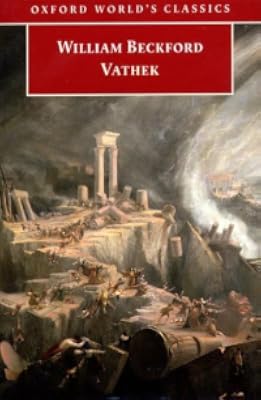
Vathek
by William Beckford
On This Page
Description
Vathek is one of the earliest and most influential Gothic novels. Its hero is the Caliph Vathek who renounces Islam in a hedonistic quest for supernatural powers, which leads to his downfall. Beckford's genius was in marrying Orientalism with the Gothic, both sources of fascination and delight to reading audiences of the time..
Tags
Recommendations




















Member Recommendations

Cecrow Missing content published in 1912.
Member Reviews
Completely preposterous and not in a good way. I can see why this orgy of Oriental tropes would have been exciting to an 18th century European reader high on the Arabian Nights and hungry for more genies, giaours, dives, and dwarfs. It's a nauseating banquet of sherbets and cordials, served by massed ranks of eunuchs, mystics, and sacrificial first-borns, a horrible literary carbuncle melting down into a bilious slurry where plot decoheres and characters implode under the weight of their own absurdity.
Here's Vathek's mom preparing a magic potion:
By secret stairs, known only to herself and her son, she first repaired to the mysterious recesses in which were deposited the mummies that had been brought from the catacombs of the ancient show more Pharaohs. Of these she ordered several to be taken. From thence she resorted to a gallery, where, under the guard of fifty female negroes, mute, and blind of the right eye, were preserved the oil of the most venomous serpents, rhinoceros’ horns, and woods of a subtle and penetrating odour, procured from the interior of the Indies, together with a thousand other horrible rarieties. This collection had been formed for a purpose like the present, by Carathis herself, from a presentiment that she might one day enjoy some intercourse with the infernal powers, to whom she had ever been passionately attached, and to whose taste she was no stranger. show less
Here's Vathek's mom preparing a magic potion:
By secret stairs, known only to herself and her son, she first repaired to the mysterious recesses in which were deposited the mummies that had been brought from the catacombs of the ancient show more Pharaohs. Of these she ordered several to be taken. From thence she resorted to a gallery, where, under the guard of fifty female negroes, mute, and blind of the right eye, were preserved the oil of the most venomous serpents, rhinoceros’ horns, and woods of a subtle and penetrating odour, procured from the interior of the Indies, together with a thousand other horrible rarieties. This collection had been formed for a purpose like the present, by Carathis herself, from a presentiment that she might one day enjoy some intercourse with the infernal powers, to whom she had ever been passionately attached, and to whose taste she was no stranger. show less
What the hell did I just read.
This novel feels like it was written by a cocaine addict having a manic episode after skimming a badly-translated pirated copy of the Arabian Nights. Needless to say nothing in here has anything to do with Arabia or the middle east in the slightest, either.
I feel like HP Lovecraft, Clark Ashton Smith, Edgar Allan Poe, Lin Carter, and everyone else who sung gushing praise of this thing, were all collectively trolling me from the grave.
This novel feels like it was written by a cocaine addict having a manic episode after skimming a badly-translated pirated copy of the Arabian Nights. Needless to say nothing in here has anything to do with Arabia or the middle east in the slightest, either.
I feel like HP Lovecraft, Clark Ashton Smith, Edgar Allan Poe, Lin Carter, and everyone else who sung gushing praise of this thing, were all collectively trolling me from the grave.
Surely few stranger works of fiction exist in the annals of Romantic literature than William Beckford’s dreamy, opulent, and hypnotically weird Vathek, where an undeniable and outrageous breed of almost slapstick comedy mingles like wine in water with scenes of utter blasphemy and perversion as the eponymous Caliph Vathek, tempted by the sprawling subterranean riches of Iblis (the Islamic demon par excellence), wanders a one-way path to absolute damnation in one of the more meandering and scandalous journeys of self-destruction ever penned. Supreme destination: a climax of hearts exploding into smokeless fire.
Along the way, a parade of droll, chimerical tableaux pepper the narrative with delightful diversions: pious dwarves bearing show more baskets of fruit and chirping incessantly, to the great annoyance of our Caliph, Qur’anic verses; saucy women tricking eunuchs into flinging about on swings in a perfumed harem; great feasts, examined in exacting detail, of everything from roasted wolves and boiled thistles to pistachio-stuffed lamb and drugged sherbets; an entire city kicking about a goblin who has curled into a ball and taken to rolling about through the streets of Samarra and eventually over a cliff; a woman burning bits and pieces of mummies, rhinoceros horns, and human beings atop a dizzyingly high tower to placate the forces of evil; divining fish; one-eyed deaf mutes getting lusty with ghouls who have risen drowsily from the grave to feast on fresh corpses. This is certainly not Aladdin.
Vathek is charming and potently hallucinatory stuff meant to be taken in one giant dose, like a short story. Take a couple of hours and give it your undivided attention; Vathek rewards with that glorious sensation of ‘I need to read this out loud to somebody.’ This is certainly not high literature, but it’s not just trash (not even just ‘good trash’) either. Vathek is a sort of world unto its own: equal parts Arabian Nights and Castle of Otranto, and also something unclassifiable and gorgeous and grotesque. The prose, while unashamedly purple, suits its narrative and has an irony about it that never fails to endear. There’s something almost Gogolian in its bizarre sense of humor, and the terror here is both Gothic and admirably understated. A jumble of contradictions, Vathek is as fickle as its author—and just as fascinating: William Beckford, ostracized from high society for his homosexual affair with young ‘Kitty’ Courtenay, was one of the wealthiest and most eccentric men of his generation, and Vathek is, in many ways, the ultimate expression of his own self-indulgent fantasies, here taken to their most far-flung extremes of escapism and ‘oriental’ magnificence. And like so many other curiosities in literature, from A Season in Hell to Melmoth the Wanderer, Vathek is all the more entrancing when this unique and sometimes uncomfortably personal relationship with its author is taken into account.
Vathek's influence on the Gothic movement as a whole is evident from the first paragraph, where we are introduced to our naughty Caliph’s ability to strike men dead with a single ‘terrible’ gaze; and this absurd, and yet ultimately captivating, sense of wonder pervades the entire novel like the cloying, and yet rapturous, odor of heady rosewater. A treat for reflective minds and those interested in literary theatrics both, I count myself an ardent admirer. show less
Along the way, a parade of droll, chimerical tableaux pepper the narrative with delightful diversions: pious dwarves bearing show more baskets of fruit and chirping incessantly, to the great annoyance of our Caliph, Qur’anic verses; saucy women tricking eunuchs into flinging about on swings in a perfumed harem; great feasts, examined in exacting detail, of everything from roasted wolves and boiled thistles to pistachio-stuffed lamb and drugged sherbets; an entire city kicking about a goblin who has curled into a ball and taken to rolling about through the streets of Samarra and eventually over a cliff; a woman burning bits and pieces of mummies, rhinoceros horns, and human beings atop a dizzyingly high tower to placate the forces of evil; divining fish; one-eyed deaf mutes getting lusty with ghouls who have risen drowsily from the grave to feast on fresh corpses. This is certainly not Aladdin.
Vathek is charming and potently hallucinatory stuff meant to be taken in one giant dose, like a short story. Take a couple of hours and give it your undivided attention; Vathek rewards with that glorious sensation of ‘I need to read this out loud to somebody.’ This is certainly not high literature, but it’s not just trash (not even just ‘good trash’) either. Vathek is a sort of world unto its own: equal parts Arabian Nights and Castle of Otranto, and also something unclassifiable and gorgeous and grotesque. The prose, while unashamedly purple, suits its narrative and has an irony about it that never fails to endear. There’s something almost Gogolian in its bizarre sense of humor, and the terror here is both Gothic and admirably understated. A jumble of contradictions, Vathek is as fickle as its author—and just as fascinating: William Beckford, ostracized from high society for his homosexual affair with young ‘Kitty’ Courtenay, was one of the wealthiest and most eccentric men of his generation, and Vathek is, in many ways, the ultimate expression of his own self-indulgent fantasies, here taken to their most far-flung extremes of escapism and ‘oriental’ magnificence. And like so many other curiosities in literature, from A Season in Hell to Melmoth the Wanderer, Vathek is all the more entrancing when this unique and sometimes uncomfortably personal relationship with its author is taken into account.
Vathek's influence on the Gothic movement as a whole is evident from the first paragraph, where we are introduced to our naughty Caliph’s ability to strike men dead with a single ‘terrible’ gaze; and this absurd, and yet ultimately captivating, sense of wonder pervades the entire novel like the cloying, and yet rapturous, odor of heady rosewater. A treat for reflective minds and those interested in literary theatrics both, I count myself an ardent admirer. show less
Vathek does a credible job of capturing the Arabian Nights tone and lush descriptive passages, based on my faint recollection. Anything mixing this and the Gothic is liable to turn incredible in places - and it does - testing a reader's patience if it's taken too seriously. But the story is still very determined to take itself seriously, notwithstanding. It barely touches upon comedy, and the drama can take some very dark turns as Vathek seeks out power above and beyond what he already enjoys as caliph. Given that he already has it all, and yet he's still tempted by infernal means of acquiring more, it's practically impossible to find any sympathy for him. His intermittent episodes of remorse are so impromptu and brief, and his chances show more to recant so many, he can't even be viewed as a victim of irresistible circumstance (or of his mother).
Beckford was writing at the height (circa 1790 to 1800) of the gothic period, while Anne Radcliffe was enjoying her throne as England's pre-eminent author before modern fiction began to take over. Even so, Vathek arguably does not fit completely into the gothic genre. It's more clearly bent towards adopting Asian storytelling traditions, which it is said to do remarkably well. This makes it an oddity among English literature and it continues to stand out today accordingly. Whether it's actually still enjoyable to read without knowing this context is another question given its preposterous plotting, unlikely events and too-plain moral. I had to drag myself through it, but I'd still take this over Radcliffe any day. show less
Beckford was writing at the height (circa 1790 to 1800) of the gothic period, while Anne Radcliffe was enjoying her throne as England's pre-eminent author before modern fiction began to take over. Even so, Vathek arguably does not fit completely into the gothic genre. It's more clearly bent towards adopting Asian storytelling traditions, which it is said to do remarkably well. This makes it an oddity among English literature and it continues to stand out today accordingly. Whether it's actually still enjoyable to read without knowing this context is another question given its preposterous plotting, unlikely events and too-plain moral. I had to drag myself through it, but I'd still take this over Radcliffe any day. show less
The 1970 (revised 1983) Oxford World Classics Editions of Beckford's 'Vathek' of 1782 is almost exhaustingly as well as exhaustively scholarly with not only the final 1816 text as the basis of the book but a full range of notes from the original.
The work is quite slight in many ways but it has to be granted its originality as a quasi-Gothic piece of orientalism and as a major influence on subsequent fantastic literature.
Beckford himself had the potential to be great but he was not only born far too rich (the equivalent of a billionaire from the cradle) but tormented, an ephebophiliac, possibly paedophiliac, pursued by scandal.
But, though the man is interesting, his life and work would only be interesting to specialists in late show more eighteenth century letters if it was not for this book which bears its frequent reprinting and sits in every history of the Gothic alongside Walpole's 'Castle of Otranto'.
Written originally in French (first published in English and French in 1786), the book might as equally be considered part of the French literary tradition. It expresses the sensibility of a European culture, both cynical and fascinated by strangeness, that would collapse into nationalism quite soon.
So, rather than be seen as the harbinger of a new literature, 'Vathek' might equally be seen as one of the last gasps of an international European aristocratic culture. This is the world of 'liaisons dangereuses', Casanova and (on the cusp of the new) Byron.
In fact, the central part of the story is quite dull - a conventional 'Persian' love story presented, however, precisely with that aristocratic cynicism that we know so well to be the stance of French literature in the years leading up to the Revolution.
What makes the book worth reading is the beginning and the end, both of which show an ability to write about voluptuousness and the nature of hell in terms that strike an imaginative and fantastic chord even today.
The whole is held together with a surprisingly detailed if often false knowledge of Arab and Persian culture, that gives a strange fantastic verisimilitude to the adventures. It represents the high point of eightenth century orientalism.
We should recognise that Beckford owed a great deal to his sources and, it would seem, to a collaborator, Samuel Henley, who 'translated' the first edition for Beckford from the French to the English - hence the necessity of a scholarly comitment to entangling the book's story.
But the modern reader need not worry about all this. The account of the lust for power and wealth (with an evident sexual undercurrent throughout) of a man prepared to murder fifty children to achieve his ends is of the essence of the fantastic expressed as horror.
The monstrous witch-mother Carathis introduces us to a world of black magic and ghouls and graveyards and the characterisation of not only this character but of others is not at all bad. Beckford could write well.
There might be much to write about the psychology of the piece which wears Beckford's neuroses on its sleeve if we were to care to look. His view of women is unforgiving and the men are all weak creatures of their passions or long serving servants doing their best under conditions of evil.
But all this is as nothing to the account of his final appearance in the Halls of Eblis (a sort of Islamic Hell) which is written with such verve and imagination that it still seems new and fresh today. What actually happens is for you to discover. show less
The work is quite slight in many ways but it has to be granted its originality as a quasi-Gothic piece of orientalism and as a major influence on subsequent fantastic literature.
Beckford himself had the potential to be great but he was not only born far too rich (the equivalent of a billionaire from the cradle) but tormented, an ephebophiliac, possibly paedophiliac, pursued by scandal.
But, though the man is interesting, his life and work would only be interesting to specialists in late show more eighteenth century letters if it was not for this book which bears its frequent reprinting and sits in every history of the Gothic alongside Walpole's 'Castle of Otranto'.
Written originally in French (first published in English and French in 1786), the book might as equally be considered part of the French literary tradition. It expresses the sensibility of a European culture, both cynical and fascinated by strangeness, that would collapse into nationalism quite soon.
So, rather than be seen as the harbinger of a new literature, 'Vathek' might equally be seen as one of the last gasps of an international European aristocratic culture. This is the world of 'liaisons dangereuses', Casanova and (on the cusp of the new) Byron.
In fact, the central part of the story is quite dull - a conventional 'Persian' love story presented, however, precisely with that aristocratic cynicism that we know so well to be the stance of French literature in the years leading up to the Revolution.
What makes the book worth reading is the beginning and the end, both of which show an ability to write about voluptuousness and the nature of hell in terms that strike an imaginative and fantastic chord even today.
The whole is held together with a surprisingly detailed if often false knowledge of Arab and Persian culture, that gives a strange fantastic verisimilitude to the adventures. It represents the high point of eightenth century orientalism.
We should recognise that Beckford owed a great deal to his sources and, it would seem, to a collaborator, Samuel Henley, who 'translated' the first edition for Beckford from the French to the English - hence the necessity of a scholarly comitment to entangling the book's story.
But the modern reader need not worry about all this. The account of the lust for power and wealth (with an evident sexual undercurrent throughout) of a man prepared to murder fifty children to achieve his ends is of the essence of the fantastic expressed as horror.
The monstrous witch-mother Carathis introduces us to a world of black magic and ghouls and graveyards and the characterisation of not only this character but of others is not at all bad. Beckford could write well.
There might be much to write about the psychology of the piece which wears Beckford's neuroses on its sleeve if we were to care to look. His view of women is unforgiving and the men are all weak creatures of their passions or long serving servants doing their best under conditions of evil.
But all this is as nothing to the account of his final appearance in the Halls of Eblis (a sort of Islamic Hell) which is written with such verve and imagination that it still seems new and fresh today. What actually happens is for you to discover. show less
Fun, if slight, over the top gothic pastiche of Doctor Faustus as filtered through every orientalist cliche you can imagine. Of course it's blazingly racist, but then again, so's Lovecraft and that's not the only connection between the two - ol' HP must have worn out the last few pages of his copy. Plus it's interesting to read a Western novel that complains that muslim rulers aren't religious enough...
Curiously impulsive. Vathek and his unending hunger for more propel forward through one massive atrocity after the other - hardly pausing for even a moment's reflection. Vathek often feels less like a character and more like a force. A story of a man told as one of a God... Until the final hell.
Members
- Recently Added By
Lists

The Guardian's 1000 Novels Everyone Must Read
1,005 works; 548 members

1001 Books You Must Read Before You Die
1,448 works; 1,135 members
501 Must-Read Books
529 works; 72 members

1898 C.K. Shorter List of Best 100 Novels
100 works; 34 members

Top Five Books of 2013
1,562 works; 715 members

100 Books to Read in a Lifetime (That Are Older Than 200 Years)
415 works; 176 members

Weird and Weirder Fiction
270 works; 35 members

Survey of Fantasy Classics
111 works; 23 members

Cawthorn and Moorcock's Fantasy: The 100 Best Books
110 works; 7 members

Gothicissisme I : Classics
24 works; 3 members
Lovecraft's 'Supernatural Horror in Literature' Reading List
216 works; 8 members

Mentioned by H.P. Lovecraft
11 works; 1 member

1,001 BYMRBYD Concensus
723 works; 27 members

Books Read in 2015
3,299 works; 129 members

Las mejores obras literarias leídas en 2022 -- Magistrales (R. D.)
30 works; 1 member

Evan's Wish List
86 works; 2 members

Works Cited in Kevin Wetmore's Eaters of the Dead
61 works; 1 member
F. B. Perkins' List of 100 Best Fiction
100 works; 5 members
Jones & Newman: Best Horror Books Further Recommended Reading
577 works; 4 members
150 Best Novels Selected by Brander Matthews (1883)
150 works; 7 members

Translingualism
191 works; 4 members

My TBR
371 works; 3 members

el
1,139 works; 1 member
Talk Discussions
Past Discussions
Vathek. in Gothic Literature (December 2024)
Folio Archives 333: Vathek by William Beckford 1958 in Folio Society Devotees (July 2023)
Author Information

Some Editions
Awards and Honors
Awards
Notable Lists
Series
Belongs to Publisher Series
Work Relationships
Is contained in
Three Gothic Novels: The Castle of Otranto; Vathek; The Vampyre; and a Fragment of a Novel by Horace Walpole
Inspired
Common Knowledge
- Canonical title*
- Vathek
- Original title
- Vathek
- Alternate titles
- Vathek, an Arabian Tale; The History of the Caliph Vathek
- Original publication date
- 1786
- People/Characters
- Caliph Vathek; Giaour; Carathis; Morakanabad; Fakreddin; Gulchenrouz (show all 8); Alboufaki; Dilara
- Important places
- Persia
- First words
- The long and extravagant career of the author of Vathek would surely have impressed Samuel Johnson as a notable and sustained illustration of what his Imlac had called (in his own very different 'oriental' tale) 'that ... (show all)hunger of imagination which preys incessantly upon life'. (Introduction)
Vathek, ninth Caliph of the race of the Abassides, was the son of Motassem, and the grandson of Haroun al Raschid. - Last words
- (Click to show. Warning: May contain spoilers.)Thus the Caliph Vathek, who, for the sake of empty pomp and forbidden power, had sullied himself with a thousand crimes, became a prey to grief without end, and remorse without imagination: whilst the humble, the despised Gulchenrouz passed whole ages in undisturbed tranquility, and in the pure happiness of childhood.
- Original language
- English
- Canonical DDC/MDS
- 848.99423
- Disambiguation notice
- Contains only Vathek. Please do not combine with editions containing The Episodes of Vathek or other works.
*Some information comes from Common Knowledge in other languages. Click "Edit" for more information.
Classifications
- Genres
- Fiction and Literature, General Fiction, Horror, Fantasy
- DDC/MDS
- 848.99423 — Literature & rhetoric French Literature French miscellaneous writings 1900- French-language literature outside of France (Francophone) Europe & Eastern Europe England and Wales Fiction
- LCC
- PQ1957 .B29 .V313 — Language and Literature French, Italian, Spanish and Portuguese literatures French literature Modern literature 18th century
- BISAC
Statistics
- Members
- 1,498
- Popularity
- 15,540
- Reviews
- 48
- Rating
- (3.12)
- Languages
- 15 — Catalan, Czech, English, Estonian, French, German, Greek, Hungarian, Italian, Polish, Portuguese, Russian, Spanish, Swedish, Turkish
- Media
- Paper, Audiobook, Ebook
- ISBNs
- 130
- UPCs
- 1
- ASINs
- 52