
Thornton Wilder (1897–1975)
Author of Our Town
About the Author
One of the most honored and versatile of modern writers, Thornton Wilder combined a career as a successful novelist with work for the theater that made him one of this century's outstanding dramatists. It was an early short novel, however, that first brought him fame. The Bridge of San Luis Rey show more (1927), a bestseller that won the Pulitzer Prize in 1927, is the story of a group of assorted people who happen to be on a bridge in Peru when it collapses. Ingeniously constructed and rich in its philosophical implications about fate and synchronicity, Wilder's book would seem to be the first well-known example of a formula that has become a cliche in popular literature. His attraction to classical themes is manifested in The Woman of Andros (1930), a tragedy about young love in pre-Christian Greece, and The Ides of March (1948), set in the time of Julius Caesar and told in letters and documents covering a long span of years. Heaven's My Destination (1934), is a seriocomic and picaresque story about a young book salesman traveling through the Midwest during the early years of the Great Depression.Theophilus North (1973), Wilder's last novel, disappointed many reviewers, but it provided its author with opportunities to offer some wry observations on the life of the idle rich in Newport during the summer of 1926 and to ponder in the story of his alter ego what might have happened if Wilder had stayed home, so to speak, instead of becoming Thornton Wilder. As a serious writer of fiction, Wilder's main claim rests on The Eighth Day (1967), an intellectual thriller, which the N.Y. Times called "the most substantial fiction of his career." It won the National Book Award for fiction in 1968. (Bowker Author Biography) show less
Series
Works by Thornton Wilder
Thornton Wilder: Collected Plays and Writings on Theater (Library of America) (2007) 198 copies, 2 reviews
The Letters of Gertrude Stein and Thornton Wilder (Henry McBride Series in Modernism and Mo) (1996) 43 copies
Drammi brevi 3 copies
Love, and How to Cure It 2 copies
Thornton Wilder's Our Town (featuring translated passages by Nilo Cruz and Jeff Augustin) (2022) 2 copies
Plays 2 copies
Obras escogidas 2 copies
Oom Pio en Camila Perichole 1 copy
Our Town (HHH Production) — Author — 1 copy
Wilder, Wilder, Wilder 1 copy
Il Ponte si San Luis Rey. 1 copy
Kahdeksas päivä 1 copy
Insurgent 1 copy
Fanny Otcott 1 copy
Autumn Thunder 1 copy
Thornton Wilder Stories — Author — 1 copy
Stories and Essays 1 copy
The Warship [short story] — Author — 1 copy
Nascuntur Poetæ 1 copy
Proserpina and the Devil 1 copy
Brother Fire 1 copy
The Penny That Beauty Spent 1 copy
The Message and Jehanne 1 copy
Centaurs 1 copy
Leviathan 1 copy
Mozart and the Gray Steward 1 copy
The Flight into Egypt 1 copy
Thirteen Plays 1 copy
Shadow of a Doubt 1 copy
Associated Works
This is My Best: American Greatest Living Authors Present and Give Their Reasons Why (1942) — Contributor — 214 copies
An American Album: One Hundred and Fifty Years of Harper's Magazine (2000) — Contributor — 145 copies, 1 review
Playwrights on Playwriting: From Ibsen to Ionesco (1960) — Contributor, some editions — 126 copies, 3 reviews
Alfred Hitchcock: The Masterpiece Collection [14 films 1942-1976] (1942) — Writer — 117 copies, 2 reviews
Gentlemen, Scholars and Scoundrels: A Treasury of the Best of Harper's Magazine from 1850 to the Present (1972) — Contributor — 62 copies
Twenty One-Act Plays: An Anthology for Amateur Performing Groups (1978) — Contributor — 41 copies, 1 review
Out of the Best Books: An Anthology of Literature, Vol. 3: Intelligent Family Living (1967) — Contributor — 34 copies
Amerikanische Kurzgeschichten (American Short Stories) (English and German Edition) (1956) — Contributor — 10 copies
Best-in-Books: Treasure of Pleasant Valley / Best of H.T. Webster / Bridge of San Luis Rey / Think Fast Mr. Moto / Hawaii / H.R.H. / Story of Philip / Answer / Sea Fights and… (1956) — Contributor — 4 copies
Teatro Norteamericano contemporaneo — Contributor — 2 copies
The long Christmas dinner : (Das lange Weihnachtsmahl) : opera in one act ; Libretto by Thornton Wilder (1961) — Author — 2 copies
A Teacher's Guide to Our Town: Common-Core Aligned Teacher Materials and a Sample Chapter (2015) — Contributor — 2 copies
The Bridge of San Luis Rey [1944 film] — Original novel — 1 copy
Tagged
Common Knowledge
- Canonical name
- Wilder, Thornton
- Legal name
- Wilder, Thornton Niven
- Birthdate
- 1897-04-17
- Date of death
- 1975-12-07
- Gender
- male
- Education
- Princeton University (MA|French|1926)
Yale University (BA|1920)
Oberlin College
American Academy in Rome
Berkeley High School
Creekside Middle School (show all 8)
China Inland Mission Chefoo School
The Thacher School - Occupations
- playwright
novelist
professor
translator
librettist
teacher (show all 12)
screenwriter
short story writer
essayist
corporal (U.S. Army Coast Artillery Corps, WWI)
lieutenant colonel (U.S. Army Air Force Intelligence, WWII)
actor - Organizations
- American Academy of Arts and Letters
Modern Language Association of America (honorary member)
Authors Guild
Actors Equity Association
Hispanic Society of America (corresponding member)
Akademie der Wissenschaften und der Literatur (West Germany) (show all 20)
Bavarian Academy of Fine Arts (honorary member)
Century Association
Players (honorary member)
Graduate Club
Elizabethan Club
Alpha Delta Phi
United States Army (WWI ∙ WWII)
Harvard University (Charles Eliot Norton professor)
University of Chicago (professor)
Institut de Cooperation Intellectuélle ( [1937])
United States Department of State
International PEN Club Congress ( [1941])
UNESCO Conference of Arts ( [1952])
Lawrenceville School, Lawrenceville, New Jersey, USA (teacher) - Awards and honors
- Presidential Medal of Freedom (1963)
Pulitzer Prize for Fiction (1927)
Pulitzer Prize for Drama (1938, 1943)
Chevalier, Legion of Honor (1951)
National Book Committee's National Medal for Literature (1965)
Edward MacDowell Medal (1960) (show all 21)
National Book Award for fiction (1968)
Peace Prize of the German Book Trade (1957)
Friedenspreis, Deutschen Buchhandels (1957)
Sonderpreis (1959)
Goethe medal (1959)
Gold Medal for Fiction, American Academy of Arts and Letters (1952)
Brandeis University Creative Arts Award for theater and film (1959-60)
Chicago Literary Hall of Fame (2013)
Medal of the Order of Merit (Peru)
Order of Merit (West Germany)
Century Association Art Medal
Honorary member of Order of the British Empire (M.B.E.)
Legion of Merit
Bronze Star
Alpha Delta Phi - Relationships
- Wilder, Amos Niven (brother)
Wilder, Isabel (sister)
Dakin, Janet Wilder (sister)
Wilder, A. Tappan (nephew)
Wilder, Charlotte (sister) - Short biography
- Thornton Wilder was born on April 17, 1897 in Madison, Wisconsin to Isabella (Niven) Wilder and Amos Parker Wilder. He attended Oberlin College (1915-1917), received an A.B. from Yale University (1920), attended the American Academy in Rome (1920-1921), and received an A.M. from Princeton University (1926). He served in the U.S. Army from 1942-1945, receiving the Legion of Merit and Bronze Star.
Wilder is best known as an author of novels, plays, and screenplays. Among his many published novels and plays, he wrote three Pulitzer Prize winning works: The Bridge of San Luis Rey (1928), Our Town (1938), and The Skin of Our Teeth (1943). He also won the Gold Medal for fiction from the American Academy of Arts and Letters (1952), the Presidential Medal of Freedom (1963), the National Book Committee's National Medal for Literature (1965), and the National Book Award (1968).
Wilder was a lecturer in comparative literature at the University of Chicago (1930-1936), a visiting professor at the University of Hawaii (1935), and Charles Eliot Norton Professor of poetry at Harvard University (1950-1951).
Wilder received honorary degrees from New York University, Yale University, Kenyon College, College of Wooster, Harvard University, Northeastern University, Oberlin College, University of New Hampshire, and University of Zurich.
Thornton Wilder died in 1975 - Nationality
- USA
- Birthplace
- Madison, Wisconsin, USA
- Places of residence
- Chefoo, China
Ojai, California, USA
Berkeley, California, USA
Douglas, Arizona, USA
Madison, Wisconsin, USA
Hamden, Connecticut, USA - Place of death
- Hamden, Connecticut, USA
- Burial location
- Mount Carmel Cemetery, Hamden, Connecticut, USA
- Associated Place (for map)
- USA
Members
Reviews

I thoroughly enjoyed this book, from its memorable opening line to its closing memorable line, and all its vividness in between. It was enjoyable to be not only so skillfully entertained but to be asked, without layers of subterfuge, the deepest philosophical question a person will ever ask at some point in their life. And I love the answer that I felt Wilder lead me to find within.
(Spoilers below.)
It's interesting that the church (who is supposed to lead us to those answers) finds Brother show more Juniper's work heretical. Here it is, the basic theological question, "Do we matter to God?" and the good monk is convinced the answer is Yes. But even after years of probing all the smallest pieces of evidence in the lives of the five, he feels he has never gained a firm understanding of the mind of God. The church judges, corrupt and barely tolerant of the question, certainly couldn't stand an unfinished answer and so condemns him in notorious Spanish Inquisition fashion. Consumed by his fiery fate, the monk never doubts God, only himself. He is the epitome of faith, believing while having no answers.
It is an interesting contrast, too, that while the pious monk's work is burned (and the other copy forgotten on a dusty shelf) the Marquesa's letters go on to great fame. The words of the drunk, the awkward, the laughable, the sincere-but-misguided Marquesa lives and inspires for centuries, an example of the fickle unpredictability of what matters and what doesn't in mere human annals.
Ultimately it's the nun, Madre Maria, who is affected in the most profound way by the collapse of the bridge and it's her thoughts on life's divine meaning that ends the novel so beautifully. She comes to believe that no, her life's work doesn't matter and that not even being remembered fondly by loved ones matters because those that remember will die soon, too. She concludes it is the love itself that matters to God. It is our love -- love by human beings destined to be unremembered and often unrewarded -- that matters by returning to "the love that made them." It's not God's love for us, or our love for God, but our love for one another is the real divine exchange, that which has its source from and that which returns to God. It is the only meaning, the only bridge between man and God. show less
(Spoilers below.)
It's interesting that the church (who is supposed to lead us to those answers) finds Brother show more Juniper's work heretical. Here it is, the basic theological question, "Do we matter to God?" and the good monk is convinced the answer is Yes. But even after years of probing all the smallest pieces of evidence in the lives of the five, he feels he has never gained a firm understanding of the mind of God. The church judges, corrupt and barely tolerant of the question, certainly couldn't stand an unfinished answer and so condemns him in notorious Spanish Inquisition fashion. Consumed by his fiery fate, the monk never doubts God, only himself. He is the epitome of faith, believing while having no answers.
It is an interesting contrast, too, that while the pious monk's work is burned (and the other copy forgotten on a dusty shelf) the Marquesa's letters go on to great fame. The words of the drunk, the awkward, the laughable, the sincere-but-misguided Marquesa lives and inspires for centuries, an example of the fickle unpredictability of what matters and what doesn't in mere human annals.
Ultimately it's the nun, Madre Maria, who is affected in the most profound way by the collapse of the bridge and it's her thoughts on life's divine meaning that ends the novel so beautifully. She comes to believe that no, her life's work doesn't matter and that not even being remembered fondly by loved ones matters because those that remember will die soon, too. She concludes it is the love itself that matters to God. It is our love -- love by human beings destined to be unremembered and often unrewarded -- that matters by returning to "the love that made them." It's not God's love for us, or our love for God, but our love for one another is the real divine exchange, that which has its source from and that which returns to God. It is the only meaning, the only bridge between man and God. show less
George: “Ma, I don’t want to grow old. Why’s everybody pushing me so?”
Emily: “Why can’t I stay for a while just as I am? Let’s go away…”
The groom and the bride lament to their respective parents on their wedding day – that universal desire at some points in a person’s life – to stay young, if only time would stand still just for a moment.
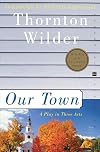
“Our Town” is an engaging and unpretentious play both in story and in style. The plot is life – from the daily lives, to love show more and marriage, and finally to death covering 13 years, ending in 1913. (Notice anything?) While the pace of life is slower than ours, the town folks, complete with a town drunk, is a comprehensible Norman Rockwell kind of mix. The stage setting is equally guileless, with sparse furniture, and a narrator as the stage manager speaking to the audience. Reading the words, I recreated the entire play on stage in my mind.
The most intriguing and I assume to be groundbreaking at the time of its first production in 1938 is its messages of death. It’s one thing to be coming out of WWI, having survived the Great Depression, and at the cusp of entering WWII, but it’s quite another to have the normalcy of death presented on stage. The affinity that the audience develops towards the cast members is instead affronted with an assault of reality that one comes to the theater to escape. I love this quote from Thornton where he challenged the norm of theatre then:
“In his 1957 introduction ‘Three Plays’, Wilder wrote of the loss of theatergoing pleasure he began to experience in the decade before writing ‘Our Town’, when he ‘cease to believe in the stories [he] saw presented there… The theatre was not only inadequate, it was evasive… I found the word for it: it aimed to be soothing. The tragic had no heat; the comic had no bite; the social criticism failed to indict us with responsibility.’”
“Our Town” is not meant to be soothing. While the ladies of the 1938 “emerged red-eyed, swollen faced, and mascara-stained”, I, slightly hardened, felt the emotions slowly seep through my body as I processed Thornton’s words. The dead repeatedly emphasized the living does not SEE their lives, blindly living their lives, not in a meaningful way, never comprehending. The living does not understand. It’s as though life is wasted on the living!
In today’s time, I sit in sold out theaters of family friendly shows that leave me drenched in artificial sweetener. Or I sit in partially filled theaters of heavy-subject shows where I exit feeling as though I was smacked upside the head, and I still want to discuss it endlessly. I choose the latter. I choose “Our Town”, or perhaps “Our Lives”.
Some Quotes:
On Life or On Death? – you decide:
“You’ve got to love life to have life, and you’ve got to have life to love life… It’s what they call a vicious circle.”
And
“Oh, earth, you’re too wonderful for anybody to realize you.”
And
“Yes, now you know. Now you know! That’s what it was to be alive. To move about in a cloud of ignorance; to go up and down trampling on the feelings of those… of those about you. To spend and waste time as though you had a million years. To be always at the mercy of one self-centered passion, or another. Now you know – that’s the happy existence you wanted to go back to. Ignorance and blindness.” show less
Emily: “Why can’t I stay for a while just as I am? Let’s go away…”
The groom and the bride lament to their respective parents on their wedding day – that universal desire at some points in a person’s life – to stay young, if only time would stand still just for a moment.
“Our Town” is an engaging and unpretentious play both in story and in style. The plot is life – from the daily lives, to love show more and marriage, and finally to death covering 13 years, ending in 1913. (Notice anything?) While the pace of life is slower than ours, the town folks, complete with a town drunk, is a comprehensible Norman Rockwell kind of mix. The stage setting is equally guileless, with sparse furniture, and a narrator as the stage manager speaking to the audience. Reading the words, I recreated the entire play on stage in my mind.
The most intriguing and I assume to be groundbreaking at the time of its first production in 1938 is its messages of death. It’s one thing to be coming out of WWI, having survived the Great Depression, and at the cusp of entering WWII, but it’s quite another to have the normalcy of death presented on stage. The affinity that the audience develops towards the cast members is instead affronted with an assault of reality that one comes to the theater to escape. I love this quote from Thornton where he challenged the norm of theatre then:
“In his 1957 introduction ‘Three Plays’, Wilder wrote of the loss of theatergoing pleasure he began to experience in the decade before writing ‘Our Town’, when he ‘cease to believe in the stories [he] saw presented there… The theatre was not only inadequate, it was evasive… I found the word for it: it aimed to be soothing. The tragic had no heat; the comic had no bite; the social criticism failed to indict us with responsibility.’”
“Our Town” is not meant to be soothing. While the ladies of the 1938 “emerged red-eyed, swollen faced, and mascara-stained”, I, slightly hardened, felt the emotions slowly seep through my body as I processed Thornton’s words. The dead repeatedly emphasized the living does not SEE their lives, blindly living their lives, not in a meaningful way, never comprehending. The living does not understand. It’s as though life is wasted on the living!
In today’s time, I sit in sold out theaters of family friendly shows that leave me drenched in artificial sweetener. Or I sit in partially filled theaters of heavy-subject shows where I exit feeling as though I was smacked upside the head, and I still want to discuss it endlessly. I choose the latter. I choose “Our Town”, or perhaps “Our Lives”.
Some Quotes:
On Life or On Death? – you decide:
“You’ve got to love life to have life, and you’ve got to have life to love life… It’s what they call a vicious circle.”
And
“Oh, earth, you’re too wonderful for anybody to realize you.”
And
“Yes, now you know. Now you know! That’s what it was to be alive. To move about in a cloud of ignorance; to go up and down trampling on the feelings of those… of those about you. To spend and waste time as though you had a million years. To be always at the mercy of one self-centered passion, or another. Now you know – that’s the happy existence you wanted to go back to. Ignorance and blindness.” show less

A classic playwright? Or a postmodern playwright before postmodernism was the buzz? Wilder has a touch for the absurd, creating characters who are charming while being surly, ridiculous but recognizable, and so outlandish you just know they have to be for real. The settings are a mixture of the realist period that shaped his youth, with set descriptions that would do Arthur Miller proud, but they aren't actually realistic - there's always something a bit off about them. Ladders for second show more floors, walls that suddenly jump for no reason, just little touches of craziness and absurdism that help take the edge off plays that could be gritty and realistic if he hadn't made them so outlandish. A true masterpiece of theatre. show less

Thornton Wilder successfully fictionalized some ages-old core existential questions that have haunted humanity since its inception in his short novel, The Bridge of San Luis Rey. Why do bad things happen to good people indiscriminately, while bad people prosper? Is there a plan or purpose behind the bad happenings? A reason? Are seemingly senseless accidents such as the one depicted in the novel -- the collapse of a bridge, a "ladder of thin slats swung out over a gorge, with handrails of show more dried vine" -- or other bad happenings such as natural disasters, poverty or war, "acts of God" or acts of fate? Or neither or something else? Are they meaningful or meaningless? If those who fell to their deaths in Wilder's novel died because God willed them to die, as Brother Juniper's order believes, is it then a capital offense to seek proof to that effect through non-Catholic means? Complicated, convoluted questions, even for skeptics, raised by this slim, but intense, and beautifully written novel, The Bridge of San Luis Rey.
Wilder, of course, doesn't explicitly answer these universal questions, though by novel's end, our narrator, Brother Juniper, eyewitness to the collapse: "He saw the bridge divide and fling five gesticulating ants into the valley below..." certainly, in part, has answered some of them. In some socks-you-in-the-gut, brutal irony, Brother Juniper, after he's dared ask why -- why did these people die?, why did the bridge collapse for them instead of others? -- and then travelled by foot great distances to probe the lives and personal histories of those who fell for possible clues to answer these deeper questions that are only natural for an inquisitive mind's pursuit, ultimately becomes the sixth and final victim of the bridge of San Luis Rey's collapse.
Brother Juniper lacked the foresight in recognizing how dangerous his questions were in a culture whose pious insularity accepted nothing less than rote avowals of faith in God's sovereign will. Moreover, and to the practical point, Brother Juniper was stealing time from his ascetic duties to solitude and prayer in order to play detective. In the least he was egregiously undisciplined; at worst, a heretic. But his fellow monks had it wrong. Brother Juniper wasn't looking to discredit God, but rather sought in his investigations a way to prove God's sovereignty, to affirm his faith in God not just by faith but facts.
Brother Juniper's decision to mix his intellect with his faith, instead of abiding strictly by faith alone; which he denied the second he began his investigation into why those five unfortunate travelers may have perished when, where, and how they perished, was not surprisingly condemned on the spot as insubordination and blatant blasphemy, an unforgivable rejection of faith in God and the most holy and sacred tenets of Catholicism. How dare a middling monk not take God automatically on faith! Who did this insignificant little man, Brother Juniper, think he was, embarrassing the Church like that with his foolish questions? And so for the supposed unpardonable sin of suggesting God's will -- God's very mind -- could be accessed through an investigation, through the woefully finite human insight of what amounted to empiricism, Brother Juniper, a devout Catholic, became essentially a martyr for science.
If there are any answers in this indifferent universe that can even partially explain how Evil and Human Suffering can comfortably coexist alongside a purported All-good and Omnipotent God, an All-wise Deity to be trusted and praised by His adherents even when disasters on a scale more monstrous than the collapse of a flimsy, make-believe bridge in Peru occur ... say the collapse of the Twin Towers, the collapse of the cities of Nagasaki and Hiroshima, or the unending collapse that has been Genocide throughout the ages, continuing still today in Syria ... then it's clear to me that Brother Juniper (one of my favorite catholics real or fictitious ever!) was at least partly successful in his heroic -- and in my opinion faithful -- quest for truth. show less
Wilder, of course, doesn't explicitly answer these universal questions, though by novel's end, our narrator, Brother Juniper, eyewitness to the collapse: "He saw the bridge divide and fling five gesticulating ants into the valley below..." certainly, in part, has answered some of them. In some socks-you-in-the-gut, brutal irony, Brother Juniper, after he's dared ask why -- why did these people die?, why did the bridge collapse for them instead of others? -- and then travelled by foot great distances to probe the lives and personal histories of those who fell for possible clues to answer these deeper questions that are only natural for an inquisitive mind's pursuit, ultimately becomes the sixth and final victim of the bridge of San Luis Rey's collapse.
Brother Juniper lacked the foresight in recognizing how dangerous his questions were in a culture whose pious insularity accepted nothing less than rote avowals of faith in God's sovereign will. Moreover, and to the practical point, Brother Juniper was stealing time from his ascetic duties to solitude and prayer in order to play detective. In the least he was egregiously undisciplined; at worst, a heretic. But his fellow monks had it wrong. Brother Juniper wasn't looking to discredit God, but rather sought in his investigations a way to prove God's sovereignty, to affirm his faith in God not just by faith but facts.
Brother Juniper's decision to mix his intellect with his faith, instead of abiding strictly by faith alone; which he denied the second he began his investigation into why those five unfortunate travelers may have perished when, where, and how they perished, was not surprisingly condemned on the spot as insubordination and blatant blasphemy, an unforgivable rejection of faith in God and the most holy and sacred tenets of Catholicism. How dare a middling monk not take God automatically on faith! Who did this insignificant little man, Brother Juniper, think he was, embarrassing the Church like that with his foolish questions? And so for the supposed unpardonable sin of suggesting God's will -- God's very mind -- could be accessed through an investigation, through the woefully finite human insight of what amounted to empiricism, Brother Juniper, a devout Catholic, became essentially a martyr for science.
If there are any answers in this indifferent universe that can even partially explain how Evil and Human Suffering can comfortably coexist alongside a purported All-good and Omnipotent God, an All-wise Deity to be trusted and praised by His adherents even when disasters on a scale more monstrous than the collapse of a flimsy, make-believe bridge in Peru occur ... say the collapse of the Twin Towers, the collapse of the cities of Nagasaki and Hiroshima, or the unending collapse that has been Genocide throughout the ages, continuing still today in Syria ... then it's clear to me that Brother Juniper (one of my favorite catholics real or fictitious ever!) was at least partly successful in his heroic -- and in my opinion faithful -- quest for truth. show less
Lists
Favourite Books (1)
bound (1)
1940s (1)
Women's Stories (1)
Sonlight Books (1)
Metafiction (1)
Wishlist (1)
1930s (1)
Five star books (2)
Plays I Like (2)
Short and Sweet (1)
AP Lit (1)
2018 ED Reads (1)
Dead narrators (1)
1970s (1)
Tom's Bookstore (1)
1920s (1)
Books with Twins (1)
Schwob Nederland (1)
Awards


You May Also Like


Associated Authors
Statistics
- Works
- 112
- Also by
- 53
- Members
- 18,553
- Popularity
- #1,180
- Rating
- 3.7
- Reviews
- 312
- ISBNs
- 419
- Languages
- 15
- Favorited
- 25

