
Milorad Pavić (1929–2009)
Author of Dictionary of the Khazars: A Lexicon Novel in 100,000 Words {Male Edition}
About the Author
Milorad Pavic was born in Belgrade on October 15, 1929. After receiving a doctorate from the University of Zagreb, he taught philosophy at the University of Novi Sad followed by the University of Belgrade. During his lifetime, he wrote several novels including Dictionary of the Khazars, Landscape show more Painted with Tea, The Inner Side of the Wind, and Last Love in Constantinople. He also wrote short stories, nonfiction and poetry. He died due to complications of a heart attack on November 30, 2009 at the age of 80. (Bowker Author Biography) show less
Series
Works by Milorad Pavić
Dictionary of the Khazars: A Lexicon Novel in 100,000 Words {Male Edition} (1984) — Author — 1,202 copies, 20 reviews
Dictionary of the Khazars: A Lexicon Novel in 100,000 Words {Female Edition} (1989) 1,071 copies, 16 reviews
Dictionary of the Khazars: A Lexicon Novel in 100,000 Words {Male and Female Editions} (1999) 13 copies
Prica Koja Je Ubila Emiliju Knor 2 copies
Atlas vetrova 2 copies
Hazarskij slovar 2 copies
Từ điển Khazar 1 copy
Erotske priče 1 copy
Rus Tazısı 1 copy
Два романа о любви: [романы] 1 copy
Sve priče 1 copy
Krevet za troje 1 copy
Blue Book (English Edition) 1 copy
נוף מצויר בתה 1 copy
Associated Works
Tagged
Common Knowledge
- Canonical name
- Pavić, Milorad
- Birthdate
- 1929-10-15
- Date of death
- 2009-11-30
- Gender
- male
- Education
- University of Zagreb
University of Belgrade - Occupations
- philosopher
novelist
poet
short story writer
literary historian - Organizations
- University of Novi Sad
University of Belgrade - Relationships
- Mihajlovic, Jasmina (wife)
- Cause of death
- heart attack
- Nationality
- Serbia
- Birthplace
- Belgrade, Yugoslavia
- Places of residence
- Belgrade, Serbia
- Place of death
- Belgrade, Serbia
- Burial location
- Novo Groblje, Belgrade, Serbia
- Associated Place (for map)
- Belgrade, Serbia
Members
Discussions
Group Read, March 2015: Dictionary of the Khazars in 1001 Books to read before you die (March 2015)
Reviews

At risk of sounding trite and pretentious, I would say this book is more of an experience than a novel. As with his earlier work, "Dictionary of the Khazars", Pavic uses his unique style to bewitch readers. Pavic is the consummate story-teller. In fact, at times, his "telling" overshadows his story. One can never be sure where Pavic's "story" is going next but one can be sure the ride will be wondrous.
"Landscape" is full of both wisdom and foolishness. It also abounds in complex and, for show more lack of a better word, bizarre characters. If you are insistent on a well-formed plot, consistent characters, and transcendent meaning, this is NOT your book. If you enjoy unremitting surprises, unpredictable twists, and a somewhat disjointed reality, this is your book.
Undoubtedly a unique author with unique talent. show less
"Landscape" is full of both wisdom and foolishness. It also abounds in complex and, for show more lack of a better word, bizarre characters. If you are insistent on a well-formed plot, consistent characters, and transcendent meaning, this is NOT your book. If you enjoy unremitting surprises, unpredictable twists, and a somewhat disjointed reality, this is your book.
Undoubtedly a unique author with unique talent. show less

WARNING:
Just as smoking is bad for your health,
so is the reading of a hundred endings
of the same book.
It is almost like gaining one hundred
deaths instead of one.
This book is described as a delta novel, with the story having a hundred possible endings. The endings were originally published in a separate book, but this English translation has everything in one volume.
An odd book, but odd in a good way, as I did enjoy it, but I was weak and read all the possible endings before choosing the show more one I liked best. My favourite editing error was 'rubble' for 'rabble'. I'm fairly sure that Pushkin's characters were attacked by an angry mob rather than having a building fall on them!
My favourite ending was number 26, which left Chief Inspector Stross with his suspicions about the suspects' degrees of guilt and innocence but no proof.
Erlangen is less guilty than could be concluded from the sentence he received. Distelli is more guilty than he seems, and than can be proven. Lempytzka had to have somebody else behind her as well, but we don't know whom. Klozewitz is the most suspicious of them all, but there is almost no tangible argument against him. show less
Just as smoking is bad for your health,
so is the reading of a hundred endings
of the same book.
It is almost like gaining one hundred
deaths instead of one.
This book is described as a delta novel, with the story having a hundred possible endings. The endings were originally published in a separate book, but this English translation has everything in one volume.
An odd book, but odd in a good way, as I did enjoy it, but I was weak and read all the possible endings before choosing the show more one I liked best. My favourite editing error was 'rubble' for 'rabble'. I'm fairly sure that Pushkin's characters were attacked by an angry mob rather than having a building fall on them!
My favourite ending was number 26, which left Chief Inspector Stross with his suspicions about the suspects' degrees of guilt and innocence but no proof.
Erlangen is less guilty than could be concluded from the sentence he received. Distelli is more guilty than he seems, and than can be proven. Lempytzka had to have somebody else behind her as well, but we don't know whom. Klozewitz is the most suspicious of them all, but there is almost no tangible argument against him. show less

I'm not sure I'm smart enough to read this. Then again I'm not sure anyone is, maybe not even the author. I'll say what others may not: this is language for the sake of language, language as paint, not as narrative. Everything is metaphor and everything is descriptive of something else. Or is it? We may never be sure.
Even after I read the story, or rather: both of them, I had to go back to the cover to find out what I had just read. Supposedly we read a story about to lovers who can get in show more each other's orbit but can never get close without destroying each other. You can read the story from her perspective or from his, depending on which end you start and which way you hold the book.
Maybe this book is an experiment in prose poetry and I would be ok with that. Having said that there are enough sharp logical observations to blow that argument out of the water. Then again, to me it reads best as if reading poetry.
If you like to read a text for its impressions and allusions, then this is the perfect book for you. If you want a narrative with a plot and clearly delineated characters and story, then it isn't. show less
Even after I read the story, or rather: both of them, I had to go back to the cover to find out what I had just read. Supposedly we read a story about to lovers who can get in show more each other's orbit but can never get close without destroying each other. You can read the story from her perspective or from his, depending on which end you start and which way you hold the book.
Maybe this book is an experiment in prose poetry and I would be ok with that. Having said that there are enough sharp logical observations to blow that argument out of the water. Then again, to me it reads best as if reading poetry.
If you like to read a text for its impressions and allusions, then this is the perfect book for you. If you want a narrative with a plot and clearly delineated characters and story, then it isn't. show less
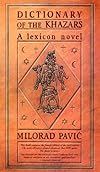
It's fiction that pretends to masquerade as fact, and I don't think I've ever enjoyed fiction more. The density of connections in "Dictionary of the Khazars" is astounding; it commonly references mythological themes and tropes, some of which originate in our "real" myths and some of which seem wholly confined to the book. These allusions are made indistinguishably, and that only helps to break down divisions between fact and fiction (what, after all, is a "real" myth?) and also to break down show more divisions between subjective and objective. show less
Lists
Awards


You May Also Like


Associated Authors
Statistics
- Works
- 71
- Also by
- 3
- Members
- 3,552
- Popularity
- #7,142
- Rating
- 3.8
- Reviews
- 54
- ISBNs
- 253
- Languages
- 28
- Favorited
- 20