
Donald A. Wollheim (1914–1990)
Author of The 1980 Annual World's Best SF
About the Author
Disambiguation Notice:
The Anthology Series World's Best Science Fiction/ Annual World's Best SF/ Wollheim's World's Best SF was republished under various titles with inconsistant numbering. See Series page for more information before separating/combining.
Series
Works by Donald A. Wollheim
The ... Annual world's best SF 6 copies
The Rag Thing [short story] 6 copies
Top Secret 4 copies
Planetringenes gåde 3 copies
The Man From the Future 2 copies
Advancing the electronic age 2 copies
Up There [short story] 2 copies
Bones 2 copies
Il Gradino di Venere 2 copies
The Lysenko Maze [short fiction] 2 copies
The Earth in Peril 2 copies
10 Story Fantasy Magazine (1951) 2 copies
Cosmic Stories 1941 07 2 copies
Extending The Holdings 2 copies
World's Best Science Fiction 2 copies
A Galaxy Trilogy, Vol. 4: Across Time, Mission to a Star, The Rim of Space (Library Edition) (2009) 1 copy, 1 review
Destiny World 1 copy
Castaway 1 copy
The feminine fraction 1 copy
Avon Fantasy Reader No. 1-18 1 copy
Blind Flight 1 copy
Zacherley's Vulture Stew 1 copy
Lotta di giganti 1 copy
She 1 copy
Give Her Hell 1 copy
The Haters 1 copy
Malice Aforethought 1 copy
nueva dimensión - 020 1 copy
Babylon: 70M 1 copy
Saknarth 1 copy
Pogo Planet 1 copy
The Planet of Illusion 1 copy
Terror in the Modern Vein 1 copy
Un mondo per Ajax 1 copy
Secrets of Saturn's Rings 1 copy
Associated Works
Ackermanthology: 65 Astonishing, Rediscovered Sci-Fi Shorts (1997) — Contributor — 97 copies, 1 review
Creatures from Beyond: Nine Stories of Science Fiction and Fantasy (1975) — Contributor — 88 copies, 1 review
England Swings SF: Stories of Speculative Fiction (1968) — Preface, some editions — 87 copies, 3 reviews
Bug-Eyed Monsters: 13 Stories of Dripping, Creeping, Gurgling, Purling, Trilling, Oozing, Seeping, Gushing Deadly Monsters (1980) — Contributor — 78 copies, 2 reviews
Famous Fantastic Mysteries: 30 Great Tales of Fantasy and Horror from the Classic Pulp Magazines Famous Fantastic Mysteries & Fantastic Novels (1991) — Contributor — 67 copies, 1 review
The Secret Visitors / Master of Life and Death (Vintage Ace Double, D-237) (1957) — Editor, some editions — 46 copies, 1 review
The Paradox Men / Dome Around America (Ace Double, No. D-118) (1955) — Editor, some editions — 44 copies, 1 review
The Magazine of Fantasy and Science Fiction November 1952, Vol. 3, No. 7 (1952) — Contributor — 8 copies
Friendly Aliens: Thirteen Stories of the Fantastic Set in Canada by Foreign Authors (1981) — Contributor — 1 copy
Tagged
Common Knowledge
- Canonical name
- Wollheim, Donald A.
- Legal name
- Wollheim, Donald Allen
- Other names
- Pearson, Martin
Grinnell, David
White, W. Malcolm
Gordon, Millard Verne
Wells, Braxton
Woods, Lawrence (show all 9)
Raynor, Darrell G.
Cooke, Arthur
Zweig, Allen - Birthdate
- 1914-10-01
- Date of death
- 1990-11-02
- Gender
- male
- Occupations
- editor
publisher
writer - Organizations
- Futurians
Avon Books
Ace Books
DAW Books
Fantasy Amateur Press Association
New York Science Fiction League (show all 7)
Casa Susanna - Awards and honors
- First Fandom Hall of Fame Award (1975)
World Fantasy Special Award Nominee (professional, 1975)
World Fantasy Special Award Nominee (professional, publishing and editing, 1976)
World Fantasy Special Award Nominee (professional, DAW Books, 1978)
World Fantasy Special Award Nominee (professional, DAW Books, 1980)
World Fantasy Special Award (professional, DAW Books, 1981) (show all 12)
World Fantasy Convention Award (1986)
World SF Convention Guest of Honor (1988)
Hugo Nominee (Professional Editor, Retro-Hugo, [1946], 1996)
SF Hall Of Fame (Posthumous Inductee, 2002)
Hugo Nominee (Professional Editor, Retro-Hugo, [1954], 2004)
Hugo Nominee (Fan Writer, Retro-Hugo, [1939], 2014) - Relationships
- Wollheim, Elizabeth R. (daughter)
Wollheim, Elsie (wife) - Short biography
- Author, Publisher. Born in New York City, New York, he was a member of the "Futurians", a group of science fiction enthusiasts who would go on to be prominent authors and editors in the field. He was one of the leading influences on the development of science fiction in the United States in the 20th century. He founded DAW Books in 1971 (company designed to produce exclusively science fiction publications), and is remembered for works such as "Across Time," "The Martian Missile," "Destination Saturn," "Two Dozen Dragon Eggs" and "The Man From Ariel."
- Cause of death
- heart attack
- Nationality
- USA
- Birthplace
- New York, New York, USA
- Places of residence
- Flushing, Queens, New York, New York, USA
- Place of death
- New York, New York, USA
- Burial location
- Mount Carmel cemetery, Queens, New York, New York, USA
- Disambiguation notice
- The Anthology Series World's Best Science Fiction/ Annual World's Best SF/ Wollheim's World's Best SF was republished under various titles with inconsistant numbering. See Series page for more information before separating/combining.
- Associated Place (for map)
- Queens, New York, New York, USA
Members
Reviews
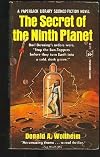
Nostalgia has its limits.
This was very possibly the first science fiction book I ever read, probably around 1970. I found it in my elementary school library, and presumably thought that something about the ninth planet would be interesting. So I read it -- and remembered it enough to identify it half a century later and find a copy. Having read it again, I find myself wondering what made it so interesting.
The book is, of course, highly inaccurate about the solar system; it was written before show more any interplanetary probes had been launched. I can accept that; I have no problems, e.g., with Robert A. Heinlein's "Future History" books, which feature a human-habitable Mars, or James Blish's "Cities in Flight," which give us a tenth planet that isn't there. An author can't be expected to know what no one knows.
But an author can be expected to know what everyone knows. Proper science fiction obeys the laws of physics except where it justifies an exception. The justification may be hand-waving ("hyperspace"), but there is one, and the number of exceptions is kept as small as possible. Here, we have anti-gravity, "sun-tapping" (capturing solar energy at a distance and redirecting it), an energy weapon that produces a visible beam in a vacuum, mind control of aliens at a distance, and an orbital entanglement of Neptune and Pluto that was known to be impossible even in 1959. And life on Neptune. How? Life needs energy. Where does it come from? And how can a pressure suit that works in Venus conditions also work on Pluto? It's too many new laws and gadgets.
And there are logical flaws. Assume that "sun-tapping" is possible -- maybe, since anti-gravity is possible, you can generate special gravity to pull in the energy. Sure, the laws of thermodynamics would make this more costly, energy-wise, than it's worth, but assume it for the sake of the argument. What sort of idiot builds the "sun-tap" stations on planets, two of which have inhabitants and three of which have atmospheres and all of which have geology (earthquakes) which might interfere. Don't build them on planets; build them in a random orbit and keep them safe! The sun-tappers are simply too stupid to have developed their technology.
And what sane person shoots at aliens on sight? Sure, the sun-tappers had been tapping the sun, but for all we know, that's an attempt to communicate: "Here's our base; come visit us." Eventually it appears this is not so (though the sun-tappers still seem too socially primitive for their technology), but the earth people don't even try. Exactly who are the uncivilized brutes here?
The whole thing reads like the worst of 1930s "science fiction" -- gadget fantasy with no science and no sociology. It's pre-John Campbell (who revolutionized science fiction in 1938), and there was a reason why Campbell's coming was such a revolution: he swept away stuff like this.
Admittedly all that might be accepted if the story were good. But 80% of the book is spent traveling between worlds and blowing up alien artifacts, and the worlds are not only inaccurate but poorly realized. It's only in the last few chapters that we get some idea of what is going on, and watch Our Heroes win an improbable victory against enemies who are, yet again, too stupid to make any sense. It's not exciting, merely improbable.
Frankly, I feel ashamed that I liked this book enough to remember it. Yes, I was a pre-teen. Even so. I can only be glad that I didn't remember the bad science!
[Update May 17, 2025 to correct a mis-typed word in first paragraph.] show less
This was very possibly the first science fiction book I ever read, probably around 1970. I found it in my elementary school library, and presumably thought that something about the ninth planet would be interesting. So I read it -- and remembered it enough to identify it half a century later and find a copy. Having read it again, I find myself wondering what made it so interesting.
The book is, of course, highly inaccurate about the solar system; it was written before show more any interplanetary probes had been launched. I can accept that; I have no problems, e.g., with Robert A. Heinlein's "Future History" books, which feature a human-habitable Mars, or James Blish's "Cities in Flight," which give us a tenth planet that isn't there. An author can't be expected to know what no one knows.
But an author can be expected to know what everyone knows. Proper science fiction obeys the laws of physics except where it justifies an exception. The justification may be hand-waving ("hyperspace"), but there is one, and the number of exceptions is kept as small as possible. Here, we have anti-gravity, "sun-tapping" (capturing solar energy at a distance and redirecting it), an energy weapon that produces a visible beam in a vacuum, mind control of aliens at a distance, and an orbital entanglement of Neptune and Pluto that was known to be impossible even in 1959. And life on Neptune. How? Life needs energy. Where does it come from? And how can a pressure suit that works in Venus conditions also work on Pluto? It's too many new laws and gadgets.
And there are logical flaws. Assume that "sun-tapping" is possible -- maybe, since anti-gravity is possible, you can generate special gravity to pull in the energy. Sure, the laws of thermodynamics would make this more costly, energy-wise, than it's worth, but assume it for the sake of the argument. What sort of idiot builds the "sun-tap" stations on planets, two of which have inhabitants and three of which have atmospheres and all of which have geology (earthquakes) which might interfere. Don't build them on planets; build them in a random orbit and keep them safe! The sun-tappers are simply too stupid to have developed their technology.
And what sane person shoots at aliens on sight? Sure, the sun-tappers had been tapping the sun, but for all we know, that's an attempt to communicate: "Here's our base; come visit us." Eventually it appears this is not so (though the sun-tappers still seem too socially primitive for their technology), but the earth people don't even try. Exactly who are the uncivilized brutes here?
The whole thing reads like the worst of 1930s "science fiction" -- gadget fantasy with no science and no sociology. It's pre-John Campbell (who revolutionized science fiction in 1938), and there was a reason why Campbell's coming was such a revolution: he swept away stuff like this.
Admittedly all that might be accepted if the story were good. But 80% of the book is spent traveling between worlds and blowing up alien artifacts, and the worlds are not only inaccurate but poorly realized. It's only in the last few chapters that we get some idea of what is going on, and watch Our Heroes win an improbable victory against enemies who are, yet again, too stupid to make any sense. It's not exciting, merely improbable.
Frankly, I feel ashamed that I liked this book enough to remember it. Yes, I was a pre-teen. Even so. I can only be glad that I didn't remember the bad science!
[Update May 17, 2025 to correct a mis-typed word in first paragraph.] show less

Yes, the science is hopelessly naive (even for 1959) but the fiction is grand---a rip-roaring hybrid of The Hardy Boys, Tom Swift, and Buck Rogers. This is pure pulp heaven featuring a balmy ocean on Venus, angry Martian bugs, and a secret on Pluto so monumental it will change human destiny...FOREVER! So put your brain in neutral, place your cynicism on hold, and just enjoy! LOL!

Here I just want to praise Fritz Leiber's 'Girl with the Hungry Eyes' (1949) as an unusual story of vampirism in which the vampire is able to feed, using advertising, on deep and subliminal male desires at the level of society as a whole.
Well written, it leaves the (male) reader with a sense of discomfort that is in danger of tipping over into misogyny. In a way that perhaps had more impact in the 1940s, it throws light on how male desire also makes the male vulnerable, capable of being show more manipulated by that which is desired.
There is a point where the narrator 'makes a pass' at the girl and is rejected with a firmness which mirrors the normal expectations of most men in most situations in a society in which gender roles were tightly defined. The game was to try it on and expect the 'good girl' to reject the advance.
And this is where it gets dark because the 'good girl' is very much an epitome of evil (a vampire) and when she decides to show her full colours, it is under conditions of a full-on total sexuality that is so absorptive that the male must run away in desperate fear.
This vampire emasculates men and the final contact between vampire and narrator is about that much older masculine fear of being overwhelmed and absorbed by the female when it finally decides to engage with the male - on its terms.
The power of the story is that it captures the fear and anxiety of men under mid-twentieth century social conditions (at least in America) perfectly. Only the narrator knows of this horror as the world becomes entranced by a 'monster' they can never see or touch except in death. show less
Well written, it leaves the (male) reader with a sense of discomfort that is in danger of tipping over into misogyny. In a way that perhaps had more impact in the 1940s, it throws light on how male desire also makes the male vulnerable, capable of being show more manipulated by that which is desired.
There is a point where the narrator 'makes a pass' at the girl and is rejected with a firmness which mirrors the normal expectations of most men in most situations in a society in which gender roles were tightly defined. The game was to try it on and expect the 'good girl' to reject the advance.
And this is where it gets dark because the 'good girl' is very much an epitome of evil (a vampire) and when she decides to show her full colours, it is under conditions of a full-on total sexuality that is so absorptive that the male must run away in desperate fear.
This vampire emasculates men and the final contact between vampire and narrator is about that much older masculine fear of being overwhelmed and absorbed by the female when it finally decides to engage with the male - on its terms.
The power of the story is that it captures the fear and anxiety of men under mid-twentieth century social conditions (at least in America) perfectly. Only the narrator knows of this horror as the world becomes entranced by a 'monster' they can never see or touch except in death. show less

I've read several of these World's Best SF anthologies from the 80s in the last couple of years, and this is definitely the best of them so far. Just a really solid collection, featuring meaty. well-written stories with lots of good world building, all of which have aged remarkably well. Even the weakest stories are interesting, and the best of them are great.
Some brief comments on the individual stories:
"Permafrost" by Roger Zelazny: On a planet where winter lasts for fifty years, a man show more returns to the site of an expedition where things went very wrong for him a very long time ago. An interesting story set on an interestingly alien world, with a nicely creepy ending. But, while Zelazny is a very good prose stylist, it almost feels like he's trying a little too hard in places here.
"Timerider" by Doris Egan: The story of a woman whose job is to travel through time to observe, or to snatch away objects or people. I liked this one a lot, not least because it somehow manages to use a lot of very familiar elements without the story itself ever feeling the least bit tired or clichéd. My one complaint is that, even though it's a good-sized story, it ends before it feels quite finished, and left me thinking that it might work even better as a novel.
"Pretty Boy Crossover" by Pat Cadigan. A sharp, well-written little piece set in a world where hip, young, pretty boys have the chance to be hip, young, and pretty forever, possibly at the expense of their souls. The editor's note refers to it as "cyberpunk" (albeit with some snarky bemusement about what that term even means), and I suppose it is, but, unlike a lot of cyberpunk, it does not feel at all dated, shallowness and exploitation having sadly not yet gone out of style.
"R & R" by Lucius Shepard: A soldier fighting a near-future war in Guatemala takes some leave in a small, squalid town and contemplates desertion in this dark, oddly mystical, very literary-feeling novella about the insanity of war. Seems a bit long to be included in a collection like this, but I'm not complaining, because it's darned good.
"Lo, How an Oak E'er Blooming" by Suzette Haden Elgin: A woman commands an oak tree to burst into miraculous bloom in the middle of winter. It does. Scientists are baffled, and the Establishment is not pleased. It's a decent little satiric metaphor of a story, but some grumpy part of me wants to complain that it's fantasy, not science fiction. Although I think I'd care less about that if the sheer stupidity of the editor's note preceding it, embracing examples of utter bunkum that supposedly "confound conservative scientists," hadn't resulted in me feeling rather hostile when I started it.
"Dream in a Bottle" by Jerry Meredith and D. E. Smirl: A spaceship is run by disembodied brains who live in fantasy worlds, controlling the ship with the actions they take in their dreams. It's a potentially interesting (albeit logically pretty ridiculous) idea, but the execution is only OK. There's more of an old-fashioned SF feel to this one than in the previous stories, I think, with less carefully crafted prose and more exposition. It's also not quite as cleverly twisty as it seems to think it is.
"Into Gold" by Tanith Lee: A marvelously creative variation on a familiar fairy tale, set not long after the fall of Rome. As with the oak tree story, this one is clearly fantasy, rather than science fiction, but by this point I was back to my usual disinclination to quibble about genre definitions. Which is fortunate, because the important thing here is that it's really, really good.
"The Lions Are Asleep This Night" by Harold Waldrop: A glimpse into an alternate history where mammoths still roam an unpopulated North America and European colonialism in Africa never fully took. It's an odd little story, and one I'm not sure has any point beyond, "Hey, look, I made a world where white people didn't screw everybody else over!" Which is probably a worthwhile exercise, but it didn't work for me nearly as well as most of the other stories here, I'm afraid. Although it does have the advantage of featuring a bookish kid as a protagonist, which always holds some appeal for me.
"Against Babylon" by Robert Silverberg. Aliens land in California, accidentally set it on fire, and come between a slightly xenophobic firefighter and his hippie-chick wife. Not Silverberg's best, by any means, but the way it takes a very human angle on what otherwise feels like a B-movie scenario is interesting.
"Strangers on Paradise" by Damon Knight: A writer working on a biography comes to the planet Paradise, where everything is beautiful, there is no disease, and happy immortality is looking like a very real future possibility. Of course, you can't help but spend the entire story tensely waiting for the other shoe to drop... and I found it surprisingly effective when it did. show less
Some brief comments on the individual stories:
"Permafrost" by Roger Zelazny: On a planet where winter lasts for fifty years, a man show more returns to the site of an expedition where things went very wrong for him a very long time ago. An interesting story set on an interestingly alien world, with a nicely creepy ending. But, while Zelazny is a very good prose stylist, it almost feels like he's trying a little too hard in places here.
"Timerider" by Doris Egan: The story of a woman whose job is to travel through time to observe, or to snatch away objects or people. I liked this one a lot, not least because it somehow manages to use a lot of very familiar elements without the story itself ever feeling the least bit tired or clichéd. My one complaint is that, even though it's a good-sized story, it ends before it feels quite finished, and left me thinking that it might work even better as a novel.
"Pretty Boy Crossover" by Pat Cadigan. A sharp, well-written little piece set in a world where hip, young, pretty boys have the chance to be hip, young, and pretty forever, possibly at the expense of their souls. The editor's note refers to it as "cyberpunk" (albeit with some snarky bemusement about what that term even means), and I suppose it is, but, unlike a lot of cyberpunk, it does not feel at all dated, shallowness and exploitation having sadly not yet gone out of style.
"R & R" by Lucius Shepard: A soldier fighting a near-future war in Guatemala takes some leave in a small, squalid town and contemplates desertion in this dark, oddly mystical, very literary-feeling novella about the insanity of war. Seems a bit long to be included in a collection like this, but I'm not complaining, because it's darned good.
"Lo, How an Oak E'er Blooming" by Suzette Haden Elgin: A woman commands an oak tree to burst into miraculous bloom in the middle of winter. It does. Scientists are baffled, and the Establishment is not pleased. It's a decent little satiric metaphor of a story, but some grumpy part of me wants to complain that it's fantasy, not science fiction. Although I think I'd care less about that if the sheer stupidity of the editor's note preceding it, embracing examples of utter bunkum that supposedly "confound conservative scientists," hadn't resulted in me feeling rather hostile when I started it.
"Dream in a Bottle" by Jerry Meredith and D. E. Smirl: A spaceship is run by disembodied brains who live in fantasy worlds, controlling the ship with the actions they take in their dreams. It's a potentially interesting (albeit logically pretty ridiculous) idea, but the execution is only OK. There's more of an old-fashioned SF feel to this one than in the previous stories, I think, with less carefully crafted prose and more exposition. It's also not quite as cleverly twisty as it seems to think it is.
"Into Gold" by Tanith Lee: A marvelously creative variation on a familiar fairy tale, set not long after the fall of Rome. As with the oak tree story, this one is clearly fantasy, rather than science fiction, but by this point I was back to my usual disinclination to quibble about genre definitions. Which is fortunate, because the important thing here is that it's really, really good.
"The Lions Are Asleep This Night" by Harold Waldrop: A glimpse into an alternate history where mammoths still roam an unpopulated North America and European colonialism in Africa never fully took. It's an odd little story, and one I'm not sure has any point beyond, "Hey, look, I made a world where white people didn't screw everybody else over!" Which is probably a worthwhile exercise, but it didn't work for me nearly as well as most of the other stories here, I'm afraid. Although it does have the advantage of featuring a bookish kid as a protagonist, which always holds some appeal for me.
"Against Babylon" by Robert Silverberg. Aliens land in California, accidentally set it on fire, and come between a slightly xenophobic firefighter and his hippie-chick wife. Not Silverberg's best, by any means, but the way it takes a very human angle on what otherwise feels like a B-movie scenario is interesting.
"Strangers on Paradise" by Damon Knight: A writer working on a biography comes to the planet Paradise, where everything is beautiful, there is no disease, and happy immortality is looking like a very real future possibility. Of course, you can't help but spend the entire story tensely waiting for the other shoe to drop... and I found it surprisingly effective when it did. show less
Lists
Awards


You May Also Like


Associated Authors
Statistics
- Works
- 205
- Also by
- 62
- Members
- 8,140
- Popularity
- #2,971
- Rating
- 3.7
- Reviews
- 114
- ISBNs
- 151
- Languages
- 10
- Favorited
- 2
