
John Joseph Adams
Author of Wastelands: Stories of the Apocalypse
About the Author
Image credit: Houari B.
Series
Works by John Joseph Adams
A People's Future of the United States: Speculative Fiction from 25 Extraordinary Writers (2019) — Editor — 543 copies, 20 reviews
The Mad Scientist's Guide to World Domination: Original Short Fiction for the Modern Evil Genius (2013) — Editor — 433 copies, 22 reviews
Loosed upon the World: The Saga Anthology of Climate Fiction (2015) — Editor — 130 copies, 4 reviews
What the #@&% Is That?: The Saga Anthology of the Monstrous and the Macabre (2016) — Editor — 94 copies, 1 review
HELP FUND MY ROBOT ARMY!!! and Other Improbable Crowdfunding Projects (2014) — Editor — 82 copies, 4 reviews
Brave New Worlds {Second Edition ebook} 11 copies
Nightmare Magazine (Subscription) 9 copies
Polychrome Futures and Fantasies — Editor — 8 copies
One Small Step: A Sampler of Queer Science Fiction & Fantasy — Editor — 7 copies
The Dystopia Triptych: Ignorance is Strength, Burn the Ashes, & Or Else the Light - Digital Box Set (2020) — Editor — 4 copies
The Far Reaches Collection: Stories to Take You Out of This World (2023) — Editor — 3 copies, 1 review
The Time Traveler's Passport Collection — Editor — 2 copies
Lightspeed: Year One 2 copies
By blood we live 1 copy
Associated Works
Starshipsofa Stories Vol 3 — Introduction — 4 copies
Tagged
Common Knowledge
- Birthdate
- 1976-07-31
- Gender
- male
- Education
- University of Central Florida (BA | English | 2000)
- Occupations
- editor
journalist
critic - Organizations
- Science Fiction and Fantasy Writers of America (affiliate member)
Fantasy & Science Fiction
Lightspeed - Awards and honors
- Locus Award Finalist (Editor, 2017)
Locus Award Finalist (Editor, 2026) - Agent
- Joe Monti (Barry Goldblatt Agency)
- Nationality
- USA
- Birthplace
- Perth Amboy, New Jersey, USA
- Places of residence
- New Jersey, USA
- Associated Place (for map)
- New Jersey, USA
Members
Reviews
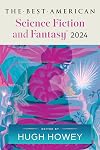
Look at me, being almost caught up on this series, finally! Only one year behind, now.
Anyway, this is a good, solid installment of a generally good yearly collection. I feel that in some sense this is maybe a more "traditional" batch of stories than we get most years, being mostly devoid of unusual formats or strongly experimental storytelling, although they're certainly diverse and creative in other ways. This volume is also rather less heavy on the social commentary than many of its show more predecessors, and completely lacking in any of those kinds of pieces that are basically all commentary with very little story. I imagine that may be a selling point for some and a disappointment for others. For myself, I just rather like the variety that having a different guest editor with different sensibilities every year brings. show less
Anyway, this is a good, solid installment of a generally good yearly collection. I feel that in some sense this is maybe a more "traditional" batch of stories than we get most years, being mostly devoid of unusual formats or strongly experimental storytelling, although they're certainly diverse and creative in other ways. This volume is also rather less heavy on the social commentary than many of its show more predecessors, and completely lacking in any of those kinds of pieces that are basically all commentary with very little story. I imagine that may be a selling point for some and a disappointment for others. For myself, I just rather like the variety that having a different guest editor with different sensibilities every year brings. show less
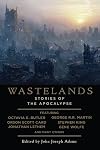
Yet another solid collection of post apocalyptic short stories from JJJ. While the first anthology was dark with a hopeful bent overall this one took a decidedly bleaker look at the end of things as we know it. There's some very unique takes in this collection which I really appreciated, whether the uniqueness was in how the story was conveyed or the content itself.
In taking a more final dark look at the subject I found myself on more of an introspective journey than before. What is the draw show more of such writing for me? Unlike most horror I consider a lot of these themes to be in the realm of possibility. So there's that slight endorphin hit of reality coupled with the fiction, that quiet reminder that should this planet go belly up most of us, myself included, will be scythed blood wheat before the Reaper despite the stories Hollywood feeds us.
Do I hope for these themes to happen? Absolutely not, but one can't help but feel a bit like playing with fire when reading this finely curated collection. show less
In taking a more final dark look at the subject I found myself on more of an introspective journey than before. What is the draw show more of such writing for me? Unlike most horror I consider a lot of these themes to be in the realm of possibility. So there's that slight endorphin hit of reality coupled with the fiction, that quiet reminder that should this planet go belly up most of us, myself included, will be scythed blood wheat before the Reaper despite the stories Hollywood feeds us.
Do I hope for these themes to happen? Absolutely not, but one can't help but feel a bit like playing with fire when reading this finely curated collection. show less
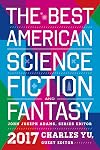
My decision to go back and read the Best American Science Fiction and Fantasy anthologies for years I'd previously missed continues to pay off spectacularly. There are maybe two stories in here that didn't 100% work for me, but those are among the shortest in the book, and are interesting even in their failure to completely click with me. Otherwise, the contents range from pretty good to fan-fucking-tastic, making it a terrific reading experience, as a whole.
One could probably spend a lot of show more time analyzing the interesting trends and patterns and repeated themes to be seen in this particular collection of stories, despite their widely varying perspectives and voices. I'm not necessarily up to doing much of that, myself, but one thing I definitely did notice is the way a surprising number of them draw on ideas from some venerable old subgenres -- especially 1950s monster movies and teen dramas, and classic kids' portal fantasies -- to do things that feel meaningful and relevant in the present day. show less
One could probably spend a lot of show more time analyzing the interesting trends and patterns and repeated themes to be seen in this particular collection of stories, despite their widely varying perspectives and voices. I'm not necessarily up to doing much of that, myself, but one thing I definitely did notice is the way a surprising number of them draw on ideas from some venerable old subgenres -- especially 1950s monster movies and teen dramas, and classic kids' portal fantasies -- to do things that feel meaningful and relevant in the present day. show less
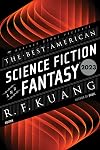
Definitely one of the best installments in this series that I've read so far. (As may be obvious, I'm still a couple of years behind.) There are a number of stories in here that I thought were just terrific, a bunch that were good or solidly decent, and a few that I didn't love but at least thought were doing something interesting. Which is a good hit rate for any anthology, even a "best of" one. Or perhaps especially a "best of" one, as I can never help raising my expectations for them, show more making it far too easy to be disappointed.
As well as the overall quality, this one is notable for how many of the stories in it feature unusual formats. Several of them take the form of academic publications or other fictional documents. There are also example of metafiction, non-linear storytelling, poetic surrealism, and other hard-to-classify stuff. All of which will not be to everybody's taste, I'm sure, but I'm into it.
As usual, these pieces are heavy on the social commentary. I've noticed in previous volumes that there is sometimes a tendency to go so heavy on the social commentary that the story aspect all but vanishes, and I have to say I'm not, in general, a fan of that. Usually I find myself thinking that I'd much rather read the opinion-piece essay that such things seem to want to be, rather than something that's vaguely gesturing at the idea of being fiction but fooling nobody. There are one or two offerings in this one, though, that prove to me that it is in fact possible to do it in a way that I find powerful and effective, which leaves me feeling pleasantly impressed. show less
As well as the overall quality, this one is notable for how many of the stories in it feature unusual formats. Several of them take the form of academic publications or other fictional documents. There are also example of metafiction, non-linear storytelling, poetic surrealism, and other hard-to-classify stuff. All of which will not be to everybody's taste, I'm sure, but I'm into it.
As usual, these pieces are heavy on the social commentary. I've noticed in previous volumes that there is sometimes a tendency to go so heavy on the social commentary that the story aspect all but vanishes, and I have to say I'm not, in general, a fan of that. Usually I find myself thinking that I'd much rather read the opinion-piece essay that such things seem to want to be, rather than something that's vaguely gesturing at the idea of being fiction but fooling nobody. There are one or two offerings in this one, though, that prove to me that it is in fact possible to do it in a way that I find powerful and effective, which leaves me feeling pleasantly impressed. show less
Lists
Awards


You May Also Like


Associated Authors
Statistics
- Works
- 383
- Also by
- 1
- Members
- 13,865
- Popularity
- #1,665
- Rating
- 3.7
- Reviews
- 559
- ISBNs
- 230
- Languages
- 5
- Favorited
- 7