
Cass R. Sunstein
Author of Nudge: Improving Decisions About Health, Wealth, and Happiness
About the Author
Cass R. Sunstein is a law professor at Harvard Law School and is the most cited law professor in the United States. (Bowker Author Biography)
Image credit: Photo courtesy the University of Chicago Experts Exchange (link)
Works by Cass R. Sunstein
The Second Bill of Rights: FDR'S Unfinished Revolution and Why We Need It More than Ever (2004) 165 copies
On Rumors: How Falsehoods Spread, Why We Believe Them, What Can Be Done (2009) 125 copies, 5 reviews
A Constitution of Many Minds: Why the Founding Document Doesn't Mean What It Meant Before (2009) 55 copies, 2 reviews
The Ethics of Influence: Government in the Age of Behavioral Science (Cambridge Studies in Economics, Choice, and Society) (2016) 36 copies
How to Become Famous: Lost Einsteins, Forgotten Superstars, and How the Beatles Came to Be (2024) 23 copies, 2 reviews
Averting Catastrophe: Decision Theory for COVID-19, Climate Change, and Potential Disasters of All Kinds (2021) 13 copies
How to Humble a Wingnut and Other Lessons from Behavioral Economics (Chicago Shorts) (2013) 8 copies, 1 review
Liberalism: In Defense of Freedom 2 copies
Fifty Shades of Manipulation 1 copy
The Second Bill of Rights: FDR's Constitutional Vision and Why We Need It Today, with a new preface by the author (2025) 1 copy
Las cuentas pendientes del sueño americano: Por qué los derechos sociales y económicos son más necesarios que nunca (2015) 1 copy
Nudging: A Very Short Guide 1 copy
Associated Works
Tagged
Common Knowledge
- Canonical name
- Sunstein, Cass R.
- Legal name
- Sunstein, Cass Robert
- Birthdate
- 1954-09-21
- Gender
- male
- Education
- Harvard University (B.A.|1975)
Harvard Law School (J.D.|1978) - Occupations
- professor (law)
Administrator of the Office of Information and Regulatory Affairs (2009-2012) - Organizations
- Harvard Law School
University of Chicago Law School
United States Government - Awards and honors
- American Philosophical Society (2010)
American Academy of Arts & Sciences (1992)
British Academy (Corresponding Fellow, 2017)
Henderson Prize (2002)
Henry M. Phillips Prize (2007)
Holberg Prize (2018) (show all 7)
Goldsmith Book Award (1994) - Relationships
- Power, Samantha (wife)
Ruddick, Lisa (first wife)
Nussbaum, Martha (companion/lover)
Thaler, Richard H. (friend, coauthor) - Nationality
- USA
- Birthplace
- Concord, Massachusetts, USA
- Places of residence
- Chicago, Illinois, USA
- Associated Place (for map)
- USA
Members
Reviews
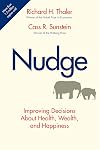
I can't think of a better public policy book than Nudge for the clear exposition of economic research, thoughtful suggestions, and downright humour. This is a book written for a country of diverse and strident opinions. Thaler and Sunstein suggest an incremental approach to public policy: why not nudge people into making better decisions for themselves. Leave them just enough choice to make them feel ownership over pension contributions, choice of medical insurance, even marriage. It's also show more a prescription for breaking the logjam in US Congress by taking a thoughtful, slightly right of centre approach to government. On my recent vacation to the West Coast I saw the ultimate bumper sticker for a cynical electorate: "Recycle Congress." show less
A Constitution of Many Minds: Why the Founding Document Doesn't Mean What It Meant Before by Cass R. Sunstein
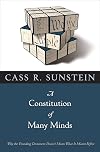
On the surface, the topic of this book would appear to entail a fairly dry analysis of a limited area in the interpretation of the U.S. Constitution: under what circumstances should the views of “many minds” (i.e., the consensus of large groups of people) influence the interpretation by judges of the Constitution? However, in evaluating three different “many minds” scenarios, Sunstein also discusses how the Constitution should be interpreted more generally, and in the process he show more introduces us to a world in which there are few certainties and many conflicting theories. In the end, despite the overall clarity of his writing, this book becomes a difficult read, but nevertheless a very rewarding introduction to the issues faced by the Supreme Court (and the people) in interpreting the Constitution, which are just as relevant today as they were when the book was published in 2009—a distant date considering the speed of change in American politics and the Supreme Court in the last eleven years.
Sunstein identifies the following three possible sources of “many minds” influence on the Constitution. First, traditions presumably reflect the judgments made by “many minds” in the past, and he divides this into a general respect for traditional practices as articulated by the philosophy of Edmund Burke and the specific, Supreme Court-created tradition of “substantive due process.” “Substantive due process” refers to fundamental rights like privacy, not specifically mentioned in the Constitution, that the Supreme Court has determined over the years should be protected from intrusive or unreasonable government interference, such as the right of a married couple to use contraceptives (Griswold), the right to marry a person of another race (Loving) and the right to control the education of one’s own children (Pierce). (As an aside, a legal background in constitutional law certainly would be helpful in absorbing at least certain parts of Sunstein’s discussion, but this is not essential given his careful efforts to explain every step of his analysis). Second, Sunstein refers to the views of the public, which he designates as populism or popular constitutionalism and which clearly raise a rich source for the views of “many minds.” Finally, he examines the laws and practices of other nations, which he designates as “cosmopolitanism.” His “main goal is to show when and why many minds arguments are strong, and when and why they are not.”
In the course of his analysis, Sunstein identifies three pervasive problems with “many minds” approaches. First, does the “many minds” source actually address the proposition before the court and how is the court to determine this (e.g., have circumstances changed)? Second, is the “many minds” source subject to “systemic bias” and thus an unacceptable input into a court’s decision? Third, the “many minds” may not reflect independent judgment of individuals in a group but rather a “cascade” of conformist views reflecting perceptions of what others (or a leader) thinks. Misapplication of the “many minds” approach can, for example, result in a denial of the equal protection of the law, especially where systemic bias is involved.
A key tool in his analysis of many minds approaches is the “jury theorem” originally developed by Marquis de Condorcet to measure the likelihood that a group of individuals will reach a correct answer. “[T]he probability of a correct answer, by a majority of the group, increases toward 100% as the group gets bigger. The key point is that groups will do better than individuals, and large groups better than smaller ones, so long as two conditions are met: (a) majority rule is used and (b) each person is more likely than not to be correct.” In situations where there is less than a 50% probability that each person is likely to be correct (e.g., because of systematic bias, ignorance, etc.), the likelihood of a correct answer by a majority of the group decreases as the group increases in size.
He concludes that traditionalism deserves a great deal of support in the areas of separation of powers, federalism and gun rights, but less so for substantive due process where “minimal rationalism” is the better approach. The establishment clause concerning religion is an intermediate case: the court should accommodate religious practices that have persisted for many years where most people agree (e.g., use of the words “under God” in the Pledge of Allegiance) but not in other areas where accommodation to religious groups might impose a practice on those who have lacked the power to resist it.
With respect to cosmopolitanism, he concludes it provides a weak basis for a many minds interpretation of US constitutional law given the depth of US constitutional experience and the burden involved in determining the relevance of foreign law. He thinks this approach may be more useful for new countries attempting to establish constitutional democracies.
Popular constitutionalism falls in the middle. In certain circumstances, a court should take into account consequentialist (including public backlash) arguments concerning the possible effects of a controversial decision. (Interestingly, Sunstein’s main example, writing in 2009, is that the Supreme Court “should not now rule that states must recognize same-sex marriage even [if] it believes that the Constitution requires that result as a matter of principle.” Of course, this is exactly what the Supreme Court did rule six years later in 2015 in the case of Obergefell v. Hodges.)
In evaluating his three many minds approaches, Sunstein is careful to take into account relevant standards of constitutional interpretation. And this is where the reader may feel at times to be at sea. Sunstein tells us that the Constitution itself provides no instructions for its interpretation. Moreover, he then contrasts two broadly different approaches: that of Madison, who felt that the Constitution should be relatively fixed subject only to rare changes such as through the complex procedure to make amendments, and that of Jefferson, who expressed a wish that each generation of the public should rethink the Constitution anew. Sunstein notes the general consensus that Madison’s view was closer to the actual development than was Jefferson’s, but that Jefferson has also had his way “through social practices and interpretations that render the Constitution very different from” that of the founders.
In the absence of interpretive instructions in the Constitution itself, in his chapter entitled Preliminaries, Sunstein summarizes the principal interpretations followed in varying degrees by courts, which he will then bring to bear as relevant in specific discussions of his three categories of “many minds.” These interpretations include Thayerism (deference to legislation unless it is plainly and unambiguously in violation of the Constitution), originalism (applying the original public meaning of the text of the Constitution), minimalism (decisions that take small steps in expanding or changing the meaning of the Constitution) and perfectionism (construing the Constitution in a way that both fits with it and makes it the best it can be). Other factors in the mix are rationalism (i.e., what is required by moral reasoning as opposed to tradition) and stare decisis (following the precedent of earlier judicial decisions). For example, Sunstein concludes that Burkean minimalism is most plausible for federal judges when three conditions are met: (a) originalism would produce unacceptable consequences (e.g., by rejecting long standing practices such as the establishment in the 20th century of independent agencies like the Federal Reserve and the SEC), (b) long-standing traditions or practices are trustworthy and (3) there is great reason to be skeptical of the rule-evaluating capacity of judges.
He also characterizes the interpretive approaches of contemporary and past justices of the Supreme Court. Thus, Ginsberg, Stevens and Breyer are generally rational minimalists, building on precedent and rational argument. Brennan and Marshall were liberal visionaries with a clear view of where they thought constitutional law should go and would offer ambitious arguments to get there. Scalia and Thomas are originalists but also conservative visionaries, calling for fundamental change. Roberts and Alito are generally characterized as minimalists with a Burkean deference to past practices that contain wisdom not available to an individual’s private reflections.
Given the plethora of interpretive approaches, the question inevitably arises as to what the standard should be in deciding the best approach among the different interpretations and the “many minds” analysis. Sunstein adopts a pragmatic approach turning on the consequences that follow from using a specific approach in interpreting the Constitution in specific circumstances. Thus, different approaches are appropriate in different contexts, i.e., a pragmatic standard does not declare one interpretation to be the sole method. In some cases, Burkean traditionalism might have the best result; in others rejection of tradition on rational grounds is the best. Of course, evaluation of consequences also requires a standard to determine good consequences from bad consequences. In this regard, Sunstein comes down more on the side of liberal and democratic values than do conservative interpreters of the Constitution, but he also is very sensitive to political repercussions of potentially unpopular decisions that, while judges might see them as morally right, could cause political backlash or instability. This is why in 2009 he recommends that the Supreme Court not recognize same sex marriage.
Sunstein brings to bear not only constitutional thought but also political philosophy, economic theory, psychological analysis and American history in his analysis of “many minds.” He also illustrates his discussion with numerous examples of past and contemporary Supreme Court decisions that one could not begin to exhaust in a short review. The result is a book that is of great interest in our current period of constitutional uncertainty.
Sunstein drew on law review articles in putting this book together. This may explain certain inconsistencies in approach and organizational incoherencies. For example, in the chapters on populism and cosmopolitanism, Sunstein lists several constitutional issues on which he then analyzes the impact of the populism and cosmopolitan approaches. He does not do this in the traditionalism chapters. He also has the virtue of being very scrupulous in looking at issues from all sides, but this can frustrate the reader trying to follow the line of the argument (on the one hand this, on the other hand that) and also leads to some repetition as arguments repeat themselves in the context of different issues. However, he is not shy in providing his own conclusions at the end of the back and forth, even though in some cases they may be tentative. show less
Sunstein identifies the following three possible sources of “many minds” influence on the Constitution. First, traditions presumably reflect the judgments made by “many minds” in the past, and he divides this into a general respect for traditional practices as articulated by the philosophy of Edmund Burke and the specific, Supreme Court-created tradition of “substantive due process.” “Substantive due process” refers to fundamental rights like privacy, not specifically mentioned in the Constitution, that the Supreme Court has determined over the years should be protected from intrusive or unreasonable government interference, such as the right of a married couple to use contraceptives (Griswold), the right to marry a person of another race (Loving) and the right to control the education of one’s own children (Pierce). (As an aside, a legal background in constitutional law certainly would be helpful in absorbing at least certain parts of Sunstein’s discussion, but this is not essential given his careful efforts to explain every step of his analysis). Second, Sunstein refers to the views of the public, which he designates as populism or popular constitutionalism and which clearly raise a rich source for the views of “many minds.” Finally, he examines the laws and practices of other nations, which he designates as “cosmopolitanism.” His “main goal is to show when and why many minds arguments are strong, and when and why they are not.”
In the course of his analysis, Sunstein identifies three pervasive problems with “many minds” approaches. First, does the “many minds” source actually address the proposition before the court and how is the court to determine this (e.g., have circumstances changed)? Second, is the “many minds” source subject to “systemic bias” and thus an unacceptable input into a court’s decision? Third, the “many minds” may not reflect independent judgment of individuals in a group but rather a “cascade” of conformist views reflecting perceptions of what others (or a leader) thinks. Misapplication of the “many minds” approach can, for example, result in a denial of the equal protection of the law, especially where systemic bias is involved.
A key tool in his analysis of many minds approaches is the “jury theorem” originally developed by Marquis de Condorcet to measure the likelihood that a group of individuals will reach a correct answer. “[T]he probability of a correct answer, by a majority of the group, increases toward 100% as the group gets bigger. The key point is that groups will do better than individuals, and large groups better than smaller ones, so long as two conditions are met: (a) majority rule is used and (b) each person is more likely than not to be correct.” In situations where there is less than a 50% probability that each person is likely to be correct (e.g., because of systematic bias, ignorance, etc.), the likelihood of a correct answer by a majority of the group decreases as the group increases in size.
He concludes that traditionalism deserves a great deal of support in the areas of separation of powers, federalism and gun rights, but less so for substantive due process where “minimal rationalism” is the better approach. The establishment clause concerning religion is an intermediate case: the court should accommodate religious practices that have persisted for many years where most people agree (e.g., use of the words “under God” in the Pledge of Allegiance) but not in other areas where accommodation to religious groups might impose a practice on those who have lacked the power to resist it.
With respect to cosmopolitanism, he concludes it provides a weak basis for a many minds interpretation of US constitutional law given the depth of US constitutional experience and the burden involved in determining the relevance of foreign law. He thinks this approach may be more useful for new countries attempting to establish constitutional democracies.
Popular constitutionalism falls in the middle. In certain circumstances, a court should take into account consequentialist (including public backlash) arguments concerning the possible effects of a controversial decision. (Interestingly, Sunstein’s main example, writing in 2009, is that the Supreme Court “should not now rule that states must recognize same-sex marriage even [if] it believes that the Constitution requires that result as a matter of principle.” Of course, this is exactly what the Supreme Court did rule six years later in 2015 in the case of Obergefell v. Hodges.)
In evaluating his three many minds approaches, Sunstein is careful to take into account relevant standards of constitutional interpretation. And this is where the reader may feel at times to be at sea. Sunstein tells us that the Constitution itself provides no instructions for its interpretation. Moreover, he then contrasts two broadly different approaches: that of Madison, who felt that the Constitution should be relatively fixed subject only to rare changes such as through the complex procedure to make amendments, and that of Jefferson, who expressed a wish that each generation of the public should rethink the Constitution anew. Sunstein notes the general consensus that Madison’s view was closer to the actual development than was Jefferson’s, but that Jefferson has also had his way “through social practices and interpretations that render the Constitution very different from” that of the founders.
In the absence of interpretive instructions in the Constitution itself, in his chapter entitled Preliminaries, Sunstein summarizes the principal interpretations followed in varying degrees by courts, which he will then bring to bear as relevant in specific discussions of his three categories of “many minds.” These interpretations include Thayerism (deference to legislation unless it is plainly and unambiguously in violation of the Constitution), originalism (applying the original public meaning of the text of the Constitution), minimalism (decisions that take small steps in expanding or changing the meaning of the Constitution) and perfectionism (construing the Constitution in a way that both fits with it and makes it the best it can be). Other factors in the mix are rationalism (i.e., what is required by moral reasoning as opposed to tradition) and stare decisis (following the precedent of earlier judicial decisions). For example, Sunstein concludes that Burkean minimalism is most plausible for federal judges when three conditions are met: (a) originalism would produce unacceptable consequences (e.g., by rejecting long standing practices such as the establishment in the 20th century of independent agencies like the Federal Reserve and the SEC), (b) long-standing traditions or practices are trustworthy and (3) there is great reason to be skeptical of the rule-evaluating capacity of judges.
He also characterizes the interpretive approaches of contemporary and past justices of the Supreme Court. Thus, Ginsberg, Stevens and Breyer are generally rational minimalists, building on precedent and rational argument. Brennan and Marshall were liberal visionaries with a clear view of where they thought constitutional law should go and would offer ambitious arguments to get there. Scalia and Thomas are originalists but also conservative visionaries, calling for fundamental change. Roberts and Alito are generally characterized as minimalists with a Burkean deference to past practices that contain wisdom not available to an individual’s private reflections.
Given the plethora of interpretive approaches, the question inevitably arises as to what the standard should be in deciding the best approach among the different interpretations and the “many minds” analysis. Sunstein adopts a pragmatic approach turning on the consequences that follow from using a specific approach in interpreting the Constitution in specific circumstances. Thus, different approaches are appropriate in different contexts, i.e., a pragmatic standard does not declare one interpretation to be the sole method. In some cases, Burkean traditionalism might have the best result; in others rejection of tradition on rational grounds is the best. Of course, evaluation of consequences also requires a standard to determine good consequences from bad consequences. In this regard, Sunstein comes down more on the side of liberal and democratic values than do conservative interpreters of the Constitution, but he also is very sensitive to political repercussions of potentially unpopular decisions that, while judges might see them as morally right, could cause political backlash or instability. This is why in 2009 he recommends that the Supreme Court not recognize same sex marriage.
Sunstein brings to bear not only constitutional thought but also political philosophy, economic theory, psychological analysis and American history in his analysis of “many minds.” He also illustrates his discussion with numerous examples of past and contemporary Supreme Court decisions that one could not begin to exhaust in a short review. The result is a book that is of great interest in our current period of constitutional uncertainty.
Sunstein drew on law review articles in putting this book together. This may explain certain inconsistencies in approach and organizational incoherencies. For example, in the chapters on populism and cosmopolitanism, Sunstein lists several constitutional issues on which he then analyzes the impact of the populism and cosmopolitan approaches. He does not do this in the traditionalism chapters. He also has the virtue of being very scrupulous in looking at issues from all sides, but this can frustrate the reader trying to follow the line of the argument (on the one hand this, on the other hand that) and also leads to some repetition as arguments repeat themselves in the context of different issues. However, he is not shy in providing his own conclusions at the end of the back and forth, even though in some cases they may be tentative. show less
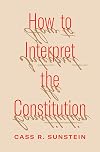
There are two undeniable facts about the US Constitution: (1) it does not contain the instructions for its own interpretation, and (2) it is written in an ambiguous way that nevertheless demands some interpretation. It is impossible, therefore, to engage in a “value-neutral” reading of the text; however you decide to interpret the Constitution inevitably changes its meaning, however slightly. And the consequences of this must be defended on some ground.
In How to Interpret the show more Constitution, Cass Sunstein seeks to explain the various interpretive frameworks that exist and to propose a simple criterion for preferring one over the other; namely, that “judges (and others) should choose the theory that would make the American constitutional order better rather than worse.”
Here’s an example to get us started. As Sunstein wrote:
In 1930 it would have been pretty radical, and maybe even preposterous, to say that the Constitution forbids racially segregated schools. As of this writing, it would be radical, and quite preposterous, to say that the Constitution does not forbid racially segregated schools.
The Constitution, in other words—prior to Brown v. Board of Education—had no “originalist” meaning that made segregation unconstitutional. So, if you adopt an “originalist” position, then congratulations: you can now proudly support the idea that segregation should be perfectly constitutional. You may have a difficult time defending this idea to others, but hey, it’s better to be consistent, right?
The point is that, as Sunstein wrote, “the effects of changes in men’s feelings for what is right and just is equally relevant” in determining how to interpret the Constitution. And if we want to simplify things, and break things down according to a single criterion, then that criterion should be “making the constitutional order better rather than worse” in terms of the effects decisions have on actual people’s lives according to evolving moral standards. And if a theory tells us that segregation is constitutionally acceptable, then that theory should be promptly discarded—original public meaning be damned.
Using this logic, the Supreme Court got it right in its decision requiring states to recognize same-sex marriage. Consider this passage from the decision:
The nature of injustice is that we may not always see it in our own times. The generations that wrote and ratified the Bill of Rights and the Fourteenth Amendment did not presume to know the extent of freedom in all of its dimensions, and so they entrusted to future generations a charter protecting the right of all persons to enjoy liberty as we learn its meaning. When new insight reveals discord between the Constitution’s central protections and a received legal stricture, a claim to liberty must be addressed.
Unfortunately, this is not the only way to think about Constitutional law. Sunstein presents the various interpretive theories—including the various forms of originalism, moral readings, democracy-reinforcing readings, common-law constitutionalism, and common-good constitutionalism—and notes, correctly, that, since the Constitution mentions no theoretical preference, it is largely at the discretion of lawyers and judges to interpret the broad and often vague language of the Constitution in whatever manner they like.
But here’s one thing you cannot do: pretend that adopting an “originalist” stance absolves you from the moral responsibility of defending your decisions, as if they were inevitable, and then deny the fact that all interpretations are unavoidably value-laden. It would be better if we all dropped the charade and said what we’re really after when we “interpret” a constitutional provision one way or another.
The danger here clearly seems to be with originalism, as its proponents fail to offer any moral justifications for their decisions, which, in a deliberative democracy, is anathema. Therefore, we might expect a more passionate and thorough critique of this misguided theory. Instead, Sunstein offers a more round-about critique under the questionable guise of objectivity, and the reader is left to piece things together themselves, at least for the first half of the book. (For a more forceful and substantive critique of originalism, read Erwin Chemerinsky’s masterpiece Worse Than Nothing: The Dangerous Fallacy of Originalism).
And so, you’re three chapters in and halfway through the book before Sunstein tells you what he really thinks; namely, that the best theory of interpretation is a form of Rawlsian reflective equilibrium that forces you to abandon theories that produce morally reprehensible results (big surprise, this means originalism). It’s not that I think Sunstein is wrong (in fact, I think he’s right), it’s just that it takes him a lot of words to get there (straining the reader’s patience along the way).
But it makes a lot of sense; if a theory of interpretation results in blatant discrimination, for example, you’d think it would be rather obvious that the theory should be discarded. It’s actually a shame that it takes a book-length explanation to make the case as to why this is preferable (but unfortunately, it probably does).
The originalist, of course, can still counter that they are perfectly fine with the fact that originalism sometimes produces morally reprehensible results (like the implicit support of segregation) because it is not the job of the courts to monitor the country’s collective moral standing; that’s the job, say the originalists, of Congress, and of a democracy’s elected representatives.
But this seems to be a rather weak and evasive response. If the Constitution does not impose any interpretive theory on us (it doesn’t), and we are then free to select our own theory, then why in the world would we want to choose a theory that produces obviously immoral results, that we can all more-or-less agree on, in specific cases? This is Sunstein’s primary argument, and it's hard to argue against.
In fact, the whole “it’s not my job or problem” attitude among conservative politicians and judges grows tiresome; imagine going to a job interview and saying, “this job doesn’t seem all that valuable, and I’ll look the other way if terrible things happen on my watch.” Well, you probably wouldn’t get hired, and yet we continue to elect politicians that openly express their hatred for the government and then appoint judges that openly express their contempt for any form of judicial oversight (even as they engage in judicial activism by, for example, granting corporations “free speech” rights).
This is, frankly, madness. And Sunstein does a decent job, in his own meandering way, of exposing it. But again, I think Chemerinsky’s book does a far better job.
Here’s a final consideration: Sunstein doesn't mention this, but to my mind, the entire originalism/nonoriginalism debate obscures the real issue, and conceals the real fault line we should be focused on.
Because the Constitution is written ambiguously, we can always interpret it either broadly or narrowly. For example, the First Amendment grants us rights to free speech, which we could interpret as protecting pretty much all speech, including hate speech, libel, and false advertising (broad application), or, alternatively, as protecting free speech except in carefully defined circumstances, like the inciting of violence (a more narrow application). The relevant concern here is not “original intent” or even “democracy-reinforcement” but rather the granting of the appropriate scope of rights—by expanding or contracting them—that is consistent with evolving moral standards of justice. (And since the founders wrote the Constitution in what appears to be an intentionally vague way, it seems like this is more likely what they envisioned.)
Thought of in this way, our theory passes the gold standard test of Brown v. Board of Education. We can say that Brown was ruled correctly because the “equal protection clause” of the Fourteenth Amendment was correctly expanded, or more broadly applied. Whereas originalism, by contrast, tells us Brown was decided incorrectly, and that segregation should be constitutional, our idea that the equal protection clause should be applied more broadly than the founders conceived not only correctly decides Brown, but can also be used to correctly decide future cases of discrimination. And if it’s ever taken too far, we can then talk about narrowing its scope—without ever having to speculate about the intentions of individuals who have been dead for hundreds of years. Is this not preferable?
In other words, when we interpret the Constitution, or decide a case, we must decide how broad or narrow our interpretation or decision is, who is impacted, and whether or not the results seem generally fair. Originalists (and all justices) are basically doing this anyway, but by focusing on the broad/narrow divide, and the inevitable trade-offs involved, at least they’ll be doing it transparently, without hiding behind the fallacy of “originalism.” Currently, the Supreme Court is slowly eroding our rights, which they don’t even have to justify other than by referencing some nebulous idea of “original public meaning,” which should entirely piss you off. show less
In How to Interpret the show more Constitution, Cass Sunstein seeks to explain the various interpretive frameworks that exist and to propose a simple criterion for preferring one over the other; namely, that “judges (and others) should choose the theory that would make the American constitutional order better rather than worse.”
Here’s an example to get us started. As Sunstein wrote:
In 1930 it would have been pretty radical, and maybe even preposterous, to say that the Constitution forbids racially segregated schools. As of this writing, it would be radical, and quite preposterous, to say that the Constitution does not forbid racially segregated schools.
The Constitution, in other words—prior to Brown v. Board of Education—had no “originalist” meaning that made segregation unconstitutional. So, if you adopt an “originalist” position, then congratulations: you can now proudly support the idea that segregation should be perfectly constitutional. You may have a difficult time defending this idea to others, but hey, it’s better to be consistent, right?
The point is that, as Sunstein wrote, “the effects of changes in men’s feelings for what is right and just is equally relevant” in determining how to interpret the Constitution. And if we want to simplify things, and break things down according to a single criterion, then that criterion should be “making the constitutional order better rather than worse” in terms of the effects decisions have on actual people’s lives according to evolving moral standards. And if a theory tells us that segregation is constitutionally acceptable, then that theory should be promptly discarded—original public meaning be damned.
Using this logic, the Supreme Court got it right in its decision requiring states to recognize same-sex marriage. Consider this passage from the decision:
The nature of injustice is that we may not always see it in our own times. The generations that wrote and ratified the Bill of Rights and the Fourteenth Amendment did not presume to know the extent of freedom in all of its dimensions, and so they entrusted to future generations a charter protecting the right of all persons to enjoy liberty as we learn its meaning. When new insight reveals discord between the Constitution’s central protections and a received legal stricture, a claim to liberty must be addressed.
Unfortunately, this is not the only way to think about Constitutional law. Sunstein presents the various interpretive theories—including the various forms of originalism, moral readings, democracy-reinforcing readings, common-law constitutionalism, and common-good constitutionalism—and notes, correctly, that, since the Constitution mentions no theoretical preference, it is largely at the discretion of lawyers and judges to interpret the broad and often vague language of the Constitution in whatever manner they like.
But here’s one thing you cannot do: pretend that adopting an “originalist” stance absolves you from the moral responsibility of defending your decisions, as if they were inevitable, and then deny the fact that all interpretations are unavoidably value-laden. It would be better if we all dropped the charade and said what we’re really after when we “interpret” a constitutional provision one way or another.
The danger here clearly seems to be with originalism, as its proponents fail to offer any moral justifications for their decisions, which, in a deliberative democracy, is anathema. Therefore, we might expect a more passionate and thorough critique of this misguided theory. Instead, Sunstein offers a more round-about critique under the questionable guise of objectivity, and the reader is left to piece things together themselves, at least for the first half of the book. (For a more forceful and substantive critique of originalism, read Erwin Chemerinsky’s masterpiece Worse Than Nothing: The Dangerous Fallacy of Originalism).
And so, you’re three chapters in and halfway through the book before Sunstein tells you what he really thinks; namely, that the best theory of interpretation is a form of Rawlsian reflective equilibrium that forces you to abandon theories that produce morally reprehensible results (big surprise, this means originalism). It’s not that I think Sunstein is wrong (in fact, I think he’s right), it’s just that it takes him a lot of words to get there (straining the reader’s patience along the way).
But it makes a lot of sense; if a theory of interpretation results in blatant discrimination, for example, you’d think it would be rather obvious that the theory should be discarded. It’s actually a shame that it takes a book-length explanation to make the case as to why this is preferable (but unfortunately, it probably does).
The originalist, of course, can still counter that they are perfectly fine with the fact that originalism sometimes produces morally reprehensible results (like the implicit support of segregation) because it is not the job of the courts to monitor the country’s collective moral standing; that’s the job, say the originalists, of Congress, and of a democracy’s elected representatives.
But this seems to be a rather weak and evasive response. If the Constitution does not impose any interpretive theory on us (it doesn’t), and we are then free to select our own theory, then why in the world would we want to choose a theory that produces obviously immoral results, that we can all more-or-less agree on, in specific cases? This is Sunstein’s primary argument, and it's hard to argue against.
In fact, the whole “it’s not my job or problem” attitude among conservative politicians and judges grows tiresome; imagine going to a job interview and saying, “this job doesn’t seem all that valuable, and I’ll look the other way if terrible things happen on my watch.” Well, you probably wouldn’t get hired, and yet we continue to elect politicians that openly express their hatred for the government and then appoint judges that openly express their contempt for any form of judicial oversight (even as they engage in judicial activism by, for example, granting corporations “free speech” rights).
This is, frankly, madness. And Sunstein does a decent job, in his own meandering way, of exposing it. But again, I think Chemerinsky’s book does a far better job.
Here’s a final consideration: Sunstein doesn't mention this, but to my mind, the entire originalism/nonoriginalism debate obscures the real issue, and conceals the real fault line we should be focused on.
Because the Constitution is written ambiguously, we can always interpret it either broadly or narrowly. For example, the First Amendment grants us rights to free speech, which we could interpret as protecting pretty much all speech, including hate speech, libel, and false advertising (broad application), or, alternatively, as protecting free speech except in carefully defined circumstances, like the inciting of violence (a more narrow application). The relevant concern here is not “original intent” or even “democracy-reinforcement” but rather the granting of the appropriate scope of rights—by expanding or contracting them—that is consistent with evolving moral standards of justice. (And since the founders wrote the Constitution in what appears to be an intentionally vague way, it seems like this is more likely what they envisioned.)
Thought of in this way, our theory passes the gold standard test of Brown v. Board of Education. We can say that Brown was ruled correctly because the “equal protection clause” of the Fourteenth Amendment was correctly expanded, or more broadly applied. Whereas originalism, by contrast, tells us Brown was decided incorrectly, and that segregation should be constitutional, our idea that the equal protection clause should be applied more broadly than the founders conceived not only correctly decides Brown, but can also be used to correctly decide future cases of discrimination. And if it’s ever taken too far, we can then talk about narrowing its scope—without ever having to speculate about the intentions of individuals who have been dead for hundreds of years. Is this not preferable?
In other words, when we interpret the Constitution, or decide a case, we must decide how broad or narrow our interpretation or decision is, who is impacted, and whether or not the results seem generally fair. Originalists (and all justices) are basically doing this anyway, but by focusing on the broad/narrow divide, and the inevitable trade-offs involved, at least they’ll be doing it transparently, without hiding behind the fallacy of “originalism.” Currently, the Supreme Court is slowly eroding our rights, which they don’t even have to justify other than by referencing some nebulous idea of “original public meaning,” which should entirely piss you off. show less
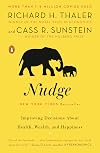
Digital audiobook read by Lloyd James.
Thaler and Sunstein are professors specializing in Behavioral Economics. This work explores the ways in which decision options are presented to achieve the result the designer hopes for … i.e. the nudges.
I found much of this very interesting and kept thinking of incidents in recent years that pointed out how such nudges were beneficial. Certainly, my parents nudged my saving habits, even though they never studied economics. But not all nudges are show more beneficial. The book also made me aware of the nudges that I need to be mindful of. (Extended warranties? Uh, no.)
I had to laugh when reading the updated section at the end, and they reported that the single example that got the most attention was the fly in the urinals at Schiphol airport! I’ve been thinking hard about how I might replicate their results to nudge my husband to put the dirty dishes IN the dishwasher vs just on the counter right above the dishwasher.
The digital audiobook I listened to most was read by Lloyd James. He does a fine job, but much of the material is rather dry, and of course, the listener misses the graphs and illustrations. My local library’s CD version was narrated by Sean Pratt. A fellow book club member listened to a version narrated by Richard Thaler. show less
Thaler and Sunstein are professors specializing in Behavioral Economics. This work explores the ways in which decision options are presented to achieve the result the designer hopes for … i.e. the nudges.
I found much of this very interesting and kept thinking of incidents in recent years that pointed out how such nudges were beneficial. Certainly, my parents nudged my saving habits, even though they never studied economics. But not all nudges are show more beneficial. The book also made me aware of the nudges that I need to be mindful of. (Extended warranties? Uh, no.)
I had to laugh when reading the updated section at the end, and they reported that the single example that got the most attention was the fly in the urinals at Schiphol airport! I’ve been thinking hard about how I might replicate their results to nudge my husband to put the dirty dishes IN the dishwasher vs just on the counter right above the dishwasher.
The digital audiobook I listened to most was read by Lloyd James. He does a fine job, but much of the material is rather dry, and of course, the listener misses the graphs and illustrations. My local library’s CD version was narrated by Sean Pratt. A fellow book club member listened to a version narrated by Richard Thaler. show less
Lists
Awards


You May Also Like


Associated Authors
Statistics
- Works
- 89
- Also by
- 3
- Members
- 10,296
- Popularity
- #2,306
- Rating
- 3.5
- Reviews
- 181
- ISBNs
- 468
- Languages
- 19
- Favorited
- 2