
Lyn Hejinian (1941–2024)
Author of My Life
About the Author
Image credit: Lyn Hejinian, photographed by Gloria Graham during the video taping of Add-Verse, 2005
Works by Lyn Hejinian
Associated Works
American Women Poets in the 21st Century: Where Lyric Meets Language (2002) — Contributor — 40 copies
The Arcadia Project: North American Postmodern Pastoral (New Series) (2012) — Contributor — 28 copies
The Serpent and the Fire: Poetries of the Americas from Origins to Present (2024) — Contributor — 18 copies
Hills 8, Summer, 1981 — Contributor — 1 copy
Telephone 9 — Contributor — 1 copy
L=A=N=G=U=A=G=E, Number 7, (Vol. 2, No. 1) — Contributor — 1 copy
Telephone 10 — Contributor — 1 copy
Sulfur 9 — Contributor — 1 copy
Telephone 12 — Contributor — 1 copy
Other Words (2003) — Contributor — 1 copy
Telephone 17 — Contributor — 1 copy
Tagged
Common Knowledge
- Canonical name
- Hejinian, Lyn
- Legal name
- Hejinian, Lyn
- Birthdate
- 1941-05-17
- Date of death
- 2024-02-24
- Gender
- female
- Education
- Université Harvard (B.A., Lettres, 19 63)
- Occupations
- poet
essayist
translator - Organizations
- Université de Californie, Berkeley (Enseignante, Poésie, Littérature contemporaine)
Atelos Editons (Editrice)
Poetics journal (Co-éditrice, 19 81 | 19 99)
Tuumba Press, Revue (Rédactrice en chef, 19 76 | 19 84) - Awards and honors
- Shelley Memorial Award (2005)
Fellowship of the Academy of American Poets (2000) - Relationships
- Ochs, Larry (Epoux)
- Cause of death
- bile duct cancer
- Nationality
- USA
- Birthplace
- San Francisco Bay Area, California, USA
- Places of residence
- Berkeley, California, USA
- Place of death
- Berkeley, California, USA
- Map Location
- California, USA
Members
Reviews
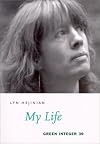
In 1980, Hejinian published the first version of this book, containing 37 sections, each with 37 sentences. The format of the autobiography reflected Hejinian’s age at the time of it’s writing so it follows that this version, written 8 years later, is longer by 8 sections and has been edited so that each section now contains 8 additional sentences. More than a formulaic exercise, the format of the book creates its own sense of chronology, providing the reader with something solid to show more cling to while exploring the unconventional approach of this autobiography. Hejinian seems more interested in the language used to convey memories and emotions and events than in transmitting the facts of her life. Perhaps that is because the language is the transmission, the filter, the translation of the reality. And because memories themselves are so illusive.
I feel as if I floated through this book, more than I read it or understood it. Fragments, patterns of phrases and images, richness of words and more a sense of poetry than of prose, this book reminds me of how elusive the combination of memory and language can be in autobiography. To quote the author, “If reality is trying to express itself in words it is certainly taking the long way around” (105). The route taken provides a tremendous experience. I highly recommend this book. show less
I feel as if I floated through this book, more than I read it or understood it. Fragments, patterns of phrases and images, richness of words and more a sense of poetry than of prose, this book reminds me of how elusive the combination of memory and language can be in autobiography. To quote the author, “If reality is trying to express itself in words it is certainly taking the long way around” (105). The route taken provides a tremendous experience. I highly recommend this book. show less
This is a valuable collection, especially for the material which is authored or co-authored by Hejinian herself. Some of the critical essays are so ... so ... critical-essayish, humorless and teetering on completely obscurantist, that I occasionally wanted to throw the book against the wall. How many times do you really need to use the word "alterity"?

This little bk has a translucent outer cover w/ minimal letterpress graphics on it. This allows the title & credits to be semi-seen thru it. My dear friend Amy Catanzano was partially hosting Hejinian when she was visiting Naropa & Amy was quite enthusiastic. She told me that Hejinian's poetics were influential for her. I've read snippets here & there of Hejinian's writing over the yrs & I've admired her Tuumba Press but've never read an entire bk by Hejinian until this (selections only show more though it is). Amy told me that her "favorite line" in this is: "Girls, my anchor has run out of print - what is my scientific name?" & that becomes a sort of clue for me.
Sometimes it seems that poetry is written as a sequence of disparate lines & that each of those lines is designed to be maximally evocative w/in itself AND in relation to surrounding lines. That seems to be the case here. Take, eg, this simple excerpt:
"O yes
I've been tied to a rail
Knock, knock
The smallest unit of time is "from here to that star"-it's a light trip"
"O yes" cd be an emphatic answer to a question, it cd be an exclamation during pleasure, it cd be the beginning to "I've been tied to a rail" wch cd be a reference to "The Perils of Pauline", it cd be a metaphor. "Knock, knock" might be most commonly associated w/ the beginning of a "Knock, knock" joke. This might've derailed the preceding 2 lines. "The smallest unit of time is "from here to that star"-it's a light trip" seems to derail the preceding, it seems to establish a scale: if that's the smallest unit then we must be on a scale much larger than the day-to-day human one - a scale larger than a knock-knock joke. I imagine starting w/ an intimate moment in the present & going back in time to silent movie serials & then going to an amorphously timed evocation of childhood & then getting into stellar scale. This, for me, is a sort of line-by-line refocus of conceptual 'lenses'. This may have nothing to do w/ Hejinian's purpose.
"Girls, my anchor has run out of print - what is my scientific name?" is like a riddle aimed at girls. What type of anchor runs out of print? To quote Wikipedia: "An anchor is a device, normally made of metal, that is used to connect a vessel to the bed of a body of water to prevent the vessel from drifting due to wind or current." So, let's say that this particular "anchor" is a metaphorical one: an anchor in the sense of 'something that keeps the 'authorial voice's personage'' 'afloat': ie: keeps the author from losing their stability, their self-control. For a writer, the "anchor" might be a text, a text can "run out of print": it can end. What's a writer w/ a bk that's ended? Do they have writer's block? What's their scientific name? A penumbra? A pen in the shadows? A pun in the shade? Upon the shade?
I'm only half-serious here. Given that Hejinian is associated w/ Language Poetry, I'm taking the readerly liberty of reading the links between her lines. What I'm really curious about is what other people find here. I read on Hejinian's Wikipedia bio that "She has received grants and awards from the California Arts Council, the Academy of American Poets, the Poetry Fund, the National Endowment of the Arts, [& the] Guggenheim Foundation." That means that there're alotof people who take her work very seriously indeed & think that she deserves to be substantially financially supported for it. Might I suggest that this is b/c she's an academic? If she were a non-academic, a person who hasn't pd into the hierarchy, wd she be so acclaimed? I think not! Some might say that it's precisely b/c she's jumped thru the academic hoops & come out a ringmaster that that's 'why' her poetry has the 'quality' it has. I beg to disagree.
I'd like to see a collection of poetry by acclaimed poets done in a poorly photocopied form w/ all the poets writing under different names. Then I'd like to see their author bios listing their professions along the lines of: "Judith Hinkle is a mother of 4 who works at Wallmart to make ends meet. In her spare time she writes poetry." Then I'd like to see that sent out to Rain Taxi for review. Wd they review it at all? I think not. It wdn't reek of enuf money & 'class' to be 'taken seriously'. Maybe a scholar wd recognize it as a hoax. Maybe a scholar wd recognize Hejinian's writing. I wonder though.. "From there I push dire to pepper".
Such class musings aside, this poetry is just dandy. However,
"It will take two days of steady rowing to take us where we're going
She says nothing, sees nothing, pinching folds into the blanket, pleating the sheet, hour by hour
Creation myths are always tales of cruelty, in which forms are forced out of ambiguous material's amorphous lumps, chunks, splotches, blobs"
I prefer to myth a new creation w/o cruelty. I hope to meet you too someday. show less
Sometimes it seems that poetry is written as a sequence of disparate lines & that each of those lines is designed to be maximally evocative w/in itself AND in relation to surrounding lines. That seems to be the case here. Take, eg, this simple excerpt:
"O yes
I've been tied to a rail
Knock, knock
The smallest unit of time is "from here to that star"-it's a light trip"
"O yes" cd be an emphatic answer to a question, it cd be an exclamation during pleasure, it cd be the beginning to "I've been tied to a rail" wch cd be a reference to "The Perils of Pauline", it cd be a metaphor. "Knock, knock" might be most commonly associated w/ the beginning of a "Knock, knock" joke. This might've derailed the preceding 2 lines. "The smallest unit of time is "from here to that star"-it's a light trip" seems to derail the preceding, it seems to establish a scale: if that's the smallest unit then we must be on a scale much larger than the day-to-day human one - a scale larger than a knock-knock joke. I imagine starting w/ an intimate moment in the present & going back in time to silent movie serials & then going to an amorphously timed evocation of childhood & then getting into stellar scale. This, for me, is a sort of line-by-line refocus of conceptual 'lenses'. This may have nothing to do w/ Hejinian's purpose.
"Girls, my anchor has run out of print - what is my scientific name?" is like a riddle aimed at girls. What type of anchor runs out of print? To quote Wikipedia: "An anchor is a device, normally made of metal, that is used to connect a vessel to the bed of a body of water to prevent the vessel from drifting due to wind or current." So, let's say that this particular "anchor" is a metaphorical one: an anchor in the sense of 'something that keeps the 'authorial voice's personage'' 'afloat': ie: keeps the author from losing their stability, their self-control. For a writer, the "anchor" might be a text, a text can "run out of print": it can end. What's a writer w/ a bk that's ended? Do they have writer's block? What's their scientific name? A penumbra? A pen in the shadows? A pun in the shade? Upon the shade?
I'm only half-serious here. Given that Hejinian is associated w/ Language Poetry, I'm taking the readerly liberty of reading the links between her lines. What I'm really curious about is what other people find here. I read on Hejinian's Wikipedia bio that "She has received grants and awards from the California Arts Council, the Academy of American Poets, the Poetry Fund, the National Endowment of the Arts, [& the] Guggenheim Foundation." That means that there're alotof people who take her work very seriously indeed & think that she deserves to be substantially financially supported for it. Might I suggest that this is b/c she's an academic? If she were a non-academic, a person who hasn't pd into the hierarchy, wd she be so acclaimed? I think not! Some might say that it's precisely b/c she's jumped thru the academic hoops & come out a ringmaster that that's 'why' her poetry has the 'quality' it has. I beg to disagree.
I'd like to see a collection of poetry by acclaimed poets done in a poorly photocopied form w/ all the poets writing under different names. Then I'd like to see their author bios listing their professions along the lines of: "Judith Hinkle is a mother of 4 who works at Wallmart to make ends meet. In her spare time she writes poetry." Then I'd like to see that sent out to Rain Taxi for review. Wd they review it at all? I think not. It wdn't reek of enuf money & 'class' to be 'taken seriously'. Maybe a scholar wd recognize it as a hoax. Maybe a scholar wd recognize Hejinian's writing. I wonder though.. "From there I push dire to pepper".
Such class musings aside, this poetry is just dandy. However,
"It will take two days of steady rowing to take us where we're going
She says nothing, sees nothing, pinching folds into the blanket, pleating the sheet, hour by hour
Creation myths are always tales of cruelty, in which forms are forced out of ambiguous material's amorphous lumps, chunks, splotches, blobs"
I prefer to myth a new creation w/o cruelty. I hope to meet you too someday. show less
For the past few years Helen Mirra's writing has been in the form of the index. Dislocated from a source text, the entries point out into the world at large. This volume relies upon John Dewey's Reconstruction in Philosophy (1920). While Dewey's book is largely about the conceptualization of ideas, Mirra's project is a materialization of conceptualization, under the auspices of a spare poetics.
The publication is part of the series of artist's projects edited by Christoph Keller.
Helen Mirra show more (*1970, Rochester, New York) makes work in varied scrap media, and teaches at Harvard University.
Edited by Christoph Keller.
Texts by Lyn Hejinian and Helen Mirra. show less
The publication is part of the series of artist's projects edited by Christoph Keller.
Helen Mirra show more (*1970, Rochester, New York) makes work in varied scrap media, and teaches at Harvard University.
Edited by Christoph Keller.
Texts by Lyn Hejinian and Helen Mirra. show less
Lists
Awards

You May Also Like


Associated Authors
Statistics
- Works
- 49
- Also by
- 14
- Members
- 1,246
- Popularity
- #20,594
- Rating
- 3.6
- Reviews
- 11
- ISBNs
- 62
- Languages
- 3
- Favorited
- 7
