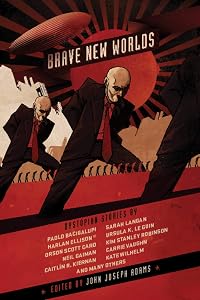
Brave New Worlds
by John Joseph Adams (Editor)
On This Page
Description
You are being watched. Your every movement is being tracked, your every word recorded. Your spouse may be an informer, your children may be listening at your door, your best friend may be a member of the secret police. You are alone among thousands, among great crowds of the brainwashed, the well-behaved, the loyal. Productivity has never been higher, the media blares, and the army is ever triumphant. One wrong move, one slip-up, and you may find yourself disappeared -- swallowed up by a show more monstrous bureaucracy, vanished into a shadowy labyrinth of interrogation chambers, show trials, and secret prisons from which no one ever escapes. Welcome to the world of the dystopia, a world of government and society gone horribly, nightmarishly wrong. What happens when civilization invades and dictates every aspect of your life? From 1984 to The Handmaid's Tale, from Children of Men to Bioshock, the dystopian imagination has been a vital and gripping cautionary force. Brave New Worlds collects the best tales of totalitarian menace by some of today's most visionary writers, including Neil Gaiman, Paolo Bacigalupi, Orson Scott Card, Kim Stanley Robinson, and Ursula K. Le Guin. When the government wields its power against its own people, every citizen becomes an enemy of the state. Will you fight the system, or be ground to dust beneath the boot of tyranny? show lessTags
Recommendations






Member Recommendations
Member Reviews
Early on when I was reading this collection I found I had to put it down because of the sheer weight of all the visions of human misery. Dystopias can be depressing! Who could have guessed. After a while, though, the sheer variety of dystopic invention would continue to provide excuses to keep pressing on, as if I were a tourist among places which were each beset with their own private version of Hell, but able to move on in fifteen pages or so. Some of the characters are crushed by the oppression and some are able to defeat it, and some are completely unaware that they have any choice in the matter. All of them have something to say to the sensitive citizen in Western society.
John Joseph Adams is a stickler for the proper use of show more terminology, carefully separating true dystopia stories which all have more-or-less intact governing structures from post-apocalyptic tales such as the ones in his other collections which speak to a very different set of preoccupations for modern people. He calls this out in his Introduction here. Few post-apocalyptic tales show those in charge attempting to paint their societies as utopias, for instance, as the Adam-Troy Castro story in this volume does. The great majority of the stories collected here are reprints, but with the current trend toward dystopia in Young Adult fiction, I think a second volume could be put together without undue fuss.
Worth a five-star rating just by including Shirley Jackson's The Lottery and Carrie Vaughn's The Amaryllis. show less
John Joseph Adams is a stickler for the proper use of show more terminology, carefully separating true dystopia stories which all have more-or-less intact governing structures from post-apocalyptic tales such as the ones in his other collections which speak to a very different set of preoccupations for modern people. He calls this out in his Introduction here. Few post-apocalyptic tales show those in charge attempting to paint their societies as utopias, for instance, as the Adam-Troy Castro story in this volume does. The great majority of the stories collected here are reprints, but with the current trend toward dystopia in Young Adult fiction, I think a second volume could be put together without undue fuss.
Worth a five-star rating just by including Shirley Jackson's The Lottery and Carrie Vaughn's The Amaryllis. show less
I have an unrepentant love of dystopian stories. I think it's an amazing vehicle to delve into men's psyche, especially when you look at the societies created. I also don't believe in utopia (someone's utopia is always someone else's dystopia).
This anthology is a great collection of different dystopias focusing on different issues. There are newer and older stories. Some of them look at man's (in)humanity, some look at totalitarian issues and how they can be implemented, and some look at the whole.
It's a great set, and it's organized thematically, which is fantastic.
Anything that includes Le Guin's "The Ones That Walk Away from Omelas" is always a win. If that story doesn't punch you in the gut, you're dead inside.
I will say, though, show more that I think the "choose your own adventure" story was my favorite, just out of childhood glee. show less
This anthology is a great collection of different dystopias focusing on different issues. There are newer and older stories. Some of them look at man's (in)humanity, some look at totalitarian issues and how they can be implemented, and some look at the whole.
It's a great set, and it's organized thematically, which is fantastic.
Anything that includes Le Guin's "The Ones That Walk Away from Omelas" is always a win. If that story doesn't punch you in the gut, you're dead inside.
I will say, though, show more that I think the "choose your own adventure" story was my favorite, just out of childhood glee. show less
I have an unrepentant love of dystopian stories. I think it's an amazing vehicle to delve into men's psyche, especially when you look at the societies created. I also don't believe in utopia (someone's utopia is always someone else's dystopia).
This anthology is a great collection of different dystopias focusing on different issues. There are newer and older stories. Some of them look at man's (in)humanity, some look at totalitarian issues and how they can be implemented, and some look at the whole.
It's a great set, and it's organized thematically, which is fantastic.
Anything that includes Le Guin's "The Ones That Walk Away from Omelas" is always a win. If that story doesn't punch you in the gut, you're dead inside.
I will say, though, show more that I think the "choose your own adventure" story was my favorite, just out of childhood glee. show less
This anthology is a great collection of different dystopias focusing on different issues. There are newer and older stories. Some of them look at man's (in)humanity, some look at totalitarian issues and how they can be implemented, and some look at the whole.
It's a great set, and it's organized thematically, which is fantastic.
Anything that includes Le Guin's "The Ones That Walk Away from Omelas" is always a win. If that story doesn't punch you in the gut, you're dead inside.
I will say, though, show more that I think the "choose your own adventure" story was my favorite, just out of childhood glee. show less
A comprehensive compilation of dystopian fiction, from classic stories to brand-new ones.
Not only is this a great collection of dystopian short stories, it's a nice round-up of speculative fiction in general. It includes two of my all-time favorite stories: "The Lottery" by Shirley Jackson and "Those Who Walk Away from Omelos" by Ursula K. Le Guin. There are several essential classics that I hadn't yet read, including "The Minority Report" by Philip K. Dick, "Harrison Bergeron" by Kurt Vonnegut and "'Repent, Harlequin!' Said the Ticktockman" by Harlan Ellison, as well as stories by Ray Bradbury, J.G. Ballard, Kate Wilhelm, James Morrow, Kim Stanley Robinson, Robert Silverberg, Orson Scott Card, Paolo Bacigalupi and Cory Doctorow, plus a show more comic written by Neil Gaiman. As with any anthology, this one can be uneven; I'm not a fan of Geoff Ryman, for instance, so I'm not sure why he's the only author with two selections. Overall, though, the quality of the writing is very high, and the ideas presented are chilling and thought-provoking, which is what a good dystopian story should be. Adams has arranged the stories more or less by theme, which is interesting, especially since all the gender-based dystopias are together. However, it might have been interesting to read them chronologically, too, to see how our societal fears have changed over the years. I'm happy to include this anthology with my small collection of short stories on sub-genres that particularly engage me: gothic, apocalyptic and now dystopian. show less
Not only is this a great collection of dystopian short stories, it's a nice round-up of speculative fiction in general. It includes two of my all-time favorite stories: "The Lottery" by Shirley Jackson and "Those Who Walk Away from Omelos" by Ursula K. Le Guin. There are several essential classics that I hadn't yet read, including "The Minority Report" by Philip K. Dick, "Harrison Bergeron" by Kurt Vonnegut and "'Repent, Harlequin!' Said the Ticktockman" by Harlan Ellison, as well as stories by Ray Bradbury, J.G. Ballard, Kate Wilhelm, James Morrow, Kim Stanley Robinson, Robert Silverberg, Orson Scott Card, Paolo Bacigalupi and Cory Doctorow, plus a show more comic written by Neil Gaiman. As with any anthology, this one can be uneven; I'm not a fan of Geoff Ryman, for instance, so I'm not sure why he's the only author with two selections. Overall, though, the quality of the writing is very high, and the ideas presented are chilling and thought-provoking, which is what a good dystopian story should be. Adams has arranged the stories more or less by theme, which is interesting, especially since all the gender-based dystopias are together. However, it might have been interesting to read them chronologically, too, to see how our societal fears have changed over the years. I'm happy to include this anthology with my small collection of short stories on sub-genres that particularly engage me: gothic, apocalyptic and now dystopian. show less
This is a very big book of very depressing stories. Read it in small doses.
The stories themselves are mixed, and range from classics that I'm glad to finally have a legal copy of (like Ursula le Guin's "The Ones Who Walked Away From Omelas"--any thinking, literate, even moderately leftish person should read this story at some point in their lives) to duds (Orson Scott Card is not a bad writer but his story in this collection, about an unfixable plague that reduces human life expectancy to the early-mid twenties as a biospheric reaction to what people have done to the planet, just doesn't work). Fortunately there were enough good stories from new-to-me authors to justify reading through the whole thing, front to back, in fifteen-minute show more lunch-break increments. "Red Card," "Amaryllis," "Dead Space for the Unexpected," "Jordan's Waterhammer" and "Resistance" were stand-outs. show less
The stories themselves are mixed, and range from classics that I'm glad to finally have a legal copy of (like Ursula le Guin's "The Ones Who Walked Away From Omelas"--any thinking, literate, even moderately leftish person should read this story at some point in their lives) to duds (Orson Scott Card is not a bad writer but his story in this collection, about an unfixable plague that reduces human life expectancy to the early-mid twenties as a biospheric reaction to what people have done to the planet, just doesn't work). Fortunately there were enough good stories from new-to-me authors to justify reading through the whole thing, front to back, in fifteen-minute show more lunch-break increments. "Red Card," "Amaryllis," "Dead Space for the Unexpected," "Jordan's Waterhammer" and "Resistance" were stand-outs. show less
https://nwhyte.livejournal.com/2941568.html
This was circulated by John Joseph Adams in 2012 as part of that year's Hugo voter packet in support of his case for the Best Professional Editor, Short Form category. There are some stories missing from this version which were in the print version - "Billennium" by J.G. Ballard, "The Pedestrian" by Ray Bradbury, "The Minority Report" by Philip K. Dick, "Harrison Bergeron" by Kurt Vonnegut - though everything else seems to be there, including "The Lottery" by Shirley Jackson, "The Ones Who Walk Away From Omelas" by Ursula K. Le Guin, "The Funeral" by Kate Wilhelm and "'Repent, Harlequin!' Said The Ticktockman" by Harlan Ellison. There are also three original stories, one of which came second in show more that year's Hugos (though to be honest I ranked it in last place).
I was struck by just how many of the stories focussed on future dystopian interference with reproductive or sexual rights. Of course, it's not absent from the classic dystopian novels - state regulation of sex is a key element of Zamyatin's We, Orwell's Nineteen Eighty-Four and Huxley's Brave New World - but for them it is one of several elements combining to create oppression. By contrast, my rough tally is that more than half of the stories in Brave New Worlds take it as a central theme.
They are all pretty good and some of them are very good stories. There is a short comic by Neil Gaiman and Bryan Talbot, "From Homogenous To Honey", about the infamous anti-LGBT Clause 28 introduced by the Conservative government in 1988. Geoff Ryman's "Oh Happy Day!" looks at a particularly grim dystopia where the gender boot is on the other foot. "Civilisation" by Vylar Kaftan takes the choose-your-own-adventure format and applies it to dystopias. Generally a good collection. show less
This was circulated by John Joseph Adams in 2012 as part of that year's Hugo voter packet in support of his case for the Best Professional Editor, Short Form category. There are some stories missing from this version which were in the print version - "Billennium" by J.G. Ballard, "The Pedestrian" by Ray Bradbury, "The Minority Report" by Philip K. Dick, "Harrison Bergeron" by Kurt Vonnegut - though everything else seems to be there, including "The Lottery" by Shirley Jackson, "The Ones Who Walk Away From Omelas" by Ursula K. Le Guin, "The Funeral" by Kate Wilhelm and "'Repent, Harlequin!' Said The Ticktockman" by Harlan Ellison. There are also three original stories, one of which came second in show more that year's Hugos (though to be honest I ranked it in last place).
I was struck by just how many of the stories focussed on future dystopian interference with reproductive or sexual rights. Of course, it's not absent from the classic dystopian novels - state regulation of sex is a key element of Zamyatin's We, Orwell's Nineteen Eighty-Four and Huxley's Brave New World - but for them it is one of several elements combining to create oppression. By contrast, my rough tally is that more than half of the stories in Brave New Worlds take it as a central theme.
They are all pretty good and some of them are very good stories. There is a short comic by Neil Gaiman and Bryan Talbot, "From Homogenous To Honey", about the infamous anti-LGBT Clause 28 introduced by the Conservative government in 1988. Geoff Ryman's "Oh Happy Day!" looks at a particularly grim dystopia where the gender boot is on the other foot. "Civilisation" by Vylar Kaftan takes the choose-your-own-adventure format and applies it to dystopias. Generally a good collection. show less
While reading this book over the past week or so, I have been asked by several people whether this book is a sequel to the classic dystopia written by Aldous Huxley. Answer: no, it isn't. The title is of course a reference to that work, but the book is not explicitly about Huxley's (although one story, "Arties Aren't Stupid" did remind me of it). Brave New Worlds is an anthology of dystopian stories by both famous and mostly unknown authors.
Like any anthology, the quality varies. Some of the stories I couldn't put down, while others I had to force myself to finish. The good definitely outweighed the bad for me in this reading experience though and I found a bunch of new authors to watch for!
The dystopian societies are ranged around a show more number of themes:
-Getting to live an easy life in exchange for suffering (either of one or many)
-Babies not allowed
-Not enough babies
-Mining (yeah, I don't know either...These were not my favorite stories)
-Removing all the homosexuals
-Removing all the heterosexuals
-Advertising
-Growing old too slowly
-Growing old too quickly
-And more...
A quick word about a couple favorites and least favorites.
The Best: I absolutely adored the story "Just Do It" by Heather Lindsley. Unfortunately, Heather has not yet written a book, so I can't read any more of her stuff. In her dystopian world, advertising has gone crazy! Ad men actually create darts that are thrown at people on the street. If you get hit by a dart, you get a craving so strong for something (i.e. french fries or fish sandwiches) that you have to go get whatever it is immediately. Even worse, it might not stop there.
Also awesome was "Caught in the Organ Draft" by Robert Silverberg. Although his name didn't ring any bells with me, Silverberg has been writing sci fi since the fifties and has a ton of books. Written in 1972, this short story considers a world where war is waged by robots to spare lives...so that all the young people can be used as organ donors as part of a draft. They only take non-vital organs, like the 'spare' kidney or lung, so it's cool, right? And the important adults can now live for upwards of a hundred and fifty years! If you liked Neal Shusterman's Unwind, you definitely don't want to miss this story.
The Worst: I actually liked "Amaryllis" by Carrie Vaughn, but in the context of the anthology, it was awful. The problem: it's not a dystopia. At all. The main character is being treated poorly by an authority figure and the society certainly isn't ideal, but her problem is resolved when they go to a higher authority. The higher authority fixes everything and not in a brainwashing kind of way. The editor even mentions in the story's introduction that it's not a dystopia. So why is it here?
"Sacrament" by Matt Williamson has, in my mind, the problem of the former, as well as being a story I did not enjoy and which did not, to me, seem particularly well-crafted. The story is from the perspective of a torturer in a society where advertising is art. The torturer likes his job, not in a creepy way, so he says, but takes pride in it. His father was one of the great ad-men/artists. The story lacks a point that I could find, does not successfully entwine the father's story with the son's and the main character is not unhappy with the world around him.
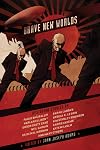
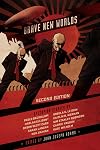
So yeah, lots of great stories (way more than I mentioned above, like "Harrison Bergeron" by Kurt Vonnegut, Jr. and "Minority Report" by Philip K. Dick). Plus, there is awesome cover art and a fabulous bibliography of dystopian literature at the back! This is a must for dystopia fans. show less
Like any anthology, the quality varies. Some of the stories I couldn't put down, while others I had to force myself to finish. The good definitely outweighed the bad for me in this reading experience though and I found a bunch of new authors to watch for!
The dystopian societies are ranged around a show more number of themes:
-Getting to live an easy life in exchange for suffering (either of one or many)
-Babies not allowed
-Not enough babies
-Mining (yeah, I don't know either...These were not my favorite stories)
-Removing all the homosexuals
-Removing all the heterosexuals
-Advertising
-Growing old too slowly
-Growing old too quickly
-And more...
A quick word about a couple favorites and least favorites.
The Best: I absolutely adored the story "Just Do It" by Heather Lindsley. Unfortunately, Heather has not yet written a book, so I can't read any more of her stuff. In her dystopian world, advertising has gone crazy! Ad men actually create darts that are thrown at people on the street. If you get hit by a dart, you get a craving so strong for something (i.e. french fries or fish sandwiches) that you have to go get whatever it is immediately. Even worse, it might not stop there.
Also awesome was "Caught in the Organ Draft" by Robert Silverberg. Although his name didn't ring any bells with me, Silverberg has been writing sci fi since the fifties and has a ton of books. Written in 1972, this short story considers a world where war is waged by robots to spare lives...so that all the young people can be used as organ donors as part of a draft. They only take non-vital organs, like the 'spare' kidney or lung, so it's cool, right? And the important adults can now live for upwards of a hundred and fifty years! If you liked Neal Shusterman's Unwind, you definitely don't want to miss this story.
The Worst: I actually liked "Amaryllis" by Carrie Vaughn, but in the context of the anthology, it was awful. The problem: it's not a dystopia. At all. The main character is being treated poorly by an authority figure and the society certainly isn't ideal, but her problem is resolved when they go to a higher authority. The higher authority fixes everything and not in a brainwashing kind of way. The editor even mentions in the story's introduction that it's not a dystopia. So why is it here?
"Sacrament" by Matt Williamson has, in my mind, the problem of the former, as well as being a story I did not enjoy and which did not, to me, seem particularly well-crafted. The story is from the perspective of a torturer in a society where advertising is art. The torturer likes his job, not in a creepy way, so he says, but takes pride in it. His father was one of the great ad-men/artists. The story lacks a point that I could find, does not successfully entwine the father's story with the son's and the main character is not unhappy with the world around him.
So yeah, lots of great stories (way more than I mentioned above, like "Harrison Bergeron" by Kurt Vonnegut, Jr. and "Minority Report" by Philip K. Dick). Plus, there is awesome cover art and a fabulous bibliography of dystopian literature at the back! This is a must for dystopia fans. show less
Members
- Recently Added By
Lists

Best Dystopias
280 works; 271 members

Survey of Classic Dystopias
29 works; 4 members

Dystopian and Apocalyptic Literature
350 works; 74 members

SFFCat 2015
35 works; 1 member

Books Read in 2015
3,299 works; 129 members
Author Information

All Editions
Some Editions
Work Relationships
Contains
Common Knowledge
- Original publication date
- 2011-01-25
- Dedication
- For Christie
- First words
- Shirley Jackson, best known for penning this classic story, was the author of several novels, such as We Have Always Lived in the Castle and The Haunting of Hill House, the latter of which has been adapted to film twice (both... (show all) times as The Haunting).
Nineteen Eighty-Four, Fahrenheit 451, and, of course, the book this anthology is named for--Brave New World--are the cornerstones of dystopian literature in novel form, but there has never, to my knowledge, been... (show all) an anthology containing all the best, classic works of dystopian short fiction in one volume. (from the Introduction) - Last words
- (Click to show. Warning: May contain spoilers.)You have a civilization.
(Click to show. Warning: May contain spoilers.)But a red light continued to blink, slowly, in the darkness. (from the Second Edition) - Canonical DDC/MDS
- 823.0876208
- Canonical LCC
- PR1309 .S3 .B728
- Disambiguation notice
- The book "Selections from Brave New Worlds: Dystopian Stories" is a subset of the book "Brave New Worlds: Dystopian Stories". Please do not combine these two volumes.
The expanded second edition adds three stories by ... (show all)Robert Reed, Jennifer Pelland, and Ken Liu, plus a filmography and study guide by Gary K. Wolfe.
Furthermore, the second edition e-book is missing the stories by Ballard, Bradbury, Dick, and Vonnegut.
Classifications
- Genres
- Fiction and Literature, Science Fiction
- DDC/MDS
- 823.0876208 — Literature & rhetoric English & Old English literatures English fiction By type Genre fiction Adventure fiction Speculative fiction Science fiction Collections and anthologies Collections
- LCC
- PR1309 .S3 .B728 — Language and Literature English English Literature Collections of English literature
- BISAC
Statistics
- Members
- 541
- Popularity
- 54,908
- Reviews
- 18
- Rating
- (3.95)
- Languages
- English
- Media
- Paper, Ebook
- ISBNs
- 4
- ASINs
- 9