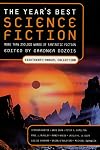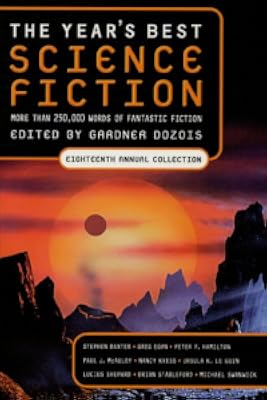
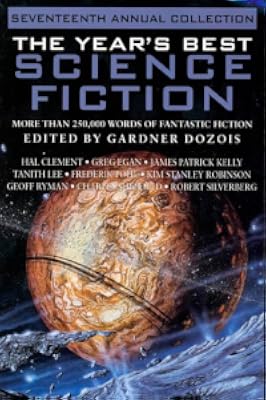
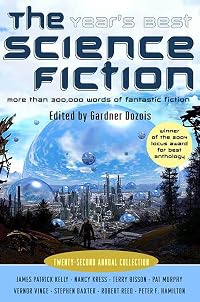
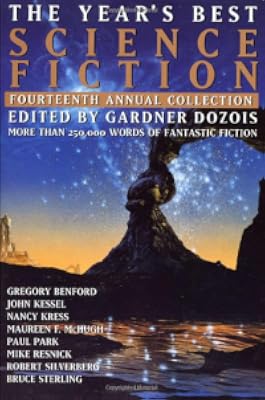
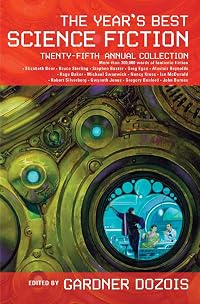
The Year's Best Science Fiction: Eighteenth Annual Collection
by Gardner Dozois (Editor)
Mammoth Book of Best New Science Fiction (14), Dozois Year's Best Science Fiction (18)
On This Page
Description
This volume presents more than two dozen SF stories. It includes John Kessel, Ursula K. Le Guin, Nancy Kress, and many other stars of SF, as well as the usual thorough summation of the year and recommended reading lists.Tags
Recommendations














Member Reviews
Most sf/f collections are made of mildly enjoyable but ultimately forgettable short stories. There are a few truly terrible stories in each, and even fewer truly good ones. I think the idea of short stories as The way to start getting noticed doesn't help (far too many people attempt a form they suck at), but the real problem seems to be editors who accept any old drek. The only editor whose anthologies I've 100% enjoyed thus far has been Sharyn November. Even John Joseph Adams and Ellen Datlow have included some memorable stinkers in this collections.
But short story collections can give you fun-sized portions of stories, a tasting menu of various authors I've never heard of or never tried before, so I keep picking them up. To my show more pleasure, this is one of the best collections I've read in a while--nothing awful, and only a few stories too boring to read all the way through. The default in sf seems to be straight white American cis-dudes, so it was a pleasure to read so many stories with non-white, non-American, even non-dude protagonists. Set in alien-invaded-Nairobi, in nano-fueled-China, in a Vietnamese circus, on matriarchial-Mars, these are not your standard cookie-cutter settings and characters. And what a pleasure it was to read about them!
My favorite story in the collection was probably "Tendeleo's Story" by Ian McDonald. Tendeleo Bi is a fantastic main character, strong, smart, devoted but with believable moments of childish self absorption, unapologetic and fierce. Her quest, first to save her village from the encroaching alien spores, then to create another home, kept me flipping through the pages. I was reading so fast I almost missed a major plot point!
Susan Palwick's "Going After Bobo" is as poignant a portrait of a kid's search for his cat as any story I had to read in English class. Palwick gives us the story in bits and pieces, only revealing a snippet at a time, and it worked beautifully. Less sf than I expected, but well-told.
Another favorite was "Obsidian Harvest" by Rick Cook and Ernest Hogan. Basically a classic private-eye story, but told in an alternate version of MesoAmerica where huetlacoatls live alongside humans. Our narrator, Tworabbit, aka Lucky, has been cast out of his noble family for some heinous crime, and now makes a living as a thug and investigator for a local crime boss. I hope this idea gets turned into something longer because I was intrigued by the world and the characters.
I liked the basic premises behind "Antibodies" by Charles Stross and Greg Egan's "Oracle," but the punch of it got lost. If they were half as long, they'd be twice as good.
Paul McAuley's "Reef" is written well, but kinda pointless. I liked the main character (a woman without genetic mods but with a sense of fair play) and the world where citizenship must be earned or bought, but there wasn't much to the plot.
Albert Cowdrey's "Crux" would have been one of my favorites except for the ending, which rather ruined the bittersweet concept of trying to prevent a cataclysm but thereby erase the present.
I wanted to like Steven Utley's "The Real World," in which a robot from the future comes back to prevent Alan Turing's persecution and help him accelerate the pace of scientific progress. Weirdly enough, the story gets bogged down in a vilification of C.S.Lewis and Christianity in general.
M. Shayne Bell's "The Thing About Benny" and Robert Charles Wilson's "The Long Goodbye" are both exactly long enough for the cute, classic twists on stories that they tell.
Ursula K Le Guin's "The Birthday of the World" and Nancy Kress's "Savior" were both great, but I'd read each of them too many times before.
Others were just too long, not well-written, or had a forgettable premise. I found these to be: Peter Hamilton's "The Suspect Genome," in which an unscrupulous businessman is framed for one murder after committing another; Lucius Shepard's "Radiant Green Star," which is an unending tale of a boy growing up in a Vietnamese circus while training to avenge his family's death; propaganda for the Singularity in Alastair Reynold's "Great Wall of Mars"; the saccharine "Patient Zero" by Tananarive Due; the just plain boring "A Colder War" by Charles Stross; and the hardly intelligible "Milo and Sylvie" by Eliot Fintshel.
Overall, fewer paragraphs of infodumps and technobabble explanations (although still far too many for my tastes) and more characterization than I'm used to getting from sf. 2000 was a pretty good year for the genre, apparently! show less
But short story collections can give you fun-sized portions of stories, a tasting menu of various authors I've never heard of or never tried before, so I keep picking them up. To my show more pleasure, this is one of the best collections I've read in a while--nothing awful, and only a few stories too boring to read all the way through. The default in sf seems to be straight white American cis-dudes, so it was a pleasure to read so many stories with non-white, non-American, even non-dude protagonists. Set in alien-invaded-Nairobi, in nano-fueled-China, in a Vietnamese circus, on matriarchial-Mars, these are not your standard cookie-cutter settings and characters. And what a pleasure it was to read about them!
My favorite story in the collection was probably "Tendeleo's Story" by Ian McDonald. Tendeleo Bi is a fantastic main character, strong, smart, devoted but with believable moments of childish self absorption, unapologetic and fierce. Her quest, first to save her village from the encroaching alien spores, then to create another home, kept me flipping through the pages. I was reading so fast I almost missed a major plot point!
Susan Palwick's "Going After Bobo" is as poignant a portrait of a kid's search for his cat as any story I had to read in English class. Palwick gives us the story in bits and pieces, only revealing a snippet at a time, and it worked beautifully. Less sf than I expected, but well-told.
Another favorite was "Obsidian Harvest" by Rick Cook and Ernest Hogan. Basically a classic private-eye story, but told in an alternate version of MesoAmerica where huetlacoatls live alongside humans. Our narrator, Tworabbit, aka Lucky, has been cast out of his noble family for some heinous crime, and now makes a living as a thug and investigator for a local crime boss. I hope this idea gets turned into something longer because I was intrigued by the world and the characters.
I liked the basic premises behind "Antibodies" by Charles Stross and Greg Egan's "Oracle," but the punch of it got lost. If they were half as long, they'd be twice as good.
Paul McAuley's "Reef" is written well, but kinda pointless. I liked the main character (a woman without genetic mods but with a sense of fair play) and the world where citizenship must be earned or bought, but there wasn't much to the plot.
Albert Cowdrey's "Crux" would have been one of my favorites except for the ending, which rather ruined the bittersweet concept of trying to prevent a cataclysm but thereby erase the present.
I wanted to like Steven Utley's "The Real World," in which a robot from the future comes back to prevent Alan Turing's persecution and help him accelerate the pace of scientific progress. Weirdly enough, the story gets bogged down in a vilification of C.S.Lewis and Christianity in general.
M. Shayne Bell's "The Thing About Benny" and Robert Charles Wilson's "The Long Goodbye" are both exactly long enough for the cute, classic twists on stories that they tell.
Ursula K Le Guin's "The Birthday of the World" and Nancy Kress's "Savior" were both great, but I'd read each of them too many times before.
Others were just too long, not well-written, or had a forgettable premise. I found these to be: Peter Hamilton's "The Suspect Genome," in which an unscrupulous businessman is framed for one murder after committing another; Lucius Shepard's "Radiant Green Star," which is an unending tale of a boy growing up in a Vietnamese circus while training to avenge his family's death; propaganda for the Singularity in Alastair Reynold's "Great Wall of Mars"; the saccharine "Patient Zero" by Tananarive Due; the just plain boring "A Colder War" by Charles Stross; and the hardly intelligible "Milo and Sylvie" by Eliot Fintshel.
Overall, fewer paragraphs of infodumps and technobabble explanations (although still far too many for my tastes) and more characterization than I'm used to getting from sf. 2000 was a pretty good year for the genre, apparently! show less
I didn't read enough stories to feel comfortable judging this. I was totally impressed by the last one, Tendeleo's Story by Ian McDonald. Some technologies did feel dated, as I read this 10-11 years after they were written.
Ratings
Members
- Recently Added By
Author Information

Gardner Dozois was born in Salem, Massachusetts on July 23, 1947. After working as an Army journalist, he became a science fiction and fantasy editor and author. He was the founding editor of The Year's Best Science Fiction anthologies and editor of Asimov's from 1984 until 2004. His work as an editor received more than 40 Hugo Awards, 40 Nebula show more Awards, and 30 Locus Awards. He received the Hugo Award for Best Professional Editor 15 times between 1988 and his retirement from Asimov's in 2004. He wrote books including Strangers and short stories including The Peacemaker and Morning Child, which won the Nebula Award for Short Story in 1983 and 1984, respectively. He also collaborated with George R. R. Martin on a series of themed anthologies including Songs of the Dying Earth, Old Mars, Dangerous Women, and Rogues. In 2011, Dozois was inducted into the Science Fiction Hall of Fame. He died on May 27, 2018 at the age of 70. (Bowker Author Biography) show less
All Editions
Some Editions
Awards and Honors
Awards
Series

Mammoth Book of Best New Science Fiction
29 works (14)

Dozois Year's Best Science Fiction
35 works (18)
Belongs to Publisher Series
Mammoth Books (Mammoth Books 234)
Work Relationships
Contains
Reef by Paul McAuley
Common Knowledge
- Canonical title
- The Year's Best Science Fiction: Eighteenth Annual Collection
- Original publication date
- 2001
- Disambiguation notice
- This is a different series from Best Science Fiction Stories of the Year (also by Dozois)
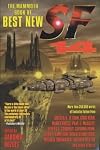
Reprinted as The Mammoth Book of Best New SF 14 in the UK.
Classifications
- Genres
- Fiction and Literature, Science Fiction
- DDC/MDS
- 813.0876208 — Literature & rhetoric American literature in English American fiction in English By type Genre fiction Adventure fiction Speculative fiction Science fiction Collections and anthologies Anthologies
- LCC
- PS648 .S3 — Language and Literature American literature American literature Collections of American literature Prose (General)
- BISAC
Statistics
- Members
- 505
- Popularity
- 59,860
- Reviews
- 2
- Rating
- (3.76)
- Languages
- English
- Media
- Paper, Ebook
- ISBNs
- 5
- ASINs
- 3