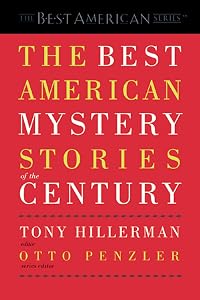
The Best American Mystery Stories of the Century
by Tony Hillerman (Editor), Otto Penzler (Series Editor)
The Best American Mystery Stories (Collections and Selections — 20th Century), Best American (20th Century)
On This Page
Description
A collection of the best in mystery writing includes contributions by O. Henry, Dashiell Hammett, Ring Lardner, Ernest Hemingway, Ellery Queen, James Thurber, Sue Grafton, Stephen King, Joyce Carol Oates, Sara Paretsky, John Steinbeck, and Mickey Spillane.Tags
Recommendations









Member Reviews
by Wombat the Bookworm
I don't envy anyone tasked with assembling a book like this. You'd want to be original, but you couldn't skip the best things. You'd need to hit many of the major figures while not ignoring minor gems. You'd want to hit every flavor and node.
Hillerman and Penzler did a fine job, selecting many moving and startling stories for the collection. Several made me laugh, some made me shiver, some stayed with me for days. At the same time, some seem out of place for tone, others for content. Rather than discuss every story (there are 46, after all), I'll list my five favorite and the five most out of place.
Let's start with the out-of-place ones:
- "The Comforts of Home" - Flannery O'Connor is a stark story, but isn't show more strictly a mystery, nor is it pleasant
- "Do with Me What You Will" by Joyce Carol Oates feels too ham-handed-- a story about something instead of being a story that makes you think about something
- "First Offense" by Evan Hunter has the same problem -- it's too "on the nose"
- "An Error in Chemistry" by William Faulkner - tries to be a clever mystery but falls flat. It's also written in a confusing way, revealing details in the wrong order.
- "Paul's Case" by Willa Cather feels like a rambling story that isn't really a mystery at all.
The five best stories. I'd like to be clear -- there are many great stories in this collection. I'd have no trouble assembling a list of 10 instead of five. But five will do:
- "The Dark Snow" by Brendan DuBois seethes with the daily torments of modern life, and challenges the reader to rethink easy dichotomies of good and evil.
- "The Terrapin" by Patricia Highsmith is perhaps the most horrifying story of the book, followed in a close second by Harlan Ellison's "The Whimper of Whipped Dogs."
- "The Catbird Seat" by James Thurber still holds as one of my favorite stories ever. A tale of petty bureaucracy and orderliness.
- "A Jury of her Peers" by Susan Glaspell brings the early 20th century feminism into bright relief, and works wonderfully.
- "The Moment of Decision" by Stanley Ellin prods our conscience, asking how we'd act if a harrowing moment presented itself.
Overall, a very good read. The anthology takes a pretty broad view of what a "mystery" is, but it can be forgiving since this broad definition yielded so many gems. show less
I don't envy anyone tasked with assembling a book like this. You'd want to be original, but you couldn't skip the best things. You'd need to hit many of the major figures while not ignoring minor gems. You'd want to hit every flavor and node.
Hillerman and Penzler did a fine job, selecting many moving and startling stories for the collection. Several made me laugh, some made me shiver, some stayed with me for days. At the same time, some seem out of place for tone, others for content. Rather than discuss every story (there are 46, after all), I'll list my five favorite and the five most out of place.
Let's start with the out-of-place ones:
- "The Comforts of Home" - Flannery O'Connor is a stark story, but isn't show more strictly a mystery, nor is it pleasant
- "Do with Me What You Will" by Joyce Carol Oates feels too ham-handed-- a story about something instead of being a story that makes you think about something
- "First Offense" by Evan Hunter has the same problem -- it's too "on the nose"
- "An Error in Chemistry" by William Faulkner - tries to be a clever mystery but falls flat. It's also written in a confusing way, revealing details in the wrong order.
- "Paul's Case" by Willa Cather feels like a rambling story that isn't really a mystery at all.
The five best stories. I'd like to be clear -- there are many great stories in this collection. I'd have no trouble assembling a list of 10 instead of five. But five will do:
- "The Dark Snow" by Brendan DuBois seethes with the daily torments of modern life, and challenges the reader to rethink easy dichotomies of good and evil.
- "The Terrapin" by Patricia Highsmith is perhaps the most horrifying story of the book, followed in a close second by Harlan Ellison's "The Whimper of Whipped Dogs."
- "The Catbird Seat" by James Thurber still holds as one of my favorite stories ever. A tale of petty bureaucracy and orderliness.
- "A Jury of her Peers" by Susan Glaspell brings the early 20th century feminism into bright relief, and works wonderfully.
- "The Moment of Decision" by Stanley Ellin prods our conscience, asking how we'd act if a harrowing moment presented itself.
Overall, a very good read. The anthology takes a pretty broad view of what a "mystery" is, but it can be forgiving since this broad definition yielded so many gems. show less
This collection of mystery stories is truly an extraordinary volume. It reflects the history of the genre from 1903 (with a classic tale by O. Henry) through 1999 (with a contribution by Dennis Lehane). The book’s editor is the eminent Tony Hillerman -- well-known to readers for his own stories, novels, and essays. Hillerman’s choices of stories show his excellent taste and his scholarly knowledge of the field.
With such early stories as Jacques Futrelle’s 1905 “Problem of Cell 13,” readers visit a time when stories reflected works of Edgar Allan Poe and Arthur Conan Doyle; the puzzle was what mattered, and characterization was unimportant. By the end of the 20th century, as in Tom Franklin’s “Poachers,” the puzzle show more mattered little, and the reader never learns for sure who was responsible for the murders. As reflected in this collection, stories from the pulp magazines of the 1920s through 1940s could hardly be more different than those of a few decades earlier; the settings were “mean streets” and gritty saloons (not parlors and drawing rooms) and the characters were far more likely to be petty criminals and prostitutes than butlers and society matrons. In this collection, among notable stories from this time frame are Dashiell Hammett’s “The Gutting of Couffignal” (1925), James Cain’s “Baby in the Icebox” (1933), Raymond Chandler’s incomparable “Red Wind” (1938), and Cornell Woolrich’s “Rear Window” (1942), which spawned a movie by that name.
Selections from the 1950s include contributions from Ross MacDonald, John D. MacDonald, and Stanley Ellin, and from the 1960s, Patricia Highsmith and Shirley Jackson. Contributors from the 1970s and onward are a virtual who’s who of authors in the genre – Sue Grafton, Sara Paretsky, Stephen King, Harlan Ellison, Donald Westlake, Dennis Lehane, Lawrence Block, and others well known to aficionados. Among the included authors are a few surprises (given the genre)—John Steinbeck, Pearl Buck, and William Faulkner each make an appearance, as do the humorists James Thurber and Ring Lardner.
With a collection this good, it’s hard to choose those that are the most outstanding. However, my favorites include the contributions by Dashiell Hammett, Raymond Chandler, James Thurber, Ross MadDonald, Henry Slesar, and Dennis Lehane. Meanwhile, the funniest stories of the collection are Donald Westlake’s “Too Many Crooks” and James Thurber’s “The Catbird Seat.” At the negative end, I consider Harlan Ellison’s violent (though oft- reprinted) tale “The Whimper of Whipped Dogs” to be out of place here. As for Joyce Carol Oates’ “Do With Me What You Will” its inclusion mars the collection; the story is socially dated, and does not pass muster today when it comes to racial aspects.
Below is a list of the 46 short stories, with my own rankings (on a scale of 0 to 5 stars):
A Retrieved Reformation (O. Henry) 3*
Paul's Case (Willa Cather ) 3*
Problem of Cell 13 (Jacques Futrelle) 4*
Blind Man's Buff (Frederick Irving Anderson) 1.5*
Naboth's Vineyard (Melville Davisson Post) 2.5*
Jury of her Peers (Susan Glaspell) 3*
Gutting of Couffignal (Dashiell Hammett) 4*
Haircut (Ring Lardner) 1*
Blue Murder (Wilbur Daniel Steele) 1*
Perfect Crime (Ben Ray Redman) 3*
Baby in the Icebox (James M. Cain) 2*
Murder (John Steinbeck) 4*
Sense of Humor (Damon Runyan) 2*
Ransom (Pearl S. Buck) 2*
Red Wind (Raymond Chandler) 4*
Catbird Seat (James Thurber) 4*
Rear Window (Cornell Woolrich) 3*
Error in Chemistry (William Faulkner) 2*
Nine Mile Walk (Harry Kemelman) 3*
Adventure of the President's Half Disme (Ellery Queen) 1*
Homesick Buick (John D. MacDonald) 3*
Gone Girl (Ross Macdonald) 4*
Moment of Decision (Stanley Ellin) 3*
First Offense (Evan Hunter) 3*
Couple Next Door (Margaret Millar) 3.5*
Day of the Execution (Henry Slesar) 4.5*
Terrapin (Patricia Highsmith) 2*
Possibility of Evil (Shirley Jackson) 3*
Comforts of Home (Flannery O'Connor)
Good man, Bad Man (Jerome Weidman) 2.5*
Goodbye, Pops (Joe Gores) 1*
Whimper of Whipped Dogs (Harlan Ellison) 1*
Wager (Robert L. Fish) 2*
Do with Me What You Will (Joyce Carol Oates) 0*
Quitters, Inc. (Stephen King) 1*
Absence of Emily (Jack Ritchie) 3.5*
By the Dawn's Early Light (Lawrence Block) 3.5*
Iris (Stephen Greenleaf) *
Three-Dot Po Sara Paretsky) 3*
Parker Shotgun (Sue Grafton) 4*
Too Many Crooks (Donald E. Westlake) 5*
Hot Springs (James Crumley) 4*
Dark Snow (Brendan DuBois) 3.5*
Red Clay (Michael Malone) 2*
Poachers (Tom Franklin) 4.5*
Running Out of Dog (Dennis Lehane) 4.5* show less
With such early stories as Jacques Futrelle’s 1905 “Problem of Cell 13,” readers visit a time when stories reflected works of Edgar Allan Poe and Arthur Conan Doyle; the puzzle was what mattered, and characterization was unimportant. By the end of the 20th century, as in Tom Franklin’s “Poachers,” the puzzle show more mattered little, and the reader never learns for sure who was responsible for the murders. As reflected in this collection, stories from the pulp magazines of the 1920s through 1940s could hardly be more different than those of a few decades earlier; the settings were “mean streets” and gritty saloons (not parlors and drawing rooms) and the characters were far more likely to be petty criminals and prostitutes than butlers and society matrons. In this collection, among notable stories from this time frame are Dashiell Hammett’s “The Gutting of Couffignal” (1925), James Cain’s “Baby in the Icebox” (1933), Raymond Chandler’s incomparable “Red Wind” (1938), and Cornell Woolrich’s “Rear Window” (1942), which spawned a movie by that name.
Selections from the 1950s include contributions from Ross MacDonald, John D. MacDonald, and Stanley Ellin, and from the 1960s, Patricia Highsmith and Shirley Jackson. Contributors from the 1970s and onward are a virtual who’s who of authors in the genre – Sue Grafton, Sara Paretsky, Stephen King, Harlan Ellison, Donald Westlake, Dennis Lehane, Lawrence Block, and others well known to aficionados. Among the included authors are a few surprises (given the genre)—John Steinbeck, Pearl Buck, and William Faulkner each make an appearance, as do the humorists James Thurber and Ring Lardner.
With a collection this good, it’s hard to choose those that are the most outstanding. However, my favorites include the contributions by Dashiell Hammett, Raymond Chandler, James Thurber, Ross MadDonald, Henry Slesar, and Dennis Lehane. Meanwhile, the funniest stories of the collection are Donald Westlake’s “Too Many Crooks” and James Thurber’s “The Catbird Seat.” At the negative end, I consider Harlan Ellison’s violent (though oft- reprinted) tale “The Whimper of Whipped Dogs” to be out of place here. As for Joyce Carol Oates’ “Do With Me What You Will” its inclusion mars the collection; the story is socially dated, and does not pass muster today when it comes to racial aspects.
Below is a list of the 46 short stories, with my own rankings (on a scale of 0 to 5 stars):
A Retrieved Reformation (O. Henry) 3*
Paul's Case (Willa Cather ) 3*
Problem of Cell 13 (Jacques Futrelle) 4*
Blind Man's Buff (Frederick Irving Anderson) 1.5*
Naboth's Vineyard (Melville Davisson Post) 2.5*
Jury of her Peers (Susan Glaspell) 3*
Gutting of Couffignal (Dashiell Hammett) 4*
Haircut (Ring Lardner) 1*
Blue Murder (Wilbur Daniel Steele) 1*
Perfect Crime (Ben Ray Redman) 3*
Baby in the Icebox (James M. Cain) 2*
Murder (John Steinbeck) 4*
Sense of Humor (Damon Runyan) 2*
Ransom (Pearl S. Buck) 2*
Red Wind (Raymond Chandler) 4*
Catbird Seat (James Thurber) 4*
Rear Window (Cornell Woolrich) 3*
Error in Chemistry (William Faulkner) 2*
Nine Mile Walk (Harry Kemelman) 3*
Adventure of the President's Half Disme (Ellery Queen) 1*
Homesick Buick (John D. MacDonald) 3*
Gone Girl (Ross Macdonald) 4*
Moment of Decision (Stanley Ellin) 3*
First Offense (Evan Hunter) 3*
Couple Next Door (Margaret Millar) 3.5*
Day of the Execution (Henry Slesar) 4.5*
Terrapin (Patricia Highsmith) 2*
Possibility of Evil (Shirley Jackson) 3*
Comforts of Home (Flannery O'Connor)
Good man, Bad Man (Jerome Weidman) 2.5*
Goodbye, Pops (Joe Gores) 1*
Whimper of Whipped Dogs (Harlan Ellison) 1*
Wager (Robert L. Fish) 2*
Do with Me What You Will (Joyce Carol Oates) 0*
Quitters, Inc. (Stephen King) 1*
Absence of Emily (Jack Ritchie) 3.5*
By the Dawn's Early Light (Lawrence Block) 3.5*
Iris (Stephen Greenleaf) *
Three-Dot Po Sara Paretsky) 3*
Parker Shotgun (Sue Grafton) 4*
Too Many Crooks (Donald E. Westlake) 5*
Hot Springs (James Crumley) 4*
Dark Snow (Brendan DuBois) 3.5*
Red Clay (Michael Malone) 2*
Poachers (Tom Franklin) 4.5*
Running Out of Dog (Dennis Lehane) 4.5* show less
As with most collections, this one had some ups and downs but for the most part it was a great selection of crime short stories. I say crime rather than mystery since some, particularly the later stories, were not 'mysteries' - they had no puzzle or whodunit aspect but were rather character studies of some mighty unpleasant characters. These stories were the ones I liked least but not because they were bad short stories, just because my tastes don't lie that way. I also didn't like a few of the very early ones which were mysteries but written in a style that didn't appeal to me (Melville Davisson Post's Uncle Abner story for example). I did like the chronological layout more than I had expected - it was interesting to see the show more progression of styles as well as the emergence of the strong female P.I.s in the 1980s.
Someone who doesn't read a lot of American mysteries might be surprised by some of the authors included here (Pearl Buck & Flannery O'Connor for example) while some other well-known mystery writers are missing (Erle Stanley Gardner for one). I was pleased to get my first introduction to some well-known authors I haven't gotten around to yet (Cornell Woolrich, Stephen King & Dennis Lehane to name 3) and to meet up with some old friends as well (James M. Cain, Sara Paretsky & Sue Grafton among others). There were also quite a few unfamiliar names to me as well. show less
Someone who doesn't read a lot of American mysteries might be surprised by some of the authors included here (Pearl Buck & Flannery O'Connor for example) while some other well-known mystery writers are missing (Erle Stanley Gardner for one). I was pleased to get my first introduction to some well-known authors I haven't gotten around to yet (Cornell Woolrich, Stephen King & Dennis Lehane to name 3) and to meet up with some old friends as well (James M. Cain, Sara Paretsky & Sue Grafton among others). There were also quite a few unfamiliar names to me as well. show less
"A Retrieved Reformation," O. Henry (1905): 8
- a simple story, simply told. And that seems to be the beauty of it, as the directness of the style, and the sincerity of the payoff work in it's favor. There are many places to go with a story about a safe cracker, although having him need to relinquish his alibi in order to save a girl locked in the safe is a nicely elegant way of tying all of these things together. I'm mostly surprised by that simple style for a story more than 100 years old, although I can't tell if it's the author or the contemporary genre expectations they create such an anachronistic effect.
"Paul's Case," by Willa Cather (1905): 8.25
- Well, there's the obvious pedantic question: in what way is this story a show more “mystery?” We have here a broody, moody tale of a broody moody teen, enamored with wealth and trappings of wealth and the lifestyles of the wealthy, albeit without any interest in doing the attendant work to access it [acting, business, etc.], until he eventually robs his place of employment, skips town to NYC , boards up in a ritzy hotel and spends lavishly, just for the sake of doing so, until he's found out and jumps in front of a train. There's never even the slightest inkling of a mystery plot -- save the only slightly delayed gratification on our knowledge of how exactly he acquires such spending cash himself (and, at that, we learn very matter of factly simply a paragraph later) -- and I’d guess that Cather herself would be hard pressed to declare whether she’s written anything like a mystery. Instead, what I’d imagine she thinks she’s written is a psychological portrait. Indeed, what success there is here largely lies in what success there is there. Because Paul is indeed an interesting case, especially in a literary sense. He’s taken by the glitz of the entertainment world, but nicely she notes that he actually has no interest in doing anything in it. He also thinks about suicide with a revolver first, but then dismisses it, and at that point it’s largely gone from the reader’s mind as well, given the narrative nature of these things. Nonetheless, the nice surprise when we find, ‘no, he’s just gonna do it jumping in front of a train.’ Strange. And in that sense successful, at least in the fact that it’s presented a compelling, if not convincing, image of a slightly off young man, although not exactly in the ways you might imagine. The smaller question: the death scene is simply a straight rip from Tolstoy though, no? It can’t have been conscious, or at least intended as a literary allusion [esp. as it serves no purpose within the story, i.e. he’s not trying to be ‘grand,’ as she admits he doesn’t read at all; and the plagiarism is otherwise not too impressive]. But, it’s not simply the event, but the description: slowing things down drastically in the moment, entering his thoughts, the immediate regret, the slightly alien ways of describing being hit by a train, the painless sort of confusion by Anna and Paul, and the understatedness of it all [I think her’s is that he is “dropping back into the immense design of things”]. That said, literary theft or not, I’m kind of in ~ come to think of it, there should be some sort of literary competition: given a common theme, write it in different ways. We all vote. Otherwise, the more interesting big question here revolves around class and capitalist critique. It’s too much to get into now, but one can’t help reading here without wondering how exactly she is targeting her critique. Im Nachhinein don’t think I that it is necessarily a critique of capitalism, especially as her acknowledgement of her lack of interest in any ‘honest’ labor is presented as damning evidence rather than than broader commentary. Given that he’s not poor -- and is easily from the upper middle class -- and that his ire is directed against the staid, earnest monotony (Calvin and Washington posters in his room) of the bourgeoisie, and his dreams wholly aristocratic, it seems instead to be half pooh-poohing the effects of this kind of glamourous display and half more intimate character study. I should maybe bump the score up a bit, given how much thought it does engender, even in spite of the clunkiness of the narrative development, even with the momentary lucidity of the big-picture prose writing. There’s also, I guess I should add, the possible homosexual undertones, which I’m always wary of highlighting off-the-cuff in these old stories, given that, when written by other, they’re just as likely as not to be channeled through clearly homophobic tropes: i.e. here Paul has a bad relationship with his Dad, no interest in women, the impossibility of life and the inevitability of tragic death, and is an aloof fop through and through, with a mincing demeanor and some sharply described affectations that unsettle/throw off those around him. I can’t, however, dismiss the short paragraph in which he meets another man from San Francisco, they enjoy the “night way of life” and return, with cold looks to each other, early in the morning from their adventures. So, there it is.
"Iris," by Stephen Greenleaf (1984): 7.25
- There's no need to belabor my irritation at genre labels, but again, here we go. This seemed like it might've fit the noir collection better, although, interestingly, the reason it isn't probably has to do with the fact that it's just not good enough. There's obviously some darkness here -- and there's also an attempt to make the detective some hardened, flea-bitten, terse mystery man, although instead he comes off more as an idealistic simpleton, the nothingness of his persona more a problem than success of characterization -- but the story does little to dig into the reality of it, beyond simply stating clearly, and in dialogue what that darkness is.
"Blind Man's Bluff," by Frederick Irving Anderson (1914): 6.5
- A trifle for its time, surely, this tale of Houdini hoodwinking some Gotham fatcats. show less
- a simple story, simply told. And that seems to be the beauty of it, as the directness of the style, and the sincerity of the payoff work in it's favor. There are many places to go with a story about a safe cracker, although having him need to relinquish his alibi in order to save a girl locked in the safe is a nicely elegant way of tying all of these things together. I'm mostly surprised by that simple style for a story more than 100 years old, although I can't tell if it's the author or the contemporary genre expectations they create such an anachronistic effect.
"Paul's Case," by Willa Cather (1905): 8.25
- Well, there's the obvious pedantic question: in what way is this story a show more “mystery?” We have here a broody, moody tale of a broody moody teen, enamored with wealth and trappings of wealth and the lifestyles of the wealthy, albeit without any interest in doing the attendant work to access it [acting, business, etc.], until he eventually robs his place of employment, skips town to NYC , boards up in a ritzy hotel and spends lavishly, just for the sake of doing so, until he's found out and jumps in front of a train. There's never even the slightest inkling of a mystery plot -- save the only slightly delayed gratification on our knowledge of how exactly he acquires such spending cash himself (and, at that, we learn very matter of factly simply a paragraph later) -- and I’d guess that Cather herself would be hard pressed to declare whether she’s written anything like a mystery. Instead, what I’d imagine she thinks she’s written is a psychological portrait. Indeed, what success there is here largely lies in what success there is there. Because Paul is indeed an interesting case, especially in a literary sense. He’s taken by the glitz of the entertainment world, but nicely she notes that he actually has no interest in doing anything in it. He also thinks about suicide with a revolver first, but then dismisses it, and at that point it’s largely gone from the reader’s mind as well, given the narrative nature of these things. Nonetheless, the nice surprise when we find, ‘no, he’s just gonna do it jumping in front of a train.’ Strange. And in that sense successful, at least in the fact that it’s presented a compelling, if not convincing, image of a slightly off young man, although not exactly in the ways you might imagine. The smaller question: the death scene is simply a straight rip from Tolstoy though, no? It can’t have been conscious, or at least intended as a literary allusion [esp. as it serves no purpose within the story, i.e. he’s not trying to be ‘grand,’ as she admits he doesn’t read at all; and the plagiarism is otherwise not too impressive]. But, it’s not simply the event, but the description: slowing things down drastically in the moment, entering his thoughts, the immediate regret, the slightly alien ways of describing being hit by a train, the painless sort of confusion by Anna and Paul, and the understatedness of it all [I think her’s is that he is “dropping back into the immense design of things”]. That said, literary theft or not, I’m kind of in ~ come to think of it, there should be some sort of literary competition: given a common theme, write it in different ways. We all vote. Otherwise, the more interesting big question here revolves around class and capitalist critique. It’s too much to get into now, but one can’t help reading here without wondering how exactly she is targeting her critique. Im Nachhinein don’t think I that it is necessarily a critique of capitalism, especially as her acknowledgement of her lack of interest in any ‘honest’ labor is presented as damning evidence rather than than broader commentary. Given that he’s not poor -- and is easily from the upper middle class -- and that his ire is directed against the staid, earnest monotony (Calvin and Washington posters in his room) of the bourgeoisie, and his dreams wholly aristocratic, it seems instead to be half pooh-poohing the effects of this kind of glamourous display and half more intimate character study. I should maybe bump the score up a bit, given how much thought it does engender, even in spite of the clunkiness of the narrative development, even with the momentary lucidity of the big-picture prose writing. There’s also, I guess I should add, the possible homosexual undertones, which I’m always wary of highlighting off-the-cuff in these old stories, given that, when written by other, they’re just as likely as not to be channeled through clearly homophobic tropes: i.e. here Paul has a bad relationship with his Dad, no interest in women, the impossibility of life and the inevitability of tragic death, and is an aloof fop through and through, with a mincing demeanor and some sharply described affectations that unsettle/throw off those around him. I can’t, however, dismiss the short paragraph in which he meets another man from San Francisco, they enjoy the “night way of life” and return, with cold looks to each other, early in the morning from their adventures. So, there it is.
"Iris," by Stephen Greenleaf (1984): 7.25
- There's no need to belabor my irritation at genre labels, but again, here we go. This seemed like it might've fit the noir collection better, although, interestingly, the reason it isn't probably has to do with the fact that it's just not good enough. There's obviously some darkness here -- and there's also an attempt to make the detective some hardened, flea-bitten, terse mystery man, although instead he comes off more as an idealistic simpleton, the nothingness of his persona more a problem than success of characterization -- but the story does little to dig into the reality of it, beyond simply stating clearly, and in dialogue what that darkness is.
"Blind Man's Bluff," by Frederick Irving Anderson (1914): 6.5
- A trifle for its time, surely, this tale of Houdini hoodwinking some Gotham fatcats. show less
This book is a collection of 100 short stories from 1901 to recent times.
The title of the book is pure fraud. These are NOT the best! Some are laughable ... even some by well known authors.
But ... there are a few diamonds to be found among the rest.
The title of the book is pure fraud. These are NOT the best! Some are laughable ... even some by well known authors.
But ... there are a few diamonds to be found among the rest.
How could a 813 page book with 46 stories titled The Best American Mystery Stories Of the Century steer you wrong? It can’t. Sure you won’t agree with everything that is in and not in the book (that is part of the fun of Best of... collections) but with contributors like [a:Lawrence Block|3389|Stephen King|http://photo.goodreads.com/authors/1175465339p2/3389.jpg], [a:James M. Cain|14473|James M. Cain|http://photo.goodreads.com/authors/1214424417p2/14473.jpg], [a:Raymond Chandler|1377|Raymond Chandler|http://photo.goodreads.com/authors/1206535318p2/1377.jpg], [a:William Faulkner|3535|William Faulkner|http://photo.goodreads.com/authors/1189905090p2/3535.jpg], [a:Sue Grafton|9559|Sue show more Grafton|http://photo.goodreads.com/authors/1202586126p2/9559.jpg], [a:Dashiel Hammett|16927|Dashiell Hammett|http://photo.goodreads.com/authors/1202585790p2/16927.jpg], [a:O. Henry|854076|Robert Louis Stevenson|http://photo.goodreads.com/authors/1192746024p2/854076.jpg], [a:Shirley Jackson|4191|Emily Brontë|http://photo.goodreads.com/authors/1200326444p2/4191.jpg], [a:Stephen King|3389|Stephen King|http://photo.goodreads.com/authors/1175465339p2/3389.jpg], [a:Donald E. Westlake|30953|Donald E. Westlake|http://photo.goodreads.com/authors/1230870096p2/30953.jpg] (still chuckling from his Dortmunder tale) and a host of others even the most hardened mystery fan will find something to like. This is truly the best. show less
Stories to span the 20th century. I had only read one before. Incredible collection of authors, ranging from O. Henry and Raymond Chandler through Pearl Buck and many more.
Members
- Recently Added By
Author Information

Tony Hillerman was born in Sacred Heart, Oklahoma on May 27, 1925. During World War II, he enlisted in the Army and was awarded the Silver Star, the Bronze Star and the Purple Heart after being severely injured during a raid behind German lines. He received a bachelor's degree from the University of Oklahoma in 1948. From 1948 to 1962, he covered show more crime and politics for newspapers in Texas, Oklahoma, and New Mexico, eventually working his way up to the position of editor of the Santa Fe New Mexican. He taught at the University of Mexico and went on to chair the journalism department for more than 20 years. He retired in 1985. His first novel, The Blessing Way, was published in 1971. During his lifetime, he wrote 29 books, including the popular 18-book mystery series featuring Navajo police officers Jim Chee and Joe Leaphorn, two non-series novels, two children's books, and nonfiction works. He received numerous awards during his lifetime including the Edgar Allan Poe Award for Best Mystery Novel for Dance Hall of the Dead in 1974, the Western Writers of America's Golden Spur Award for Skinwalkers in 1987, the Mystery Writers of America's Grand Master Award in 1991, the Navajo tribe's Special Friend Award, France 's Grand Prix de Litterature Policiere, the 2002 Malice Domestic Lifetime Achievement Award, the Agatha Award for Best Nonfiction Book for Seldom Disappointed, and the Wister Award for Lifetime achievement in 2008. He died from pulmonary failure on October 26, 2008 at the age of 83. (Bowker Author Biography) show less

Otto Penzler owns the Mysterious Bookshop in New York & founded the Mysterious Press & Otto Penzler Books. He has written & edited several books, including the Edgar-winning "Encyclopedia of Mystery & Detection". (Bowker Author Biography)
All Editions
Series


Work Relationships
Contains
Common Knowledge
- Canonical title
- The Best American Mystery Stories of the Century
- Original publication date
- 2000
- Disambiguation notice
- Contains 46 stories.
Classifications
- Genres
- Fiction and Literature, Mystery
- DDC/MDS
- 813.087208 — Literature & rhetoric American literature in English American fiction in English By type Genre fiction Adventure fiction Mystery fiction Collections
- LCC
- PS648 .D4 .B468 — Language and Literature American literature American literature Collections of American literature Prose (General)
- BISAC
Statistics
- Members
- 516
- Popularity
- 58,057
- Reviews
- 7
- Rating
- (3.93)
- Languages
- English
- Media
- Paper
- ISBNs
- 2
- UPCs
- 2
- ASINs
- 2