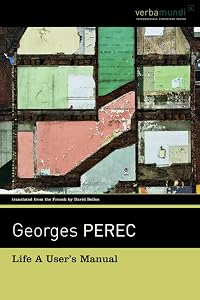
Life: A User's Manual
by Georges Perec
On This Page
Description
From the confessions of a racing cyclist to the plans of an avenging murderer, from a young ethnographer obsessed with a Sumatran tribe to an eccentric English millionaire, who has devised the ultimate pastime, Life: A User's Manual is a symphony of human irony, portraying the mixed marriages of fortunes, passions and despairs, betrayals and bereavements, of hundreds of lives in Paris and around the world. The apartment block's one hundred rooms are arranged in a magic square, and the book show more as a whole is peppered with a staggering range of literary puzzles and allusions, acrostics, and problems of chess and logic. All are there for the reader to solve. show lessTags
Recommendations













Member Recommendations
Cecrow Perec gives away its ending. Might want to read it first!
20

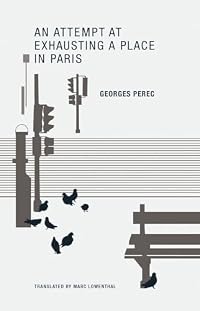
RuthD. In both books, there's a pursuit of suspending time, to document that which is lost, that which is on the verge of being lost, frozen into a past. Both are elliptical books, requiring concentration, attention, focus; both are deeply rewarding works of serious, emotionally-full literature.
Member Reviews
One of the most bizarre books I have ever read. I'm not sure how to describe it, or whether it deserves one star or whether it deserves more stars than any rating system can provide. Laboriously cataloguing the lives, possessions, pasts and futures of the residents and rooms of an entire Parisian apartment building, Perec weaves little threads of puzzles throughout a dense narrative. It can be heavy-going to read, but at the same time feels immensely rewarding, even when you're not quite sure what that reward is.
Okay, this is the vaguest review I have EVER written, but I'm at a loss for words. It's certainly an astounding achievement, but I might need a few decades to figure out why I liked it... or even IF I did!
Okay, this is the vaguest review I have EVER written, but I'm at a loss for words. It's certainly an astounding achievement, but I might need a few decades to figure out why I liked it... or even IF I did!
In 1977, NASA launched two space probes, Voyager 1 and Voyager 2, and sent them hurtling off into the cosmos to gather data on the planets and their moons and whatever else there was to be found. Both probes have officially entered interstellar space, out beyond the solar system, and Voyager 1 is currently the manmade object that has travelled furthest from Earth.
The probes were each carrying, aboard all their scientific instruments and delicate data-collecting architecture, a record made entirely of gold.
They're intended as a message for any extraterrestrials which may come across them, encoded with all sorts of information meant to display what life on Earth is like: people speaking various languages, sounds of thunder and ocean show more waves and rain and wind, birdsong, laughter, music from J.S. Bach to Chuck Berry; photos representing scientific discoveries, architecture, food, landscapes, portraits, scenes of daily life.
Per Carl Sagan's Billions and Billions: Thoughts on Life and Death at the Brink of the Millennium,
While it would've been impossible to do so—the probes were launched in 1977 and the book published a year later—I would've included Georges Perec's Life: A User's Manual somewhere on the Golden Record. Le Monde called it the novel of the decade but I'd go even further into senseless hyperbole and call it the novel of the century. It doesn't have a great recognition factor compared to other books (say, The Quran or The Collected Works of Shakespeare). And, as opposed to a book that's more representative of humanity as a whole, it's incredibly specific, entirely taking place within an apartment building in Paris' XVII arondissement on June 23rd, 1975 around 8PM—its cultural references are niche and occasionally intentionally abstruse. So why would I place it on the single furthest relic from Earth as an offering to the extraterrestrials to understand mankind?
I think it encompasses more of that indescribable thing called Life than encyclopaedias four times as thick. In its remarkable specificity and astounding level of detail, it somehow hits upon themes and subjects that are so universal and crucial.
Naturally, a book like this doesn't lend itself well to summation. I wouldn't even know where to begin. The Goodreads description calls it "an unclassified masterpiece" and... yeah, that pretty much sums it up. In a way, it touches nearly every genre. The literary structure of Life: A User's Manual is, essentially, a collection of descriptions of apartments in a building, broken up by anecdotes connected to these descriptions (the summary of a book somebody is reading, a character's family history, what became of a room's previous tenants). Imagine a massive, intricately detailed still life, a cross-section frozen in time, reality paused and coolly picked apart. These anecdotes range from the hilarious to the tragic to the sweet to the flat-out absurd. A trapeze artist who refuses to come down from his perch; a wealthy couple who steals for libidinous pleasure; an autodidact who only discovers academia in midlife; a murder-suicide preceded by years of simmering revenge; a millionaire who succumbs to a shockingly complex scheme to rob him of his wealth. And then there are more quotidian stories: a motorcycle accident; a raucous birthday party; a group of friends stuck in the lift; a woman slowly losing her mind to dementia. Both of these, the dramatic and the mundane, are the sorts of scenes that make up our lives in all their patchwork mess of love, beauty, boredom, misfortune, triumph, quiet fortitude...
It's difficult to convey just how precisely Perec crafts this place, its residents, its interiors and its rumours and its history. He seems obsessed with lists. We read an exhaustively enumerated list comprising the contents of a wine cellar, pages of sale listings in a hardware catalog, entire letters, a survey of the remnants left on the floor the morning after a party (a chapter that I inexplicably loved, although it's essentially just a list of various old foods and misplaced ties and crumpled wrapping paper). He specifies the exact shade and hue and texture of a couch, the precise size and cut of a ring, the appearance and history behind any piece of art hung on a wall. Rarely is one person noted and left alone; often we will hear about their father, grandfather, their unlucky great-great aunt, the circumstances regarding their brother's will; or their relation to other tenants, the concierge they particularly dislike because of some long-ago tiff or the baby they give to the cleaning lady to watch or their jaunty steps down the stairs as they take down the garbage bags.
This book presents such a close facsimile to real life with its texture and detail that we're left with the question: Why read this book at all?
You could just as easily take a minuscule survey of your own house or apartment complex, its history, the stories of its inhabitants, their family trees, the minute details of its decor and architecture, set it in an imitation of Perec's voice, and it would likely look a lot like Life: A User's Manual. In fact, there were many times I looked something up that was mentioned in the book only to find that Perec had completely fabricated it, and done it so masterfully that it didn't cross my mind for a second that, for example, the supposedly storied Carel van Loorens was not a real man at all. Which begs the same question I mentioned before. Why read a book that so cunningly imitates real life without being literally real? (That is to say that the apartment building it describes does not exist, nor in fact does Rue Simon-Crubellier, the street on which Perec places it.)
I don't know. I don't know why we read fiction that's close enough to reality that it becomes virtually indistinguishable. But it doesn't feel pointless, somehow; it feels like an exercise in empathy, in rediscovering the beauty in the mundane and the endless complexity and strangeness of fellow human beings: their obsessions, pathologies, dreams, fears, hobbies, losses, hopes. I can't give you a good reason to read this book or any book like it (if books remotely like it do indeed exist). I can just tell you that I read it and adored it and feel like a better person for having done so—these are the easiest five stars I've ever given. show less
The probes were each carrying, aboard all their scientific instruments and delicate data-collecting architecture, a record made entirely of gold.
They're intended as a message for any extraterrestrials which may come across them, encoded with all sorts of information meant to display what life on Earth is like: people speaking various languages, sounds of thunder and ocean show more waves and rain and wind, birdsong, laughter, music from J.S. Bach to Chuck Berry; photos representing scientific discoveries, architecture, food, landscapes, portraits, scenes of daily life.
Per Carl Sagan's Billions and Billions: Thoughts on Life and Death at the Brink of the Millennium,
The Golden Record also carries an hour-long recording of the brainwaves of Ann Druyan. During the recording of the brainwaves, Druyan thought of many topics, including Earth's history, civilizations and the problems they face, and what it was like to fall in love.
While it would've been impossible to do so—the probes were launched in 1977 and the book published a year later—I would've included Georges Perec's Life: A User's Manual somewhere on the Golden Record. Le Monde called it the novel of the decade but I'd go even further into senseless hyperbole and call it the novel of the century. It doesn't have a great recognition factor compared to other books (say, The Quran or The Collected Works of Shakespeare). And, as opposed to a book that's more representative of humanity as a whole, it's incredibly specific, entirely taking place within an apartment building in Paris' XVII arondissement on June 23rd, 1975 around 8PM—its cultural references are niche and occasionally intentionally abstruse. So why would I place it on the single furthest relic from Earth as an offering to the extraterrestrials to understand mankind?
I think it encompasses more of that indescribable thing called Life than encyclopaedias four times as thick. In its remarkable specificity and astounding level of detail, it somehow hits upon themes and subjects that are so universal and crucial.
Naturally, a book like this doesn't lend itself well to summation. I wouldn't even know where to begin. The Goodreads description calls it "an unclassified masterpiece" and... yeah, that pretty much sums it up. In a way, it touches nearly every genre. The literary structure of Life: A User's Manual is, essentially, a collection of descriptions of apartments in a building, broken up by anecdotes connected to these descriptions (the summary of a book somebody is reading, a character's family history, what became of a room's previous tenants). Imagine a massive, intricately detailed still life, a cross-section frozen in time, reality paused and coolly picked apart. These anecdotes range from the hilarious to the tragic to the sweet to the flat-out absurd. A trapeze artist who refuses to come down from his perch; a wealthy couple who steals for libidinous pleasure; an autodidact who only discovers academia in midlife; a murder-suicide preceded by years of simmering revenge; a millionaire who succumbs to a shockingly complex scheme to rob him of his wealth. And then there are more quotidian stories: a motorcycle accident; a raucous birthday party; a group of friends stuck in the lift; a woman slowly losing her mind to dementia. Both of these, the dramatic and the mundane, are the sorts of scenes that make up our lives in all their patchwork mess of love, beauty, boredom, misfortune, triumph, quiet fortitude...
"Sometimes Valène dreamt of cataclysms and tempests, of whirlwinds that could carry the whole house off like a wisp of straw and display the infinite marvels of the solar system to its shipwrecked inhabitants; or that an unseen crack would run through the building from top to bottom, like a shiver, and with a long, deep, snapping sound it would open in two and be slowly swallowed up in an indescribable yawning chasm; then hordes would overrun it, bleary-eyed monsters, giant insatiable mouths: the wood would crumble, the stone would turn to sand, the cupboards would collapse under their own weight, all would return to dust." (p. 219)
It's difficult to convey just how precisely Perec crafts this place, its residents, its interiors and its rumours and its history. He seems obsessed with lists. We read an exhaustively enumerated list comprising the contents of a wine cellar, pages of sale listings in a hardware catalog, entire letters, a survey of the remnants left on the floor the morning after a party (a chapter that I inexplicably loved, although it's essentially just a list of various old foods and misplaced ties and crumpled wrapping paper). He specifies the exact shade and hue and texture of a couch, the precise size and cut of a ring, the appearance and history behind any piece of art hung on a wall. Rarely is one person noted and left alone; often we will hear about their father, grandfather, their unlucky great-great aunt, the circumstances regarding their brother's will; or their relation to other tenants, the concierge they particularly dislike because of some long-ago tiff or the baby they give to the cleaning lady to watch or their jaunty steps down the stairs as they take down the garbage bags.
This book presents such a close facsimile to real life with its texture and detail that we're left with the question: Why read this book at all?
You could just as easily take a minuscule survey of your own house or apartment complex, its history, the stories of its inhabitants, their family trees, the minute details of its decor and architecture, set it in an imitation of Perec's voice, and it would likely look a lot like Life: A User's Manual. In fact, there were many times I looked something up that was mentioned in the book only to find that Perec had completely fabricated it, and done it so masterfully that it didn't cross my mind for a second that, for example, the supposedly storied Carel van Loorens was not a real man at all. Which begs the same question I mentioned before. Why read a book that so cunningly imitates real life without being literally real? (That is to say that the apartment building it describes does not exist, nor in fact does Rue Simon-Crubellier, the street on which Perec places it.)
I don't know. I don't know why we read fiction that's close enough to reality that it becomes virtually indistinguishable. But it doesn't feel pointless, somehow; it feels like an exercise in empathy, in rediscovering the beauty in the mundane and the endless complexity and strangeness of fellow human beings: their obsessions, pathologies, dreams, fears, hobbies, losses, hopes. I can't give you a good reason to read this book or any book like it (if books remotely like it do indeed exist). I can just tell you that I read it and adored it and feel like a better person for having done so—these are the easiest five stars I've ever given. show less
A series of scenes, snapshots of the same moment in time (almost 8:00 p.m. on June 23, 1975) in each room of an apartment complex in Paris, presented in a generally random order. I thought to read it as a series of short stories with some interlinking, but it doesn't really lend itself to that. For one thing, 'scenes' is a better descriptor than stories since there is practically no dialogue in these. For another, Perec explicitly opens with an essay about jigsaw puzzles, describing how each piece on its own reveals nothing until it is made part of the whole. It would be possible to 'sort' the pieces based on chapter headings, but even then you would not succeed at getting the entire story for any one character that way since some bits show more about their lives appear in other chapters; thus the pieces may be said to interlink.
Like any story told out of order, perceiving the whole in all its detail is possible but in this case requires more powers of memory and observation than I can bring to bear (I'm not terribly good at either.) An index is offered as an aid, but it runs to sixty pages. Perec at least somewhat relieves the task he's set by using straightforward language, making his pieces plain though very detailed, and he adds entertainment value to what threatens to be dry content with several nested stories that illuminate the occupants while also delving into the lives of several former residents and the building's history.
Why so many descriptions of the artworks in each room? I see a parallel between these and Perec's frozen-in-time rooms themselves; he is painting with literature. Laurence Sterne would have some satiric things to say about this, but Perec shows us the advantage of his medium: he can give us the backstory behind the scene, or at least clues with which to piece that backstory together. This metaphor also suggests a parallel between Perec and the declared aim of Bartlebooth as described in Chapter 26. He has made it his aim to produce scenes which can be perceived as puzzle pieces, that may be brought together to make a whole (a novel), but that whole does not need to have any ultimately deeper meaning in order to achieve his aesthetic aim.
The book offers another lesson or reminder; the mystery of the enormous variety in others' lives with which we are surrounded in our urban environments, as when you pass a few dozen cars on the freeway and have the idle thought of wondering about the business of each. I feel certain that Michael Hutchence was inspired by Perec when he co-wrote "The Stairs" for INXS. It is a melancholy song about isolation in the midst of a crowded space, a kind of starvation surrounded by plenty. Some of the song's lines are cribbed from this novel's opening scene (which is even titled "On the Stairs"). Conversely, Perec's denizens who surround one another are all explicitly linked together in some way, although what the whole looks like is left even more a mystery to them than it is to us. Hutchence and Perec reach the same conclusion, but Perec doesn't see any problem. His stairs, his entire building, is an end in itself that you are welcome to simply wash your mind clean of once more, like the empty building outline which Valene leaves behind. show less
Like any story told out of order, perceiving the whole in all its detail is possible but in this case requires more powers of memory and observation than I can bring to bear (I'm not terribly good at either.) An index is offered as an aid, but it runs to sixty pages. Perec at least somewhat relieves the task he's set by using straightforward language, making his pieces plain though very detailed, and he adds entertainment value to what threatens to be dry content with several nested stories that illuminate the occupants while also delving into the lives of several former residents and the building's history.
Why so many descriptions of the artworks in each room? I see a parallel between these and Perec's frozen-in-time rooms themselves; he is painting with literature. Laurence Sterne would have some satiric things to say about this, but Perec shows us the advantage of his medium: he can give us the backstory behind the scene, or at least clues with which to piece that backstory together. This metaphor also suggests a parallel between Perec and the declared aim of Bartlebooth as described in Chapter 26. He has made it his aim to produce scenes which can be perceived as puzzle pieces, that may be brought together to make a whole (a novel), but that whole does not need to have any ultimately deeper meaning in order to achieve his aesthetic aim.
The book offers another lesson or reminder; the mystery of the enormous variety in others' lives with which we are surrounded in our urban environments, as when you pass a few dozen cars on the freeway and have the idle thought of wondering about the business of each. I feel certain that Michael Hutchence was inspired by Perec when he co-wrote "The Stairs" for INXS. It is a melancholy song about isolation in the midst of a crowded space, a kind of starvation surrounded by plenty. Some of the song's lines are cribbed from this novel's opening scene (which is even titled "On the Stairs"). Conversely, Perec's denizens who surround one another are all explicitly linked together in some way, although what the whole looks like is left even more a mystery to them than it is to us. Hutchence and Perec reach the same conclusion, but Perec doesn't see any problem. His stairs, his entire building, is an end in itself that you are welcome to simply wash your mind clean of once more, like the empty building outline which Valene leaves behind. show less
A perplexidade nos envolve nessa leitura a todo momento. São centenas (mesmo!!) de histórias entrelaçadas que tem em comum um prédio em Paris. Algumas tão loucas e improváveis que no final percebemos que não, que a vida é que é mesmo louca e improvável. São contadas como um inventário de fatos e coisas, como para um testamento metafísico ou um documentário para arqueólogos de séculos vindouros. Talvez contadas pelo próprio prédio com serenidade, uma certa ironia cínica e um pseudo desprendimento que demonstram o domínio que o autor possui da arte narrativa. A perplexidade nos é trazida pelos detalhes esmiuçados com ou sem importância, tudo é importante e nada é importante. Comentei com uma amiga arquiteta que show more seria um livro obrigatório para o profissional dessa área. O arquiteto veria que sua obra é apenas um objeto que dispara um processo que foge do controle, histórias, vidas, objetos que se encaixam como centenas de quebras cabeças que só servem para ser destruídos quando completados. Um fio condutor é sobre um personagem que pinta aquarelas que são transformadas em quebra-cabeças que são depois de anos montados e destruídos sistematicamente num projeto de vida. Como uma metáfora que a busca de sentido não tem sentido. É um bom livro para clubes de leitura, leituras em grupo pois cada história suscita muitas reflexões e considerações que se não são logo compartilhadas, correm o risco de serem soterradas nas próximas que vão se atropelando sem parar. Recomendo. show less
The book's formal structure is so clear as to constrict the plot into a straitjacket of character and description, but as such, is a tour throughout the shape of an apartment building. (This source was particularly useful in illuminating Perec's intent: http://wordaligned.org/knights-tour)
This was my first experience with a book generated by the mathematically preoccupied Oulipo movement. It provided the secondary kind of reading obsession: rather than spurring me off to the library for other Oulipo works, it gave me a need to try something similar. The intricacy of executing any such clever project would require the realization of my dreams for a novel built on many charts, many plans, many restrictions. It seems that I might be able show more to plan my way out of the mysteries of the long work, clarify the structure, and feel justified in the excessive number of words I write.
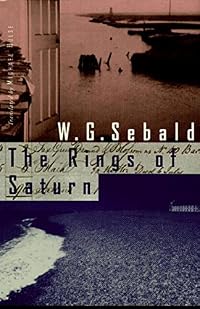
Related: between finishing this and writing about it, I've started Rings of Saturn, and realized my own obvious taste for books which use photos, diagrams, and reproductions inside them. It should have been easy to tell when I was younger and loved the American Girl scrapbook series, but after loving New Topics in Calamity Physics and The Scrapbook of Frankie Pratt, I cannot imagine how I missed the signs.
Anyway, to get to the meat of the review, Bellos' translation provides an exquisite hall of curiosities. His and Perec's efforts present the apartment building's inhabitants as if they're on display in a museum. The dramatic moment of the narrative (another clever conceit: the whole thing takes place in the space of five minutes) mimics the temporary intersection of audience and exhibit. The most scintillating sections of the book are the backstories, presented with the candor of an explanatory notecard next to the exhibit. Yet these stories go far, far further than any placard could, with the luxury of depth that his page count affords him. Because of his chosen timeframe, it's in these histories that the plot moves forward, although there are also details in his painstaking descriptions of environment that provide secrets about the characters.
I am reminded of those people who say that no book should be longer than 200 pages, and of other reviews I've read which suggest he could have sent half the manuscript through a wood chipper and come out better on the other side. But that would be a fundamentally different book.
I wish I had read this all in one go, and remembered all of it, and also been a good deal more clever so that I could catch more of Perec's jokes. show less
This was my first experience with a book generated by the mathematically preoccupied Oulipo movement. It provided the secondary kind of reading obsession: rather than spurring me off to the library for other Oulipo works, it gave me a need to try something similar. The intricacy of executing any such clever project would require the realization of my dreams for a novel built on many charts, many plans, many restrictions. It seems that I might be able show more to plan my way out of the mysteries of the long work, clarify the structure, and feel justified in the excessive number of words I write.
Related: between finishing this and writing about it, I've started Rings of Saturn, and realized my own obvious taste for books which use photos, diagrams, and reproductions inside them. It should have been easy to tell when I was younger and loved the American Girl scrapbook series, but after loving New Topics in Calamity Physics and The Scrapbook of Frankie Pratt, I cannot imagine how I missed the signs.
Anyway, to get to the meat of the review, Bellos' translation provides an exquisite hall of curiosities. His and Perec's efforts present the apartment building's inhabitants as if they're on display in a museum. The dramatic moment of the narrative (another clever conceit: the whole thing takes place in the space of five minutes) mimics the temporary intersection of audience and exhibit. The most scintillating sections of the book are the backstories, presented with the candor of an explanatory notecard next to the exhibit. Yet these stories go far, far further than any placard could, with the luxury of depth that his page count affords him. Because of his chosen timeframe, it's in these histories that the plot moves forward, although there are also details in his painstaking descriptions of environment that provide secrets about the characters.
I am reminded of those people who say that no book should be longer than 200 pages, and of other reviews I've read which suggest he could have sent half the manuscript through a wood chipper and come out better on the other side. But that would be a fundamentally different book.
I wish I had read this all in one go, and remembered all of it, and also been a good deal more clever so that I could catch more of Perec's jokes. show less
Gestalt.
In one magnificently loaded word, this novel of the postmodern Oulipo school sums up itself. A slow portrait of inhabitants, past and present, - the many puzzle pieces which in isolation,... means nothing -, of 11 Rue Simon-Crubellier, whose lives impacts each other with the subtle influences of everyday life built up over a lifetime. It describes in minute, exhaustive detail of a snapshot of the apartment in time - every item, every decor, every painting, every object in the painting - , using it as a launchpad into the complete history, again in vignette form, of all its characters,. And what characters they are! The entire novel is in the details and backstories of the characters, every little tidbit painstakingly show more contributing to the impossibly-elaborate Life. As the gimmicky title suggests, the novel has gargantuan ambitions - as evident by a useful comprehensive appendix with all the characters, anecdotes, places, etc, necessary due to the story's scope - which it fearlessly meets and breezily surpasses. Read it and let's all make Dinteville salad a global phenomenon. show less
In one magnificently loaded word, this novel of the postmodern Oulipo school sums up itself. A slow portrait of inhabitants, past and present, - the many puzzle pieces which in isolation,... means nothing -, of 11 Rue Simon-Crubellier, whose lives impacts each other with the subtle influences of everyday life built up over a lifetime. It describes in minute, exhaustive detail of a snapshot of the apartment in time - every item, every decor, every painting, every object in the painting - , using it as a launchpad into the complete history, again in vignette form, of all its characters,. And what characters they are! The entire novel is in the details and backstories of the characters, every little tidbit painstakingly show more contributing to the impossibly-elaborate Life. As the gimmicky title suggests, the novel has gargantuan ambitions - as evident by a useful comprehensive appendix with all the characters, anecdotes, places, etc, necessary due to the story's scope - which it fearlessly meets and breezily surpasses. Read it and let's all make Dinteville salad a global phenomenon. show less
Apparently it took him 9 years to write it, and I don't doubt it for a second - is considered Perec's masterpiece. And while it's not so much FUN as A Void, it's certainly impressive. This novel - if indeed it can be called a novel - is basically a literary jigsaw puzzle. The setting is a Paris apartment building with 99 rooms; the framework of the story is one single afternoon in 1975, and each of the 99 chapters describes what is happening - or not happening - in each room in this precise moment in time. In a way, the novel is sort of a mimeogram or whatever you want to call it; each chapter lists the objects found in each room - something which does, unfortunately, make the book a bit repetitive - as well as the people. One of show more Perec's most common themes, it seems, is memory; not just one person's memories, but the collective memories of a people (one of his novels, Je Me Souviens, is apparently made up entirely of sentences like "I remember [insert object/person/song/whatever]"). And the building in Life contains the flotsam and jetsam of the entire 19th and 20th centuries; people from all over Europe and all walks of life, the young and the old, the keepsakes of their ancestors, and of course the stories. Because each chapter also contains a short story - sometimes VERY short, sometimes tens of pages - describing how they got here, what other people they ran in to, the wars, the technology, the literature, the... well, all the facets of history, both personal and international.
Part of the framework is the story of one of the tenants, Bartlebooth, who as a bored young wealthy man sets himself what looks like a completely pointless task: he will spend 10 years learning how to paint, 20 years travelling around the world painting, then have his paintings sawed into jigsaw puzzles and spend the next 20 years laying those puzzles. After he's done, the paintings will be restored, shipped back to the places they were painted, and destroyed again so that nothing remains. And the entire novel IS a puzzle, one which takes much more than one read-through to complete; there are tons of interconnected storylines, objects that show up in several places, people that meet and influence each other's lives and then split apart again, circumstances ranging from the hilarious to the utterly tragic, and just... life. Someone said it was a book one could live in.
In a way, I suppose it's a story of how we see the world. Any three things, one of the character points out, can be seen as part of a pattern; any two jigsaw puzzle pieces can turn out to fit together. It's all about how we connect the dots. One read-through isn't nearly enough to connect them all, but I'm not sure if that's the point either; so many of the pieces - the stories - are beautiful/funny/fascinating in their own right, and I'm perfectly happy for now to have picked each one up, turned it around a couple of times, and put it in a pile next to some others that I think it might fit with. show less
Part of the framework is the story of one of the tenants, Bartlebooth, who as a bored young wealthy man sets himself what looks like a completely pointless task: he will spend 10 years learning how to paint, 20 years travelling around the world painting, then have his paintings sawed into jigsaw puzzles and spend the next 20 years laying those puzzles. After he's done, the paintings will be restored, shipped back to the places they were painted, and destroyed again so that nothing remains. And the entire novel IS a puzzle, one which takes much more than one read-through to complete; there are tons of interconnected storylines, objects that show up in several places, people that meet and influence each other's lives and then split apart again, circumstances ranging from the hilarious to the utterly tragic, and just... life. Someone said it was a book one could live in.
In a way, I suppose it's a story of how we see the world. Any three things, one of the character points out, can be seen as part of a pattern; any two jigsaw puzzle pieces can turn out to fit together. It's all about how we connect the dots. One read-through isn't nearly enough to connect them all, but I'm not sure if that's the point either; so many of the pieces - the stories - are beautiful/funny/fascinating in their own right, and I'm perfectly happy for now to have picked each one up, turned it around a couple of times, and put it in a pile next to some others that I think it might fit with. show less
Members
- Recently Added By
Published Reviews
The appendices to Life: a user's manual seem to me less appended than integrated parts of the narrative, so much of which consists in clues, patterns, linkages, quests and resolutions. To follow a character or place through the text via the index, checklist, chronology, is to be led to other people, places and topics; only in this 'second reading' may some of the threads in the tapestry stand show more out to delineate the pieces of a pattern which was there all along but perhaps not perceived. Do read this manylayered, multi-dimensional book; then play with the endmatter and discover more of it. show less
added by KayCliff
Lists

1001 Books You Must Read Before You Die
1,448 works; 1,131 members

The Guardian's 1000 Novels Everyone Must Read
1,005 works; 546 members

Recommend the 20 best books you've read in the last five years
2,168 works; 601 members

Le Monde - Les 100 livres du siècle
121 works; 25 members

Best of French Literature
138 works; 26 members

Favorite Long Books
330 works; 42 members

Top-Rated Books on LibraryThing
272 works; 116 members

Metafiction
84 works; 20 members
20th Century Literature
1,161 works; 54 members

The Top Ten: Writers Pick Their Favorite Books
240 works; 31 members

Top Five Books of 2013
1,562 works; 715 members

French Books
102 works; 15 members

EU Fiction: 1950-2022
223 works; 70 members

50 Tough Books for Extreme Readers
71 works; 38 members

Significant works of postmodern fiction
86 works; 25 members

Canon de la narrativa universal del siglo XX
254 works; 6 members

1970s
657 works; 23 members

Books I've Read More Than Once
602 works; 49 members

Top Five Books of 2020
982 works; 350 members

Experimental Literature
141 works; 18 members
LibraryThingers' 1001 Books You Must Read Before You Die
442 works; 30 members

One Book, Many Authors
441 works; 40 members

Time is out of joint
19 works; 3 members

Houses and Buildings as Characters in Fiction
182 works; 28 members
1,001 BYMRBYD Concensus
723 works; 27 members

A Novel Cure
742 works; 23 members
Five star books
1,755 works; 107 members
Paris, City of Lights
103 works; 17 members

Желаемое
5 works; 1 member

Maybe This Year? Books to Look Forward To
409 works; 9 members

Cooper
79 works; 1 member
E's Reader
30 works; 1 member

recommended
8 works; 1 member

Favorite Books in Translation
320 works; 133 members
Books We Want To Read Again For The First Time
384 works; 160 members
Widely acclaimed, one book per year
105 works; 3 members

Les 50 meilleurs livres de langue française de 1900 à aujourd’hui
69 works; 2 members
Canon de la narrativa universal del s. XX (cicutadry)
499 works; 3 members

Juggernauts (fiction)
21 works; 3 members

Mind-Benders: Fiction that Hurts Your Head
34 works; 8 members

My Favourite Books
86 works; 5 members

Books With the Most Memorable Titles
478 works; 158 members
Books With Our Favorite First Lines
168 works; 104 members

Mustich's 1000 Books to Read Before You Die: A Life Changing List
1,001 works; 18 members

Swinging Seventies
255 works; 16 members
.
396 works; 1 member
Talk Discussions
Past Discussions
Life A User's Manual: An Introduction in 75 Books Challenge for 2011 (August 2011)
Author Information

149+ Works 13,516 Members
Georges Perec was born in Paris on March 7, 1936 and was educated in Claude-Bernard and Geoffroy-Saint-Hilaire. Perec was a parachutist in the French Military before he began publishing his writing in magazines like Partisans. Perec also wrote the book, Life: A Users Manual. Perec is noted for his constrained writing: his 300-page novel La show more disparition (1969) is a lipogram, written without ever using the letter "e". Perec won the Prix Renaudot in 1965, the Prix Jean Vigo in 1974, the Prix Médicis in 1978. Georges Perec died on March 3, 1982. (Bowker Author Biography) show less
Some Editions
Awards and Honors
Awards
Notable Lists
Series
Belongs to Publisher Series
Verba Mundi Book (18)
Verba Mundi : Godine (18)
Work Relationships
Is contained in
Common Knowledge
- Canonical title
- Life: A User's Manual
- Original title
- La vie mode d'emploi
- Original publication date
- 1978 (French) (French); 1987 (English) (English)
- People/Characters
- Percival Bartlebooth; Blanche Altamont; Cyrille Altamont; Remi Rorschach; Serge Valene; Gaspard Winckler (show all 9); Mortimer Smautf; Marie-Therese Moreau; Gratiolet family
- Important places
- Paris, France
- Epigraph
- Look with all your eyes, look
(Jules Verne, Michael Strogoff) - Dedication
- to the memory of RAYMOND QUENEAU
- First words
- Preamble
To begin with, the art of jigsaw puzzles seems of little substance....
PART ONE, CHAPTER ONE
Yes, it could begin this way, right here, just like that, in a rather slow and ponderous way, in this... (show all) neutral place that belongs to all and none, where people pass by almost without seeing each other, where the life of the building regualrly and distantly resounds. - Last words
- (Click to show. Warning: May contain spoilers.)The canvas was practically blank: a few charcoal lines had been carefully drawn, dividing it up into regular square boxes, the sketch of a cross-section of a block of flats which no figure, now, would ever come to inhabit.
- Blurbers
- Taylor, Robert; Calvino, Italo; Eder, Richard; Auster, Paul; Burton-Page, Piers; Irwin, Robert (show all 14); Jones, Lewis; Sturrock, John; Bellos, David; Dulac, Philippe; Glendinning, Victoria; Adair, Gilbert; Kimberley, Nick; Flower, Desmond
- Original language
- French
- Canonical DDC/MDS
- 843.914
- Canonical LCC
- PQ2676.E67
Classifications
Statistics
- Members
- 4,251
- Popularity
- 3,555
- Reviews
- 66
- Rating
- (4.26)
- Languages
- 20 — Catalan, Czech, Danish, Dutch, English, Estonian, Finnish, French, German, Greek, Italian, Japanese, Norwegian (Bokmål), Polish, Portuguese, Russian, Slovenian, Spanish, Swedish, Turkish
- Media
- Paper, Ebook
- ISBNs
- 80
- ASINs
- 23