
Robyn Davidson
Author of Tracks
About the Author
Works by Robyn Davidson
Pistas 2 copies
Associated Works
Tagged
Common Knowledge
- Birthdate
- 1950-09-06
- Gender
- female
- Occupations
- writer
author
travel writer - Nationality
- Australia
- Birthplace
- Miles, Queensland, Australia
- Places of residence
- Brisbane, Queensland, Australia
London, England, UK
Sydney, New South Wales, Australia
Alice Springs, Northern Territory, Australia
Castlemaine, Victoria, Australia - Associated Place (for map)
- Australia
Members
Reviews
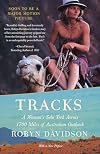
Non-fiction about Robyn Davidson’s 1977-1978 trip across the Australian desert, accompanied by four camels and a dog. During this trip, she developed capabilities she did not know she possessed as she crossed over 1700 miles, mostly by walking and occasionally riding one of the camels. She started her trip in Alice Springs and ended at the Indian Ocean. Along the way, she interacts with various people, animals, and pests.
Filled with novelties such as:
- How to train your camel
- What it’s show more like to own a pet crow (not recommended!)
- Surviving in the Australian Outback
And more traditional themes such as:
- A woman confronting a machismo culture
- Finding the inner strength to deal with external perils
- Self-discovery through suffering
- The nature of solitude
- Transcending social and self-imposed limitations
One of my favorite parts of the book is her descriptions of how she adapted to the vastness of the desert, the isolation, and the dreamlike state induced by endurance in an extreme environment. She developed creative solutions to the setbacks that inevitably occurred. She seemed to intuit at some level that her journey into the desert would change her for the better. I recognized her evolution from a somewhat immature and vulnerable person to an agent in her own life. I enjoyed reading the reasons she undertook such a trip, what she learned, and how it changed her. One of her goals was to become more familiar with the Aboriginal people, and she cogently illuminates their plight. Although she was not an author at that point, the book is filled with striking imagery of the desert.
Be advised that it includes a significant amount of abuse and harm to animals, along with racism and sexism. Recommended to fans of memoirs about personal challenges, travel-related adventures, endurance tests, or self-discovery. Overall, I found it an inspirational tale of a remarkable journey, both physically and psychologically.
Memorable quotes:
"To be free is to test yourself constantly, to gamble. It is not safe. I had learnt to use my fears as stepping stones rather than stumbling blocks..."
"Capacity for survival may be the ability to be changed by environment." show less
Filled with novelties such as:
- How to train your camel
- What it’s show more like to own a pet crow (not recommended!)
- Surviving in the Australian Outback
And more traditional themes such as:
- A woman confronting a machismo culture
- Finding the inner strength to deal with external perils
- Self-discovery through suffering
- The nature of solitude
- Transcending social and self-imposed limitations
One of my favorite parts of the book is her descriptions of how she adapted to the vastness of the desert, the isolation, and the dreamlike state induced by endurance in an extreme environment. She developed creative solutions to the setbacks that inevitably occurred. She seemed to intuit at some level that her journey into the desert would change her for the better. I recognized her evolution from a somewhat immature and vulnerable person to an agent in her own life. I enjoyed reading the reasons she undertook such a trip, what she learned, and how it changed her. One of her goals was to become more familiar with the Aboriginal people, and she cogently illuminates their plight. Although she was not an author at that point, the book is filled with striking imagery of the desert.
Be advised that it includes a significant amount of abuse and harm to animals, along with racism and sexism. Recommended to fans of memoirs about personal challenges, travel-related adventures, endurance tests, or self-discovery. Overall, I found it an inspirational tale of a remarkable journey, both physically and psychologically.
Memorable quotes:
"To be free is to test yourself constantly, to gamble. It is not safe. I had learnt to use my fears as stepping stones rather than stumbling blocks..."
"Capacity for survival may be the ability to be changed by environment." show less

Non-fiction about Robyn Davidson’s 1977-1978 trip across the Australian desert, accompanied by four camels and a dog. During this trip, she developed capabilities she did not know she possessed as she crossed over 1700 miles, mostly by walking and occasionally riding one of the camels. She started her trip in Alice Springs and ended at the Indian Ocean. Along the way, she interacts with various people, animals, and pests.
Filled with novelties such as:
- How to train your camel
- What it’s show more like to own a pet crow (not recommended!)
- Surviving in the Australian Outback
And more traditional themes such as:
- A woman confronting a machismo culture
- Finding the inner strength to deal with external perils
- Self-discovery through suffering
- The nature of solitude
- Transcending social and self-imposed limitations
One of my favorite parts of the book is her descriptions of how she adapted to the vastness of the desert, the isolation, and the dreamlike state induced by endurance in an extreme environment. She developed creative solutions to the setbacks that inevitably occurred. She seemed to intuit at some level that her journey into the desert would change her for the better. I recognized her evolution from a somewhat immature and vulnerable person to an agent in her own life. I enjoyed reading the reasons she undertook such a trip, what she learned, and how it changed her. One of her goals was to become more familiar with the Aboriginal people, and she cogently illuminates their plight. Although she was not an author at that point, the book is filled with striking imagery of the desert.
Be advised that it includes a significant amount of abuse and harm to animals, along with racism and sexism. Recommended to fans of memoirs about personal challenges, travel-related adventures, endurance tests, or self-discovery. Overall, I found it an inspirational tale of a remarkable journey, both physically and psychologically.
Memorable quotes:
"To be free is to test yourself constantly, to gamble. It is not safe. I had learnt to use my fears as stepping stones rather than stumbling blocks..."
"Capacity for survival may be the ability to be changed by environment." show less
Filled with novelties such as:
- How to train your camel
- What it’s show more like to own a pet crow (not recommended!)
- Surviving in the Australian Outback
And more traditional themes such as:
- A woman confronting a machismo culture
- Finding the inner strength to deal with external perils
- Self-discovery through suffering
- The nature of solitude
- Transcending social and self-imposed limitations
One of my favorite parts of the book is her descriptions of how she adapted to the vastness of the desert, the isolation, and the dreamlike state induced by endurance in an extreme environment. She developed creative solutions to the setbacks that inevitably occurred. She seemed to intuit at some level that her journey into the desert would change her for the better. I recognized her evolution from a somewhat immature and vulnerable person to an agent in her own life. I enjoyed reading the reasons she undertook such a trip, what she learned, and how it changed her. One of her goals was to become more familiar with the Aboriginal people, and she cogently illuminates their plight. Although she was not an author at that point, the book is filled with striking imagery of the desert.
Be advised that it includes a significant amount of abuse and harm to animals, along with racism and sexism. Recommended to fans of memoirs about personal challenges, travel-related adventures, endurance tests, or self-discovery. Overall, I found it an inspirational tale of a remarkable journey, both physically and psychologically.
Memorable quotes:
"To be free is to test yourself constantly, to gamble. It is not safe. I had learnt to use my fears as stepping stones rather than stumbling blocks..."
"Capacity for survival may be the ability to be changed by environment." show less
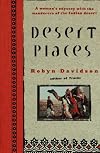
Travel, as a mountaineer once described mountain climbing, is “the conquest of nothing.” It is an absurd activity, and this you fully understand after reading Robyn Davidson. Tourism is part of the commodity logic of a market system; it has a clear and circumscribed place in that scheme of things, but travel the way Davidson does it is a kind of existentialist, degree zero activity, from which, however, you can actually learn something, because she is a good, vivid writer with neither show more false pride nor phony self-deprecation, willing to strip away layer after layer of her own illusions to try to get at whatever truth the experience has. What you learn in this book has a lot to do with the phenomenon of privilege without power, the sheer freakishness, that is a white woman’s experience when she tries to insert herself into the rigid hierarchies of poor, patriarchal worlds. But you also learn something about how extreme cultural and economic difference have stretched human solidarity almost to the breaking point of a completely insane each against all, and exhausted the natural world, and yet both continue to hold, so tenuously, the possibility of repair and renewal. And, in clear and compelling detail, the very particular way this unfolds in a tiny slice of the vast, complex societies of India. Yes, all that’s in here. You should read Robyn Davidson if you want to take a trip to somewhere very real. show less
Friday Flashback: Woman on a camel
Tracks: One Woman’s Journey Across 1,700 Miles of Australian Outback by Robyn Davidson (Open Road Media, $14.99 e-book).
A smash hit Down Under—and with adventure and travel readers all over—Robyn Davidson’s 1980 memoir of her 1977 camel-ride across the Australian desert has just been made into a film starring Mia Wasikowska.
And while the movie may be good, the book is fan-freaking-tastic. Long before Elizabeth Gilbert went off to find herself in show more food, spiritual seeking and new romance, Davidson went from Alice Springs to the Western Coast just, uh, because.
In short, she went for precisely the same reason that any man ever set off on an adventure: She wanted to do it. That she ended up writing about it for National Geographic, as well as this book, was rather incidental.
She off she went with her camels—she loves them, you can tell, though she doesn’t short her accounts of their disgusting, slimy camel spit. She had great fun in a stark and appealing landscape that few get the opportunity to appreciate, as well as cross-cultural encounters with the Aborigines—who probably understood her walkabout much better than most.
And she had more than a few bad turns: loneliness and self-doubt, a hip injury, a dog that she had to put down herself after it was poisoned.
Through it all, her writing is honest, compassionate, and most importantly of all, interesting. Ultimately, that’s what counts. show less
Tracks: One Woman’s Journey Across 1,700 Miles of Australian Outback by Robyn Davidson (Open Road Media, $14.99 e-book).
A smash hit Down Under—and with adventure and travel readers all over—Robyn Davidson’s 1980 memoir of her 1977 camel-ride across the Australian desert has just been made into a film starring Mia Wasikowska.
And while the movie may be good, the book is fan-freaking-tastic. Long before Elizabeth Gilbert went off to find herself in show more food, spiritual seeking and new romance, Davidson went from Alice Springs to the Western Coast just, uh, because.
In short, she went for precisely the same reason that any man ever set off on an adventure: She wanted to do it. That she ended up writing about it for National Geographic, as well as this book, was rather incidental.
She off she went with her camels—she loves them, you can tell, though she doesn’t short her accounts of their disgusting, slimy camel spit. She had great fun in a stark and appealing landscape that few get the opportunity to appreciate, as well as cross-cultural encounters with the Aborigines—who probably understood her walkabout much better than most.
And she had more than a few bad turns: loneliness and self-doubt, a hip injury, a dog that she had to put down herself after it was poisoned.
Through it all, her writing is honest, compassionate, and most importantly of all, interesting. Ultimately, that’s what counts. show less
Lists
Awards


You May Also Like


Associated Authors
Statistics
- Works
- 20
- Also by
- 13
- Members
- 1,705
- Popularity
- #15,047
- Rating
- 3.8
- Reviews
- 64
- ISBNs
- 98
- Languages
- 11
- Favorited
- 1