

Ralph Ellison (1913–1994)
Author of Invisible Man
About the Author
Ralph Ellison (March 1, 1914 - April 16, 1994) has the distinction of being one of the few writers who has established a firm literary reputation on the strength of a single work of long fiction. Writer and teacher, Ralph Ellison was born in Oklahoma City, studied at Tuskegee Institute, and has show more lectured at New York, Columbia, and Fisk universities and at Bard College. He received the Prix de Rome from the Academy of Arts and Letters in 1955, and in 1964 he was elected a member of the National Institute of Arts and Letters. He has contributed short stories and essays to various publications. Invisible Man (1952), his first novel, won the National Book Award for 1953 and is considered an impressive work. It is a vision of the underground man who is also the invisible African American, and its possessor has employed this subterranean view and viewer to so extraordinary an advantage that the impression of the novel is that of a pioneer work. A book of essays, Shadow and Act, which discusses the African American in America and Ellison's Oklahoma boyhood, among other topics, appeared in 1964. Ralph Ellison died on April 16, 1994 of pancreatic cancer and was interred in a crypt at Trinity Church Cemetery in the Washington Heights neighborhood of Upper Manhattan. (Bowker Author Biography) show less
Image credit: From Wikipedia
Works by Ralph Ellison
“Cadillac Flambé “ 1 copy
Associated Works
The Sound and the Fury, A Norton Critical Edition (1929) — Contributor, some editions — 2,053 copies, 22 reviews
Perrine's Literature: Structure, Sound, and Sense (1970) — Contributor, some editions — 893 copies, 4 reviews
Points of View: An Anthology of Short Stories, Revised & Updated Edition (1995) — Contributor — 443 copies, 7 reviews
Black Voices: An Anthology of Afro-American Literature (Mentor) (1968) — Contributor — 358 copies, 1 review
Adventures of Huckleberry Finn [Norton Critical Edition, 2nd ed.] (1977) — Contributor — 329 copies, 4 reviews
The Norton Anthology of African American Literature {2nd edition} (2003) — Contributor, some editions — 282 copies, 2 reviews
The Best Short Stories by Black Writers, 1899-1967: The Classic Anthology (1967) — Contributor — 200 copies, 1 review
The Mark Twain Anthology: Great Writers on His Life and Work (2010) — Contributor — 159 copies, 1 review
The Norton Anthology of American Literature, Volume 2: 1865 to Present (1979) — Contributor, some editions — 136 copies
Black on White: Black Writers on What It Means to Be White (1998) — Contributor — 129 copies, 2 reviews
Children of the Night: The Best Short Stories by Black Writers, 1967 to the Present (1995) — Contributor — 126 copies
The Glorious American Essay: One Hundred Essays from Colonial Times to the Present (2020) — Contributor — 118 copies
Calling the Wind: Twentieth Century African-American Short Stories (1992) — Contributor — 116 copies
Writing New York: A Literary Anthology (Expanded 10th-Anniversary Edition) (2008) — Contributor — 101 copies, 1 review
The Heath Anthology of American Literature, Concise Edition (2003) — Contributor — 73 copies, 1 review
Lapham's Quarterly - Lines of Work: Volume IV, Number 2, Spring 2011 (2011) — Contributor — 32 copies, 2 reviews
New World Writing: Fifth Mentor Selection - Fiction, Drama, Poetry, Criticism (1954) — Contributor — 9 copies
The Human Commitment - An Anthology of Contemporary Short Fiction — Contributor — 1 copy
The Ethnic Image in Modern American Literature, 1900-1950, Volumes 1-2 (1984) — Contributor — 1 copy
Tagged
Common Knowledge
- Canonical name
- Ellison, Ralph
- Legal name
- Ellison, Ralph Waldo
- Birthdate
- 1913-03-01
- Date of death
- 1994-04-16
- Gender
- male
- Education
- Tuskegee Institute
- Occupations
- novelist
short story writer
essayist
literary critic
photographer
sculptor (show all 7)
professor - Organizations
- United States Merchant Marine
Fellowship of Southern Writers (charter member)
Century Association
New York University - Awards and honors
- Presidential Medal of Freedom (1969)
Chevalier de l'Ordre des Arts et Lettres (1970)
Langston Hughes Medallion (1984)
National Medal of Arts (1985)
American Academy of Arts and Letters (Literature ∙ 1964)
National Book Award (1953) (show all 7)
Ansfield-Wolf Book Award (1992) - Short biography
- Born in Deep Deuce neighborhood of Oklahoma City.
- Cause of death
- pancreatic cancer
- Nationality
- USA
- Birthplace
- Oklahoma City, Oklahoma, USA
- Places of residence
- New York, New York, USA
Plainfield, Massachusetts, USA - Place of death
- New York, New York, USA
- Burial location
- Trinity Church Cemetery and Mausoleum, Washington Heights, Manhattan, New York, New York, USA
- Associated Place (for map)
- New York, USA
Members
Discussions
Anisha's Book Bits & Pieces, started April 2026 in Journey In Books (Yesterday 10:54am)
26Shorts2026: prompt --- set in North America in 26 Short Stories for 2026 (May 19)
***Group Read: Invisible Man Prologue & Chapters 1-12 in 1001 Books to read before you die (September 2010)
Reviews
Read it twice, fiercely written from the first page where the narrator looms out of his underworld existence to punch an angry white man in the face, then laughs at how absurd it must be to be beaten up by an invisible man. Also striking is the down south boxing and speech, and the by turns patronising and manipulative ways that the protagonist is used by white communists and artists as much as he is abused by outright racists, until the book reaches its climax in Harlem riots.

37. Invisible Man by Ralph Ellison
OPD: 1952
format: 596-page paperback (1995 edition)
acquired: February 2022 read: May 7 – Jun 12 time reading: 18:29, 1.9 mpp
rating: 5
genre/style: Classic novel theme: Richard Wright sorta
locations: Manhattan, circa 1930s? or maybe post-war.
about the author: 1913-1994. American writer and critic from in Oklahoma City, mostly famous for this novel.
What a monster of a book, laying out long gangly arms every which way, rolling as it wants, until suddenly there show more is structure and its slowly locks into a reality, and then stays there a long time, but not entirely. It pushes a little surreal one way, a little the other, wobbly between literary states. Ellison uses American communism to work his ideas of racism, blindness, and the truth of conformity as an argument used for power grabs. But it's gloriously complex while staying completely within reach. Long, wandering, and very powerful. Not sure what I expected, but this was certainly richer and more rewarding than whatever I imagined.
A plot summary, it opens in the present, with famous opening lines:
We never learn the man's name, or names. But after setting his underground Manhattan situation, he reflects back on his history, attending a Jim Crowe era southern black college, and being expelled for mishandling a white trustee's visit. Arriving and stumbling through Manhattan and especially Harlem. He becomes the spokesperson for a lightly disguised equivalent of the communist groups active in New York in the 1930's. Communists were the first only non-all-black group of this era to openly recruit black members and support black issues and equality. Most of the book is about his role in this organization, how they use him and he uses it, how he learns and manages his community. But his success brings unexpected responses and lessons. It's here, where equality is preached, racism and blindness stand out so clear, and incontrovertible. In many ways, this world falls apart.
This is a demanding, but smart, creative and rewarding 5-star read.
2023
https://www.librarything.com/topic/351556#8169193 show less
OPD: 1952
format: 596-page paperback (1995 edition)
acquired: February 2022 read: May 7 – Jun 12 time reading: 18:29, 1.9 mpp
rating: 5
genre/style: Classic novel theme: Richard Wright sorta
locations: Manhattan, circa 1930s? or maybe post-war.
about the author: 1913-1994. American writer and critic from in Oklahoma City, mostly famous for this novel.
What a monster of a book, laying out long gangly arms every which way, rolling as it wants, until suddenly there show more is structure and its slowly locks into a reality, and then stays there a long time, but not entirely. It pushes a little surreal one way, a little the other, wobbly between literary states. Ellison uses American communism to work his ideas of racism, blindness, and the truth of conformity as an argument used for power grabs. But it's gloriously complex while staying completely within reach. Long, wandering, and very powerful. Not sure what I expected, but this was certainly richer and more rewarding than whatever I imagined.
A plot summary, it opens in the present, with famous opening lines:
"I am an invisible man. No, I am not a spook like those who haunted Edgar Allan Poe; nor am I one of your Hollywood-movie ectoplasms. I am a man of substance, of flesh and bone, fiber and liquids -- and I might even be said to possess a mind. I am invisible, understand, simply because people refuse to see me."
We never learn the man's name, or names. But after setting his underground Manhattan situation, he reflects back on his history, attending a Jim Crowe era southern black college, and being expelled for mishandling a white trustee's visit. Arriving and stumbling through Manhattan and especially Harlem. He becomes the spokesperson for a lightly disguised equivalent of the communist groups active in New York in the 1930's. Communists were the first only non-all-black group of this era to openly recruit black members and support black issues and equality. Most of the book is about his role in this organization, how they use him and he uses it, how he learns and manages his community. But his success brings unexpected responses and lessons. It's here, where equality is preached, racism and blindness stand out so clear, and incontrovertible. In many ways, this world falls apart.
This is a demanding, but smart, creative and rewarding 5-star read.
2023
https://www.librarything.com/topic/351556#8169193 show less
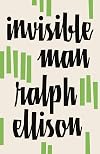
I'm deeply saddened that once again this is a book I wasn't introduced to until adulthood. I missed out on so many wonderful works of literature simply because of my proximity to whiteness. And though I'm rectifying it now, I wonder what younger me would have gained from the thoughts and themes around race and identity in this work. Would she have been less ashamed of her blackness? Would she have embraced being biracial sooner? We'll never know.

Invisible Man's nameless southern protagonist forces the reader to run the gamut of emotions: by turns we are frightened, touched, shocked, amused, even pitying and hopeful. When we first meet him, he lives on the hem of society in an unused part of the basement of a building for whites. He steals shelter and electricity like a boogeyman. He is truly invisible. There comes a point in time when he tries to reach the light by going to college only to be expelled after being accused of show more offending a white man. Invisible again. Through various trials and tribulations this nameless young man finally makes it to New York where he is confronted with the reality of his race. His lack of identity allows him to be mistaken for someone else. As he becomes more and more invisible, the more and more I wanted him to rage against it. The problem is, when you are a young black man trying to escape the white man's thumb in the 1940s, rage is the last emotion you are allowed to express. Every endeavor leads him closer to destruction. Like a horror movie, I wanted to read Invisible Man with one eye closed against all the gross misunderstandings prejudice and racism can bring. show less
Lists
Unread books (1)
AP Lit (1)
Favourite Books (1)
Obama Reads (1)
1950s (1)
Nifty Fifties (1)
. (1)
Florida (1)
Urban Fiction (1)
Black Authors (1)
Southern Fiction (1)
Overdue Podcast (1)
Existentialism (1)
My TBR (1)
Modernism (1)
Read These Too (1)
100 knjiga (1)
Best First Lines (1)
1940s (1)
ethnic history (1)
Fiction For Men (1)
Five star books (1)
A Novel Cure (1)
bound (1)
BitLife (1)
Fiction: BLM (1)
Awards


You May Also Like


Associated Authors
Statistics
- Works
- 22
- Also by
- 43
- Members
- 21,329
- Popularity
- #1,016
- Rating
- 4.0
- Reviews
- 272
- ISBNs
- 155
- Languages
- 15
- Favorited
- 58


