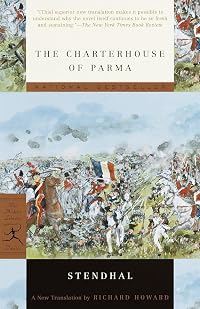
The Charterhouse of Parma
by Stendhal
On This Page
Description
Written in just fifty-two days in 1839, "The Charterhouse of Parma" has since become known as one of Stendhal's finest works. Evidence of haste is infrequently apparent in this remarkable story, which follows the eventful life of the young Italian nobleman Fabrizio del Dongo. From his childhood in the family castle by Lake Como to the battlefields of Waterloo, Fabrizio proves himself charmingly headstrong and painfully naïve. Upon returning injured to Italy, the young man begins to recover show more and pursue ill-fated amorous exploits while his well-intentioned aunt Gina tries to plan a successful career for him with the help of her lover Count Mosca. When a period of confinement in prison leads Fabrizio to meet the beautiful and passionate Clélia, Stendahl's amazing skill with psychological insight comes to the fore, testing the courage of his characters as never before. Considered by contemporary readers to be one of the greatest French novels of its time, "The Charterhouse of Parma" overflows with military feats, court intrigue, and romance that encapsulates both youthful excitement and the harsh realities that test happiness at every turn. show lessTags
Recommendations









Member Recommendations
P_S_Patrick These two books have a fair bit in common, though much is different between them too. They both are set in Italy and are concerned with court and family life, with politics, and the state of the country at the time they were written. The Charterhouse is set mainly in the north, around Milan, Parma, and Lake Como, near the Swiss border, in the first half of the 19th Century. The Leopard is set in the South, much of it in Sicily, starting over halfway through the 19th Century and ending in the next one. Stendhal writes dramatically about adventures and high emotions, whereas Lampedusa is far less baroque about it and writes with greater reserve and elegance. Together these books complement each other and give the reader a reasonably balanced view of Italian life over around a 100 years. Readers are likely to prefer one book over the other, but I am sure that if they enjoyed one they are very likely to enjoy the other. There are passages in the Charterhouse that outshine the best in the Leopard, but I prefer the latter due to it being nearer to perfection when taken as a whole.
50

Member Reviews
If you saw "Chartreuse de Parme" on a restaurant menu, you would probably wonder whether it was a liqueur, a cheese, or a dish with ham in it. As a novel, it seems almost as tricky to pin down. Like all great French 19th century novels it's about a young man on the make and the older woman who is hopelessly in love with him; it's also a picaresque 18th century story in which the plot is driven by incidents every bit as random as those in Tom Jones or Candide; it's a satirical description of Italian politics in a period when the country was run by wealthy men with huge egos and a complete contempt for proper legal process (no, not Berlusconi - this is the post-Waterloo era); and here and there it gives a stark, clear-sighted view of the show more cruelty and absurdity of the world that looks more like post-1918 than post-1815. It's hard to believe that Stendhal's description of Waterloo could have been written a century before Brecht's Mother Courage.
I think it is very much a writer's novel. There is some great material here, some passages (like the Waterloo chapters or the confrontation between Gina and the Prince) you will want to go back to over and over again, but there's also a lot of mess. You can see that it was a book written in a hurry: just like some of Scott's novels, there are passages where the pacing gets completely out of control, there are obvious afterthoughts, important characters who appear for the first time in the last twenty or thirty pages, and a scattering of minor inconsistencies and anachronisms in the text.
There is a tremendously French cynicism in Stendhal's world-view: the sympathetic characters are all amoral schemers of one sort or another, distinguished from the unsympathetic characters mainly in being less principled and more intelligent. No-one in this novel feels guilty for a moment about adultery or murder, and even less so about betraying family members, political principles, or the government they are members of. Even the innocent young romantic heroine is able to reconcile an adulterous relationship with her conscience by reasoning that she has merely promised not to see her lover (they only meet in the dark, so that's all right...).
A decade before 1848, Stendhal has no hesitation in telling us that absolutism and petty princes have had their day, but he doesn't hold out much hope for what will replace them. American republicanism is too dull for his taste, and the Italian liberals who appear in the story are either hypocrites or fools. show less
I think it is very much a writer's novel. There is some great material here, some passages (like the Waterloo chapters or the confrontation between Gina and the Prince) you will want to go back to over and over again, but there's also a lot of mess. You can see that it was a book written in a hurry: just like some of Scott's novels, there are passages where the pacing gets completely out of control, there are obvious afterthoughts, important characters who appear for the first time in the last twenty or thirty pages, and a scattering of minor inconsistencies and anachronisms in the text.
There is a tremendously French cynicism in Stendhal's world-view: the sympathetic characters are all amoral schemers of one sort or another, distinguished from the unsympathetic characters mainly in being less principled and more intelligent. No-one in this novel feels guilty for a moment about adultery or murder, and even less so about betraying family members, political principles, or the government they are members of. Even the innocent young romantic heroine is able to reconcile an adulterous relationship with her conscience by reasoning that she has merely promised not to see her lover (they only meet in the dark, so that's all right...).
A decade before 1848, Stendhal has no hesitation in telling us that absolutism and petty princes have had their day, but he doesn't hold out much hope for what will replace them. American republicanism is too dull for his taste, and the Italian liberals who appear in the story are either hypocrites or fools. show less
I don’t know what my expectations were, but certainly I never expected a soap-opera. A great soap-opera, though, that kept me intrigued by the most part.
I also did not expect the stream of consciousness, the lightness and the sense that Stendhal was breaking the writing rules, of his time and even of ours.
I cannot let go of the feeling that Stendhal would had been better under the guidance of a good editor. Some passages are too long, some are too short. Important information is thrown at us hidden in the third sentence in a paragraph that is a page long.
Yet, yet… maybe this is where the greatness of this book lies: in the breaking of the forms. I don’t know. ..
What I do know is that I enjoyed more than I expected.
I also did not expect the stream of consciousness, the lightness and the sense that Stendhal was breaking the writing rules, of his time and even of ours.
I cannot let go of the feeling that Stendhal would had been better under the guidance of a good editor. Some passages are too long, some are too short. Important information is thrown at us hidden in the third sentence in a paragraph that is a page long.
Yet, yet… maybe this is where the greatness of this book lies: in the breaking of the forms. I don’t know. ..
What I do know is that I enjoyed more than I expected.
(6) This was a bit of a slog for me especially at the beginning. This is the story of Fabrizio del Dongo and his beautiful aunt the Duchessa of Sanserverino. They live in the court of the duchy of Parma in post-napoleonic times where local passions and petty court power struggles obsess daily lives. It is hard to suss out who is who - liberal, Jacobins, Marcheses, Contis, etc., etc. seem to be bamboozling and inscrutable for the bulk of this book - but the central conflicts of unrequited love; unjust imprisionment; overwhelming passion win out and eventually one is sucked into the melodrama. The best part of the book is Fabrizio's imprisonment in the Farnese Tower and perhaps the only part I can say that I truly enjoyed.
I am not show more entirely sure why this novel is considered a classic and is in 1001 Books. . . It is melodramatic and uneven and I thought the prose was a bit all over the place. The ending was incredibly rushed (apparently this was forced on Stendhal by the publisher to save money?) and all was a bit unsatisfying. For me as I mentioned, it was saved by Fabrizio's time in the tower which was written with clarity, dramatic tension, and attention to setting and detail that made these scenes memorable and romantic.
I am not sure I will be in a hurry to read Stendhal's other classic 'The Red and the Black,' but I feel accomplished that I at least added another well regarded author to my reading repertoire. But in truth, this was just 'OK' for me and at times a bit of a chore. show less
I am not show more entirely sure why this novel is considered a classic and is in 1001 Books. . . It is melodramatic and uneven and I thought the prose was a bit all over the place. The ending was incredibly rushed (apparently this was forced on Stendhal by the publisher to save money?) and all was a bit unsatisfying. For me as I mentioned, it was saved by Fabrizio's time in the tower which was written with clarity, dramatic tension, and attention to setting and detail that made these scenes memorable and romantic.
I am not sure I will be in a hurry to read Stendhal's other classic 'The Red and the Black,' but I feel accomplished that I at least added another well regarded author to my reading repertoire. But in truth, this was just 'OK' for me and at times a bit of a chore. show less
A wise man once told me that when a soap opera was written more than 100 years ago, they call it "classic literature."
This soap opera set in northern Italy against the backdrop of the Napoleonic Wars veered from tedious to hilarious to gripping and back again. It's the story of the annoying Fabrizio del Dongo, younger son of a noble family, and his various military and romantic misadventures. Parts of it (the Battle of Waterloo, the escape from the Torre Farnese) were truly awesome. The political intrigues were funny, though it was hard to keep track of who all the factions were (everyone seems to have a family name, a first name, a nickname, and at least one title) and what they wanted (power, obviously, but how, and at whose show more expense?). Most of the time I enjoyed reading it. But I wished it were about 25% shorter. show less
This soap opera set in northern Italy against the backdrop of the Napoleonic Wars veered from tedious to hilarious to gripping and back again. It's the story of the annoying Fabrizio del Dongo, younger son of a noble family, and his various military and romantic misadventures. Parts of it (the Battle of Waterloo, the escape from the Torre Farnese) were truly awesome. The political intrigues were funny, though it was hard to keep track of who all the factions were (everyone seems to have a family name, a first name, a nickname, and at least one title) and what they wanted (power, obviously, but how, and at whose show more expense?). Most of the time I enjoyed reading it. But I wished it were about 25% shorter. show less
Wow! I had no idea what a page-turner this book was, despite the blurb on my copy from The New Yorker that says ""An epic tale of war, love, sex, politics, and religion . . . an action-packed narrative." Actually, there is less of war, despite early vivid scenes at the Battle of Waterloo, and much more of love, sex, and politics. In some ways, perhaps surprisingly, it is the politics that is the most interesting.
The novel starts with Fabrizio del Dongo's largely unhappy childhood and his passion for joining Napoleon's army, and then settles down to following the ups and downs of his fortunes; under the guidance and political shenanigans of his aunt, "the Duchess," and her lover Count Mosca, "the Count," who is a minister to the Prince show more of Parma, he obtains a high-ranking religious position despite being almost completely unsuited for a religious life. The Duchess is in love with Fabrizio, but he is a young man who loves chasing women but has never felt love himself. In the course of following an actress he has been involved with, he ends up killing her lover, an actor, and thus has to flee Parma. Many many complications ensue and eventually he is captured by subterfuge and confined to a fortress where, despite the ever-growing risk that he will be killed, either by the law or by poison, lo and behold, he falls genuinely in love for the first time -- with the jailer's daughter who, needless to say, has been promised to a rich man. Many many more complications ensue.
While Fabrizio is the ostensible hero of this tale, he is a somewhat colorless young man, and the characters who really stand out are the Duchess and the Count and the other schemers of the court of the Prince of Parma. The depth and breadth of their scheming, and especially the Count's interactions with the prince and others, are an endless delight, and involve, among other aspects, the Count's getting the Duchess married to someone else (that's when she becomes the Duchess), blackmail, poisoning, spying, escape schemes, and sexual favors given and withheld. Despite being quite the 19th century soap opera, this novel does explore serious topics, including the politics of not yet unified Italy, the role of petty princes and the nobility, the corruption of the church, what makes people act the way they do, and somewhat snide comparisons of the Italians (passionate) with the French (practical and ironic). Another theme Stendhal explores is how people reinvent themselves, as Fabrizio runs through several names and identities in the course of the novel, as do various other characters. In places, Stendhal (or his narrator, for he was "told" this tale by some Italian), addresses the reader, a very modern touch. (For example, "I fear that Fabrizio's credulity will deprive him of the reader's sympathy; but after all, this is what he was like, why flatter him more than any other man?")
I have had one copy of this book on the TBR since 1973, but apparently I forgot that I owned it and bought a new translation in 2000; that is the one I read. It is a Modern Library edition that is enhanced by several illustrations, as well as by Balzac's review of the book, Stendhal's response, and a New York Times Book Review review of this translation. While Balzac was largely enthusiastic, he made some criticisms which I found very apt about the beginning and end of the book. All in all, I can't believe it's taken me over 40 years to read it! show less
The novel starts with Fabrizio del Dongo's largely unhappy childhood and his passion for joining Napoleon's army, and then settles down to following the ups and downs of his fortunes; under the guidance and political shenanigans of his aunt, "the Duchess," and her lover Count Mosca, "the Count," who is a minister to the Prince show more of Parma, he obtains a high-ranking religious position despite being almost completely unsuited for a religious life. The Duchess is in love with Fabrizio, but he is a young man who loves chasing women but has never felt love himself. In the course of following an actress he has been involved with, he ends up killing her lover, an actor, and thus has to flee Parma. Many many complications ensue and eventually he is captured by subterfuge and confined to a fortress where, despite the ever-growing risk that he will be killed, either by the law or by poison, lo and behold, he falls genuinely in love for the first time -- with the jailer's daughter who, needless to say, has been promised to a rich man. Many many more complications ensue.
While Fabrizio is the ostensible hero of this tale, he is a somewhat colorless young man, and the characters who really stand out are the Duchess and the Count and the other schemers of the court of the Prince of Parma. The depth and breadth of their scheming, and especially the Count's interactions with the prince and others, are an endless delight, and involve, among other aspects, the Count's getting the Duchess married to someone else (that's when she becomes the Duchess), blackmail, poisoning, spying, escape schemes, and sexual favors given and withheld. Despite being quite the 19th century soap opera, this novel does explore serious topics, including the politics of not yet unified Italy, the role of petty princes and the nobility, the corruption of the church, what makes people act the way they do, and somewhat snide comparisons of the Italians (passionate) with the French (practical and ironic). Another theme Stendhal explores is how people reinvent themselves, as Fabrizio runs through several names and identities in the course of the novel, as do various other characters. In places, Stendhal (or his narrator, for he was "told" this tale by some Italian), addresses the reader, a very modern touch. (For example, "I fear that Fabrizio's credulity will deprive him of the reader's sympathy; but after all, this is what he was like, why flatter him more than any other man?")
I have had one copy of this book on the TBR since 1973, but apparently I forgot that I owned it and bought a new translation in 2000; that is the one I read. It is a Modern Library edition that is enhanced by several illustrations, as well as by Balzac's review of the book, Stendhal's response, and a New York Times Book Review review of this translation. While Balzac was largely enthusiastic, he made some criticisms which I found very apt about the beginning and end of the book. All in all, I can't believe it's taken me over 40 years to read it! show less
I started The Charterhouse of Parma about fifteen years ago and didn't get through the first chapter. This time I made it through that chapter which was still tough, through the next couple of chapters were perfectly readable but relatively compelling, but when about one-sixth of the way into the book Gina del Dongo (later Countess Pietrnera, then Duchess Sanseverina for the bulk of the book) comes into her own, Count Mosca is introduced, and the focus shifts to the Principality of Parma, the book really takes off. It becomes a combination of intrigue in the court of a petty despot, romance, adventure, and love story--all strung together with ironic detachment by a narrator who does not seem to have even decided who is the main show more character or what type of story he is telling. As such, it reads almost like a realistic and compiled chronicle of a period in Parma.
The politics are one part Machiavelli, but with the Prince occasionally restrained with the worry about how he will be depicted in the Paris newspapers. And the love triangle is borderline absurd, but it is compelling and moving nonetheless.
The essence of Stendhal's attitude in writing the book is best captured by this relatively rare piece of narrative commentary:
"But the reader may be somewhat weary of all these procedural details, no less than of all these court intrigues. From which one may draw this moral: that the man who comes near a court compromises his happiness, if he is happy, and in every case, makes his future depend on the intrigues of a chambermaid. On the other hand, in a republic like America you have to suffer the tedium of fawning upon the common shopkeepers all day long and becoming as stupid as they are; and over there, there‰Ãªs no opera." show less
The politics are one part Machiavelli, but with the Prince occasionally restrained with the worry about how he will be depicted in the Paris newspapers. And the love triangle is borderline absurd, but it is compelling and moving nonetheless.
The essence of Stendhal's attitude in writing the book is best captured by this relatively rare piece of narrative commentary:
"But the reader may be somewhat weary of all these procedural details, no less than of all these court intrigues. From which one may draw this moral: that the man who comes near a court compromises his happiness, if he is happy, and in every case, makes his future depend on the intrigues of a chambermaid. On the other hand, in a republic like America you have to suffer the tedium of fawning upon the common shopkeepers all day long and becoming as stupid as they are; and over there, there‰Ãªs no opera." show less
One of the best books I've read. Politics, action, humanism vs.conservatism, passion vs. lack of passion, lovers, rivals, extreme wealth and the values of aristocracy, all the characters with both good and bad actions and ways of thinking. Set in the autocratic monarchy of Parma in Italy between 1815 and 1830.
A fascinating exploration of what motivates people and how they act. The plot is held together by the stories of a brilliant, activist Duchess and her impetuous nephew, but includes many main characters. The author doesn't lead us to sympathize with any of them or choose one to root for--all pay the psychological price for their choices.
Early in the book, the plot turns to a long episode where the Fabrizio, the nephew, goes to show more France, hoping to fight for his hero, Napolean, who had earlier brought a short period of liberation from the autocracy, the Church, and Austrian influence. On his way, Fabrizio stumbles upon the battle at Waterloo. Stendhal's description of the confusion felt by an individual soldier during a battle is at least as good as Tolstoy's description of the Battle of Borodino in "War and Peace".
Amazing writing. show less
A fascinating exploration of what motivates people and how they act. The plot is held together by the stories of a brilliant, activist Duchess and her impetuous nephew, but includes many main characters. The author doesn't lead us to sympathize with any of them or choose one to root for--all pay the psychological price for their choices.
Early in the book, the plot turns to a long episode where the Fabrizio, the nephew, goes to show more France, hoping to fight for his hero, Napolean, who had earlier brought a short period of liberation from the autocracy, the Church, and Austrian influence. On his way, Fabrizio stumbles upon the battle at Waterloo. Stendhal's description of the confusion felt by an individual soldier during a battle is at least as good as Tolstoy's description of the Battle of Borodino in "War and Peace".
Amazing writing. show less
Members
- Recently Added By
Lists

The Guardian's 1000 Novels Everyone Must Read
1,005 works; 550 members

1001 Books You Must Read Before You Die
1,448 works; 1,134 members

Best of French Literature
138 works; 27 members

Favourite 19th century fiction
257 works; 62 members
501 Must-Read Books
529 works; 72 members

Books Set in Italy
167 works; 19 members

The Top Ten: Writers Pick Their Favorite Books
240 works; 31 members

Best Historical Fiction
620 works; 261 members

Favorite Long Books
330 works; 42 members

Top Five Books of 2013
1,562 works; 721 members

Philip Ward's Lifetime Reading Plan
592 works; 22 members
Best Political Fiction
92 works; 12 members

The Guardian's 100 greatest novels of all time
100 works; 16 members

19th Century
190 works; 16 members

Western World's Greatest Books - Project Gutenberg
295 works; 15 members
Books I've Read More Than Once
602 works; 49 members

War Literature
101 works; 19 members

Top Five Books of 2014
1,064 works; 398 members

LibraryThingers' 1001 Books You Must Read Before You Die
442 works; 30 members
Harold Bloom - The Western Canon: C. The Democratic Age
336 works; 15 members

1,001 BYMRBYD Concensus
723 works; 27 members

W. S. Maugham's Reading Suggestions for Spiritual Enrichment: Continental
19 works; 3 members
Jordan B. Peterson's Recommended Books
104 works; 5 members

Books Read in 2023
5,547 works; 145 members

Livres français
9 works; 1 member

SHOULD Read Books!
354 works; 9 members

CCE 1000 Good Books List
1,033 works; 12 members

Romans
49 works; 1 member

Books in The Club Dumas
72 works; 1 member

.
396 works; 1 member

Novels with a city or town in the title
61 works; 1 member

DigitalDreamDoor top 300
300 works; 4 members
Favorite Books in Translation
320 works; 133 members

Trinity College Booklist (1951): Class Nine, Foreign Literatures
161 works; 3 members

Recommended Reading : 600 Classics Reviewed, Editors of Salem Press, 2015
634 works; 6 members
Books We Love to Reread
688 works; 296 members

Greatest Books, allegedly
484 works; 9 members
How to Read a Book's Recommended Reading List
309 works; 10 members

Bibliografia essenziale
86 works; 2 members

Tagged 19th Century
104 works; 7 members

Französische Romantik
16 works; 1 member
Talk Discussions
Past Discussions
Group Read, July 2017: Charterhosue of Parma in 1001 Books to read before you die (August 2017)
Author Information

530+ Works 21,937 Members
One of the great French novelists of the nineteenth century, Stendhal (pseudonym for Marie-Henri Beyle) describes his unhappy youth with sensitivity and intelligence in his autobiographical novel The Life of Henri Brulard. It was written in 1835 and 1836 but published in 1890, long after his death. He detested his father, a lawyer from Grenoble, show more France, whose only passion in life was making money. Therefore, Stendhal left home as soon as he could. Stendhal served with Napoleon's army in the campaign in Russia in 1812, which helped inspire the famous war scenes in his novel The Red and the Black (1831). After Napoleon's fall, Stendhal lived for six years in Italy, a country he loved during his entire life. In 1821, he returned to Paris for a life of literature, politics, and love affairs. Stendhal's novels feature heroes who reject any form of authority that would restrain their sense of individual freedom. They are an interesting blend of romantic emotionalism and eighteenth-century realism. Stendhal's heroes are sensitive, emotional individuals who are in conflict with the society in which they live, yet they have the intelligence and detachment to analyze their society and its faults. Stendhal was a precursor of the realism of Flaubert. He once described the novelist's function as that of a person carrying a mirror down a highway so that the mirror would reflect life as it was, for all society. (Bowker Author Biography) show less
Some Editions
Awards and Honors
Notable Lists
Series
Belongs to Publisher Series
Anchor Books (1)
Modern Library Giant (isbn)
ET Tascabili [Einaudi] (298)
Gli struzzi [Einaudi] (105)
Gallimard, Folio Classique (3925)
The Phoenix Library (65)
GF Flammarion (1424)
insel taschenbuch (0307)
Le livre de poche (851-852)
Penguin Classics (L061)
Gallimard, Folio (155)
Work Relationships
Is contained in
Contains
Has as a study
Common Knowledge
- Canonical title
- The Charterhouse of Parma
- Original title
- La Chartreuse de Parme
- Original publication date
- 1839
- People/Characters
- Fabrizio Valserra, Marchesino del Dongo; Contessa Gina Pietranera; Clelia Conti
- Important places
- Milan, Lombardy, Italy; Parma, Emilia-Romagna, Italy; Waterloo, Walloon Brabant, Belgium; Naples, Campania, Italy; Italy; Lake Como, Lombardy, Italy
- Important events
- Georgian Era (1714 | 1837); Napoleonic Wars (1803 | 1815); Battle of Waterloo (1815-06-18)
- Related movies
- La Chartreuse de Parme (1948 | IMDb); La Certosa di Parma (1981 | IMDb)
- Epigraph*
- Già mi fur dolci inviti a empir le carte i luoghi ameni.
Ariosto, Satira IV - First words
- Le 15 mai 1796, le général Bonaparte fit son entrée dans Milan à la tête de cette jeune armée qui venait de passer le pont de Lodi, et d'apprendre au monde qu'après tant de siècles César et Alexandre avaient un succe... (show all)sseur.
- Quotations*
- Den latterlige form for mot som kalles resignasjon, det vil si en dåres mot når han lar seg henge uten protester, var overhodet ikke grevinnens stil.
Grev Mosca pleide å si at det var hennes vedvarende smil, kombinert med innvendige gjesp, som ga henne så mange rynker.
Politikk i et litterært verk er som et pistolskudd midt i en konsert, det vil si noe vulgært, men likevel umulig ikke å bli opptatt av.
Det er to ting å bemerke om hertuginnens karakter: Hun ville alltid det hun engang hadde villet, og tok aldri opp til ny vurdering det hun engang hadde bestemt. I den anledning pleide hun å sitere sin første mann, den elsk... (show all)elige general Pietranera: 'Hvilken frekkhet mot meg selv! Hvorfor skulle jeg tro at jeg er mer begavet i dag enn da jeg i sin tid tok denne beslutning?' - Last words
- (Click to show. Warning: May contain spoilers.)Les prisons de Parme étaient vides, le comte immensément riche, Ernest V adoré de ses sujets qui comparaient son gouvernement à celui des grands-ducs de Toscane.
(Click to show. Warning: May contain spoilers.)TO THE HAPPY FEW - Original language
- French
*Some information comes from Common Knowledge in other languages. Click "Edit" for more information.
Classifications
- Genres
- Fiction and Literature, General Fiction, Historical Fiction
- DDC/MDS
- 843.7 — Literature & rhetoric French Literature French fiction Constitutional monarchy 1815–48
- LCC
- PQ2435 .C4 .E5 — Language and Literature French, Italian, Spanish and Portuguese literatures French literature Modern literature 19th century
- BISAC
Statistics
- Members
- 4,977
- Popularity
- 2,814
- Reviews
- 82
- Rating
- (3.72)
- Languages
- 27 — Catalan, Czech, Danish, Dutch, English, Estonian, Finnish, French, German, Galician, Greek, Hebrew, Hungarian, Italian, Lithuanian, Norwegian (Bokmål), Norwegian, Polish, Romanian, Russian, Serbian, Slovak, Slovenian, Spanish, Swedish, Turkish, Portuguese (Portugal)
- Media
- Paper, Audiobook, Ebook
- ISBNs
- 335
- UPCs
- 1
- ASINs
- 195