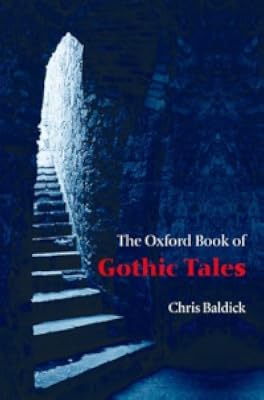
The Oxford Book of Gothic Tales
by Chris Baldick (Editor)
Oxford Books of Prose and Verse, Oxford Books of Prose
On This Page
Description
Brimming with tales of terror, suspense, and the uncanny, this work offers the first collection devoted to the Gothic genre. Each story contains the common elements of the gothic tale--a warped sense of time, a claustrophobic setting, a link to archaic modes of thought, and the impression of a descent into disintegration. Yet taken together, they reveal the progression of the genre from stories of feudal villains amid crumbling ruins to a greater level of sophistication in which writers show more brought the gothic tale out of its medieval setting, and placed it in the contemporary world. Bringing together the work of such writers as Eudora Welty, Thomas Hardy, Edgar Allan Poe, William Faulkner, Arthur Conan Doyle, Joyce Carol Oates, and Jorge Luis Borges, The Oxford Book of Gothic Tales presents a wide array of the sinister and unsettling for all lovers of ghost stories, fantasy, and horror. show lessTags
Recommendations
















Member Reviews
Baldick's smart, lively introduction alone makes this book a must-have for committed aficionados of the Gothic and dabblers in the supernatural tale alike. Baldick traces the tangled histories of all things Gothic, carefully yet wittily showing how the term has had radically different meanings over time. Indeed, the anachronistic variations in the meaning of "Gothic" produce the paradox that the "literary Gothic is really anti-Gothic," or at least strongly prejudiced against the European Middle Ages. In other words, the Gothic novel bodies forth an "ingrained distrust of medieval civilization," and it represents "the past primarily in terms of tyranny and superstition."
The first few stories in the volume, examples of the Gothic tale of show more the later eighteenth century, are violent and violently compressed narratives that move from danger to dismemberment and death within a few short pages.
Teachers of eighteenth-century fiction will find the first few stories particularly wonderful for classroom use.
Readers in search of the original publication history of the included narratives are advised to turn to the Notes at the end of the volume. show less
The first few stories in the volume, examples of the Gothic tale of show more the later eighteenth century, are violent and violently compressed narratives that move from danger to dismemberment and death within a few short pages.
Teachers of eighteenth-century fiction will find the first few stories particularly wonderful for classroom use.
Readers in search of the original publication history of the included narratives are advised to turn to the Notes at the end of the volume. show less
I will be straight with you, I dislike short stories; they're too short, you can't get into them before they're over, their brevity can't provide proper fleshed-out details, and they very often have fairly depressing resolutions—it seems somehow to be in their very nature. However, shortcomings aside, they make for good introductions into distinctive types of literature that one hasn't properly explored before. A good collection of short stories gives a glimpse into the style and characteristic features commonly found, and generally give someone at least a few ideas of authors to look further into. Hence, I will occasionally read some collections (also those of authors I especially enjoy, but I hate when they write them and make me show more read them! :P). And since I've read very little Gothic fiction but am very interested in it, especially the earlier prominent works, I figured I woul brave the evils of the short story and utilize this as a first real introduction.
I especially appreciated the introduction to this anthology; Baldick provided a nice detailed explanation of what makes Gothic literature, its origins, and background. This is rather complex and there's lots of details people disagree about (does it need to have X or Y, etc), but he does a nice job of laying out the fundamentals and giving readers a clear idea of what Gothic means. As for the stories, well, I'm sure Baldick had his reasons for choosing the stories he did, but a handful of them I just did not see the value of. I imagine this is partially due to my natural distate of short stories, but a few of them just didn't go anywhere at all. That said, there were definitely some good stories in this collection. One that sticks out especially much in my mind is The Yellow Wall-Paper by Charlotte Perkins Stetson. I don't know that she actually meant any of it to be humorous, but some of her descriptions of what was going on had me laughing out loud. It was not a light-hearted tale, to be sure, but her wit in the text clearly shines. And while I don't enjoy all of Stevenson's tales, I found his Olalla to be quite interesting. These were not the only stories I enjoyed, of course, but they're the two that have really stuck with me the most. There were a bunch more I am glad to have read, though.
So. In the end, in spite of my general lack of favor, I gave this collection four stars. Since I don't care for short stories, my view on them often tends to be rather skewed to the negative; so I rounded up a bit for balance. Maybe that's silly, but I know I judge short stories more harshly than is really warranted plenty of the time.
For fans of Gothic fiction, and/or short stories, I'd suggest giving this collection a shot. show less
I especially appreciated the introduction to this anthology; Baldick provided a nice detailed explanation of what makes Gothic literature, its origins, and background. This is rather complex and there's lots of details people disagree about (does it need to have X or Y, etc), but he does a nice job of laying out the fundamentals and giving readers a clear idea of what Gothic means. As for the stories, well, I'm sure Baldick had his reasons for choosing the stories he did, but a handful of them I just did not see the value of. I imagine this is partially due to my natural distate of short stories, but a few of them just didn't go anywhere at all. That said, there were definitely some good stories in this collection. One that sticks out especially much in my mind is The Yellow Wall-Paper by Charlotte Perkins Stetson. I don't know that she actually meant any of it to be humorous, but some of her descriptions of what was going on had me laughing out loud. It was not a light-hearted tale, to be sure, but her wit in the text clearly shines. And while I don't enjoy all of Stevenson's tales, I found his Olalla to be quite interesting. These were not the only stories I enjoyed, of course, but they're the two that have really stuck with me the most. There were a bunch more I am glad to have read, though.
So. In the end, in spite of my general lack of favor, I gave this collection four stars. Since I don't care for short stories, my view on them often tends to be rather skewed to the negative; so I rounded up a bit for balance. Maybe that's silly, but I know I judge short stories more harshly than is really warranted plenty of the time.
For fans of Gothic fiction, and/or short stories, I'd suggest giving this collection a shot. show less
The stories are great, but what makes it a five-star book is the introduction, which explains where gothic came from, what it originally tried to do, how its viewpoint survives, and what cultures it thrives in.
The Gothic tale has been with us for over two hundred years, but this collection is the first to illustrate the continuing strength of this special fictional tradition from the late eighteenth century to the present day. Gothic fiction is generally identified with Horace Walpole's Castle of Otranto and the works of Ann Radcliffe, and with heroes and heroines menaced by feudal villains amid crumbling ruins. While the repertoire of claustrophobic settings, gloomy themes, and threatening atmosphere established the Gothic genre, later writers from Poe onwards achieved an ever greater sophistication, and a shift in emphasis from cruelty to decadence. Modern Gothic is distinguished by its imaginative variety of voice, from the chilling show more depiction of a disordered mind to the sinister suggestion of vampirism. This anthology brings together the work of writers such as Le Fanu, Hawthorne, Hardy, Faulkner, and Borges with their earliest literary forebears, and emphasizes the central role of women writers from Anna Laetitia Aikin to Isabel Allende. While the Gothic tale shares some characteristics with the ghost story and tales of horror and fantasy, the present volume triumphantly celebrates the distinctive features that define this powerful and unsettling literary form. show less
This collection of short stories is an excellent overview of the gothic genre, from its inception in the late Eighteenth Century to the modern era.
In the introduction, Baldick explains what the gothic genre is. The stories selected were obviously selected with care and are all great examples. They are organized by date, from earliest to the present, making it easy to see how the genre has evolved over time.
My personal favorites were the Speckled Band by Arthur Conan Doyle and Hurst of Hurstcote by E. Nesbit, although I thoroughly enjoyed almost all of the stories. I'm still trying to figure out Secret Observations of the Goat-Girl by Joyce Carol Oates. That was decidedly odd - even for a gothic tale!
I have to say that I had a lot of fun show more reading this! show less
In the introduction, Baldick explains what the gothic genre is. The stories selected were obviously selected with care and are all great examples. They are organized by date, from earliest to the present, making it easy to see how the genre has evolved over time.
My personal favorites were the Speckled Band by Arthur Conan Doyle and Hurst of Hurstcote by E. Nesbit, although I thoroughly enjoyed almost all of the stories. I'm still trying to figure out Secret Observations of the Goat-Girl by Joyce Carol Oates. That was decidedly odd - even for a gothic tale!
I have to say that I had a lot of fun show more reading this! show less
A massive collection of stories spanning the history of gothic fiction. Tragic, strange, dark and grim, the stories are varied in length and structure, and will give you hours of sinister entertainment. It's sometimes hard to define what a gothic tale is, but reading this book will give you an understanding of the genre.
Ratings
Members
- Recently Added By
Lists

Ghosts
278 works; 18 members
Author Information

Chris Baldick is Professor of English at Goldsmiths, University of London. He has written several works of literary history including The Modern Movement (2004), along with the Oxford Dictionary of Literary Terms (2008), and co-edited with Jane Desmarais, Decadence: An Annotated Anthology (2012).
All Editions
Series


Work Relationships
Contains
Common Knowledge
- Canonical title
- The Oxford Book of Gothic Tales
- Original publication date
- 1992
- Dedication
- To Grace and Ken Curtis
Classifications
- Genres
- Fiction and Literature, Horror, Fantasy
- DDC/MDS
- 808.838729 — Literature & rhetoric Literature, rhetoric & criticism Composition Literature Collections Collections of fiction Genre fiction Adventure fiction Mystery and suspense Gothic fiction
- LCC
- PN6120.95 .G64 .O95 — Language and Literature Literature (General) Literature (General) Collections of general literature Fiction
- BISAC
Statistics
- Members
- 608
- Popularity
- 48,002
- Reviews
- 6
- Rating
- (3.97)
- Languages
- English
- Media
- Paper
- ISBNs
- 4
- ASINs
- 1