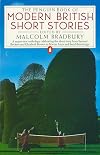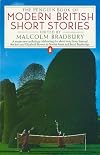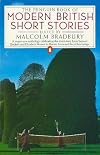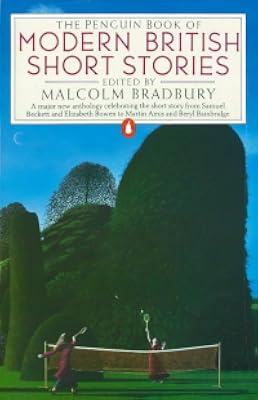
The Penguin Book of Modern British Short Stories
by Malcolm Bradbury (Editor)
On This Page
Description
This anthology contains gems from 34 of Britain's outstanding contemporary writers. It includes stories of love and crime, stories touched with comedy and the supernatural, stories set in London, Los Angeles, Bucharest and Tokyo.Tags
Recommendations



















Member Reviews
As I was reading a masterful short story by Salman Rushdie, he was being stabbed on stage. I had just talked about how certain authors in this collection (and in literature, generally) operate on a different level than others who are still very good, then I read about the contemptible attack. I hope he will recover as soon and as completely as possible.
I found this to be a very strong collection, with absolutely no weak points, and some real gems. Each short story was at least fine, but some were simply outstanding:
Samuel Beckett: Ping - I have a soft spot for the nonsense which of course does have sense and such a strong rhythm in all its minimalism that it is positively enjoyable
Dylan Thomas: The Burning Baby - nightmarish as its show more title, intense and skilful, with all due respect, trying to purge my memory of it
Ted Hughes: The Rain Horse - a tad less nightmarish but still very much in that territory, also very intense and skilful
Salman Rushdie: The Prophet's Hair - this is where I had to pause to acknowledge how certain authors produced works that were not better but on a completely different level of quality than others, and those others were also very good. (for me, authors of this different quality include Auster, Nabokov, Esterházy) I intend to use this in ESL lessons as I did with the following one.
Kazuo Ishiguro: A Family SupperWhat a twist! I loved how he built up the readers' expectations very clearly towards one final outcome and then provided an utter anticlimax. This is a short story I already used with my C1-level students. As I was making photocopies for them to read, I accidentally dropped the last page, which gave me the idea to make them write their own ending to the story. (Some loved the idea, others detested it.) I only gave them the last page when they handed in their versions. I thoroughly enjoyed the experience, and would definitely repeat with other groups.
I really appreciate the following as well:
Graham Greene: The Invisible Japanese Gentlemen - another one up for ESL lessons
William Golding: Miss Pulkinhorn
Alan Sillitoe: The Fishing-boat Picture
Doris Lessing: To Room Nineteen
Muriel Spark: The House of the Famous Poet
John Fowles: The Enigma - started as a detective story but turned out to be something even better
Malcolm Bradbury: Composition - with its 3 different endings
Beryl Bainbridge: Clap Hands, Here Comes Charlie - very powerful
Ian McEwan: Psychopolis -turning so suddenly from a constant mood, and capturing the shock perfectly
Julian Barnes: One of a Kind
Clive Sinclair: Bedbugs show less
I found this to be a very strong collection, with absolutely no weak points, and some real gems. Each short story was at least fine, but some were simply outstanding:
Samuel Beckett: Ping - I have a soft spot for the nonsense which of course does have sense and such a strong rhythm in all its minimalism that it is positively enjoyable
Dylan Thomas: The Burning Baby - nightmarish as its show more title, intense and skilful, with all due respect, trying to purge my memory of it
Ted Hughes: The Rain Horse - a tad less nightmarish but still very much in that territory, also very intense and skilful
Salman Rushdie: The Prophet's Hair - this is where I had to pause to acknowledge how certain authors produced works that were not better but on a completely different level of quality than others, and those others were also very good. (for me, authors of this different quality include Auster, Nabokov, Esterházy) I intend to use this in ESL lessons as I did with the following one.
Kazuo Ishiguro: A Family Supper
I really appreciate the following as well:
Graham Greene: The Invisible Japanese Gentlemen - another one up for ESL lessons
William Golding: Miss Pulkinhorn
Alan Sillitoe: The Fishing-boat Picture
Doris Lessing: To Room Nineteen
Muriel Spark: The House of the Famous Poet
John Fowles: The Enigma - started as a detective story but turned out to be something even better
Malcolm Bradbury: Composition - with its 3 different endings
Beryl Bainbridge: Clap Hands, Here Comes Charlie - very powerful
Ian McEwan: Psychopolis -
Julian Barnes: One of a Kind
Clive Sinclair: Bedbugs show less
If you're amused by stories centred on women's breasts (David Lodge) or about compulsive masturbation (Martin Amis), , if you would welcome reminders that even the most competent woman can be a victim imprisoned by a man's sharp glance and failure to share housework (Fay Weldon's tale of elective martyrdom) and that Chinese people dress in silly clothes and are incapable of speaking English properly*(Malcolm Bradbury), well, then, this is the book for you.
,
I read at least the first few pages and far more often all of each sory but gave up on one because it was unreadable and on several others because the writing inspired no confidence in the author and/or because they bored me so. Only one of the stories seemed in any way original (and show more that, not by a British author), some were enjoyable, and none was memorable.
Malcom Bradbury was also the editor of this book. And as should be apparent from the quote below he obviously shares the not-uncommon casual English attitude of superiority to other peoples. Not surprising then that he he appropriates non-British authors from a former British-occpied country.
* 'The little oriental who met him stands there, in shortie pyjamas. "You must close lindow . Water coming . . . into my loom. . . Also, offplint of article for loo to lead." ' No no, 'The rittle oliental who ret him rands rare, in sholtie pyjamas . . . ' Ftfy Ml. Bladbuly. show less
,
I read at least the first few pages and far more often all of each sory but gave up on one because it was unreadable and on several others because the writing inspired no confidence in the author and/or because they bored me so. Only one of the stories seemed in any way original (and show more that, not by a British author), some were enjoyable, and none was memorable.
Malcom Bradbury was also the editor of this book. And as should be apparent from the quote below he obviously shares the not-uncommon casual English attitude of superiority to other peoples. Not surprising then that he he appropriates non-British authors from a former British-occpied country.
* 'The little oriental who met him stands there, in shortie pyjamas. "You must close lindow . Water coming . . . into my loom. . . Also, offplint of article for loo to lead." ' No no, 'The rittle oliental who ret him rands rare, in sholtie pyjamas . . . ' Ftfy Ml. Bladbuly. show less
140063064
University of Edinburgh, 1997.
Ratings
Members
- Recently Added By
Author Information

A professor of English literature and American studies who has published numerous critical works, Malcolm Bradbury is also a novelist whose protagonists are academics who make muddles of their personal and professional lives. He maintains that his main concern is to explore problems and dilemmas of liberalism and issues of moral responsibility. show more The targets of Bradbury's satires include intellectual pretension, cultural myopia, and official smugness. His protagonists are largely sympathetic, if comic, failures at mastering their own fates in a world of absurd rules and regulations. His major novels include Eating People Is Wrong (1959), Stepping Westward (1965), and The History Man (1975). This last, a novel of intellectual and political conflict at an English university in the late 1960s, was made into a successful television minidrama. More recent novels include Rates of Exchange (1983) and Cuts (1987). (Bowker Author Biography) Malcolm Bradbury is a novelist, critic, television dramatist, & satirist. His many books include "Rates of Exchange", which was short-listed for the Booker Prize, & "The Modern American Novel". (Publisher Provided) show less
All Editions
Work Relationships
Contains
Common Knowledge
- Canonical title
- The Penguin Book of Modern British Short Stories
- Original publication date
- 1989
Classifications
Statistics
- Members
- 483
- Popularity
- 62,733
- Reviews
- 4
- Rating
- (3.59)
- Languages
- English
- Media
- Paper, Ebook
- ISBNs
- 4
- ASINs
- 5