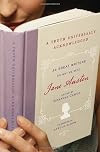
A Truth Universally Acknowledged: 33 Great Writers on Why We Read Jane Austen
by Susannah Carson (Editor)
On This Page
Description
Why are readers so fascinated by Jane Austen's novels? In essays culled from the last 100 years of criticism, great authors and literary critics of the past and present offer insights into her writing and her unique appeal to readers across generations.Tags
Recommendations






Member Reviews
A Truth Universally Acknowledged: Why We Read Jane Austen edited by Susannah Carson, contains 33 essays by well-known writers about their love of Jane's novels. Austen was the seventh of eight children, lived only to the age of 42, and wrote at a time when published novels by women were still unusual. She created a "tiny world in which a canceled dinner party or a shower of rain is an important event, so that we could attend to and enjoy her subtle comedy". (J. B. Priestly). Yet somehow she has managed to approach the stature of Shakespeare, with her works read and taught and performed and turned into movies and plays over and over and over again. How can this be?
This book is not a smooth production. The editor might have considered show more thematic entries to link the essays, for example, or short overview introductions before each. However, the disjointed feel is far outweighed by the gems she has gathered for us. Eudora Welty, E.M. Forster, Martin Amis, A.S. Byatt, Lionel Trilling, Virginia Woolf - it's an all-star line-up, with each giving his or her take on Why We Read Jane Austen. As I had hoped, it is filled with insights that had not occurred to me. For example, because she was a realist and wrote about what she knew, "she never attempted to reproduce a conversation of men when by themselves, which in the nature of things she could never have heard." (W. Somerset Maugham). We never hear Darcy talking to Bingley, or Wickham, or Captain Wentworth speaking to Captain Harville, unless a woman is there to witness it. As another example, C.S. Lewis quotes four key passages from Northanger Abbey, Sense and Sensibility, Pride and Prejudice, and Emma, and observes that, "All four heroines painfully, though with varying degrees of pain, discover that they have been making mistakes both about themselves and about the world in which they live. All of their data have to be reinterpreted. Indeed, considering the differences of their situations and characters. the similarity of the process in all four is strongly marked. All realize that the cause of the deception lies within . . ."
It has always struck me that readers of the six novels will put them in such varying orders from favorite to least. Several essayists find Mansfield Park (my least favorite) the most accomplished and interesting of the novels; others give the award to Emma, although seemingly all consider the "most delightful" to be Pride and Prejudice. Austen in fact was apparently concerned that P & P was too bright and sparkling, and that it may have needed more shadow. Several essayists comment on the different, "autumnal" feel to Persuasion, her last novel, which some see as signalling the transition to a different style that would have developed had she lived longer. Many comment on her comedic talents. She can be quite sharp, e.g. "a large bulky figure has as good a right to be in deep affliction as the most graceful set of limbs in the world." If you want to enjoy her witticisms apart from the novels, I recommend The Wicked Wit of Jane Austen, collected by Dominque Enright. As Amy Bloom says in her essay, "Jane Austen is often unkind, occasionally contemptuous, but almost never wrong."
The differences in perspective among these well-known authors is striking. Diane Johnson observes that, "Austen's great serious subject was the precariousness of the lives of women in early-nineteenth century England and, lacking other options, the urgent need for them to establish themselves by marriage." But Amy Bloom sees Jane Austen as "the best writer for anyone who believes in love more than romance, and who cares more for the private than the public. She understands that men and women have to grow up in order to deserve and achieve great love, that some suffering is necessary (that mewling about it in your memoir or on a talk show will not help at all), and that people who mistake the desirable object for the one necessary and essential love will get what they deserve." Kingsley Amis is a contrarian to all the Austen appreciation, writing of her moral "corruption" displayed in Mansfield Park, and has one of the best lines. He points out that in that book the ostensibly villainous Henry and Mary Crawford actually are "good fun", and that Edmund and Fanny, whom we are intended to admire, are "morally detestable" bores: "to invite Mr. and Mrs. Edmund Bertram round for the evening would not be lightly undertaken." Eva Brann finds Austen's work perfect in every way, and "the most felicitous of her perfections is her knowledge of the human heart." For Jay McInerney, it is our affinity for the female leads which is critical: "unless we are cranky scholars or celibate critics, we love and rank the novels according to our regard for the female principals." He finds his own "admiration shifting" among them at different points in time.
Virginia Woolf has perhaps the most thought-provoking essay. She goes back to the juvenalia, particularly the "astonishing and unchildish story Love and Freindship", written when Austen was 15, and wonders about something in it which "never merges with the rest, which sounds distinctly and penetratingly all through the volume? It is the sound of laughter. The girl of fifteen is laughing, in her corner, at the world." That laughter, the acute sense of our ridiculousness, is an undercurrent that manifests itself in later novels as well. At the same time, "what she offers {in the novels} is . . . composed of something that expands in the reader's mind and endows with the most endearing form of life." "Never did any novelist make more use of an impeccable sense of human values. It is against the disc of of an unerring heart, an unfailing good taste, and almost stern morality, that she shows up these deviations from kindness, truth and sincerity which are among the most delightful things in English literature." Woolf speculates on what Austen would have written had she lived longer, with her growing popularity. "She would have stayed in London, dined out, lunched out, met famous people, made new friends, read, traveled, and carried back to the quiet country cottage a hoard of observations to feast upon at leisure." If only!
All of this inspired me to think about why, despite the dramatic differences in the breadth of their landscapes, Austen rises, for me, to the level of Shakespeare. What I say next could be applied to him, too: She is smarter than we are, and more insightful about human nature. She's wittier than we are, with a sharp, sometimes wicked, sense of humor. She writes with an almost unfathomable grace. We sense that so much lies within those crafted sentences that we find ourselves re-reading her books again and again. Just as the author-essayists in Why We Read Jane Austen obviously have. show less
This book is not a smooth production. The editor might have considered show more thematic entries to link the essays, for example, or short overview introductions before each. However, the disjointed feel is far outweighed by the gems she has gathered for us. Eudora Welty, E.M. Forster, Martin Amis, A.S. Byatt, Lionel Trilling, Virginia Woolf - it's an all-star line-up, with each giving his or her take on Why We Read Jane Austen. As I had hoped, it is filled with insights that had not occurred to me. For example, because she was a realist and wrote about what she knew, "she never attempted to reproduce a conversation of men when by themselves, which in the nature of things she could never have heard." (W. Somerset Maugham). We never hear Darcy talking to Bingley, or Wickham, or Captain Wentworth speaking to Captain Harville, unless a woman is there to witness it. As another example, C.S. Lewis quotes four key passages from Northanger Abbey, Sense and Sensibility, Pride and Prejudice, and Emma, and observes that, "All four heroines painfully, though with varying degrees of pain, discover that they have been making mistakes both about themselves and about the world in which they live. All of their data have to be reinterpreted. Indeed, considering the differences of their situations and characters. the similarity of the process in all four is strongly marked. All realize that the cause of the deception lies within . . ."
It has always struck me that readers of the six novels will put them in such varying orders from favorite to least. Several essayists find Mansfield Park (my least favorite) the most accomplished and interesting of the novels; others give the award to Emma, although seemingly all consider the "most delightful" to be Pride and Prejudice. Austen in fact was apparently concerned that P & P was too bright and sparkling, and that it may have needed more shadow. Several essayists comment on the different, "autumnal" feel to Persuasion, her last novel, which some see as signalling the transition to a different style that would have developed had she lived longer. Many comment on her comedic talents. She can be quite sharp, e.g. "a large bulky figure has as good a right to be in deep affliction as the most graceful set of limbs in the world." If you want to enjoy her witticisms apart from the novels, I recommend The Wicked Wit of Jane Austen, collected by Dominque Enright. As Amy Bloom says in her essay, "Jane Austen is often unkind, occasionally contemptuous, but almost never wrong."
The differences in perspective among these well-known authors is striking. Diane Johnson observes that, "Austen's great serious subject was the precariousness of the lives of women in early-nineteenth century England and, lacking other options, the urgent need for them to establish themselves by marriage." But Amy Bloom sees Jane Austen as "the best writer for anyone who believes in love more than romance, and who cares more for the private than the public. She understands that men and women have to grow up in order to deserve and achieve great love, that some suffering is necessary (that mewling about it in your memoir or on a talk show will not help at all), and that people who mistake the desirable object for the one necessary and essential love will get what they deserve." Kingsley Amis is a contrarian to all the Austen appreciation, writing of her moral "corruption" displayed in Mansfield Park, and has one of the best lines. He points out that in that book the ostensibly villainous Henry and Mary Crawford actually are "good fun", and that Edmund and Fanny, whom we are intended to admire, are "morally detestable" bores: "to invite Mr. and Mrs. Edmund Bertram round for the evening would not be lightly undertaken." Eva Brann finds Austen's work perfect in every way, and "the most felicitous of her perfections is her knowledge of the human heart." For Jay McInerney, it is our affinity for the female leads which is critical: "unless we are cranky scholars or celibate critics, we love and rank the novels according to our regard for the female principals." He finds his own "admiration shifting" among them at different points in time.
Virginia Woolf has perhaps the most thought-provoking essay. She goes back to the juvenalia, particularly the "astonishing and unchildish story Love and Freindship", written when Austen was 15, and wonders about something in it which "never merges with the rest, which sounds distinctly and penetratingly all through the volume? It is the sound of laughter. The girl of fifteen is laughing, in her corner, at the world." That laughter, the acute sense of our ridiculousness, is an undercurrent that manifests itself in later novels as well. At the same time, "what she offers {in the novels} is . . . composed of something that expands in the reader's mind and endows with the most endearing form of life." "Never did any novelist make more use of an impeccable sense of human values. It is against the disc of of an unerring heart, an unfailing good taste, and almost stern morality, that she shows up these deviations from kindness, truth and sincerity which are among the most delightful things in English literature." Woolf speculates on what Austen would have written had she lived longer, with her growing popularity. "She would have stayed in London, dined out, lunched out, met famous people, made new friends, read, traveled, and carried back to the quiet country cottage a hoard of observations to feast upon at leisure." If only!
All of this inspired me to think about why, despite the dramatic differences in the breadth of their landscapes, Austen rises, for me, to the level of Shakespeare. What I say next could be applied to him, too: She is smarter than we are, and more insightful about human nature. She's wittier than we are, with a sharp, sometimes wicked, sense of humor. She writes with an almost unfathomable grace. We sense that so much lies within those crafted sentences that we find ourselves re-reading her books again and again. Just as the author-essayists in Why We Read Jane Austen obviously have. show less
In a piece called “Emma and the Legend of Jane Austen,” Lionel Trilling addresses the two kinds of admiration for Jane Austen. He quotes none other Henry James, who admired Miss Austen, and who indeed had a moral and artistic affinity with her. Mr. James proclaimed that her reputation had exceeded her intrinsic interest and was unwarranted. He blames: “the body of publishers, editors, illustrators, producers of magazines, which have found their ‘dear,’ our dear, everybody’s dear Jane so infinitely to their material purpose.” In the more recent past, Dr. Leavis expresses his impatience with Miss Austen’s admirers while he honors her work. The same essential notion emerges in the work of Dr. Mudrick and D.W. Harding. show more Mudrick describes “a mere mass of cozy family adulation, self-glorif [ication] … and nostalgic latterday enshrinements of the gentle-hearted chronicler of Regency order.”
For some part of A Truth Universally Acknowledged: 33 Great Writers on Why We Read Jane Austen, an admirable collection edited by Susannah Carson, the issue of the “ownership” of Jane Austen – who has the right to admire her the most – rears its rather ridiculous head. The fact that there exist in parallel two main thrusts of Jane Austen love, the one where the charm of setting and sweetness of outcome rule, which I call the visceral, and the other dominated by academic research, and which deals with the more recondite, esoteric matters of exegesis and comparative aesthetics, which I will term the cerebral. For those of us who look for patterns, tricks, and subtle effects in our fiction, Jane Austen is a magnificent delight, over and over. And yet, how much less magnificent can Austen be to the devoted “lay” reader, who returns to her favorite novel, knowing that once again, the delights can be depended on? This is ridiculous, as I said. I can quote from a critic: “Long life, good health, and much prosperity to the reader who simply enjoys the narrative.” And I myself, have no qualms whatever to acknowledging a deep, visceral love for the Austen oeuvre, and it coexists quite nicely, thank you, with my delight in her subtler shadings, those lovely and beautifully-expressed barbs that skewer, and those ineffable expositions of psychology and human nature. I like “dear Jane” too.
So I guess, there you have it. True devotion to Jane Austen should be reserved (according to some) to those with the background, taste, credentials, and temperament to understand the literary merits, and shunned by the rest. Fat chance, and rightly so. I must admit to liking her work first and foremost for the ruthless candor of her observations of Regency hypocrisy and cant. At least they look and sound like hypocrisy and cant to us now. She strikes as far ahead of her times when portraying human motivation and real longing. The quality of her individuals never flags, never fails to ring exactly true, no matter the character’s state in life. Others enjoy Jane Austen – perhaps revere is a better word – for her portrayal of manners, her tight, quiet plots, her felicitous heroines, and her fulsome heroines. Why not? I like all those things, too, and admit to a good measure of reverence myself. Apparently I’m in decent company.
E.M. Forster famously opens an essay on Jane Austen, “I am a Jane Austenite, and therefore slightly imbecile about Jane Austen … She is my favorite author! I read and reread, the mouth open and the mind closed … The Jane Austenite possesses little of the brightness he so freely ascribes to his idol. Like all regular churchgoers, he scarcely notices what is being said.”
E.M. Forster was no neophyte when it comes to judging a fiction’s quality, bit I read his words impressed by his visceral, rather than his cerebral, enjoyment. Isn’t this what Henry James, and professors Mudrick and Harding object to? These issues present perhaps the high water mark to the flood tide of her reputation. Implicit within the arguments is the acknowledged truth, a “truth universally acknowledged,” that Jane Austen, that peerless portraitist and storyteller, that purveyor of gentle manners cloaking a barbed, prickly sarcasm, ranks at the very top of artists writing English narrative. Yes, right there with Shakespeare. We find we can hardly blame critics and scholars for their apparent proprietary feelings toward her. We all feel that way.
I stared out wanting to review this collection. Ms. Carson, the editor, leads the festivities off with a fine, thought-provoking essay of her own. The work carries the subtitle “33 Great Writers on Why We Read Jane Austen.” The collection does not lack for star power. Besides Forster’s need-I-say-hardly “imbecile” views, we get perception, insight, circumspection, and appreciation from Eudora Welty, Martin Amis, Kingsley Amis, Lionel Trilling (twice), W. Somerset Maugham, Anna Quindlen, Louis Auchincloss, Janet Todd, Amy Heckerling, Margot Livesey, Jay McInerney, and Virginia Woolf. Contributions from lesser-known scribes add light and weight, as well.
We do have a mix here, between the cerebral and the visceral, and perhaps nowhere is the visceral more in evidence than Martin Amis’s wish for a twenty-page extension to Pride and Prejudice to get a detailed description of the Darcys’ wedding night, “with Mr. Darcy, furthermore, acquitting himself uncommonly well.” The cerebral, however, is everywhere. And I reserve the highest rank for Harold Bloom.
Mr. Bloom treasures "Persuasion" above all, as do I. He compares Anne Elliot to Rosalind of Shakespeare’s "As You Like It," saying they are the two heroines who carry almost omniscient understanding of their stories. He says of Anne and Rosalind, “Their poise cannot transcend perspectivizing completely, but Rosalind’s wit and Anne’s sensbiliy, both balanced and free of either excessive aggressivity or defensiveness, enable them to share more of their creators’ poise than we ever come to do.” Mr. Bloom goes on to cite others’ elegant points, and to make his own, about the deep understanding and unceasing and unspoken communication between Anne and Captain Wentworth. These points, and the truth that Anne outshines Emma Woodhouse and Elizabeth Bennet in understanding, sympathy, and virtue, helped clarify for me the lovely features of this masterwork, to which Mr. Bloom ascribes “extraordinary aesthetic distinction.” He avers to feeling sad after each rereading, but I must say I never felt so tinged. The joy is, I admit, more alloyed than that accompanying "Sense and Sensibility" and "Pride and Prejudice," but not at all because we value the heroine less. Appropriately enough, Mr. Bloom describes the novel as having a “canonical persuasiveness.”
We all read Jane Austen for different reasons. Whether you value her satisfying plots, her persuasive characters, or her sparkling wit, you will find 33 new perspectives, all from artists themselves, for reading and appreciating her work all over again. show less
For some part of A Truth Universally Acknowledged: 33 Great Writers on Why We Read Jane Austen, an admirable collection edited by Susannah Carson, the issue of the “ownership” of Jane Austen – who has the right to admire her the most – rears its rather ridiculous head. The fact that there exist in parallel two main thrusts of Jane Austen love, the one where the charm of setting and sweetness of outcome rule, which I call the visceral, and the other dominated by academic research, and which deals with the more recondite, esoteric matters of exegesis and comparative aesthetics, which I will term the cerebral. For those of us who look for patterns, tricks, and subtle effects in our fiction, Jane Austen is a magnificent delight, over and over. And yet, how much less magnificent can Austen be to the devoted “lay” reader, who returns to her favorite novel, knowing that once again, the delights can be depended on? This is ridiculous, as I said. I can quote from a critic: “Long life, good health, and much prosperity to the reader who simply enjoys the narrative.” And I myself, have no qualms whatever to acknowledging a deep, visceral love for the Austen oeuvre, and it coexists quite nicely, thank you, with my delight in her subtler shadings, those lovely and beautifully-expressed barbs that skewer, and those ineffable expositions of psychology and human nature. I like “dear Jane” too.
So I guess, there you have it. True devotion to Jane Austen should be reserved (according to some) to those with the background, taste, credentials, and temperament to understand the literary merits, and shunned by the rest. Fat chance, and rightly so. I must admit to liking her work first and foremost for the ruthless candor of her observations of Regency hypocrisy and cant. At least they look and sound like hypocrisy and cant to us now. She strikes as far ahead of her times when portraying human motivation and real longing. The quality of her individuals never flags, never fails to ring exactly true, no matter the character’s state in life. Others enjoy Jane Austen – perhaps revere is a better word – for her portrayal of manners, her tight, quiet plots, her felicitous heroines, and her fulsome heroines. Why not? I like all those things, too, and admit to a good measure of reverence myself. Apparently I’m in decent company.
E.M. Forster famously opens an essay on Jane Austen, “I am a Jane Austenite, and therefore slightly imbecile about Jane Austen … She is my favorite author! I read and reread, the mouth open and the mind closed … The Jane Austenite possesses little of the brightness he so freely ascribes to his idol. Like all regular churchgoers, he scarcely notices what is being said.”
E.M. Forster was no neophyte when it comes to judging a fiction’s quality, bit I read his words impressed by his visceral, rather than his cerebral, enjoyment. Isn’t this what Henry James, and professors Mudrick and Harding object to? These issues present perhaps the high water mark to the flood tide of her reputation. Implicit within the arguments is the acknowledged truth, a “truth universally acknowledged,” that Jane Austen, that peerless portraitist and storyteller, that purveyor of gentle manners cloaking a barbed, prickly sarcasm, ranks at the very top of artists writing English narrative. Yes, right there with Shakespeare. We find we can hardly blame critics and scholars for their apparent proprietary feelings toward her. We all feel that way.
I stared out wanting to review this collection. Ms. Carson, the editor, leads the festivities off with a fine, thought-provoking essay of her own. The work carries the subtitle “33 Great Writers on Why We Read Jane Austen.” The collection does not lack for star power. Besides Forster’s need-I-say-hardly “imbecile” views, we get perception, insight, circumspection, and appreciation from Eudora Welty, Martin Amis, Kingsley Amis, Lionel Trilling (twice), W. Somerset Maugham, Anna Quindlen, Louis Auchincloss, Janet Todd, Amy Heckerling, Margot Livesey, Jay McInerney, and Virginia Woolf. Contributions from lesser-known scribes add light and weight, as well.
We do have a mix here, between the cerebral and the visceral, and perhaps nowhere is the visceral more in evidence than Martin Amis’s wish for a twenty-page extension to Pride and Prejudice to get a detailed description of the Darcys’ wedding night, “with Mr. Darcy, furthermore, acquitting himself uncommonly well.” The cerebral, however, is everywhere. And I reserve the highest rank for Harold Bloom.
Mr. Bloom treasures "Persuasion" above all, as do I. He compares Anne Elliot to Rosalind of Shakespeare’s "As You Like It," saying they are the two heroines who carry almost omniscient understanding of their stories. He says of Anne and Rosalind, “Their poise cannot transcend perspectivizing completely, but Rosalind’s wit and Anne’s sensbiliy, both balanced and free of either excessive aggressivity or defensiveness, enable them to share more of their creators’ poise than we ever come to do.” Mr. Bloom goes on to cite others’ elegant points, and to make his own, about the deep understanding and unceasing and unspoken communication between Anne and Captain Wentworth. These points, and the truth that Anne outshines Emma Woodhouse and Elizabeth Bennet in understanding, sympathy, and virtue, helped clarify for me the lovely features of this masterwork, to which Mr. Bloom ascribes “extraordinary aesthetic distinction.” He avers to feeling sad after each rereading, but I must say I never felt so tinged. The joy is, I admit, more alloyed than that accompanying "Sense and Sensibility" and "Pride and Prejudice," but not at all because we value the heroine less. Appropriately enough, Mr. Bloom describes the novel as having a “canonical persuasiveness.”
We all read Jane Austen for different reasons. Whether you value her satisfying plots, her persuasive characters, or her sparkling wit, you will find 33 new perspectives, all from artists themselves, for reading and appreciating her work all over again. show less
I have just indulged in a week of Jane Austen. It's so good for the soul; I really should make it an annual tradition. I read one of the six original novels, a contemporary update of one of the novels, watched cinematic adaptations, and finally delved into this wonderful book of literary criticism. I'd been holding off, wanting to be just a bit more steeped in Janeism before I tackled it. I've been so looking forward to diving in based merely on the wildly distinguished list of contributors.
There are renowned literary critics like Harold Bloom and Lionel Trilling, academicians like John Wiltshire and Janet Todd, classic novelists like Eudora Welty and Somerset Maugham, and contemporary novelists like A.S. Byatt and Jay McInerney. show more There's even a token filmmaker, Amy Heckerling! There is no hyperbole at all in the assertion that these are 33 (34, really) great writers. One name is more impressive than the next, and I've barely scratched the surface.
Based on the diversity of the contributors, you would be correct in suspecting the diversity of the essays in this collection. Some deal with the author herself, or the time in which she lived, others the entirety of her work, and some focus on a single novel. My first thought was to read the more general essays first and to then focus on the contributions specific to a novel after I had just read or re-read it, so that the particulars were very fresh in my mind. Now that I've been reading the essays, Austen's work, and the work of others inspired by Austen at roughly the same time, I don't believe my approach need be that rigid. Reading some of the essays on Emma while still reading the novel gave me great insights that I might not have come to or appreciated on my own.
I'm refraining, in this review, from pulling out quotes from the essays, but only because I wouldn't know where to start. There hasn't been one yet that wasn't infinitely quotable. Where's a highlighter when you need one? Some of the essays are more academic in tone than others (many have endnotes), but they are all smartly-written, challenging, and elucidating on this eminently worthy subject. This collection of essays will surely become a cherished reference I delve into over and over as I continue to enjoy Ms. Austen's timeless works the rest of my life. show less
There are renowned literary critics like Harold Bloom and Lionel Trilling, academicians like John Wiltshire and Janet Todd, classic novelists like Eudora Welty and Somerset Maugham, and contemporary novelists like A.S. Byatt and Jay McInerney. show more There's even a token filmmaker, Amy Heckerling! There is no hyperbole at all in the assertion that these are 33 (34, really) great writers. One name is more impressive than the next, and I've barely scratched the surface.
Based on the diversity of the contributors, you would be correct in suspecting the diversity of the essays in this collection. Some deal with the author herself, or the time in which she lived, others the entirety of her work, and some focus on a single novel. My first thought was to read the more general essays first and to then focus on the contributions specific to a novel after I had just read or re-read it, so that the particulars were very fresh in my mind. Now that I've been reading the essays, Austen's work, and the work of others inspired by Austen at roughly the same time, I don't believe my approach need be that rigid. Reading some of the essays on Emma while still reading the novel gave me great insights that I might not have come to or appreciated on my own.
I'm refraining, in this review, from pulling out quotes from the essays, but only because I wouldn't know where to start. There hasn't been one yet that wasn't infinitely quotable. Where's a highlighter when you need one? Some of the essays are more academic in tone than others (many have endnotes), but they are all smartly-written, challenging, and elucidating on this eminently worthy subject. This collection of essays will surely become a cherished reference I delve into over and over as I continue to enjoy Ms. Austen's timeless works the rest of my life. show less
An accessible and enjoyable ensemble of essays on the influence of a great writer
When the new Austen literary tome A Truth Universally Acknowledged edited by Susannah Carson started off with a foreword by Harold Bloom the famous American writer, literary critic and current Sterling Professor of the Humanities at Yale University, I was more than a bit anxious fearing the book would be over my head. Firstly, I am neither a scholar nor a brilliant intellectual and have trouble understanding all the pedantic puffery about Jane Austen that passes as literary criticism these days. Moreover, do I really need 33 great writers making me feel inadequate? Secondly, if these great minds explain to me why I read Jane Austen, the last veil will have show more fallen and the party will be over. After years of awe and admiration, do I really want to see the wizard behind the curtain?
My apprehension was softened after reading Bloom's foreword. I smiled deeply when he expressed why we read Jane Austen. This was a promising beginning. "[S]he seems to know us better than we know ourselves, and she seems to know us so intimately for the simple reason that she helped determine who we are as both readers and as human beings." He makes her sound like she sits on the right hand of God! He is definitely on to something. The balance of essays are from a wide range of Austen admirers: contemporary and classic authors, movie directors, literary critics and scholars. Some of the essays are newly commissioned from contemporary writers such as Anna Quindlen, Jay McInerney, A.S. Byatt and Amy Heckerling. Others are from deceased literary giants such as C. S. Lewis, Virginia Woolf, E. M. Forster and W. Somerset Maugham and previously published in the last century. The editor Susannah Carson has also contributed her own slant on Austen's current appeal from her essay Reading Northanger Abbey. Here is a memorable passage.
"It is a truth universally acknowledged that Austen's novels are about marriage: they all end with at least one successful match, and sometimes as many as three. Dating guidebooks have been compiled from advice culled from her novels, suggesting that much of Austen's current appeal lies in her treatment of romance plot. If we read Austen, will we improve our chances of finding the right mate? Perhaps, but such instruction is incidental: Austen does not set out to describe ideal relationships. Her interest is in flawed characters who achieve a greater level of self understanding throughout the course of each novel and who are rewarded at the end with the relationship which, although never entirely perfect, are perfect for them."
Carson hit the nail on the head for me. Austen's characters and plots are indeed perfect imperfections. That is why I am so drawn to them. There are also many other tidbits of wisdom and insight throughout the book, along with some pure folly and nonsense. Some still think Fanny Price is a prig. (C.S. Lewis defends her bless his heart). One felt that the sparkling Elizabeth Bennet's appeal is diminished by accepting Mr. Darcy who is a dud and not her intellectual equal. Another had mixed feelings about Austen's masterpiece Emma. And those in the Henry Tilney camp will need a strong dose of aromatic vinegar after reading that he and Catherine Morland are ill suited for marriage; his acerbic wit quickly growing tired of her vapid naivety. The upside of a book containing essays is that you're not stuck for very long with an author you're not enjoying or learning from. The downside is when the majority fall into that category. Happily, opinions on Austen vary as greatly in this book as her enduring appeal to readers. There is something here for every level of adulation, Janeite or scholar; even some "Till this moment I never knew myself" epiphanies.
Like Austen's characters, this book does have its endearing flaws. To understand the context of the essays, you must have read Austen or seen a movie or two. Hopefully the former. Unfortunately, the essays are not dated, so the reader is left to peruse the biographies of the writers in the back of the book to understand the timeframe of when the essay might have been written. It also suffers from some wobbly bits of unevenness in cohesion as a whole. 33 great writers enthusiastically enlighten us on why we read Jane Austen, wander a bit, individually entertain, but do not always directly address the primary theme. Honestly, in their defense, I do not think the question of why we read Jane Austen is answerable to everyone's satisfaction. It is far too personal, and therein lays Austen's brilliance and success. In actuality, what should be asked is why we continue to read Jane Austen? There is big a difference. Many read Austen for the first time in school because they were required to. Those who return to re-read her offer the greatest compliment that an author can receive and a testament to her enduring appeal. After nearly two hundred years of complements queuing up in support of her works it is no wonder that she is the literary and pop media phenomenon that many of the essays expound upon.
Regardless of my quibbles with the semantics, if you are enthralled by Austen's alluring prose and are intrigued to learn what great writers have said about her over the last century, this volume is the most accessible and enjoyable ensemble of Austen essays I have read. Kudos to editor Carson (who by-the-way is herself a doctoral candidate and literary scholar) for having the foresight and ingenuity to pull together a collection of writers who do not all look down at Janeites from an ivory tower and are not afraid to show a personal side of their adulation. This everyman Austen reader is most grateful, and happy that in conclusion, Austen is as enigmatic as ever.
Laurel Ann, Austenprose show less
When the new Austen literary tome A Truth Universally Acknowledged edited by Susannah Carson started off with a foreword by Harold Bloom the famous American writer, literary critic and current Sterling Professor of the Humanities at Yale University, I was more than a bit anxious fearing the book would be over my head. Firstly, I am neither a scholar nor a brilliant intellectual and have trouble understanding all the pedantic puffery about Jane Austen that passes as literary criticism these days. Moreover, do I really need 33 great writers making me feel inadequate? Secondly, if these great minds explain to me why I read Jane Austen, the last veil will have show more fallen and the party will be over. After years of awe and admiration, do I really want to see the wizard behind the curtain?
My apprehension was softened after reading Bloom's foreword. I smiled deeply when he expressed why we read Jane Austen. This was a promising beginning. "[S]he seems to know us better than we know ourselves, and she seems to know us so intimately for the simple reason that she helped determine who we are as both readers and as human beings." He makes her sound like she sits on the right hand of God! He is definitely on to something. The balance of essays are from a wide range of Austen admirers: contemporary and classic authors, movie directors, literary critics and scholars. Some of the essays are newly commissioned from contemporary writers such as Anna Quindlen, Jay McInerney, A.S. Byatt and Amy Heckerling. Others are from deceased literary giants such as C. S. Lewis, Virginia Woolf, E. M. Forster and W. Somerset Maugham and previously published in the last century. The editor Susannah Carson has also contributed her own slant on Austen's current appeal from her essay Reading Northanger Abbey. Here is a memorable passage.
"It is a truth universally acknowledged that Austen's novels are about marriage: they all end with at least one successful match, and sometimes as many as three. Dating guidebooks have been compiled from advice culled from her novels, suggesting that much of Austen's current appeal lies in her treatment of romance plot. If we read Austen, will we improve our chances of finding the right mate? Perhaps, but such instruction is incidental: Austen does not set out to describe ideal relationships. Her interest is in flawed characters who achieve a greater level of self understanding throughout the course of each novel and who are rewarded at the end with the relationship which, although never entirely perfect, are perfect for them."
Carson hit the nail on the head for me. Austen's characters and plots are indeed perfect imperfections. That is why I am so drawn to them. There are also many other tidbits of wisdom and insight throughout the book, along with some pure folly and nonsense. Some still think Fanny Price is a prig. (C.S. Lewis defends her bless his heart). One felt that the sparkling Elizabeth Bennet's appeal is diminished by accepting Mr. Darcy who is a dud and not her intellectual equal. Another had mixed feelings about Austen's masterpiece Emma. And those in the Henry Tilney camp will need a strong dose of aromatic vinegar after reading that he and Catherine Morland are ill suited for marriage; his acerbic wit quickly growing tired of her vapid naivety. The upside of a book containing essays is that you're not stuck for very long with an author you're not enjoying or learning from. The downside is when the majority fall into that category. Happily, opinions on Austen vary as greatly in this book as her enduring appeal to readers. There is something here for every level of adulation, Janeite or scholar; even some "Till this moment I never knew myself" epiphanies.
Like Austen's characters, this book does have its endearing flaws. To understand the context of the essays, you must have read Austen or seen a movie or two. Hopefully the former. Unfortunately, the essays are not dated, so the reader is left to peruse the biographies of the writers in the back of the book to understand the timeframe of when the essay might have been written. It also suffers from some wobbly bits of unevenness in cohesion as a whole. 33 great writers enthusiastically enlighten us on why we read Jane Austen, wander a bit, individually entertain, but do not always directly address the primary theme. Honestly, in their defense, I do not think the question of why we read Jane Austen is answerable to everyone's satisfaction. It is far too personal, and therein lays Austen's brilliance and success. In actuality, what should be asked is why we continue to read Jane Austen? There is big a difference. Many read Austen for the first time in school because they were required to. Those who return to re-read her offer the greatest compliment that an author can receive and a testament to her enduring appeal. After nearly two hundred years of complements queuing up in support of her works it is no wonder that she is the literary and pop media phenomenon that many of the essays expound upon.
Regardless of my quibbles with the semantics, if you are enthralled by Austen's alluring prose and are intrigued to learn what great writers have said about her over the last century, this volume is the most accessible and enjoyable ensemble of Austen essays I have read. Kudos to editor Carson (who by-the-way is herself a doctoral candidate and literary scholar) for having the foresight and ingenuity to pull together a collection of writers who do not all look down at Janeites from an ivory tower and are not afraid to show a personal side of their adulation. This everyman Austen reader is most grateful, and happy that in conclusion, Austen is as enigmatic as ever.
Laurel Ann, Austenprose show less
This is a diverse selection of essays covering everything Jane from Northanger Abbey to Persuasion. You may wonder, as I did, how some essays fit in - such as the college professor writing about his course in the '70s, and the researcher who made his way to the home of Jane Austen's great-niece to inspect the manuscript of "Volume 2" of her early writings. But if nothing else, this diversity gives the reader a sense of the breadth of readers and writers who love Jane Austen and the variety of reasons why she is still beloved today.
The writers included range from familiar names such as C.S. Lewis and Virginia Woolf, to perhaps less familiar such as Lionel Trilling (who has two essays) or Amy Heckerling. Some essays are broad in scope, show more while others focus very specifically on one novel. One aspect of the selection that I appreciated was the inclusion of essays that referenced each other, one which quoted Virginia Woolf in making a point, for example, and another that directly quoted and disagreed with another. Readers of only some of Jane Austen's works should beware that reading this from cover to cover will give spoilers for all of her novels and Villette to boot. But for readers who can't get enough Jane, this is an excellent collection of literary criticism that doesn't get too heavily academic for the non-English major. show less
The writers included range from familiar names such as C.S. Lewis and Virginia Woolf, to perhaps less familiar such as Lionel Trilling (who has two essays) or Amy Heckerling. Some essays are broad in scope, show more while others focus very specifically on one novel. One aspect of the selection that I appreciated was the inclusion of essays that referenced each other, one which quoted Virginia Woolf in making a point, for example, and another that directly quoted and disagreed with another. Readers of only some of Jane Austen's works should beware that reading this from cover to cover will give spoilers for all of her novels and Villette to boot. But for readers who can't get enough Jane, this is an excellent collection of literary criticism that doesn't get too heavily academic for the non-English major. show less
This book collects 33 essays by writers, readers, movie producers and Austen scholars- all dedicated to celebrating Jane Austen. It's a perfect book to publish at this time since Jane has never been cooler. She is an action figure, she is a detective, her characters have been made into vampires and zombies, there are countless movies and books surrounding her and her stories. This collection of essays, though, is about READING Austen's novels. Not reading the sequels. Not watching beautiful adaptations. No, it's about reading the witty, ironic and fabulous Jane's words herself.
On that level, this collection succeeds. Everyone in it reads and enjoys Austen, and they're all willing to share with readers why they do so. However, 33 essays show more is a lot. There are (in my opinion) far too many essays on Mansfield Park. This would be fine if they varied a bit, but they basically all say the same sort of thing: Fanny Price is boring, but she is a moral and kind person. Yes, I get it. I don't need to read that five times.
And that, in my opinion, is the shortcoming of this collection. When you have 33 people talking about one author who wrote six books, you get a lot of repetition. I can't tell you how many times the same quotes were used- from "It is a truth universally acknowledged" all the way down to Austen's "little bit (two inches wide) of ivory." It got aggravating.
I think I would have preferred fewer essays in this book- perhaps one on each book Austen wrote, one on her earlier writings, one on her unfinished ones, and then a few on the experience of reading her as a whole. It was great to read so many opinions on Austen, but as everyone in the book loved her writing, it got a bit repetitive in general (though the specific points made were interesting on their own).
However, that said, this is a book most Janeites will want to own and enjoy. It is fun to read, though I recommend reading the essays over a longer period of time than I did. And it will make you want to read Austen again. As soon as possible. show less
On that level, this collection succeeds. Everyone in it reads and enjoys Austen, and they're all willing to share with readers why they do so. However, 33 essays show more is a lot. There are (in my opinion) far too many essays on Mansfield Park. This would be fine if they varied a bit, but they basically all say the same sort of thing: Fanny Price is boring, but she is a moral and kind person. Yes, I get it. I don't need to read that five times.
And that, in my opinion, is the shortcoming of this collection. When you have 33 people talking about one author who wrote six books, you get a lot of repetition. I can't tell you how many times the same quotes were used- from "It is a truth universally acknowledged" all the way down to Austen's "little bit (two inches wide) of ivory." It got aggravating.
I think I would have preferred fewer essays in this book- perhaps one on each book Austen wrote, one on her earlier writings, one on her unfinished ones, and then a few on the experience of reading her as a whole. It was great to read so many opinions on Austen, but as everyone in the book loved her writing, it got a bit repetitive in general (though the specific points made were interesting on their own).
However, that said, this is a book most Janeites will want to own and enjoy. It is fun to read, though I recommend reading the essays over a longer period of time than I did. And it will make you want to read Austen again. As soon as possible. show less
I happily admit to being a very keen reader of Austen’s works, so when I saw this book of Austen focused essays in a local charity shop I knew I wasn’t leaving without it. Pretending to my husband that this was a vital teaching resource, I happily handed over a sum of money that was much less than the R.R.P for this sturdy hardback.
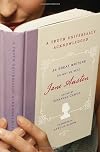
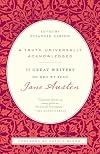
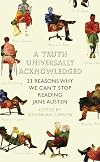
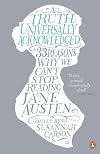
Interestingly, my copy hails from America and the subtitle and cover image are different from the UK edition. The American version seems determined to stress the academic nature of the book so the subtitle states that the book contains “33 great writers on why we read Jane Austen” and the cover features a hint of a smiling reader holding a copy of what purports to be this book. The overall impression show more is elegant and tasteful. When I contrast this to the British version I am rather pleased to have my ‘special edition’. I find the subtitle more sensational and less accurate (“33 reasons why we can’t stop reading Jane Austen”) and the scattered pictures of various colourfully depicted readers reminded me of the front cover of a child’s book of nursery tales.
The idea
Carson has gathered together 33 short pieces of writing on Austen and her works, purportedly in order to explore why so many people still read and enjoy Austen today. Some of these are critical essays, most are taken from introductions to editions of the stories but there is a great diversity of forms, including letters and even one recorded conversation. There are a range of voices, from modern writers to Austen’s contemporary critics, and a range of approaches, ranging from the biographical to the purely exclamatory.
The approach
I liked the idea of a range of writers and approaches but I was soon struck by the lack of clarity. The contents pages list the articles included, but there is no attempt to place them in any kind of context. I have generally found that, when reading non-fiction, it is helpful to be aware of the context of a piece of writing. Carson offers no help here at all. I had to search through the permissions acknowledgements page at the back of the book to confirm that some of the essays had originally been prefaces. The pieces are evidently not organised chronologically (though again, this is only clear from my knowledge of the contributors and reading the sketchy contributor biographies at the back of the book). I thought this was a shame as a chronological approach could potentially have shown some historical development in approaches to Austen.
However, the sheer eclecticism of the collection means that it is difficult to create a central strand. Carson’s approach, in so far as it exists, appears to be text based – essays which primarily focus on ‘Pride and Prejudice’, for example, are grouped together. This is not necessarily helpful as readers are unlikely to read these essays in the same linear way they might approach a story. I thought that a clearly signalled chronological or thematic approach might have been more helpful to readers.
The supporting materials
There is a brief foreword by Harold Bloom followed by a longer introduction by Carson. I felt the praise in both to be rather excessive, claiming that Austen's novels "inform our understanding of what it is to be human" among other magical qualities she apparently possessed. I admire Austen as a writer but I dislike the elevation of any writer to a mythical status and Bloom’s sweeping claim that “those who now read Austen ‘politically’ are not reading her at all” annoyed me with its implication that there are right and wrong positions to take regarding any writer. I have never been impressed by the notion that not everyone can ‘truly understand’ a writer’s particular genius. Instead, I am a strong believer in allowing everyone to reach their own (well reasoned and logically supported) positions in relation to texts and their authors. This is, however, a minor complaint in relation to these materials.
After establishing her own perspective, Carson briefly sketches each essayist's central position. I didn't find the order of this to be helpful. The links the editor makes are relevant, but I would have much preferred a chronological approach – if indeed such a summary is necessary at all. It is really a rather dull approach and a shame the editor didn't focus in on one or two key articles and her own response, but I believe that this is simply the way in which introductions to collections of essays generally work. I would not bother reading either the introduction or the foreword again but they do succeed in suggesting the multiplicity of approaches to Austen.
As I already noted previously, I thought it was disappointing that the essays were not helpfully contextualised. It would have been simple enough to write a brief paragraph above each essay noting who the author was and why the piece was written. The rather brief author biographies in the back of the book are alphabetical rather than following the structure of the essays in the book, which I found mildly irritating, and there was generally on clue regarding the context. E M Forster appears to be writing a
foreword for a collected works – specifically the 1923 Oxford edition edited by R W Chapman. Surely this would be worth mentioning? One essay is in the form of a dialogue but no account is made of its genesis. I found this lack of information increasingly frustrating and felt that this did reduce my enjoyment of the book.
The 33 pieces
As suits a book with such diverse contributors and approaches, my response to the essays was mixed. I did read them in order, simply because there seemed to be no good reason not to, but there is certainly no requirement to do so and it would be quite fun to dip in and out of these like a box of chocolates. (Again, having more details in the contents page would support this.) I will not discuss all the essays but will instead comment on a selection to give an idea of the quality and variety.
I was very pleased by first essay ‘Why We Read Jane Austen: Young Persons in Interesting Situations’. Interesting points were made about marriage in the nineteenth century, Austen's focus on moral character and use of landscape. The second essay, ‘The Radiance of Jane Austen’, by contrast, says nothing useful. It is simply a paean to Austen and I found it a little annoying. I suppose it is useful to give a flavour of the depth of feeling some people will develop for a writer, but my feeling is that if you’ve selected a book of essays on Austen, you’re probably either already quite keen on the writer or a diligent student. In neither case would reading gushing prose be helpful or, I would imagine, interesting.
‘Six Reasons to Read Jane Austen’ is, unsurprisingly, rather listlike and, again, little more than a homage. Later on, ‘Reading Northanger Abbey’ is an interesting examination of this slightly less typical novel by Susannah Carson. It is more academic in style than the preceding pieces – unsurprisingly as she is a PHD student. The link she made to Mr and Mrs Bennett confirmed my own thoughts, which is of course always gratifying, and identified a genuine problem at the heart of the novel. The essay gathers pace as Carson inverts her argument – could Austen have deliberately crafted this flaw in order to make a point? It is a worthwhile argument. I enjoyed Ian Watts’ piece ‘On Sense and Sensibility’ for similar reasons. It is true that I have more of an academic interest than a general reader might, but these are short and accessible pieces which I think a range of readers could find interesting and worthwhile reading.
There is a genuine variety of approaches. For instance, Lionel Trilling discusses student response to Austen as a way into establishing a humanist perspective. There was a very interesting point made by John Wiltshire considering why the films of Austen's novels are problematic. One writer briefly considers how Austen is presented and how this alienates some potential readers and even some critics. I did enjoy the diversity of approaches and thought it was a strength of the book that the contributors came from a range of backgrounds as they could offer different perspectives. One essay that surprised me was Martin Amis’: it seems out of place as it is forcefully critical of Austen's 'Mansfield Park', and this led me to wonder with renewed force what the organising force behind this collection was. It certainly didn’t seem like Amis was writing about ‘reasons to read Austen’ though I suppose he covers ‘why we read Austen’.
Inevitably, there is some overlap in terms of quotations used and comments made, but this is a minor feature of the text and did not bother me in the slightest. Occasionally, the writers referred to each others' essays, which I also found interesting as it helped to develop a sense of overall criticism and response to the novels. There were a few writers who conveyed an irksome sense of ‘knowing best’ (Eva Brann states that Austen's work does not have themes and is resistant to interpretation, which makes me wonder how on earth I manage to teach it!) but generally there was a feeling of discussion and a pleasant sense of sharing ideas.
Overall thoughts
While this collection is certainly not perfect, I did enjoy it and it is something I will definitely reread. (I even found a few ideas to share with my students so it turned out I wasn’t fibbing to my husband after all!) I liked the diversity of approaches and thought it would make a great gift for someone who is genuinely interested in Austen.
One significant omission is that there are no noticeable references to Austen’s juvenilia or to her unfinished novel ‘Sandition’. I do not find this omission surprising as Austen is widely known as the author of six competed novels and I did not know anything about her other works until I studied her at university. However, I did think it was a missed opportunity to bring these works more widely to the public’s attention.
All the essays are relatively short and they are all easy to follow and understand (with the exception of Harold Bloom’s essay on Persuasion, which I found rather dense and unrewarding). There is no glossary included as none is required. This is clearly a book aimed to a general reading audience rather than an academic reader.
Despite its flaws, I am very glad I found this and know I will eventually reread many of the essays. I would recommend it to anyone who has a basic familiarity with at least some of Austen’s books and a genuine interest in literature. In particular, I would recommend it to students studying Austen as a gentle introduction to literary criticism. show less
Interestingly, my copy hails from America and the subtitle and cover image are different from the UK edition. The American version seems determined to stress the academic nature of the book so the subtitle states that the book contains “33 great writers on why we read Jane Austen” and the cover features a hint of a smiling reader holding a copy of what purports to be this book. The overall impression show more is elegant and tasteful. When I contrast this to the British version I am rather pleased to have my ‘special edition’. I find the subtitle more sensational and less accurate (“33 reasons why we can’t stop reading Jane Austen”) and the scattered pictures of various colourfully depicted readers reminded me of the front cover of a child’s book of nursery tales.
The idea
Carson has gathered together 33 short pieces of writing on Austen and her works, purportedly in order to explore why so many people still read and enjoy Austen today. Some of these are critical essays, most are taken from introductions to editions of the stories but there is a great diversity of forms, including letters and even one recorded conversation. There are a range of voices, from modern writers to Austen’s contemporary critics, and a range of approaches, ranging from the biographical to the purely exclamatory.
The approach
I liked the idea of a range of writers and approaches but I was soon struck by the lack of clarity. The contents pages list the articles included, but there is no attempt to place them in any kind of context. I have generally found that, when reading non-fiction, it is helpful to be aware of the context of a piece of writing. Carson offers no help here at all. I had to search through the permissions acknowledgements page at the back of the book to confirm that some of the essays had originally been prefaces. The pieces are evidently not organised chronologically (though again, this is only clear from my knowledge of the contributors and reading the sketchy contributor biographies at the back of the book). I thought this was a shame as a chronological approach could potentially have shown some historical development in approaches to Austen.
However, the sheer eclecticism of the collection means that it is difficult to create a central strand. Carson’s approach, in so far as it exists, appears to be text based – essays which primarily focus on ‘Pride and Prejudice’, for example, are grouped together. This is not necessarily helpful as readers are unlikely to read these essays in the same linear way they might approach a story. I thought that a clearly signalled chronological or thematic approach might have been more helpful to readers.
The supporting materials
There is a brief foreword by Harold Bloom followed by a longer introduction by Carson. I felt the praise in both to be rather excessive, claiming that Austen's novels "inform our understanding of what it is to be human" among other magical qualities she apparently possessed. I admire Austen as a writer but I dislike the elevation of any writer to a mythical status and Bloom’s sweeping claim that “those who now read Austen ‘politically’ are not reading her at all” annoyed me with its implication that there are right and wrong positions to take regarding any writer. I have never been impressed by the notion that not everyone can ‘truly understand’ a writer’s particular genius. Instead, I am a strong believer in allowing everyone to reach their own (well reasoned and logically supported) positions in relation to texts and their authors. This is, however, a minor complaint in relation to these materials.
After establishing her own perspective, Carson briefly sketches each essayist's central position. I didn't find the order of this to be helpful. The links the editor makes are relevant, but I would have much preferred a chronological approach – if indeed such a summary is necessary at all. It is really a rather dull approach and a shame the editor didn't focus in on one or two key articles and her own response, but I believe that this is simply the way in which introductions to collections of essays generally work. I would not bother reading either the introduction or the foreword again but they do succeed in suggesting the multiplicity of approaches to Austen.
As I already noted previously, I thought it was disappointing that the essays were not helpfully contextualised. It would have been simple enough to write a brief paragraph above each essay noting who the author was and why the piece was written. The rather brief author biographies in the back of the book are alphabetical rather than following the structure of the essays in the book, which I found mildly irritating, and there was generally on clue regarding the context. E M Forster appears to be writing a
foreword for a collected works – specifically the 1923 Oxford edition edited by R W Chapman. Surely this would be worth mentioning? One essay is in the form of a dialogue but no account is made of its genesis. I found this lack of information increasingly frustrating and felt that this did reduce my enjoyment of the book.
The 33 pieces
As suits a book with such diverse contributors and approaches, my response to the essays was mixed. I did read them in order, simply because there seemed to be no good reason not to, but there is certainly no requirement to do so and it would be quite fun to dip in and out of these like a box of chocolates. (Again, having more details in the contents page would support this.) I will not discuss all the essays but will instead comment on a selection to give an idea of the quality and variety.
I was very pleased by first essay ‘Why We Read Jane Austen: Young Persons in Interesting Situations’. Interesting points were made about marriage in the nineteenth century, Austen's focus on moral character and use of landscape. The second essay, ‘The Radiance of Jane Austen’, by contrast, says nothing useful. It is simply a paean to Austen and I found it a little annoying. I suppose it is useful to give a flavour of the depth of feeling some people will develop for a writer, but my feeling is that if you’ve selected a book of essays on Austen, you’re probably either already quite keen on the writer or a diligent student. In neither case would reading gushing prose be helpful or, I would imagine, interesting.
‘Six Reasons to Read Jane Austen’ is, unsurprisingly, rather listlike and, again, little more than a homage. Later on, ‘Reading Northanger Abbey’ is an interesting examination of this slightly less typical novel by Susannah Carson. It is more academic in style than the preceding pieces – unsurprisingly as she is a PHD student. The link she made to Mr and Mrs Bennett confirmed my own thoughts, which is of course always gratifying, and identified a genuine problem at the heart of the novel. The essay gathers pace as Carson inverts her argument – could Austen have deliberately crafted this flaw in order to make a point? It is a worthwhile argument. I enjoyed Ian Watts’ piece ‘On Sense and Sensibility’ for similar reasons. It is true that I have more of an academic interest than a general reader might, but these are short and accessible pieces which I think a range of readers could find interesting and worthwhile reading.
There is a genuine variety of approaches. For instance, Lionel Trilling discusses student response to Austen as a way into establishing a humanist perspective. There was a very interesting point made by John Wiltshire considering why the films of Austen's novels are problematic. One writer briefly considers how Austen is presented and how this alienates some potential readers and even some critics. I did enjoy the diversity of approaches and thought it was a strength of the book that the contributors came from a range of backgrounds as they could offer different perspectives. One essay that surprised me was Martin Amis’: it seems out of place as it is forcefully critical of Austen's 'Mansfield Park', and this led me to wonder with renewed force what the organising force behind this collection was. It certainly didn’t seem like Amis was writing about ‘reasons to read Austen’ though I suppose he covers ‘why we read Austen’.
Inevitably, there is some overlap in terms of quotations used and comments made, but this is a minor feature of the text and did not bother me in the slightest. Occasionally, the writers referred to each others' essays, which I also found interesting as it helped to develop a sense of overall criticism and response to the novels. There were a few writers who conveyed an irksome sense of ‘knowing best’ (Eva Brann states that Austen's work does not have themes and is resistant to interpretation, which makes me wonder how on earth I manage to teach it!) but generally there was a feeling of discussion and a pleasant sense of sharing ideas.
Overall thoughts
While this collection is certainly not perfect, I did enjoy it and it is something I will definitely reread. (I even found a few ideas to share with my students so it turned out I wasn’t fibbing to my husband after all!) I liked the diversity of approaches and thought it would make a great gift for someone who is genuinely interested in Austen.
One significant omission is that there are no noticeable references to Austen’s juvenilia or to her unfinished novel ‘Sandition’. I do not find this omission surprising as Austen is widely known as the author of six competed novels and I did not know anything about her other works until I studied her at university. However, I did think it was a missed opportunity to bring these works more widely to the public’s attention.
All the essays are relatively short and they are all easy to follow and understand (with the exception of Harold Bloom’s essay on Persuasion, which I found rather dense and unrewarding). There is no glossary included as none is required. This is clearly a book aimed to a general reading audience rather than an academic reader.
Despite its flaws, I am very glad I found this and know I will eventually reread many of the essays. I would recommend it to anyone who has a basic familiarity with at least some of Austen’s books and a genuine interest in literature. In particular, I would recommend it to students studying Austen as a gentle introduction to literary criticism. show less
Members
- Recently Added By
Published Reviews
ThingScore 75
Curiously enough, much of the best work in Carson’s book comes from academic critics. Ian Watt’s examination of Sense and Sensibility in the context of late-18th-century philosophy is a model of lit crit at its best; so is Lionel Trilling’s classic essay "Why We Read Jane Austen." In a dazzling analysis of some of the formal attributes of Austen’s novels, Eva Brann points out that show more “no symbols, metaphors, mere patterns, or levels of abstraction are to be found in them. Certainly there are revelations, correspondences, significances. But nothing is ever there for mere form’s sake or to suggest or stand for something else—which is why the novels so repel literary criticism." show less
added by atbradley
Lists

Books about Books
149 works; 23 members
Author Information

All Editions
Common Knowledge
- Canonical title
- A Truth Universally Acknowledged: 33 Great Writers on Why We Read Jane Austen
- Alternate titles
- A Truth universally acknowledged : thirty three great writers on why we read Jane Austen; A Truth Universally Acknowledged : 33 Reasons Why We Can't Stop Reading Jane Austen; A Truth Universally Acknowledged: Thirty-three Reasons Why We Can't Stop Reading Jane Austen
- Original publication date
- 2009
- People/Characters
- Jane Austen
- Important places
- Steventon, Hampshire, England, UK; Chawton, Hampshire, England, UK
Classifications
Statistics
- Members
- 411
- Popularity
- 75,118
- Reviews
- 18
- Rating
- (3.94)
- Languages
- English
- Media
- Paper, Ebook
- ISBNs
- 5
- ASINs
- 1