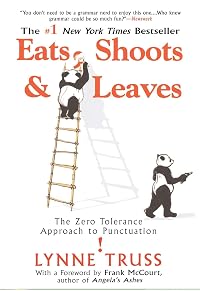
Eats, Shoots & Leaves: The Zero Tolerance Approach to Punctuation
by Lynne Truss
On This Page
Description
We all know the basics of punctuation. Or do we? A look at most neighborhood signage tells a different story. Through sloppy usage and low standards on the internet, in email, and now text messages, we have made proper punctuation an endangered species. In Eats, Shoots & Leaves, former editor Lynne Truss dares to say, in her delightfully urbane, witty, and very English way, that it is time to look at our commas and semicolons and see them as the wonderful and necessary things they are. This show more is a book for people who love punctuation and get upset when it is mishandled. From the invention of the question mark in the time of Charlemagne to George Orwell shunning the semicolon, this lively history makes a powerful case for the preservation of a system of printing conventions that is much too subtle to be mucked about with. show lessTags
Recommendations








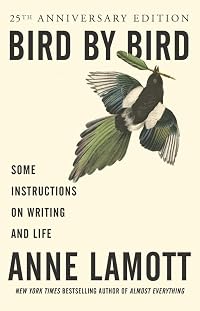

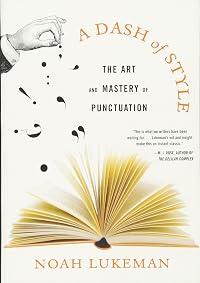


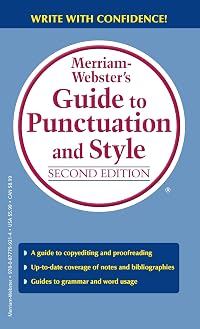
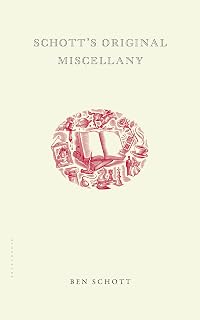
Member Recommendations
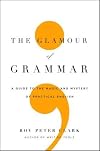
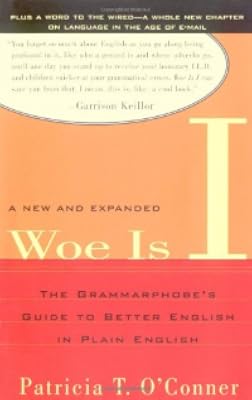
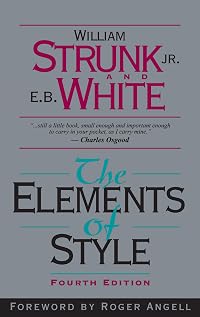
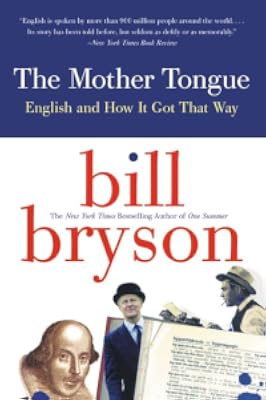
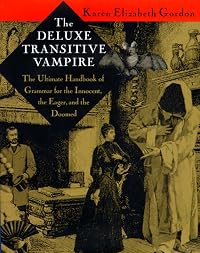
Voracious_Reader Fun with grammar. Easy read for a nonprofessional technician.
31
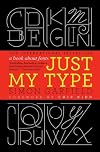
CGlanovsky Learn to appreciate an underappreciated facet of print and language
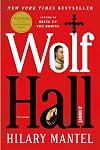
EerierIdyllMeme I was very impressed by Mantel's writing style, and I think a big part of it is her use of punctuation. Mantel uses the comma like whatever the opposite of a stupid person is. But in particular, if you were worried that the semicolon was dead, Mantel wields it with such precision that it is clearly indispensable.
04

Member Reviews
I thought I would like this book. Boy howdy, was I wrong. Honestly, if the copy I read hadn't been the property of my local library, then I would have used it as compost already. Eats, Shoots & Leaves is written in a very divisive style. Readers will either laugh with their noses in the air at those who don't follow Lynne Truss's grammatical rules and pat themselves on the back for falling in line, or they'll be offended by Truss's purist take on the English language. What I found most irritating is that any worthwhile grammatical advice Truss gives her readers is prescribed in an utterly condescending and elitist tone. Essentially, her "high moral arguments" (202) amount to linguistic prescriptivism, a practice I am wholeheartedly show more against.
Oh, but I did love how she has the hypocritical gall to call those who haven't mastered (and don't want to master) the semicolon "pompous sillies" (109).
Oh, but I did love how she has the hypocritical gall to call those who haven't mastered (and don't want to master) the semicolon "pompous sillies" (109).
"I'm talking 'bout the man in the mirror/ I'm asking him to change his ways." - Michael Jackson
pot = kettle, or whatever.
A delightfully written grammar guide that feels more like an extended conversation and rant rather than an attempt to teach, yet I learned so much!
When I see the title of this book, I want to add an Oxford comma after Shoots, so you could say that it is no surprise that I liked this book. It certainly is a good read about punctuation with many historical anecdotes, cultural factoids, and a whole lot of humor. I am not a stickler, but I certainly appreciate it when people use punctuation to communicate well; however, I do worry that, because of this book, more and more people will start punctuating well and there will be nothing to laugh at in street signs, billboards, and on the subway (and there goes the Oxford comma, again. Yes, the comma goes inside the parentheses in our neck of the woods. Should I have capitalized "and?" I know, one is not supposed to start a sentence with show more "and," but that's just the way I like it.)
ps. One of my favorite street signs in the U.S. is similar to one mentioned in the book; it reads:
Slow children at play show less
ps. One of my favorite street signs in the U.S. is similar to one mentioned in the book; it reads:
Slow children at play show less
Every person who possesses an ounce of passion on any subject needs (1) friends who share similar passions and/or (2) a self-help book. Eats, Shoots & Leaves is my self-help book. Thank you, Lynne Truss, for reminding me that I'm not the only one who wants to start a murderous rampage when someone misuses an apostrophe. But most of all, thank you for encouraging—no, demanding—sticklers to unite. Language is a living, changing thing, but that doesn't mean it has to deteriorate back to the caveman days.
I'll admit I have many pet peeves – too many when I start to think about it. One of them is misused punctuation, which is especially prominent on handmade signs, be it at the front of grocery stores, on marquees, wherever. (A documentary I watched recently showed a sign inviting "employee's and families" to an event. Argh!) Lynne Truss shares that pet peeve, but unlike me she went and wrote a book about it. I could never have done so, since outside of obvious things like possessive apostrophes, I'm not very stringent with punctuation, especially commas. Truss is very strict in the use of punctuation, but also very clear, commonsensical and funny. The title, the cover and the "punctuation repair kit" inside the cover clearly indicate show more her sense of humor. Every so often I pick up a book on writing to improve my own. I'm glad I came across this one in a used bookstore. Even after reading it I keep it on my shelf at work as a handy reference when doubts about punctuation use spring up. show less
A fun little book about, of all thing, punctuation. Author Lynne Truss claims she goes about with white paint and markers correcting punctuation in signs. She’s particularly hard on excessive apostrophes, decrying the “greengrocer’s apostrophe”, as in “potato’s, turnip’s and rutabaga’s for sale”, but admits to pulling up short at “Carrot’s Fruits and Vegetables Stand”, which turned out to be owned by Reginald Carrot. A “Law of Conservation of Apostrophes” is suggested: For every apostrophe omitted from a contraction (“Its raining.”) an extra one is added to a possessive (“It’s weather is bad.”).
One of her interesting observation is punctuation was originally used for reading aloud; in fact Latin show more texts often included now extinct punctuation marks used to indicate duration of pauses and inflection: the only survivors of that lineage are commas, semicolons, and colons. (She notes the earliest Latin, however, not only had no punctuation marks; there were no spaces between words, leading to text much like “word search” puzzles where the reader had to stare at it for a while before suddenly receiving the sense in a sort of epiphany).
After initial complaints about poor punctuation, the bulk of the book discusses rules (while noting that commas are resistant to rigorous usage schemes). Truss cites cases where the presence or absence of a comma is vital:
Sir Roger Casement was an Irishman involved in the Easter Rebellion and accused of treason under an act dating to 1351. The phrase in question was “… if a man be adherent to the king’s enemies in his realm giving to them aid and comfort in the realm or elsewhere…”; the argument was Casement was not “adherent to the king’s enemies in his realm because all his plotting had been done in Germany. Careful examination of the original document found a tiny hint of a comma after the first “realm” and Casement was hanged.
On his deathbed author Graham Greene signed a document stating:
“I, Graham Greene, grant permission to Norman Sherry, my authorized biographer, excluding any other, to quote from my copyright material published or unpublished.”
The ambiguity is whether all other researchers are precluded from quoting material, or only other biographers. The current position of the curator at Georgetown University, where Greene’s papers were deposited, is nobody except Norman Sherry can consult the material at all. Truss notes attempts to use “formal” language creates semantic problems like this; if Greene had written “Don’t let anybody but Sherry see my stuff” or “Only Sherry can quote from it but otherwise all are welcome” the problem would be resolved.
Verily, I say onto thee, This day thou shalt be with me in Paradise.
Versus
Verily, I say onto thee this day, Thou shalt be with me in Paradise.
The first version is the Protestant reading, implying instantaneous admission to Heaven after death (or at least same day service); the second version is the Catholic one, allowing for a delay – Purgatory – on the way. People died over this one.
Truss writes light and lively prose. She notes – about Venetian printer Aldus Manutius the Elder, inventor of italic type and the semicolon – “I will happily admit I hadn’t heard of him until about a year ago but am now absolutely kicking myself that I never volunteered to have his babies.” After observing that Woodrow Wilson called the hyphen “un-American”, she provides a list of counter-examples:
Extra marital sex
Superfluous hair remover
Pickled herring merchant
Two hundred odd members of the Conservative party
And, if you’re unfamiliar with the title example:
A panda walks into a restaurant, orders a sandwich, devours it, produces a pistol, and shoots it in the air. The astonished waiter asks “Why?”. The panda tosses him a poorly punctuated wildlife manual and walks out. The waiter thumbs through to the definition of “panda”: “A black and white bear-like mammal native to China. Eats, shoots, and leaves.” show less
One of her interesting observation is punctuation was originally used for reading aloud; in fact Latin show more texts often included now extinct punctuation marks used to indicate duration of pauses and inflection: the only survivors of that lineage are commas, semicolons, and colons. (She notes the earliest Latin, however, not only had no punctuation marks; there were no spaces between words, leading to text much like “word search” puzzles where the reader had to stare at it for a while before suddenly receiving the sense in a sort of epiphany).
After initial complaints about poor punctuation, the bulk of the book discusses rules (while noting that commas are resistant to rigorous usage schemes). Truss cites cases where the presence or absence of a comma is vital:
Sir Roger Casement was an Irishman involved in the Easter Rebellion and accused of treason under an act dating to 1351. The phrase in question was “… if a man be adherent to the king’s enemies in his realm giving to them aid and comfort in the realm or elsewhere…”; the argument was Casement was not “adherent to the king’s enemies in his realm because all his plotting had been done in Germany. Careful examination of the original document found a tiny hint of a comma after the first “realm” and Casement was hanged.
On his deathbed author Graham Greene signed a document stating:
“I, Graham Greene, grant permission to Norman Sherry, my authorized biographer, excluding any other, to quote from my copyright material published or unpublished.”
The ambiguity is whether all other researchers are precluded from quoting material, or only other biographers. The current position of the curator at Georgetown University, where Greene’s papers were deposited, is nobody except Norman Sherry can consult the material at all. Truss notes attempts to use “formal” language creates semantic problems like this; if Greene had written “Don’t let anybody but Sherry see my stuff” or “Only Sherry can quote from it but otherwise all are welcome” the problem would be resolved.
Verily, I say onto thee, This day thou shalt be with me in Paradise.
Versus
Verily, I say onto thee this day, Thou shalt be with me in Paradise.
The first version is the Protestant reading, implying instantaneous admission to Heaven after death (or at least same day service); the second version is the Catholic one, allowing for a delay – Purgatory – on the way. People died over this one.
Truss writes light and lively prose. She notes – about Venetian printer Aldus Manutius the Elder, inventor of italic type and the semicolon – “I will happily admit I hadn’t heard of him until about a year ago but am now absolutely kicking myself that I never volunteered to have his babies.” After observing that Woodrow Wilson called the hyphen “un-American”, she provides a list of counter-examples:
Extra marital sex
Superfluous hair remover
Pickled herring merchant
Two hundred odd members of the Conservative party
And, if you’re unfamiliar with the title example:
A panda walks into a restaurant, orders a sandwich, devours it, produces a pistol, and shoots it in the air. The astonished waiter asks “Why?”. The panda tosses him a poorly punctuated wildlife manual and walks out. The waiter thumbs through to the definition of “panda”: “A black and white bear-like mammal native to China. Eats, shoots, and leaves.” show less
It should come as no surprise to anyone that I gave this book five stars, as it was clearly written by a true stickler who knows her stuff, cares passionately about grammar, and has a marvelous sense of humor. I share Truss' violent reaction upon seeing "its" in place of "it's" (and vice versa), and I realize that this response may be out of proportion. However, Truss recognizes this while also making a case for the importance of grammar and punctuation in written communication and in literature; without punctuation as our guide, we would be lost as to the meaning. Truss compares punctuation to musical notation; both provide guidance to the reader/speaker/singer/player as to intonation and volume. She also gives several examples wherein show more the placement of a comma, for example, alters the meaning of a sentence entirely (e.g. "eats, shoots and leaves" vs. "eats shoots and leaves"). Overall, a marvelous validation for grammarians with a sense of humor.
To those who care about punctuation, a sentence such as "Thank God its Friday" (without the apostrophe) rouses feelings not only of despair but of violence. (43)
As with other paired bracketing devices (such as parentheses, dashes and quotation marks), there is actual mental cruelty involved, incidentally, in opening up a pair of commas and then neglecting to deliver the closing one. The reader hears the first shoe drop and then strains in agony to hear the second. In dramatic terms, it's like putting a gun on the mantelpiece in Act I and then having the heroine drown herself quietly offstage in the bath during the interval. (91)
Lewis Thomas, The Medusa and the Snail, 1979: But with the semicolon there you get a pleasant feeling of expectancy; there is more to come; read on; it will get clearer. (114)
...the material on the internet is unmediated, except by the technology itself. And having no price, it has questionable value. (181) show less
To those who care about punctuation, a sentence such as "Thank God its Friday" (without the apostrophe) rouses feelings not only of despair but of violence. (43)
As with other paired bracketing devices (such as parentheses, dashes and quotation marks), there is actual mental cruelty involved, incidentally, in opening up a pair of commas and then neglecting to deliver the closing one. The reader hears the first shoe drop and then strains in agony to hear the second. In dramatic terms, it's like putting a gun on the mantelpiece in Act I and then having the heroine drown herself quietly offstage in the bath during the interval. (91)
Lewis Thomas, The Medusa and the Snail, 1979: But with the semicolon there you get a pleasant feeling of expectancy; there is more to come; read on; it will get clearer. (114)
...the material on the internet is unmediated, except by the technology itself. And having no price, it has questionable value. (181) show less
Members
- Recently Added By
Published Reviews
ThingScore 50
The first punctuation mistake in “Eats, Shoots & Leaves: The Zero Tolerance Approach to Punctuation” (Gotham; $17.50), by Lynne Truss, a British writer, appears in the dedication, where a nonrestrictive clause is not preceded by a comma. It is a wild ride downhill from there.
added by SR510
When [Truss] stops straining at lawks-a-mussy chirpiness and analyzes punctuation malpractice, she is often persuasive
added by Shortride
The passion and fun of her arguments are wonderfully clear. Here is someone with abiding faith in the idea that ''proper punctuation is both the sign and the cause of clear thinking.''
added by Shortride
Lists

Good Books for Word Geeks
16 works; 6 members

Great Books About Language
73 works; 48 members

The Telegraph's 110 Best Books: The Perfect Library
101 works; 18 members

Unread books
1,063 works; 87 members

What're you reading? ..Words, words words.
11 works; 2 members

2000s decade
85 works; 7 members
Female Author
1,234 works; 67 members

Books Read in 2014
2,343 works; 89 members
Craft Books
41 works; 1 member

Read
293 works; 4 members

Books With Numbers in the Title
308 works; 13 members

Books Read in 2010
631 works; 11 members

Funny Books
33 works; 2 members

unread and uncatalogued
48 works; 1 member

Non-Fiction
68 works; 1 member
Author Information

Lynne Truss was born on May 31, 1955, in Kingston upon Thames, England. She is an English writer and journalist. Her book Eats, Shoots & Leaves: The Zero Tolerance Approach to Punctuation was a best-seller in 2003. Truss received a first-class honors degree in English Language and Literature from University College London in 1977. After show more graduation, she worked for the Radio Times as a sub-editor before moving to the Times Higher Education Supplement as the deputy literary editor in 1978. From 1986 to 1990, she was the literary editor of The Listener and was an arts and books reviewer for The Independent on Sunday before joining The Times in 1991. She currently reviews books for The Sunday Times. She has also written numerous books including Tennyson's Gift; Going Loco; Eats, Shoots and Leaves: The Zero Tolerance Approach to Punctuation; and Talk to the Hand: The Utter Bloody Rudeness of the World Today, or Six Good Reasons to Stay Home and Bolt the Door. (Bowker Author Biography) show less
Some Editions
Awards and Honors
Awards
Distinctions
Work Relationships
Has the (non-series) sequel
Has the adaptation
Is an expanded version of
Is parodied in
Is replied to in
Has as a supplement
Common Knowledge
- Canonical title
- Eats, Shoots & Leaves: The Zero Tolerance Approach to Punctuation
- Original title
- Eats, Shoots & Leaves
- Alternate titles*
- Kaznit' nelzya pomilovat'
- Original publication date
- 2003
- Dedication
- To the memory of the striking Bolshevik printers of St Petersburg who, in 1905, demanded to be paid the same rate for punctuation marks as for letters, and thereby directly precipitated the first Russian Revolution
- First words
- Either this will ring bells for you, or it won't.
- Quotations
- On the page, punctuation performs its grammatical function, but in the mind of the reader it does more than that. It tells the reader how to hum the tune.
But I can't help feeling that our punctuation system, which has served the written word with grace and ingenuity for centuries, must not be allowed to disappear without a fight.
A panda walks into a cafe.
He orders a sandwich, eats it, then draws a gun and fires two shots in the air.
"Why?" asks the confused waiter, as the panda makes towards the exit. The panda produces a badly punctuated ... (show all)wildlife manual and tosses it over his shoulder.
"I'm a panda," he says at the door. "Look it up."
The waiter turns to the relevant entry and, sure enough, finds an explanation.
"Panda. Large black-and-white bear-like mammal, native to China. Eats, shoots and leaves." - Last words
- (Click to show. Warning: May contain spoilers.)It really does.
- Blurbers
- McCourt, Frank; Lederer, Richard; Lipton, James; Walsh, John; Williams, Nigel; Humphrys, John (show all 17); Vine, Sarah; Eagleton, Terry; Turner, E. S.; Hartston, William; Kenny, Mary; Madely, Richard; Skapinker, Michael; Rosenthal, Tom; Hensher, Philip; Maslin, Janet; Sutherland, John
- Original language
- English
- Canonical LCC
- PE1450
- Disambiguation notice
- This is not the same work as:
1. "Eats, Shoots and Leaves: Why, Commas Do Make a Difference!", which is the children's version of the book;
2. the various calendars inspired by this book;
3. "Eats, Shoot... (show all)s and Leaves: Cutting a Dash", which is a recording of a radio show associated with the book.
*Some information comes from Common Knowledge in other languages. Click "Edit" for more information.
Classifications
Statistics
- Members
- 16,687
- Popularity
- 401
- Reviews
- 343
- Rating
- (3.80)
- Languages
- 8 — Dutch, English, German, Italian, Japanese, Korean, Russian, Chinese, traditional
- Media
- Paper, Audiobook, Ebook
- ISBNs
- 29
- ASINs
- 39