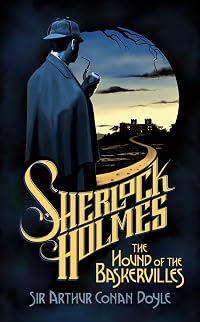
The Hound of the Baskervilles
by Arthur Conan Doyle 
Sherlock Holmes Original Novels {Conan Doyle} (3)
On This Page
Description
At Baskerville Hall on the grim moors of Devonshire, a legendary curse has apparently claimed one more victim. Sir Charles Baskerville has been found dead. There are no signs of violence, but his face is hideously distorted with terror. Years earlier, a hound-like beast with blazing eyes and dripping jaws was reported having torn out Hugo Baskerville's throat. Is Sir Henry Baskerville, younger heir to the estate, now in danger? Enter Sherlock Holmes, summoned to protect Sir Henry from the show more fate that threatens the Baskerville family. As Holmes and Watson begin to investigate, a blood-chilling howl from the fog-shrouded edges of the great Grimpen Mire signals that the legendary hound of the Baskervilles is poised for yet another murderous attack. show lessTags
Recommendations


















Member Recommendations


Member Reviews
The most known Holmes novel that flirts with straying from the themes of the universe but ultimately pulls back. There's a fascinating contradiction between Doyle the man, the gullible spiritualist falling for hoaxes as simple as double exposures, and his skeptical avatar who instead scoffs at Victorian ghost stories and cursed lineages. The story effectively needs to take a break from Holmes dismissiveness so it has Watson go on a solo adventure where he can get swept up in the mystery and horror like the dolt he is, only to have Holmes swoop in to pull the mask off the proverbial Scooby Doo villain.
Although Doyle tries to give some redeeming remarks about Watson, this time from the lips of Holmes, and show some level of growth and show more adoption of his master's talents, it doesn't really come to fruition. This type of relationship seemed much more acceptable around the beginning of the century, lasting into the 30s and 40s with Christie's similarly incompetent Hastings as Poirot's shadow. In adaptations you often see a compensatory set of gifts bestowed Watson to make him more than Holmes' biographer and it's probably objectively better writing to have the relationship be based on more than his devoted attention and tolerance to exposition.
Lessons learned here: watch your step on the moors. show less
Although Doyle tries to give some redeeming remarks about Watson, this time from the lips of Holmes, and show some level of growth and show more adoption of his master's talents, it doesn't really come to fruition. This type of relationship seemed much more acceptable around the beginning of the century, lasting into the 30s and 40s with Christie's similarly incompetent Hastings as Poirot's shadow. In adaptations you often see a compensatory set of gifts bestowed Watson to make him more than Holmes' biographer and it's probably objectively better writing to have the relationship be based on more than his devoted attention and tolerance to exposition.
Lessons learned here: watch your step on the moors. show less
I’m rereading the Sherlock Holmes canon more than sixty years after devouring it for the first time. My enjoyment is as great as the first time, but a young adolescent reads differently than a graybeard. Now, I’m interested not only in a clever plot, a satisfying reveal, and the protagonist’s quirks but also in how great writing is achieved.
Doyle, bowing to popular demand, wrote this novel after killing off Holmes nearly a decade earlier. Improbably, acquiescence resulted in a masterpiece. The question of how this was achieved interests me.
Perhaps Doyle’s attempt to write books that succeeded without Holmes spurred him to work on his craft. The well-constructed opening lines indicate that Doyle brings his best literary skills to show more the project. The use of a variety of techniques—straight narrative, a back story (complete with an ancient document), copies of letters from Watson to Holmes, diary entries, and a summation from Holmes at the end—keeps the plot moving along without revealing too much at once. Finally, there is the atmospheric evocation of the Devonshire moors, culminating in a thick fog that threatens to thwart our heroes at the expected moment of triumph.
Along with these steps forward in style, there are elements familiar from other Holmes stories — the fortune made abroad, the readiness to let an escaped convict emigrate, and the failure to apprehend the culprit, only to have justice served by the elements rather than a court of law. While these motifs are interesting, other recurrent features have not aged well. For instance, the paternalistic, chivalrous view of women (invariably beautiful, unless they are servants). In addition, the racism many readers today find objectionable is there, but off-handedly, in the unspoken assumption of Anglo-Saxon superiority. More prominent is the casual class prejudice, aligned with the belief that character can be read in physiognomy; in fact, one character is obsessed with phrenology.
One element contributing to this book’s page-turning success is the plot’s balance between the natural and the supernatural.
Finally, an anomaly: this tale relies less than the earlier Holmes stories on the detective’s eccentricities. In fact, Holmes is off-stage for much of the plot. Is that part of why this works so well? Hmm, a three-pipe problem, indeed. show less
Doyle, bowing to popular demand, wrote this novel after killing off Holmes nearly a decade earlier. Improbably, acquiescence resulted in a masterpiece. The question of how this was achieved interests me.
Perhaps Doyle’s attempt to write books that succeeded without Holmes spurred him to work on his craft. The well-constructed opening lines indicate that Doyle brings his best literary skills to show more the project. The use of a variety of techniques—straight narrative, a back story (complete with an ancient document), copies of letters from Watson to Holmes, diary entries, and a summation from Holmes at the end—keeps the plot moving along without revealing too much at once. Finally, there is the atmospheric evocation of the Devonshire moors, culminating in a thick fog that threatens to thwart our heroes at the expected moment of triumph.
Along with these steps forward in style, there are elements familiar from other Holmes stories — the fortune made abroad, the readiness to let an escaped convict emigrate, and the failure to apprehend the culprit, only to have justice served by the elements rather than a court of law. While these motifs are interesting, other recurrent features have not aged well. For instance, the paternalistic, chivalrous view of women (invariably beautiful, unless they are servants). In addition, the racism many readers today find objectionable is there, but off-handedly, in the unspoken assumption of Anglo-Saxon superiority. More prominent is the casual class prejudice, aligned with the belief that character can be read in physiognomy; in fact, one character is obsessed with phrenology.
One element contributing to this book’s page-turning success is the plot’s balance between the natural and the supernatural.
Finally, an anomaly: this tale relies less than the earlier Holmes stories on the detective’s eccentricities. In fact, Holmes is off-stage for much of the plot. Is that part of why this works so well? Hmm, a three-pipe problem, indeed. show less
I went into my first Sherlock Holmes novel not expecting to like it very much. Sherlock Holmes is all about reason, logic, and deduction-- all things that I am not a fan of! Come on, I’m a Twin Peaks lover, a show where an FBI agent solves crimes by having mysterious dreams and throwing stones at milk bottles. Even after the first chapter, I found Sherlock’s persona grating and I did not think we were going to get along
-BUT-
I was so wrong! This was wonderful! It turns out Sherlock is a huge weirdo and this is one heck of a bizarre mystery. Big plus for being set on the English moors, a mysterious eerie setting that never fails to draw me into a story. I relished every second of prose describing the rugged countryside and fatal bogs. show more Seriously, this book is totally about running amok on the moors and I was here for it show less
-BUT-
I was so wrong! This was wonderful! It turns out Sherlock is a huge weirdo and this is one heck of a bizarre mystery. Big plus for being set on the English moors, a mysterious eerie setting that never fails to draw me into a story. I relished every second of prose describing the rugged countryside and fatal bogs. show more Seriously, this book is totally about running amok on the moors and I was here for it show less
This is probably my favorite Sherlock Holmes mystery. I loved the way Doyle described the moor as having a grim charm. The thought of an escaped convict, someone dubbed the Nottinghill Murderer, living out on the fog-filled moor was eerie. Whole ponies have been swallowed up by this deadly bog and yet, supposedly, this murderer was out there with an evil creature, something with "diabolical agency" and supernatural powers. Something that looked like a dog, but twice its size with glowing eyes and a mouth teeth and flames. this is another tale of deception and greed, but with a welcomed unusual twist.
Potete leggerlo quando volete e come volete. E' un bel giallo, uno dei più belli di Conan Doyle. De mistero e de paura. Quando l'ho letto (nella mia infanzia pleistocenica) l'ho consumato a furia di rileggerlo. In casa mi prendevano in giro, ma ad ogni rilettura rabbrividivo sentendo la ghiaia del sentiero di casa Baskerville scricchiolare sotto i piedi di chi cercava di sfuggire al male, correndo nella notte. Oggi siamo tutti troppo smaliziati e, forse, potrebbe non funzionare più ma datemi retta: se avete in casa giovani lettori regalategliene una copia.
{fifth of 9 in Sherlock Holmes canon; detective, Victorian England, London, Devonshire, moors, murder, mystery, Gothic}(1902/ 2024)
As a teenager I read as many Sherlock Holmes books as I could get my hands on (until I got a bit fed up with Holmes's omniscience); I'm hoping to interest my children in this classic (and then, hopefully, other classics). The introduction to our edition (Puffin Classic) is by Judith Kerr. Rereading this now I found it actually quite funny, at least at the beginning.
And so Watson describes to us the gloomy, spooky nature of the Hall and the moors that surround it while he investigates the servants and neighbours on Holmes's behalf. The case is further complicated by an escaped convict from nearby Princetown prison and another suspicious character seen on the moors as well as by rumours of the unearthly cries of a hellhound.
The story telling varies between narrative, letters and diary entries. Conan Doyle originally serialised this Gothic-style story in The Strand Magazine from August 1901 - April 1902 (according to Wikipedia) so this tactic would have stretched out the narrative and encompassed a few cliff hangers to keep readers coming back for the next instalments. (At one point I felt sure we had lost Sir Henry as well, for instance.)
I must say that I have memories of being spellbound (and slightly scared) when I read this as a child but as a sceptical adult (with some vague memory of the outcome) I didn't feel quite as apprehensive as it did the first time I read this fairly slim book, though it does build the brooding atmosphere well.
Word of warning - this is a book of its times and there are cases of abuse which are written about quite matter of factly but which I found a bit upsetting; several animals die over the course of the narrative and it's a bit startling to remember that women were still effectively property of their husbands with few rights.
It is still well written and mesmerising. Don't worry - Holmes does turn up to save the day before the end.
I read this for the September 2025 TIOLI Challenge 6: Read a book discussed in any September on the BBC Worldservice Bookclub and then listened to the podcast. Obviously they couldn't interview Sir Arthur Conan Doyle himself but they had two Holmes scholars who answered questions sent in by Sherlock Holmes societies around the world. These are points that I gleaned from listening:
- Though Conan Doyle borrowed ideas from contemporaries such as Edgar Allan Poe and Wilkie Collins he differentiated the Holmes stories by adding Watson as a narrator.
- They suggested that Conan Doyle didn't dislike his creation but he didn't like the pressure of producing the stories to a schedule
- and pointed out that there are similarities between Holmes and the villains he battles, such as Moriarty of similar intellect.
- Sherlock Holmes was such a success that he has seeped into the culture and affects it even now, inspiring such modern day characters as House MD.
- After disposing of Holmes and Moriarty at the Reichenbach Falls, Conan Doyle succumbed to pressure to write more adventures for him; The Hound of the Baskervilles was written after, though set before, The Final Problem. He put the villainin plain sight and then distracts us .
- Holmes is missing for first part of The Hound of the Baskervilles and it is more of a gothic novel than a detective story. It sets the paradox of Holmes's logical deduction against the supernatural; Conan Doyle made use of medieval legends of supernatural hounds from parts of the country such as Devon, Yorkshire and Norfolk.
- Apparently Conan Doyle was writing gothic stories 20 years before he authored this book so it was not really a departure from the norm for him.
* MRCS = Member of the Royal College of Surgeons; once qualified as a surgeons, practitioners revert to 'Mister' (or other relevant title) from 'Doctor'.
(September 2025)
4.5 stars show less
As a teenager I read as many Sherlock Holmes books as I could get my hands on (until I got a bit fed up with Holmes's omniscience); I'm hoping to interest my children in this classic (and then, hopefully, other classics). The introduction to our edition (Puffin Classic) is by Judith Kerr. Rereading this now I found it actually quite funny, at least at the beginning.
'I presume that it is Mr Sherlock Holmes whom I am addressing and not -'show more
'No, this is my friend Dr Watson.'
'Glad to meet you, sir. I have heard your name mentioned in connection with that of your friend. You interest me very much, Mr Holmes. I had
hardly expected so dolichocephalic a skull or such well-marked supra-orbital development. Would you have any objection to my running my finger along your parietal fissure? A cast of your skull, sir, until the original is available, would be an ornament to any anthropological museum. It is not my intention to be fulsome, but I confess that I covet your skull.'The story (the third novel but the fifth book in canon) is narrated in the first person by Dr John Watson, self-appointed biographer to Sherlock Holmes the great detective. It opens with them pondering the mystery of a 'Penang lawyer' (an Anglicised misnomer), a type of walking stick, which was left behind by a potential client. Having made deductions about the owner (erroneously by Watson, as it turns out), the man himself - a doctor, Mr ('Mister, sir, Mister - a humble MRCS'*) James Mortimer, from Dartmoor, Devonshire - turns up to reclaim his stick and to request Holmes's aid (and skull) in a case regarding one of his patients; Sir Charles Baskerville, a baronet who had rebuilt his decrepit family fortunes to £740,000 after the legacies in his will (in 1889 - which would be worth somewhere near £100 million today (September 2025)!). He reads out to them the Baskerville family legend of a wicked ancestor who was eventually, according to the legend, killed by a supernatural hound and then tells them that the current head of the family had recently died from unknown causes with a look of terror on his face.
'I presume, sir,' said he at last, 'that it was not merely for the purpose of examining my skull that you have done me the honour to call here last night and again today?'Mortimer wants Holmes's advice as to whether he should warn off the heir, Henry Baskerville, who is just about to arrive in London from Canada, or accompany him back to Baskerville Hall. Holmes's response - especially after noticing someone following Sir Henry - is to send Watson to Devonshire with the two men since Holmes himself will be tied up in London with some important cases, but Watson is to report to him every day. It wasn't until a third of the way into the book that we finally left London and arrived at Baskerville Hall - sans Holmes.
'No, sir, no; though I am happy to have had the opportunity of doing that as well. I came to you, Mr Holmes, because I recognize that I am myself an unpractical man, and because I am suddenly confronted with a most serious and extraordinary problem. Recognizing, as I do, that you are the second highest expert in Europe -'
'Indeed, sir! May I inquire who has the honour to be the first?' asked Holmes, with some asperity.
'To the man of precisely scientific mind the work of Monsieur Bertillon must always appeal strongly.'
'Then had you not better consult him?'
And so Watson describes to us the gloomy, spooky nature of the Hall and the moors that surround it while he investigates the servants and neighbours on Holmes's behalf. The case is further complicated by an escaped convict from nearby Princetown prison and another suspicious character seen on the moors as well as by rumours of the unearthly cries of a hellhound.
The story telling varies between narrative, letters and diary entries. Conan Doyle originally serialised this Gothic-style story in The Strand Magazine from August 1901 - April 1902 (according to Wikipedia) so this tactic would have stretched out the narrative and encompassed a few cliff hangers to keep readers coming back for the next instalments. (At one point I felt sure we had lost Sir Henry as well, for instance.)
I must say that I have memories of being spellbound (and slightly scared) when I read this as a child but as a sceptical adult (with some vague memory of the outcome) I didn't feel quite as apprehensive as it did the first time I read this fairly slim book, though it does build the brooding atmosphere well.
Word of warning - this is a book of its times and there are cases of abuse which are written about quite matter of factly but which I found a bit upsetting; several animals die over the course of the narrative and it's a bit startling to remember that women were still effectively property of their husbands with few rights.
It is still well written and mesmerising. Don't worry - Holmes does turn up to save the day before the end.
I read this for the September 2025 TIOLI Challenge 6: Read a book discussed in any September on the BBC Worldservice Bookclub and then listened to the podcast. Obviously they couldn't interview Sir Arthur Conan Doyle himself but they had two Holmes scholars who answered questions sent in by Sherlock Holmes societies around the world. These are points that I gleaned from listening:
- Though Conan Doyle borrowed ideas from contemporaries such as Edgar Allan Poe and Wilkie Collins he differentiated the Holmes stories by adding Watson as a narrator.
- They suggested that Conan Doyle didn't dislike his creation but he didn't like the pressure of producing the stories to a schedule
- and pointed out that there are similarities between Holmes and the villains he battles, such as Moriarty of similar intellect.
- Sherlock Holmes was such a success that he has seeped into the culture and affects it even now, inspiring such modern day characters as House MD.
- After disposing of Holmes and Moriarty at the Reichenbach Falls, Conan Doyle succumbed to pressure to write more adventures for him; The Hound of the Baskervilles was written after, though set before, The Final Problem. He put the villain
- Holmes is missing for first part of The Hound of the Baskervilles and it is more of a gothic novel than a detective story. It sets the paradox of Holmes's logical deduction against the supernatural; Conan Doyle made use of medieval legends of supernatural hounds from parts of the country such as Devon, Yorkshire and Norfolk.
- Apparently Conan Doyle was writing gothic stories 20 years before he authored this book so it was not really a departure from the norm for him.
* MRCS = Member of the Royal College of Surgeons; once qualified as a surgeons, practitioners revert to 'Mister' (or other relevant title) from 'Doctor'.
(September 2025)
4.5 stars show less
A very, very enjoyable read: definitely the pinnacle (thus far) of the Holmes canon.
Every element fits into its proper place: the isolated location is well described, with many fascinating features such as the Neolithic huts, fatal bogs and rows of yews. Each character is well-drawn, and each has their own mystery which interlocks perfectly with the overarching puzzle. By utilising different aspects of Watson's narrative voice - his diary, his letters, his reminiscences - Conan Doyle is able to shake up his writing formula somewhat, and present us with a mystery in which both Watson and Holmes are used to their respective strengths.
Beyond this, the mystery is multi-faceted and - particularly noteworthy - the novel is about every aspect show more of the crime, not just the "whodunnit" or how. As a result, even though the revelations are really no more than typical Conan Doyle fare, they are in no way a letdown, because it is only part of a larger canvas.
Seasoned crime readers like myself will probably pick up on the big clue planted very early in the book but, even then, it by no means allows you to solve the crime. The only aspect which might be seen by some as negative is that the book is always happy to pause and consider any minute clue (half a chapter is spent on exactly which newspaper a ransom-style note was cut from). To me, though, this is quintessential Holmes. The traces of romantic characterisation and storytelling linger, but are kept in check by the power of the work overall. As a result, I'm soldiering on with renewed vigour to the sixth of the nine Holmes books. show less
Every element fits into its proper place: the isolated location is well described, with many fascinating features such as the Neolithic huts, fatal bogs and rows of yews. Each character is well-drawn, and each has their own mystery which interlocks perfectly with the overarching puzzle. By utilising different aspects of Watson's narrative voice - his diary, his letters, his reminiscences - Conan Doyle is able to shake up his writing formula somewhat, and present us with a mystery in which both Watson and Holmes are used to their respective strengths.
Beyond this, the mystery is multi-faceted and - particularly noteworthy - the novel is about every aspect show more of the crime, not just the "whodunnit" or how. As a result, even though the revelations are really no more than typical Conan Doyle fare, they are in no way a letdown, because it is only part of a larger canvas.
Seasoned crime readers like myself will probably pick up on the big clue planted very early in the book but, even then, it by no means allows you to solve the crime. The only aspect which might be seen by some as negative is that the book is always happy to pause and consider any minute clue (half a chapter is spent on exactly which newspaper a ransom-style note was cut from). To me, though, this is quintessential Holmes. The traces of romantic characterisation and storytelling linger, but are kept in check by the power of the work overall. As a result, I'm soldiering on with renewed vigour to the sixth of the nine Holmes books. show less
Members
- Recently Added By
Lists

The Guardian's 1000 Novels Everyone Must Read
1,005 works; 548 members

1001 Books You Must Read Before You Die
1,448 works; 1,134 members

Read the book and saw the movie
1,170 works; 195 members

Best Crime Fiction
262 works; 39 members
501 Must-Read Books
529 works; 72 members
BBC Big Read
191 works; 45 members

Cerebral Mysteries
34 works; 23 members

The Top 100 Crime Novels of All Time
100 works; 15 members

Books That Will Keep You on the Edge of Your Seat
73 works; 20 members

Best Gothic Fiction
110 works; 31 members
Best of British Literature
226 works; 41 members

Survey of Mysteries and Crime Fiction
96 works; 17 members

Le Monde - Les 100 livres du siècle
121 works; 25 members

Crime and Mysteries to Read
746 works; 31 members

BBC's 100 Novels That Shaped Our World
100 works; 22 members

NPRs your picks: top 100 Killer Thrillers
100 works; 17 members

British Mystery
469 works; 14 members

Survey of Classic Crime
39 works; 7 members

100 Best Thrillers of All Time
100 works; 6 members

Top Cops (Detectives in Fiction)
86 works; 24 members

Global Reads: Books Set in the United Kingdom and Ireland
109 works; 5 members

Books Set in Great Britain
191 works; 13 members

Recommend the 20 best books you've read in the last five years
2,168 works; 606 members
Murder Mysteries
57 works; 11 members

Haycraft Queen Cornerstones
181 works; 3 members
H.R.F. Keating's 100 Best Crime & Mystery Books
100 works; 8 members
MysteryCAT 2014
19 works; 1 member

Books About Murder
313 works; 7 members

Jones and Newman's Horror: Another 100 Best Books
100 works; 7 members

Barzun and Taylor's Classics of Crime
93 works; 3 members
Detective Stories
343 works; 5 members

75 Books Challenge Halloween Read "Official" Selections
71 works; 7 members

Books mentioned in Julian Symons’ Bloody Murder
438 works; 6 members

Thrillers
20 works; 3 members

Books Read in 2022
5,226 works; 115 members

Mythical Monsters of the World
199 works; 79 members
Publisher's Weekly Bestsellers Part I - 1895-1939
399 works; 8 members

Mind Expanding Books by hackerkid
581 works; 8 members

Out of Copyright
244 works; 14 members

Novels/Poems/Short Stories/Anything Storytelling Related
112 works; 2 members

Literary Works Read in College
316 works; 15 members

Books Read in 2020
4,379 works; 124 members

Adult Stories Involving Animals
76 works; 6 members

Books I recommend to everyone
29 works; 1 member

Top Five Books of 2022
736 works; 272 members

DigitalDreamDoor top 300
300 works; 4 members

Goalhanger Book Club
21 works; 1 member

.
396 works; 1 member

Books talked about in Pamela Dean's Tam Lin
74 works; 1 member
Ghost Stories That Thrill Us
256 works; 115 members
Reading LIst
648 works; 1 member

BBC World Book Club
265 works; 5 members

ClubLeabhar: Leabhar na Míosa
121 works; 1 member

.
194 works; 2 members

Read in 2010
48 works; 1 member
Las 10 mejores novelas negras para comenzar a leer novela negra
10 works; 1 member

Great Books Favorites
71 works; 6 members
Tozai Mystery Best 100 | The Top 100 Mystery Novels
111 works; 3 members
Canon de la narrativa universal del s. XX (cicutadry)
499 works; 3 members

Recommended Reading : 600 Classics Reviewed, Editors of Salem Press, 2015
634 works; 6 members
Best Mysteries With a Historical Setting
292 works; 160 members

Books Read in 2010
631 works; 11 members

Books Read in 2014
2,343 works; 89 members

Books You Read For University
184 works; 3 members

Five star books
1,767 works; 110 members

Recommended Literary Books
111 works; 1 member

Books Read in 2008
335 works; 8 members

Unread books
1,063 works; 87 members
Fave Books
27 works; 1 member

Victorian Period
113 works; 10 members
My list of 100 books to read next
100 works; 4 members
New York Public Library's Books of the Century - All
170 works; 14 members
Canon de la narrativa universal del siglo XX
254 works; 6 members
New York Public Library's Books of the Century
120 works; 20 members
20th Century Literature
1,161 works; 55 members
One Book, Many Authors
441 works; 40 members

Childhood Favorites
427 works; 24 members

Best Horror Mega-List
342 works; 6 members

Children's Classics Worth Reading
68 works; 9 members

1001 Children's Books You Must Read Before You Grow Up
774 works; 101 members
1900s (Decade, not century)
73 works; 17 members
19th Century
190 works; 16 members

Classics you know you should have read but probably haven't
421 works; 409 members
Best Horror Books
281 works; 85 members
Readable Classics
110 works; 15 members

Western World's Greatest Books - Project Gutenberg
295 works; 15 members
Books Featured on Readers' Review of the Diane Rehm Show
161 works; 8 members
Retrospective of Horror and Thrillers
21 works; 2 members
Lithub: 50 Great Classic Novels Under 200 pages
50 works; 10 members

Shelf 101
60 works; 1 member
1,001 BYMRBYD Concensus
723 works; 27 members
Books available on Open Library
171 works; 4 members
My TBR
371 works; 3 members
Animals in the Title
498 works; 11 members

A Good Read (Radio 4)
287 works; 1 member
Overdue Podcast
806 works; 9 members
Books on my Kindle
162 works; 3 members
LibraryThingers' 1001 Books You Must Read Before You Die
442 works; 30 members
Haunted Britain and Ireland
51 works; 7 members
Sherlock Holmes and Jack the Ripper
13 works; 1 member
Books Read in 2016
4,666 works; 199 members

Tagged 19th Century
104 works; 7 members
Best Books of the 20th Century
193 works; 5 members
Favourite 19th century fiction
257 works; 60 members
Talk Discussions
Past Discussions
the Hound of the Baskervilles in Baker Street and Beyond (December 2012)
Group read: Hound of the Baskervilles SPOILER Thread in The Green Dragon (February 2011)
Hound of the Baskervilles Spoiler FREE thread in The Green Dragon (February 2011)
Author Information

4,014+ Works 170,098 Members
The most famous fictional detective in the world is Arthur Conan Doyle's Sherlock Holmes. However, Doyle was, at best, ambivalent about his immensely successful literary creation and, at worst, resentful that his more "serious" fiction was relatively ignored. Born in Edinburgh, Doyle studied medicine from 1876 to 1881 and received his M.D. in show more 1885. He worked as a military physician in South Africa during the Boer War and was knighted in 1902 for his exceptional service. Doyle was drawn to writing at an early age. Although he attempted to enter private practice in Southsea, Portsmouth, in 1882, he soon turned to writing in his spare time; it eventually became his profession. As a Liberal Unionist, Doyle ran, unsuccessfully, for Parliament in 1903. During his later years, Doyle became an avowed spiritualist. Doyle sold his first story, "The Mystery of the Sasassa Valley," to Chambers' Journal in 1879. When Doyle published the novel, A Study in Scarlet in 1887, Sherlock Holmes was introduced to an avid public. Doyle is reputed to have used one of his medical professors, Dr. Joseph Bell, as a model for Holmes's character. Eventually, Doyle wrote three additional Holmes novels and five collections of Holmes short stories. A brilliant, though somewhat eccentric, detective, Holmes employs scientific methods of observation and deduction to solve the mysteries that he investigates. Although an "amateur" private detective, he is frequently called upon by Scotland Yard for assistance. Holmes's assistant, the faithful Dr. Watson, provides a striking contrast to Holmes's brilliant intellect and, in Doyle's day at least, serves as a character with whom the reader can readily identify. Having tired of Holmes's popularity, Doyle even tried to kill the great detective in "The Final Problem" but was forced by an outraged public to resurrect him in 1903. Although Holmes remained Doyle's most popular literary creation, Doyle wrote prolifically in other genres, including historical adventure, science fiction, and supernatural fiction. Despite Doyle's sometimes careless writing, he was a superb storyteller. His great skill as a popular author lay in his technique of involving readers in his highly entertaining adventures. (Bowker Author Biography) show less
Arthur Conan Doyle has a Legacy Library. Legacy libraries are the personal libraries of famous readers, entered by LibraryThing members from the Legacy Libraries group.
Some Editions
Awards and Honors
Distinctions
Notable Lists
BBC's Big Read (128)
Daniel S. Burt's Novel 100 (099 – 99)
Series

Belongs to Publisher Series
Punainen sulka (1)
Omnibus (Omnibus-Verlag München) (21410)
Can Gotik Romantik (10)
Penguin Clothbound Classics (2009)
El País Aventuras (10)
Světová četba (196)
Geração Público (13)
Arion Press (16)
L&PM Pocket (90)
Den svarte serie (32)
Tus libros (90)
Airmont Classics (62)
Penguin English Library, 2012 series (2012-12)
Gli Oscar [Mondadori] (664)
Work Relationships
Is contained in
The Sherlock Holmes Novels: A Study in Scarlet / The Sign of the Four / The Hound of the Baskervilles / The Valley of Fear by Arthur Conan Doyle
Treasury of World Masterpieces "The Celebrated Cases of Sherlock Holmes" & "H.G. Wells (Treasury of World Masterpieces) by Sir Arthur Conan Doyle (indirect)
Sherlock Holmes: The Complete Novels and Stories, Vol. 1 and 2 (Bantam) by Arthur Conan Doyle (indirect)
A Study in Scarlet / The Sign of Four / The Adventures of Sherlock Holmes / The Memoirs of Sherlock Holmes / The Hound of the Baskervilles (B&N Classics 1/2) by Arthur Conan Doyle
The Return of Sherlock Holmes / The Hound of the Baskervilles (The Later Adventures of Sherlock Holmes) by Sir Arthur Conan Doyle
Children's Classic Compendium: Hound of the Baskervilles / White Fang / Dr Jekyll and Mr Hyde by Arthur Conan Doyle
British Mystery Megapack Volume 5 - The Sherlock Holmes Collection: 4 Novels and 43 Short Stories + Extras by Arthur Conan Doyle
Classic Illustrated Sherlock Holmes: Thirty Seven Short Stories Plus a Complete Novel by Arthur Conan Doyle
study in scarlet / sign of four / hound of the baskervilles / memoirs of sherlock holmes by Sir Arthur Conan Doyle
Sherlock Holmes - volume 2 : La Vallée de la peur ; Le Chien des Baskerville ; Les Archives de Sherlock Holmes ; Son dernier coup d'archet ; Les Exploits de Sherlock Holmes by Arthur Conan Doyle
A Study in Scarlet / The Sign of Four / The Valley of Fear / The Hound of the Baskervilles / The Adventures of Sherlock Holmes by Arthur Conan Doyle
Sherlock Holmes: Volume 2: Memórias de Sherlock Holmes | O cão dos Baskerville (Portuguese Edition) by Arthur Conan Doyle
A Study in Scarlet / The Adventures of Sherlock Holmes / The Hound of the Baskervilles / Sign of Four by Arthur Conan Doyle
The Sherlock Holmes illustrated omnibus : The adventures of Sherlock Holmes, The memoirs of Sherlock Holmes, The hound of the Baskervilles, The return of Sherlock Holmes : a facsimile of the stories and the adventure as they were first published in the Strand magazine, London by Sir Arthur Conan Doyle
The Hound of the Baskervilles, A Study in Scarlet, The Sign of Four (Everyman's Library) by Sir Arthur Conan Doyle
The adventures of Sherlock Holmes ; The memoirs of Sherlock Holmes ; The return of Sherlock Holmes ; The hound of the Baskervilles ; A study in ... the Bruce-Partington plans (Masters Library) by Arthur Conan Doyle (indirect)
Contains
Is retold in
Has the (non-series) sequel
Has the adaptation
The Hound of the Baskervilles: A Sherlock Holmes Graphic Novel (Illustrated Classics) by Sir Arthur Conan Doyle
Match Wits with Sherlock Holmes: The Hound of the Baskervilles [adaptation - graphic novel - Graphic Universe] by Murray Shaw
Reading & Training : Sir Arthur Conan Doyle : The hound of the Baskervilles [book + sound recording] by CIDEB
Color Your Own Graphic Novel SHERLOCK HOLMES: The Hound of the Baskervilles (Dover Classic Stories Coloring Book) by Sir Arthur Conan Doyle
Is abridged in
Is expanded in
Is parodied in
Inspired
Has as a reference guide/companion
Has as a study
Has as a commentary on the text
Has as a student's study guide
Has as a teacher's guide
Common Knowledge
- Canonical title
- The Hound of the Baskervilles
- Original title
- The Hound of the Baskervilles
- Alternate titles*
- Kamala öinen kummitus
- Original publication date
- 1902
- People/Characters
- Sherlock Holmes; John H. Watson; Sir Henry Baskerville (heir); Dr. James Mortimer; Inspector G. Lestrade; John Barrymore (show all 17); Eliza Barrymore; Beryl Stapleton; Jack Stapleton; Selden; Mr. Frankland; Laura Lyons; Sir Charles Baskerville (victim); Sir Hugo Baskerville (ancestor); Perkins (coachman); Cartwright (messenger boy); John Clayton (cab driver)
- Important places
- Dartmoor, Devon, England, UK; Baskerville Hall, Dartmoor, Devon, England, UK; 221B Baker Street, London, England, UK; Merripit House, Dartmoor, Devon, England, UK; Grimpen, Dartmoor, Devon, England, UK; Grimpen Mire, Dartmoor, Devon, England, UK (show all 9); Lafter Hall, Dartmoor, Devon, England, UK; Fernworthy, Dartmoor, Devon, England, UK; Coombe Tracey, Dartmoor, Devon, England, UK
- Related movies
- The Hound of the Baskervilles (1939 | Sidney Lanfield | IMDb); The Hound of the Baskervilles (1959 | Terence Fisher | IMDb); The Hound of the Baskervilles (1978 | Paul Morrissey | IMDb); The Hound of the Baskervilles (1988 | TV | IMDb); The Hound of the Baskervilles (2000 | Rodney Gibbons | IMDb); The Hound of the Baskervilles (2002 | TV | IMDb) (show all 23); Der Hund von Baskerville (1914 | IMDb); Der Hund von Baskerville, 2. Teil - Das einsame Haus (1914 | IMDb); Der Hund von Baskerville, 3. Teil - Das unheimliche Zimmer (1915 | IMDb); Der Hund von Baskerville, 4. Teil (1915 | IMDb); Der Hund von Baskerville - 5 Teil: Dr. Macdonalds Sanatorium (1920 | IMDb); Der Hund von Baskerville - 6. Teil: Das Haus ohne Fenster (1920 | IMDb); Das dunkle Schloß (1915 | IMDb); The Hound of the Baskervilles (1922 | IMDb); Moken no himitsu (1924 | IMDb); The Hound of the Baskervilles (1932 | IMDb); The Hound of the Baskervilles (1937 | IMDb); Der Hund von Baskerville (1955 | IMDb); L'ultimo dei Baskerville (1968 | IMDb); The Hound of the Baskervilles (1972 | IMDb); Priklyucheniya Sherloka Kholmsa i doktora Vatsona: Sobaka Baskerviley (1981 | IMDb); The Hound of the Baskervilles (1982 | IMDb); The Hound of the Baskervilles (1983 | IMDb)
- Dedication
- This story owes its inception to my friend, Mr Fletcher Robinson, who has helped me both in the general plot and in the local details
MY DEAR ROBINSON: It was your account of a west country legend which first suggested the idea of this little tale to my mind. For this, and for the help which you gave me in it evolution, all thanks.
Your most truly,
A... (show all). CONAN DOYLE - First words
- Mr. Sherlock Holmes, who was usually very late in the mornings, save upon those not infrequent occasions when he was up all night, was seated at the breakfast table.
- Quotations
- A long, low moan, indescribably sad, swept over the moor. It filled the whole air, and yet it was impossible to say whence it came. From a dull murmur it swelled into a deep roar, and then sank back into a melancholy, throbbi... (show all)ng murmur once again. Stapleton looked at me with a curious expression in his face.
"Queer place, the moor!" said he. - Last words
- (Click to show. Warning: May contain spoilers.)"Might I trouble you then to be ready in half an hour, and we can stop at Marcini’s for a little dinner on the way?”
- Original language
- English
- Canonical DDC/MDS
- 823.08721; 823.0872; 823.912
- Disambiguation notice
- This is the main work for The Hound of the Baskervilles. Please do not combine it with any abridgement, adaptation, omnibus containing additional works, etc.
Contents: About the Author -- Characters You Will Mee... (show all)t -- Chapter 1. Mr. Sherlock Holmes -- Chapter 2. The Curse of the Baskervilles -- Chapter 3. The Problem -- Chapter 4. Sir Henry Baskerville -- Chapter 5. Three Broken Threads -- Chapter 6. Baskerville Hall -- Chapter 7. The Stapletons of Merripit House -- Chapter 8. First Report of Dr. Watson -- Chapter 9. Second Report of Dr. Watson -- Chapter 10. Extract from the Diary of Dr. Watson -- Chapter 11. The Man on the Tor -- Chapter 12. Death on the Moor -- Chapter 13. Fixing the Nets -- Chapter 14. The Hound of the Baskervilles -- Chapter 15. A Retrospective
*Some information comes from Common Knowledge in other languages. Click "Edit" for more information.
Classifications
- Genres
- Fiction and Literature, Mystery
- DDC/MDS
- 823.08721 — Literature & rhetoric English & Old English literatures English fiction By type Genre fiction Adventure fiction Mystery fiction Detective fiction
- LCC
- PR4622 .H6 — Language and Literature English English Literature 19th century , 1770/1800-1890/1900
- BISAC
Statistics
- Members
- 17,949
- Popularity
- 356
- Reviews
- 343
- Rating
- (3.94)
- Languages
- 37 — Arabic, Bulgarian, Catalan, Chinese, Czech, Danish, Dutch, English, Esperanto, Estonian, Finnish, French, German, Irish, Galician, Greek, Hebrew, Hungarian, Italian, Japanese, Latvian, Lithuanian, Norwegian (Nynorsk), Norwegian (Bokmål), Norwegian, Polish, Russian, Croatian, Slovenian, Spanish, Swedish, Thai, Turkish, Ukrainian, Urdu, Portuguese (Portugal), Portuguese (Brazil)
- Media
- Paper, Audiobook, Ebook
- ISBNs
- 1,306
- UPCs
- 13
- ASINs
- 392