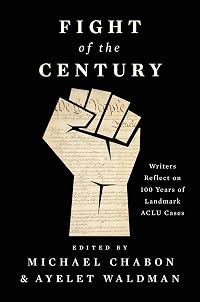
Fight of the Century: Writers Reflect on 100 Years of Landmark ACLU Cases
by Michael Chabon (Editor), Ayelet Waldman (Editor)
On This Page
Description
To mark its 100-year anniversary, the American Civil Liberties Union partners with award-winning authors Michael Chabon and Ayelet Waldman to bring together many of our greatest living writers, each contributing an original piece inspired by a historic ACLU case. On January 19, 1920, a small group of idealists and visionaries, including Helen Keller, Jane Addams, Roger Baldwin, and Crystal Eastman, founded the American Civil Liberties Union. A century after its creation, the ACLU remains the show more nation's premier defender of the rights and freedoms guaranteed by the Constitution. In collaboration with the ACLU, authors Michael Chabon and Ayelet Waldman have curated an anthology of essays about landmark cases in the organization's one-hundred-year history. Fight of the Century takes you inside the trials and the stories that have shaped modern life. Some of the most prominent cases that the ACLU has been involved in--Brown v. Board of Education, Roe v. Wade, Miranda v. Arizona--need little introduction. Others you may never even have heard of, yet their outcomes quietly defined the world we live in now. Familiar or little-known, each case springs to vivid life in the hands of the acclaimed writers who dive into the history, narrate their personal experiences, and debate the questions at the heart of each issue. Hector Tobar introduces us to Ernesto Miranda, the felon whose wrongful conviction inspired the now-iconic Miranda rights--which the police would later read to the man suspected of killing him. Yaa Gyasi confronts the legacy of Brown v. Board of Education, in which the ACLU submitted a friend of- the-court brief questioning why a nation that has sent men to the moon still has public schools so unequal that they may as well be on different planets. True to the ACLU's spirit of principled dissent, Scott Turow offers a blistering critique of the ACLU's stance on campaign finance. These powerful stories, along with essays from Neil Gaiman, Meg Wolitzer, Salman Rushdie, Ann Patchett, Viet Thanh Nguyen, Louise Erdrich, George Saunders, and many more, remind us that the issues the ACLU has engaged over the past one hundred years remain as vital as ever today, and that we can never take our liberties for granted. Chabon and Waldman are donating their advance to the ACLU and the contributors are forgoing payment. show lessTags
Recommendations


Member Reviews
In their introduction, editors Michael Chabon and Ayelet Waldman write, “To understand the vital role that the ACLU plays in American society requires a nuanced understanding of the absolute value of freedom of speech, freedom of assembly, freedom from unwanted search and seizure, of the right to due process and equal justice under the law, even – again, especially – when those rights protect people we find abhorrent or speech that offends us” (pg. xv). The book itself covers forty different cases presented in chronological order, from Stromberg v. California (1931) through ACLU v. United States Department of Defense, et al. (2018). Some authors, like Jacqueline Woodson on Powell v. Alabama (1932) and Patterson v. Alabama (1935) show more or Neil Gaiman on Reno v. ACLU (1997) and Ashcroft v. ACLU (2004), examine similar cases to show how rulings changed, were refined, or upheld. What emerges is a careful study of jurisprudence in defense of civil liberties over the last century. Fight of the Century is a necessary primer for anyone studying civil liberties.
Co-editor Michael Chabon writes the entry on United States v. One Book Called ‘Ulysses’, giving the background, “Over the previous sixty years the Supreme Court had consistently upheld the constitutionality of the federal Comstock Act, which banned obscene speech. The New York State antipornography laws were broad, loose, and vaguely worded. And the standard used to determine whether speech was obscene, the Hicklin test, appeared to be invincible” (pg. 17). Chabon explains that the danger of the Hicklin test was that “it could be applied piecemeal. The government had only to prove the obscenity of part of a book in order to ban it entirely. There was no obligation to consider context or the interpretations of a work as a whole” (pg. 17). Under Judge Woolsey’s ruling, however, “By definition, a work of literature could not be obscene, could not be pornographic, could not corrupt and deprave, could never be intended to arouse a reader, even if certain passages in said work dealt with sexual activity and bodily functions in plain, even vulgar terms” (pg. 23). Later, the editors summarize Hannegan v. Esquire (1946), in which the Supreme Court ruled that the postmaster general could not “serve as the arbiter of obscenity” such as when he attempted to revoke Esquire’s second-class postage status due to his objection to some images he felt were obscene (pg. 40).
Neil Gaiman discusses the role of telecommunications technology on censorship laws, specifically focusing on Reno v. ACLU (1997) and Ashcroft v. ACLU (2004). He writes of the background to the former, “Title V of the Telecommunications Act of 1996, better known as the Communications Decency Act (CDA). It was signed into law by President Clinton in 1996 and attempted to target indecency and obscenity on the Internet by making it a crime punishable by two years in jail, a $250,000 fine, or both, to engage in speech that was ‘indecent’ or ‘patently offensive,’ if that speech could be viewed by a minor” (pg. 200). While the Court struck down the law 7-2, Congress passed the Child Online Protection Act in 1998 to replace it. This had its own problems, including the fact that its use of the word “simulated” provided too much grounds for debate as did its reliance on the generalized “community standards” (pg. 201). Gaiman discusses how the Court decided Ashcroft v. ACLU partly due to its overreach and faulty understanding of technology, but also writes, “The decisions in both Reno and Ashcroft make explicit reference to the rights of adults, the former in part decided on the grounds that the CDA was an abridgement of the First Amendment because it didn’t allow parents to decide what material was acceptable for their children” (pg. 203). Gaiman concludes with a plea to understand that part of a parent’s responsibility is to protect their children, but it is also to help them grow rather than by restricting their access to material that will help them to do so.
Due to my current research, the essays most of interest to me were those related to censorship and obscenity case law, but the others offered valuable insight into ACLU’s activism. In many ways, Chabon and Waldman’s work recalls Peter Irons’ A People’s History of the Supreme Court and, like that work, is a necessary guide to American jurisprudence and civil liberties. An essential read for all studying the social sciences. show less
Co-editor Michael Chabon writes the entry on United States v. One Book Called ‘Ulysses’, giving the background, “Over the previous sixty years the Supreme Court had consistently upheld the constitutionality of the federal Comstock Act, which banned obscene speech. The New York State antipornography laws were broad, loose, and vaguely worded. And the standard used to determine whether speech was obscene, the Hicklin test, appeared to be invincible” (pg. 17). Chabon explains that the danger of the Hicklin test was that “it could be applied piecemeal. The government had only to prove the obscenity of part of a book in order to ban it entirely. There was no obligation to consider context or the interpretations of a work as a whole” (pg. 17). Under Judge Woolsey’s ruling, however, “By definition, a work of literature could not be obscene, could not be pornographic, could not corrupt and deprave, could never be intended to arouse a reader, even if certain passages in said work dealt with sexual activity and bodily functions in plain, even vulgar terms” (pg. 23). Later, the editors summarize Hannegan v. Esquire (1946), in which the Supreme Court ruled that the postmaster general could not “serve as the arbiter of obscenity” such as when he attempted to revoke Esquire’s second-class postage status due to his objection to some images he felt were obscene (pg. 40).
Neil Gaiman discusses the role of telecommunications technology on censorship laws, specifically focusing on Reno v. ACLU (1997) and Ashcroft v. ACLU (2004). He writes of the background to the former, “Title V of the Telecommunications Act of 1996, better known as the Communications Decency Act (CDA). It was signed into law by President Clinton in 1996 and attempted to target indecency and obscenity on the Internet by making it a crime punishable by two years in jail, a $250,000 fine, or both, to engage in speech that was ‘indecent’ or ‘patently offensive,’ if that speech could be viewed by a minor” (pg. 200). While the Court struck down the law 7-2, Congress passed the Child Online Protection Act in 1998 to replace it. This had its own problems, including the fact that its use of the word “simulated” provided too much grounds for debate as did its reliance on the generalized “community standards” (pg. 201). Gaiman discusses how the Court decided Ashcroft v. ACLU partly due to its overreach and faulty understanding of technology, but also writes, “The decisions in both Reno and Ashcroft make explicit reference to the rights of adults, the former in part decided on the grounds that the CDA was an abridgement of the First Amendment because it didn’t allow parents to decide what material was acceptable for their children” (pg. 203). Gaiman concludes with a plea to understand that part of a parent’s responsibility is to protect their children, but it is also to help them grow rather than by restricting their access to material that will help them to do so.
Due to my current research, the essays most of interest to me were those related to censorship and obscenity case law, but the others offered valuable insight into ACLU’s activism. In many ways, Chabon and Waldman’s work recalls Peter Irons’ A People’s History of the Supreme Court and, like that work, is a necessary guide to American jurisprudence and civil liberties. An essential read for all studying the social sciences. show less
Provided a fascinating look at just what the subtitle says through the eyes of writers, many of whom I have enjoyed in their fictional endeavors. I was somewhat taken aback--though it shouldn't have been a surprise, as I am rapidly moving into the "elderly" category--to realize that so many of these cases occurred in my lifetime. These strides toward freedom and justice are relatively recent and anything but decisive, as many of the authors point out and as we are all feeling acutely at the present time. Was glad to see Scott Turow was included with a refreshing slap-down of a particular ACLU stance: "Spending Money Isn't Speech: How the ACLU Ruined Campaign Finance Laws." A great idea and an enlightening read, all in all.
This is a book I'll be coming back to again and again, both for my own reading and for use in courses I teach. It covers a huge range of civil rights cases, presenting them clearly and offering succinct, engaging reflections on them. This is the kind of writing, involving both research and personal reflection, that I encourage my students to do. If things go as I plan, I will use this as a class text for the first time next winter.
FYI review:
-No More Flags by Viet Thanh Nguyen (Stromberg v. California, 1931)
-Scottsboro, USA by Jacqueline Woodson (Powell v, Alabama, 1932, Powell v. Alabama, 1935)
-The Dirtiest, Most Indecent, Obscene Thing Ever Written by Michael Chabon (United States v. One Book Called 'Ulysses,' 1933)
-The Brother-in-Law by Ann Patchett (Edwards v. California, 1941)
-Victory Formation by Brit Bennett (West Virgina State Board of Education v. Barnette, 1943, Amicus)
The Nail by Steven Okazaki (Korematsu v. United States, 1944)
-A Short Essay About Shorts by Daniel Handler (Hannegan v. Esquire, 1946, Amicus)
-They Talk Like That by Geraldine Brooks (Terminiello v. City of Chicago, 1949, Amicus)
-Rocket City by Yaa Gyasi (Brown v. Board of Education, show more 1954, Amicus)
-One Will Be Provided for You by Sergio De La Pava (Gideon v. Wainwright, 1963, Amicus)
-Legal Counsel at the Moment Most Crucial by Dave Eggers (Escobedo v. Illinois, 1964)
-How the First Amendment Finally Got Its Wing by Timothy Egan (New York Times v. Sullivan, 1964, Amicus)
-Your Mail Belongs to Us by Yiyun Li (Lamont v. Postmaster General, 1965, Amicus)
-Protection by Meg Wolitzer (Griswold v. Connecticut, 1965, Amicus)
-Ernesto's Prayer by Hector Tobar (Miranda v. Arizona, 1966, Amicus)
-Loving by Aleksandar Hemon (Loving v. Virginia, 1967)
-The Black Armband by Elizabeth Strout (Tinker v. Des Moines Independent School District, 1969)
-Crowd Work by Andrian Nicole LeBlance (Gregory v. City of Chicago, 1969)
-The Right to Offend by Rabih Alameddine (Street v. New York, 1969)
-On Jews, Blacks, the KKK, and Freedom of Speech by Moriel Rothman-Zecher (Brandenburg v. Ohio, 1969)
-Disturbing the War by Jonathan Lethem (Cohen v. California, 1971)
-Secrets and Lies by Salman Rushdie (New York Times v. United States, 1971)
-The Ambivalent Activist, Jane Roe by Lauren Groff (Roe v. Wade, 1973; Doe v. Bolton, 1973)
-A Nondangerous Person by Ayelet Waldman (O'Connor v. Donaldson, 1975)
-Father Sues for 'Mother's Benefits' by Jennifer Egan (Weinberger v. Wiesenfeld, 1975)
-Spending Money Isn't Speech (How the ACLU Ruined Campaign Finance Laws) by Scott Turow (Buckley v. Valeo, 1976)
-Bob Jones Builds a Wall by Morgan Parker (Bob Jones University v. United States, 1983)
-Some Gods Are Better Than Others by Victor LaValle (Church of the Lukumi Babalu Aye v. City of Hialeah, 1993)
-Queer, Irish, Marching by Michael Cunningham (Hurley v. Irish-American Gay, Lesbian, and Bisexual Group of Bost, 1995)
-"Because Girls Can read as Well as Boys," On Protecting the Children by Neil Gaiman (Reno v ACLU, 1997, Ashcroft v. ACLU, 2004)
-We Gather by Jesmyn Ward (City of Chicago v. Morales, 1999)
-Stateside Statelessness by Moses Sumney (Zadvydas v. Davis, 2001, Amicus)
-The Way the Law Leads Us by George Saunders (Griswold v. Connecticut, 1965, Amicus)
-Live from the Bedroom, The Culture War by Marlon James (Lawrence v. Texas, 2003)
-Habeas, Guantanamo, and the Forever War by William Finnegan (Rasul v. Bush, 2004)
-Who's Your Villain? by Anthony Doerr (Kitzmiller v. Dover Area School District, 2005)
-You've Given Me a Lot to Think About by Charlie Jane Anders (Schroer v. Billington, 2008)
-Relative Sovereignty: A Brief History of Indigenous Family Separation in the United States by Brenda J. Child (Adoptive Couple v. Baby Girl, 2013)
-We Love You, Edie Windsor by Andrew Sean Greer (United States v. Windsor, 2013)
-Surveillance Capitalism Versus Indigenous Led Protect by Louise Erdrich (ACLU v. United States Department of Defense, et. al., 2018) show less
-No More Flags by Viet Thanh Nguyen (Stromberg v. California, 1931)
-Scottsboro, USA by Jacqueline Woodson (Powell v, Alabama, 1932, Powell v. Alabama, 1935)
-The Dirtiest, Most Indecent, Obscene Thing Ever Written by Michael Chabon (United States v. One Book Called 'Ulysses,' 1933)
-The Brother-in-Law by Ann Patchett (Edwards v. California, 1941)
-Victory Formation by Brit Bennett (West Virgina State Board of Education v. Barnette, 1943, Amicus)
The Nail by Steven Okazaki (Korematsu v. United States, 1944)
-A Short Essay About Shorts by Daniel Handler (Hannegan v. Esquire, 1946, Amicus)
-They Talk Like That by Geraldine Brooks (Terminiello v. City of Chicago, 1949, Amicus)
-Rocket City by Yaa Gyasi (Brown v. Board of Education, show more 1954, Amicus)
-One Will Be Provided for You by Sergio De La Pava (Gideon v. Wainwright, 1963, Amicus)
-Legal Counsel at the Moment Most Crucial by Dave Eggers (Escobedo v. Illinois, 1964)
-How the First Amendment Finally Got Its Wing by Timothy Egan (New York Times v. Sullivan, 1964, Amicus)
-Your Mail Belongs to Us by Yiyun Li (Lamont v. Postmaster General, 1965, Amicus)
-Protection by Meg Wolitzer (Griswold v. Connecticut, 1965, Amicus)
-Ernesto's Prayer by Hector Tobar (Miranda v. Arizona, 1966, Amicus)
-Loving by Aleksandar Hemon (Loving v. Virginia, 1967)
-The Black Armband by Elizabeth Strout (Tinker v. Des Moines Independent School District, 1969)
-Crowd Work by Andrian Nicole LeBlance (Gregory v. City of Chicago, 1969)
-The Right to Offend by Rabih Alameddine (Street v. New York, 1969)
-On Jews, Blacks, the KKK, and Freedom of Speech by Moriel Rothman-Zecher (Brandenburg v. Ohio, 1969)
-Disturbing the War by Jonathan Lethem (Cohen v. California, 1971)
-Secrets and Lies by Salman Rushdie (New York Times v. United States, 1971)
-The Ambivalent Activist, Jane Roe by Lauren Groff (Roe v. Wade, 1973; Doe v. Bolton, 1973)
-A Nondangerous Person by Ayelet Waldman (O'Connor v. Donaldson, 1975)
-Father Sues for 'Mother's Benefits' by Jennifer Egan (Weinberger v. Wiesenfeld, 1975)
-Spending Money Isn't Speech (How the ACLU Ruined Campaign Finance Laws) by Scott Turow (Buckley v. Valeo, 1976)
-Bob Jones Builds a Wall by Morgan Parker (Bob Jones University v. United States, 1983)
-Some Gods Are Better Than Others by Victor LaValle (Church of the Lukumi Babalu Aye v. City of Hialeah, 1993)
-Queer, Irish, Marching by Michael Cunningham (Hurley v. Irish-American Gay, Lesbian, and Bisexual Group of Bost, 1995)
-"Because Girls Can read as Well as Boys," On Protecting the Children by Neil Gaiman (Reno v ACLU, 1997, Ashcroft v. ACLU, 2004)
-We Gather by Jesmyn Ward (City of Chicago v. Morales, 1999)
-Stateside Statelessness by Moses Sumney (Zadvydas v. Davis, 2001, Amicus)
-The Way the Law Leads Us by George Saunders (Griswold v. Connecticut, 1965, Amicus)
-Live from the Bedroom, The Culture War by Marlon James (Lawrence v. Texas, 2003)
-Habeas, Guantanamo, and the Forever War by William Finnegan (Rasul v. Bush, 2004)
-Who's Your Villain? by Anthony Doerr (Kitzmiller v. Dover Area School District, 2005)
-You've Given Me a Lot to Think About by Charlie Jane Anders (Schroer v. Billington, 2008)
-Relative Sovereignty: A Brief History of Indigenous Family Separation in the United States by Brenda J. Child (Adoptive Couple v. Baby Girl, 2013)
-We Love You, Edie Windsor by Andrew Sean Greer (United States v. Windsor, 2013)
-Surveillance Capitalism Versus Indigenous Led Protect by Louise Erdrich (ACLU v. United States Department of Defense, et. al., 2018) show less
Excellent essays on important subjects.
Ratings
Members
- Recently Added By
Lists

To borrow next
38 works; 1 member
Author Information

Michael Chabon was born in Washington, D.C. on May 24, 1963. He received a B.A. in English literature from the University of Pittsburgh in 1985 and a Master of Fine Arts degree in English writing at the University of California at Irvine in 1987. Chabon found success at the age of 24, when William Morrow publishing house offered him $155,000, a show more near-record sum, for the rights to his first novel The Mysteries of Pittsburgh, which was his thesis in graduate school. After The Mysteries of Pittsburgh became a national bestseller, he began writing a series of short stories about a little boy dealing with his parents' divorce. The stories, which in part appeared in The New Yorker and G.Q., were bound together in 1991 into a volume titled A Model World and Other Stories. His other works include Wonder Boys, The Astonishing Secret of Awesome Man, Telegraph Avenue, and Pop: Fatherhood in Pieces. In 2001 he won the Pulitzer Prize for fiction for his novel The Amazing Adventures of Kavalier and Clay. He and Ayelet Waldman are co-editors of, Kingdom of Olives and Ash: Writers Confront the Occupation.. (Bowker Author Biography) show less

Ayelet Waldman was born on December 11, 1964. She graduated from Wesleyan University in 1986 and from Harvard Law School in 1991. Before becoming a full-time writer, she worked at a New York law firm and as a federal public defender in California. She is the author of the Mommy-Track Mysteries series, Daughter's Keeper, Love and Other Impossible show more Pursuits, and Red Hook Road. In her essay Motherlove, which was published in Because I Said So: 33 Mothers Write about Children, Sex, Men, Aging, Faith, Race and Themselves, Waldman admitted that she loves her husband more than her children. Her book Bad Mother was written as a result of the negative reaction to her essay. She and Michael Chabon are co-editors of, Kingdom of Olives and Ash: Writers Confront the Occupation. (Bowker Author Biography) show less
All Editions
Awards and Honors
Awards
Common Knowledge
- Canonical title
- Fight of the Century: Writers Reflect on 100 Years of Landmark ACLU Cases
- Original publication date
- 2020-01-21
- Dedication
- To the ACLU's clients, who for over 100 years have refused to accept injustice and have chosen to fight for civil liberties and civil rights.
- First words
- Every year the moon is struck, and its cratered face forever marred, by tens of thousands of ateroids and meteors. -Introduction
"The decisions of the courts have nothing to do with justice." So proclaimed Morris Ernst, the ACLU's first general counsel, in 1935. -Foreward, David Cole - Quotations
- Practically the only constitutional right the Supreme Court recognized in the 1920s was the right of big businesses not to be subject to laws designed to protect workers and consumers from exploitation.
In the battle over free speech, the problem lies, as it always does, when both sides believe their speech is correct.
When it comes to flags, the most persuasive act of free thinking that I encountered during the debate between Vietnamese students came from one young Vietnamese American man. Perhaps, he said, we should fly both flags. And if... (show all) we cannot agree to do that, we should not fly any flag at all.
The Supreme Court found in the magazine's favor, ruling that the postmaster's personal tastes could not serve as the arbiter of obscenity. The Court wrote, ruling that “a requirement that literature or art conform to some n... (show all)orm prescribed by an official smacks of an ideology foreign to our system.…
This was, for me, the crucial lesson of middle school and one for the rest of life: that one can protest, fight, and win against injustice, but that those in power will just change the circumstances rather than concede the ar... (show all)gument.
When we win the argument, they change the subject. When we prevail in court, they change the rules. It is not a fair fight because they keep fixing it, and there's no lasting victory, just small strikes, toeholds really, agai... (show all)nst shifting shiftiness. As the ACLU understands, it's our right, and our responsibility, to do this: to tussle like middle schoolers against our principals and in favor of our principles.
Dick Gregory's reply that day holds as much weight as any Supreme Court case: “Read the Constitution,” he suggested, “and see how many times it mentions law and obeying the law. The one thing the Constitution talks abou... (show all)t, which the Negro do not have, and when we get that we will have no more problem with the law, is justice. Until you give me justice, you can't talk to me about disobeying the law. Once you have proper justice, the law takes care of itself.”
...that's the thing about white supremacists: their rhetoric is mostly self-evident stupidity and silliness nestled between bursts of horrific vitriol. As cathartic as it can feel to mock, said silliness doesn't make their rh... (show all)etoric any less deadly serious. Or less deadly.
Deeply embedded prejudices against those we view as less than fully human are as integral to the American character as the fantasy of “rugged individualism,” and the most severely mentally ill among us fall neatly into th... (show all)e category of despised other.
Rawls proposes that a just society would be constructed behind a veil of ignorance in which the governing principles would be composed by their authors with no idea of where we stood in the social hierarchy, no notion of our ... (show all)wealth, our gender, our race, our intelligence, our geographical location. Not knowing how any of us would come out in the pecking order, we would all quickly agree from the start that the only arrangement that is just and fair is to give each citizen an equal voice in governance. Thus, a system that gives a greater political voice to the rich, because they are able to “say” more is, quite literally, un-American.
The idea that corporations (or unions or other associations) ought to be able to spend freely on political expression is preposterous. It has nothing to do with the reasons corporations exist, and the idea of granting politic... (show all)al rights to fictional persons, who do not hold the right to vote, makes no more sense than creating free speech rights for dogs.
...youth group leaders or pale Bible teachers presented rigorously fabricated interpretations of scripture. There are some slick acrobatics involved in using biblical text to prove your doctrine, bending the world to your vis... (show all)ion of it until other points of view vanish. A kind of speaking that creates truth from scratch, without question. This is what it says, and who can argue with God's words?
...any fantasy semblance of constructing a quintessential American family had dissipated. I had gone off to university, and my family had decided that after twenty. or so years courting America, they just didn't want to date ... (show all)it anymore. Besides, they had what they needed—passports for their kids, citizenship for themselves: clinging to a dying economy would be overkill. Over the course of three years, ravaged by the recession, we had downsized from a five-bedroom, two-story stand-alone house to a two-bedroom apartment for five people. My mom took a government job with the county, but it still wasn't enough. The American dream had long given way to night terrors by the time my brother finally arrived. And though he made it over the pond, he found it hard to make it in America without a support system.
“Where do you go when no one will claim you?” is not just a jurisdictional question. It is a psychic one, an emotional one, a spiritual one.
West African immigrants (not unlike Latin and Central American immigrants) are trying to correct, on an individual basis, the sociopolitical trappings of neo-imperialism. That is to say, these nations are territories that hav... (show all)e been politically destabilized, resourcefully depleted, culturally corrupted, and exploited by the United States and its allies.
...when I breathed a sigh of relief, thinking I would no longer have to keep asking Amazon to delete one-star reviews that found my books “disgusting,” or talk about my “wife” in small town diners, or butch it up in b... (show all)ars while waiting for a friend, just to keep from being beaten to a pulp. No, I'm enraged at myself right now—for still believing, despite all evidence, that the fairy-dust magic of marriage somehow dispels the smaller, pernicious evils of our country, when in fact, those evils are the only ones that count.
...the administration is waging its attack by telling us we are not protected by the law in anything except the abstraction of marriage; nothing flows from that single right. We are not fit to serve in the military (we've see... (show all)n this one before). We are not fit to order the same cake or flowers as “normal” people. We are not fit to mention our lives in our workplace. We are being reminded that our lives depend not on federal protection but on the whims of our fellow citizens, whose hearts were not changed by the fact that the Supreme Court said we can now marry one another. And in this America, we are not human.
There is no profit in depicting protesters as human, ordinary, or speaking for the public good. When government agencies get their information from profiteers of violence, it is tainted by business incentives that exploit par... (show all)anoia and, increasingly, by extralegal information gathered via aerial surveillance and radio eavesdropping. - Last words
- (Click to show. Warning: May contain spoilers.)By defending the right to free assembly, the right to dissent, the right to know what the government is planning to quash indigenous dissent and environmental activism, the ACLU is working toward a future place for us on this wildly beautiful, generous, living earth. -Louise Erdrich
- Canonical DDC/MDS
- 323.06073
- Canonical LCC
- JC599.U5
Classifications
- Genres
- Politics and Government, Nonfiction, General Nonfiction, History
- DDC/MDS
- 323.06073 — Society, government, & culture Political science Civil Rights & Liberties/ Human Rights Civil Rights Societies
- LCC
- JC599 .U5 — Political Science Political theory Political theory. The state. Theories of the state Purpose, functions, and relations of the state
- BISAC
Statistics
- Members
- 260
- Popularity
- 124,705
- Reviews
- 5
- Rating
- (3.94)
- Languages
- English
- Media
- Paper, Audiobook, Ebook
- ISBNs
- 5
- ASINs
- 3