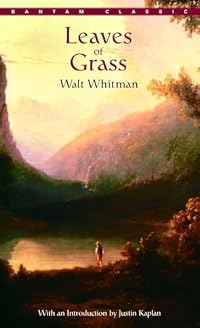
Leaves of Grass
by Walt Whitman
On This Page
Description
Leaves of Grass is a collection of poems by Walt Whitman originally published in 1855 at the poet's own expense. Criticized when first released for Whitman's use of free verse and his rather racy depictions of sexual love and the senses, Leaves of Grass is a celebration of the human form, the material world and nature..
Tags
Recommendations
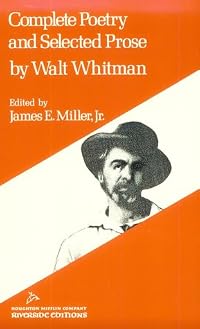



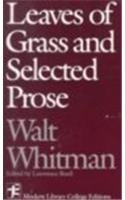















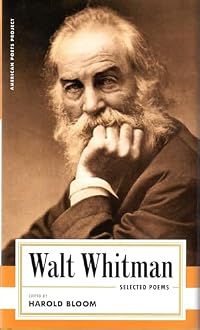
Member Recommendations
Member Reviews
Wow. This book. It's an exultant ode to America, nature, love, sex, equality, class, justice, race, religion, relationships. Written in 1855, Whitman's ideas are still fresh and relevant, 170 years later. He writes like no one else. Elegiac and colloquial, Whitman weaves the plainspoken with the lyrical. It really took me out of my head, and maybe turned it upside down, or sideways, backwards, everything. Reading this book was an intensely immersive experience for me. It was pure poetry, joyful and challenging and eloquent and passionate.
Whitman is all encompassing, exhausting, full of himself, and lovely, and true. He isn't perfect, his chants are invocations, a paean to human frailty and the human drive to sink below and, with blessings, rise above; but he requires you to read him as he defines. To really enjoy what Whitman has to offer you must open yourself to a new way of reading, a new way of thinking and feeling These aren't just poems. This is an epic poetic narrative of the birth pangs of an entire nation. And in being those things you must surrender yourself to the universality of Whitman's particulars.
Granted, in our cynical age of orange presidents and soul destroying social media, it can be easy (too easy) to look at Whitman and parse him naive. He isn't. show more Whitman is as much a scholar of human failure and degradation as human drive and hope and fortune. If anything, Whitman became a victim of his own success, a legacy somewhat besmirched by too many people reading him too simplistically, think Robert Frost and his "Two Paths Diverged" syndrome.
He was and is a test. But I thoroughly enjoyed Whitman's Leaves, and can now fully understand and appreciate its place within the American and international literary canon. show less
Granted, in our cynical age of orange presidents and soul destroying social media, it can be easy (too easy) to look at Whitman and parse him naive. He isn't. show more Whitman is as much a scholar of human failure and degradation as human drive and hope and fortune. If anything, Whitman became a victim of his own success, a legacy somewhat besmirched by too many people reading him too simplistically, think Robert Frost and his "Two Paths Diverged" syndrome.
He was and is a test. But I thoroughly enjoyed Whitman's Leaves, and can now fully understand and appreciate its place within the American and international literary canon. show less
2011 will go down, for me, as The Year Ben Caught Up On His Classics. Partly due to shame at continually seeing "Top 100" lists (B&N, Modern Library, etc.) of which I had invariably only read about 10, partly due to increased reading time thanks to becoming a train commuter, but mostly due to buying an e-reader and suddenly having easy, free access to public domain material, I've spent a good chunk of this year reading famous old books. Some of them were great; others, mediocre. Some of them have aged beautifully; others now seem quaint, silly, or merely boring.
In any event, whether I've enjoyed the books or not, when I sit down to review them, I do so knowing that my better-read friends have probably already read them, often decades show more ago. And thus it is with Leaves of Grass. There's nothing I'm going to be able to say to shed any new light on a work that's been loved, hated, studied and scrutinized for over a century, and has had numerous critical works written about it. So I won't even try. But here are a few personal observations, in lazy man's bullet points, because I write paragraphs for a living and I'm on vacation right now:
- This is a warm, beautiful collection of writings. Whitman makes constant references to throwing his arm around you, the reader, and the tone of the writing bears that out. Walt is the drunk guy at the party who really loves you, maaaaaannnnn, and keeps giving you hugs.
- I love how he manages to give structure to his poems. "Free verse" is really a misnomer, I think, because the verse is musical and wonderfully well-crafted. Shorn of the restrictions of meter or rhyme, Whitman makes amazing use of alliteration and psalm-like repetition to impart rhythm. These are lovely poems to read out loud.
- This stuff must have been scandalously graphic for the time period. There's a lot of throbbing and sliding going on. I can see why Emily Dickinson hated it.
- It's interesting how Whitman's persona and point of view subtly shift: from omnipotent and omniscient, to solipsistic; from being above all, to being one with everything. One moment he's a silent, ghostly observer, separate from the observed, and the next moment he's just one more microscopic cell in the sweaty body of humanity.
Leaves of Grass is so intense that it actually started to burn a bit by the end, an overstimulated, almost snowblind feeling. I suppose that's to be expected when you read in a few dozen hours what took a lifetime to write. I feel as though this is a book I will come back to for small doses, re-savoring favorite passages when the occasion and mood call for it. Wise, kind, funny, sexy, generous, and passionate. I'm sorry I waited 38 years to let Walt sound his barbarian yawp across the screen of my Kindle. show less
In any event, whether I've enjoyed the books or not, when I sit down to review them, I do so knowing that my better-read friends have probably already read them, often decades show more ago. And thus it is with Leaves of Grass. There's nothing I'm going to be able to say to shed any new light on a work that's been loved, hated, studied and scrutinized for over a century, and has had numerous critical works written about it. So I won't even try. But here are a few personal observations, in lazy man's bullet points, because I write paragraphs for a living and I'm on vacation right now:
- This is a warm, beautiful collection of writings. Whitman makes constant references to throwing his arm around you, the reader, and the tone of the writing bears that out. Walt is the drunk guy at the party who really loves you, maaaaaannnnn, and keeps giving you hugs.
- I love how he manages to give structure to his poems. "Free verse" is really a misnomer, I think, because the verse is musical and wonderfully well-crafted. Shorn of the restrictions of meter or rhyme, Whitman makes amazing use of alliteration and psalm-like repetition to impart rhythm. These are lovely poems to read out loud.
- This stuff must have been scandalously graphic for the time period. There's a lot of throbbing and sliding going on. I can see why Emily Dickinson hated it.
- It's interesting how Whitman's persona and point of view subtly shift: from omnipotent and omniscient, to solipsistic; from being above all, to being one with everything. One moment he's a silent, ghostly observer, separate from the observed, and the next moment he's just one more microscopic cell in the sweaty body of humanity.
Leaves of Grass is so intense that it actually started to burn a bit by the end, an overstimulated, almost snowblind feeling. I suppose that's to be expected when you read in a few dozen hours what took a lifetime to write. I feel as though this is a book I will come back to for small doses, re-savoring favorite passages when the occasion and mood call for it. Wise, kind, funny, sexy, generous, and passionate. I'm sorry I waited 38 years to let Walt sound his barbarian yawp across the screen of my Kindle. show less
I'm just going to say it: Walt Whitman was the King of List Poems. (At least, that's how I think of them.)
He does tend to get repetitive after a while, so I certainly wasn't able to read this in one sitting... But I've always thought that poetry was meant to be savored a little at a time.
Whitman will never be one of my favorite poets, but he certainly excelled at his craft. I enjoyed seeing the evolution of his writing as his life progressed, especially since he kept adding on to Leaves of Grass every so often.
My favorite of his poems will always be "Song of the Open Road" and "When Lilacs Last in the Dooryard Bloomed." I found a few more I really enjoy upon completion of this book though: "A Clear Midnight," "Out of May's Shows show more Selected," "The Voice of the Rain," and "A Prairie Sunset."
Whitman is a classic American poet and I'm glad I finally took the time to read this seminal work. I can't say I'll ever read it in its entirety again, but I'll definitely occasionally enjoy the poems I mentioned when my mood suits! show less
He does tend to get repetitive after a while, so I certainly wasn't able to read this in one sitting... But I've always thought that poetry was meant to be savored a little at a time.
Whitman will never be one of my favorite poets, but he certainly excelled at his craft. I enjoyed seeing the evolution of his writing as his life progressed, especially since he kept adding on to Leaves of Grass every so often.
My favorite of his poems will always be "Song of the Open Road" and "When Lilacs Last in the Dooryard Bloomed." I found a few more I really enjoy upon completion of this book though: "A Clear Midnight," "Out of May's Shows show more Selected," "The Voice of the Rain," and "A Prairie Sunset."
Whitman is a classic American poet and I'm glad I finally took the time to read this seminal work. I can't say I'll ever read it in its entirety again, but I'll definitely occasionally enjoy the poems I mentioned when my mood suits! show less
yes, its beautiful and inspiring and whatnot
i suppose i dont feel like walt's radical equanimity and universal love have much to offer the present moment in the US. like, ya i get that it must have been super subversive for the time, thats rad and all, but walt only gets as far as "mb... criminals and poor ppl r not bad," never quite reaching "mb... police and rich ppl r bad"
yes im being reductive but frankly idgaf. like, this sort of even-handedness can only do so much, can only go so far. at least nietzsche transforms his ultra-individualism into a clarion call for action and vibrant life. i certainly like walt's sort of existentialism better than nietzsche's, but damn walt just makes it so fucking BORING, so content w the world as it show more is! nietzsche, in his refutation of schopenhauer and the dharmic traditions, attempted to find a role for striving, for desire, for ego within the physical world of direct unmediated sensation. when this centered direction is taken out of existentialism, we're left w a bland acceptance of the world of illusions, a sad refusal to acknowledge to reality of suffering that suffuses all, in its horrifying depth
several passages reminded me of this famous dril tweet:
the wise man bowed his head solemnly and spoke: "theres actually zero difference between good and bad things. you imbecile. you fucking moron." (June 1, 2014) show less
i suppose i dont feel like walt's radical equanimity and universal love have much to offer the present moment in the US. like, ya i get that it must have been super subversive for the time, thats rad and all, but walt only gets as far as "mb... criminals and poor ppl r not bad," never quite reaching "mb... police and rich ppl r bad"
yes im being reductive but frankly idgaf. like, this sort of even-handedness can only do so much, can only go so far. at least nietzsche transforms his ultra-individualism into a clarion call for action and vibrant life. i certainly like walt's sort of existentialism better than nietzsche's, but damn walt just makes it so fucking BORING, so content w the world as it show more is! nietzsche, in his refutation of schopenhauer and the dharmic traditions, attempted to find a role for striving, for desire, for ego within the physical world of direct unmediated sensation. when this centered direction is taken out of existentialism, we're left w a bland acceptance of the world of illusions, a sad refusal to acknowledge to reality of suffering that suffuses all, in its horrifying depth
several passages reminded me of this famous dril tweet:
the wise man bowed his head solemnly and spoke: "theres actually zero difference between good and bad things. you imbecile. you fucking moron." (June 1, 2014) show less
It is easy, and periodically fashionable to take Whitman for granted. Yes he is shamelessly self-involved and often goofy. He is also -- and here's the point, brothers and sisters -- continually amazing, and very good company. As with Bruckner Symphonies and the poems of Homer, there will always be the vexing question of which text is best. This particular edition is that, but its occasional inadequacies are more than covered by the wonderful illustrations by Lewis C. Daniel, an artist who dserved better than the obscurity into whic he has fallen.
"This is what you shall do: Love the earth and sun and the animals, despise riches, give alms to every one that asks, stand up for the stupid and crazy, devote your income and labor to others, hate tyrants, argue not concerning God, have patience and indulgence toward the people, take off your hat to nothing known or unknown or to any man or number of men, go freely with powerful uneducated persons and with the young and with the mothers of families, read these leaves in the open air every season of every year of your life, reexamine all you have been told at school or church or in any book, dismiss whatever insults your own soul, and your very flesh shall be a great poem and have the richest fluency not only in its words but in the show more silent lines of its lips and face and between the lashes of your eyes and in every motion and joint of your body."
So Walt Whitman instructs us in the Preface to the 1855 edition of his seminal and landmark book of poetry, Leaves of Grass. This is why I love him. Even 160 years later, the book still strikes like a lightning bolt of profundity. At the time of publishing, no less a personage than Emerson stated in a letter to Whitman that
"I am not blind to the worth of the wonderful gift of “Leaves of Grass”…I rubbed my eyes a little, to see if this sunbeam were no illusion…"
In her introduction, Helen Vendler, writes that another hero of mine, Thoreau, said
In an 1856 letter, Thoreau, after an initial flinching at Whitman’s candor (“It is as if the beasts spoke”) continued by saying “He is awfully good”, and with an early insight, suggested that Whitman’s apparent “egoism” was earned: “He may turn out the least of a braggart of all, having a better right to be confident.”
Whitman speaks to everyone about everyday things without pretense and in language that is understandable to the masses. He does it in unrhymed free verse without the sometimes intimidating formal structure of other poets and poetry. He addresses issues that were groundbreaking at the time. Some may seem mundane now, some have new urgency or interpretations within his lines, and some need new poets, writers, artists, activists, and everyday people to carry the torch forward.
There is too much that I love here. I can only touch on some of the flashes of genius that have always touched me, and others that strike me with new meaning each time I open the book depending on what my country, culture, or I am struggling with when I reread him.
For example, in other writing and volunteer work I have been involved in the issues of body image and imposed gender expectations have been front and center. But no worries, even back when body image was not necessarily a articulated concept, I find that Walt has covered it:
"The bodies of men and women engirth me, and I engirth them,
They will not let me off nor I them till I go with them and respond
to them and love them."
Gender expectations? Sexuality? No problem. Way before androgyny and choosing personal pronouns, Walt was mixing his pronouns and confusing believers in the sexual binary with his poetry of the gray area in between:
"If you meet some stranger in the street and love him or her, do I not often
meet strangers in the street and love them?"
"Darkness you are gentler than my lover….his flesh was sweaty and
panting.
I feel the hot moisture yet that he left me."
"Divine am I inside and out, and I make holy whatever I touch or am
touched from;
The scent of these arm-pits is aroma finer than prayer,
This head is more than churches or bibles or creeds.
If I worship any particular thing it shall be some of the spread of my body;
Translucent mould of me it shall be you,
Shaded ledges and rests, firm masculine coulter, it shall be you,
Whatever goes to the tilth of me it shall be you,
You my rich blood, your milky stream pale stripping of my life;
Breast that presses against other breasts it shall be you.
My brain it shall be your occult convolutions,
Root of washed sweet-flag, timorous pond-snipe, nest of guarded
duplicate eggs, it shall be you.
Mixed tussled hay of head and beard and brawn it shall be you,
Trickling sap of maple, fibre of manly wheat, it shall be you;
Sun so generous it shall be you,
Vapors lighting and shading my face it shall be you,
You sweaty brooks and dews it shall be you,
Winds whose soft-tickling genitals rub against me it shall be you,
Broad muscular fields, branches of liveoak, loving lounger in my winding
paths, it shall be you,
Hands I have taken, face I have kissed, mortal I have ever touched, it shall
be you."
"My lovers suffocate me!
Crowding my lips, and thick in the pores of my skin,
Jostling me through streets and public halls....coming naked to me at
night,
Crying by day Ahoy from the rocks of the river....swinging and chirping
over my head,
Calling my name from flowerbeds or vines or tangled underbrush,
Or while I swim in the bath....or drink from the pump at the corner....
or the curtain is down at the opera...or I glimpse at a woman's
face in the railroad car;
Lighting on every moment of my life,
Bussing my body with soft and balsamic busses,
Noiselessly passing handfuls out of their hearts and giving them to
be mine."
"Come closer to me,
Push close my lovers and take the best I possess,
Yield closer and closer and give me the best you possess."
"What is known I strip away...I launch all men and women forward with
me into the unknown. "
If there is one thing I don’t connect with Walt on, it is his occasional jingoist digressions while singing his nationalistic praise of the United States. But bear with the poet, he has much good advice that our country needs to hear. Confused about our immigrant past or wanting to scapegoat the latest group to want to come here? Walt says,
"Here is not merely a nation but a teeming nation of nations."
Dismissing the importance of literature and the arts? Alas Whitman’s vision has not quite come to pass…
"Of all nations the United States with veins full of poetical stuff most need poets and will doubtless have the greatest and use them the greatest. Their presidents shall not be their common referee so much as their poets shall."
Need encouragement to fight for your particular marginalized rights? Walt has you covered there too:
"Not a grave of the murdered for freedom but grows seed for freedom....in
its turn to bear seed.
Which the winds carry afar and re-sow, and the rains and the snows nourish."
Morality and spirituality? Whitman was well read in the western canon and drew off of Christian and jewish sacred writings but his writings also seem to reflect some of the eastern beliefs and ideas. I hear the Tao in some of his verses.
"The vulgar and the refined....what you call sin and what you call
goodness....to think how wide the difference;
To think the difference will still continue to others, yet we lie beyond the difference."
"I swear I see now that every thing has an eternal soul!
The trees have, rooted in the ground....the weeds of the sea have....
the animals"
The beautiful thing about Whitman’s poetry is that it is affirming poetry that most people will find some affirmation within. What you pull out of and what you get from reading Leaves of Grass depends on your own personal history and experience.
My love for Whitman makes resisting new editions especially hard, particularly fine press editions but also quirky new ones like the recent Whitman Illuminated: Song of Myself. The Arion Press edition was a no-brainer.
In keeping with Whitman’s desire for his “barbaric yawp” to appeal to the masses, this 100th Arion Press edition was kept simple but elegant. No converting Whitman into a livre de artiste here. The illustrations are confined to the familiar portrait of Walt from the original edition and an image of grass by Arion Press binder Rochelle Youk. The binding is beautiful with oak veneered boards and green Nigerian goatskin. The book block and spine are nicely rounded, a welcome departure from the disappointingly frequent flat spine of recent Arion books. My one nit with the design is that the titling on the spine of the book is very fine and hard to read. I would have liked the title to stand out as boldly and saucily as Whitman does in his portrait. The book is cased in a nicely done and equally elegant slipcase. As usual with me, the paper is the clincher, a special 1985 run of Langley from the Barcham Green Mill with watermarks of the mill and of the Arion Press’ lyre pressmark. And rough deckle edge seems like just the right touch for Leaves of Grass.
In her lucid foreword, Helen Vendler states that the opening poem, which later was named “Song of Myself”, is “…the first masterpiece of American poetry, and has influenced not only every subsequent generation of American writers but also foreign poets from Russia to Chile. Indeed, I love finding references to Whitman among the words of writers. One of my favorite recent poems of homage to Whitman is by Rudulfo Anaya. I found “Walt Whitman Strides the Llano of New Mexico” in The Outlaw Bible of American Poetry. It’s a long poem and worth seeking out. I’ll just quote a small part:
"Hold me in the safety of your arms, wise poet, old poet,
Abuelo de todos. Your fingers stir my memory."
Leaves of Grass should be our National Poem, if such a thing existed, though I’m not sure we still deserve it, if ever we did. Walt might have a few things to say about how our nation has strayed. But that is part of the beauty of Whitman’s gift. He gives this gift freely, without judgment of our need or worth. Open the gift in whatever form you can: fine or trade edition, used or new, graphic adaptation, paperback, e-book. Take a turn together….it will repay you.
"I bequeath myself to the dirt to grow from the grass I love,
If you want me again look for me under your bootsoles
You will hardly know who I am or what I mean,
But I shall be good health to you nevertheless,
And filter and fibre your blood.
Failing to fetch me at first keep encouraged,
Missing me one place search another,
I stop some where waiting for you."
AVAILABILITY: The Arion Press edition is limited to 275 copies at a price of $1250. It was almost instantly out of print. show less
So Walt Whitman instructs us in the Preface to the 1855 edition of his seminal and landmark book of poetry, Leaves of Grass. This is why I love him. Even 160 years later, the book still strikes like a lightning bolt of profundity. At the time of publishing, no less a personage than Emerson stated in a letter to Whitman that
"I am not blind to the worth of the wonderful gift of “Leaves of Grass”…I rubbed my eyes a little, to see if this sunbeam were no illusion…"
In her introduction, Helen Vendler, writes that another hero of mine, Thoreau, said
In an 1856 letter, Thoreau, after an initial flinching at Whitman’s candor (“It is as if the beasts spoke”) continued by saying “He is awfully good”, and with an early insight, suggested that Whitman’s apparent “egoism” was earned: “He may turn out the least of a braggart of all, having a better right to be confident.”
Whitman speaks to everyone about everyday things without pretense and in language that is understandable to the masses. He does it in unrhymed free verse without the sometimes intimidating formal structure of other poets and poetry. He addresses issues that were groundbreaking at the time. Some may seem mundane now, some have new urgency or interpretations within his lines, and some need new poets, writers, artists, activists, and everyday people to carry the torch forward.
There is too much that I love here. I can only touch on some of the flashes of genius that have always touched me, and others that strike me with new meaning each time I open the book depending on what my country, culture, or I am struggling with when I reread him.
For example, in other writing and volunteer work I have been involved in the issues of body image and imposed gender expectations have been front and center. But no worries, even back when body image was not necessarily a articulated concept, I find that Walt has covered it:
"The bodies of men and women engirth me, and I engirth them,
They will not let me off nor I them till I go with them and respond
to them and love them."
Gender expectations? Sexuality? No problem. Way before androgyny and choosing personal pronouns, Walt was mixing his pronouns and confusing believers in the sexual binary with his poetry of the gray area in between:
"If you meet some stranger in the street and love him or her, do I not often
meet strangers in the street and love them?"
"Darkness you are gentler than my lover….his flesh was sweaty and
panting.
I feel the hot moisture yet that he left me."
"Divine am I inside and out, and I make holy whatever I touch or am
touched from;
The scent of these arm-pits is aroma finer than prayer,
This head is more than churches or bibles or creeds.
If I worship any particular thing it shall be some of the spread of my body;
Translucent mould of me it shall be you,
Shaded ledges and rests, firm masculine coulter, it shall be you,
Whatever goes to the tilth of me it shall be you,
You my rich blood, your milky stream pale stripping of my life;
Breast that presses against other breasts it shall be you.
My brain it shall be your occult convolutions,
Root of washed sweet-flag, timorous pond-snipe, nest of guarded
duplicate eggs, it shall be you.
Mixed tussled hay of head and beard and brawn it shall be you,
Trickling sap of maple, fibre of manly wheat, it shall be you;
Sun so generous it shall be you,
Vapors lighting and shading my face it shall be you,
You sweaty brooks and dews it shall be you,
Winds whose soft-tickling genitals rub against me it shall be you,
Broad muscular fields, branches of liveoak, loving lounger in my winding
paths, it shall be you,
Hands I have taken, face I have kissed, mortal I have ever touched, it shall
be you."
"My lovers suffocate me!
Crowding my lips, and thick in the pores of my skin,
Jostling me through streets and public halls....coming naked to me at
night,
Crying by day Ahoy from the rocks of the river....swinging and chirping
over my head,
Calling my name from flowerbeds or vines or tangled underbrush,
Or while I swim in the bath....or drink from the pump at the corner....
or the curtain is down at the opera...or I glimpse at a woman's
face in the railroad car;
Lighting on every moment of my life,
Bussing my body with soft and balsamic busses,
Noiselessly passing handfuls out of their hearts and giving them to
be mine."
"Come closer to me,
Push close my lovers and take the best I possess,
Yield closer and closer and give me the best you possess."
"What is known I strip away...I launch all men and women forward with
me into the unknown. "
If there is one thing I don’t connect with Walt on, it is his occasional jingoist digressions while singing his nationalistic praise of the United States. But bear with the poet, he has much good advice that our country needs to hear. Confused about our immigrant past or wanting to scapegoat the latest group to want to come here? Walt says,
"Here is not merely a nation but a teeming nation of nations."
Dismissing the importance of literature and the arts? Alas Whitman’s vision has not quite come to pass…
"Of all nations the United States with veins full of poetical stuff most need poets and will doubtless have the greatest and use them the greatest. Their presidents shall not be their common referee so much as their poets shall."
Need encouragement to fight for your particular marginalized rights? Walt has you covered there too:
"Not a grave of the murdered for freedom but grows seed for freedom....in
its turn to bear seed.
Which the winds carry afar and re-sow, and the rains and the snows nourish."
Morality and spirituality? Whitman was well read in the western canon and drew off of Christian and jewish sacred writings but his writings also seem to reflect some of the eastern beliefs and ideas. I hear the Tao in some of his verses.
"The vulgar and the refined....what you call sin and what you call
goodness....to think how wide the difference;
To think the difference will still continue to others, yet we lie beyond the difference."
"I swear I see now that every thing has an eternal soul!
The trees have, rooted in the ground....the weeds of the sea have....
the animals"
The beautiful thing about Whitman’s poetry is that it is affirming poetry that most people will find some affirmation within. What you pull out of and what you get from reading Leaves of Grass depends on your own personal history and experience.
My love for Whitman makes resisting new editions especially hard, particularly fine press editions but also quirky new ones like the recent Whitman Illuminated: Song of Myself. The Arion Press edition was a no-brainer.
In keeping with Whitman’s desire for his “barbaric yawp” to appeal to the masses, this 100th Arion Press edition was kept simple but elegant. No converting Whitman into a livre de artiste here. The illustrations are confined to the familiar portrait of Walt from the original edition and an image of grass by Arion Press binder Rochelle Youk. The binding is beautiful with oak veneered boards and green Nigerian goatskin. The book block and spine are nicely rounded, a welcome departure from the disappointingly frequent flat spine of recent Arion books. My one nit with the design is that the titling on the spine of the book is very fine and hard to read. I would have liked the title to stand out as boldly and saucily as Whitman does in his portrait. The book is cased in a nicely done and equally elegant slipcase. As usual with me, the paper is the clincher, a special 1985 run of Langley from the Barcham Green Mill with watermarks of the mill and of the Arion Press’ lyre pressmark. And rough deckle edge seems like just the right touch for Leaves of Grass.
In her lucid foreword, Helen Vendler states that the opening poem, which later was named “Song of Myself”, is “…the first masterpiece of American poetry, and has influenced not only every subsequent generation of American writers but also foreign poets from Russia to Chile. Indeed, I love finding references to Whitman among the words of writers. One of my favorite recent poems of homage to Whitman is by Rudulfo Anaya. I found “Walt Whitman Strides the Llano of New Mexico” in The Outlaw Bible of American Poetry. It’s a long poem and worth seeking out. I’ll just quote a small part:
"Hold me in the safety of your arms, wise poet, old poet,
Abuelo de todos. Your fingers stir my memory."
Leaves of Grass should be our National Poem, if such a thing existed, though I’m not sure we still deserve it, if ever we did. Walt might have a few things to say about how our nation has strayed. But that is part of the beauty of Whitman’s gift. He gives this gift freely, without judgment of our need or worth. Open the gift in whatever form you can: fine or trade edition, used or new, graphic adaptation, paperback, e-book. Take a turn together….it will repay you.
"I bequeath myself to the dirt to grow from the grass I love,
If you want me again look for me under your bootsoles
You will hardly know who I am or what I mean,
But I shall be good health to you nevertheless,
And filter and fibre your blood.
Failing to fetch me at first keep encouraged,
Missing me one place search another,
I stop some where waiting for you."
AVAILABILITY: The Arion Press edition is limited to 275 copies at a price of $1250. It was almost instantly out of print. show less
Members
- Recently Added By
Published Reviews
ThingScore 100
Whitman's verse-technique is still of interest to the prosodist. His basic rhythm is an epic one—the Virgilian dactyl-spondee—and his line often hexametric. He sometimes sounds like Clough's Amours de Voyage, though it would be hard to imagine a greater disparity of tone and attitude than that which subsists between these two Victorians. Nevertheless, both Clough and Whitman saw that the show more loose hexameter could admit the contemporary and sometimes the colloquial..
He has only one subject—acceptance of the life-death cycle and reverence for it—and, since he uses an invariable technique, Leaves of Grass has a unity to be found in few other poets' collected volumes... But Whitman's aim is rather to present a universal democratic vista in terms of the American myth. The America of his poems sometimes seems as symbolic as that of Blake, and the bearded figure that strides across it with a big hello—the Answerer, all things to all men—is as much a home-made archetype as the Giant Albion. show less
He has only one subject—acceptance of the life-death cycle and reverence for it—and, since he uses an invariable technique, Leaves of Grass has a unity to be found in few other poets' collected volumes... But Whitman's aim is rather to present a universal democratic vista in terms of the American myth. The America of his poems sometimes seems as symbolic as that of Blake, and the bearded figure that strides across it with a big hello—the Answerer, all things to all men—is as much a home-made archetype as the Giant Albion. show less
added by SnootyBaronet
Nature may have given the hint to the author of the "Leaves of Grass", but there exists no book or fragment of a book, which can have given the hint to them. All beauty, he says, comes from beautiful blood and a beautiful brain... Who then is that insolent unknown? Who is it, praising himself as if others were not fit to do it, and coming rough and unbidden among writers to unsettle what was show more settled, and to revolutionize, in fact, our modern civilization?
You have come in good time, Walt Whitman! In opinions, in manners, in costumes, in books, in the aims and occupancy of life, in associates, in poems, conformity to all unnatural and tainted customs passes without remark, while perfect naturalness, health, faith, self-reliance, and all primal expressions of the manliest love and friendship, subject one to the stare and controversy of the world. show less
You have come in good time, Walt Whitman! In opinions, in manners, in costumes, in books, in the aims and occupancy of life, in associates, in poems, conformity to all unnatural and tainted customs passes without remark, while perfect naturalness, health, faith, self-reliance, and all primal expressions of the manliest love and friendship, subject one to the stare and controversy of the world. show less
added by SnootyBaronet
Lists

Unread books
1,063 works; 87 members

Recommended Reading : 600 Classics Reviewed, Editors of Salem Press, 2015
634 works; 6 members

Fake Top 100 Fiction
81 works; 4 members

Publisher's Weekly Bestsellers Prior to 1895 in Chronological Order
95 works; 6 members

Out of Copyright
244 works; 14 members

College Reads (Lit Edition)
75 works; 5 members

Greatest Books, allegedly
484 works; 9 members

Mustich's 1000 Books to Read Before You Die: A Life Changing List
1,001 works; 18 members

The Well-Educated Mind, Susan Wise Bauer, 2016
179 works; 3 members

The Luca Guadagnino Universe
62 works; 1 member

Books Mentioned in The Wedding Planner's Daughter series
107 works; 2 members

Books That Changed Our Perspective
423 works; 166 members

The Complete Rory Gilmore Reading List
506 works; 5 members

.
194 works; 2 members
Vlogbrothers Book Recommendations
307 works; 4 members

Books talked about in Pamela Dean's Tam Lin
74 works; 1 member
.
396 works; 1 member

Books in the Bibliography of Freethinkers by Susan Jacoby
155 works; 1 member

bound
100 works; 1 member

Rory Gilmore Book Club
193 works; 5 members

1964 College Preparatory Reading List
202 works; 8 members

The 100 Best Books of All Time by Norwegian Book Club (World Library)
104 works; 23 members
Best of American Literature
146 works; 9 members
Newsweek's Top 100 Books: The Meta-List
100 works; 18 members
Philip Ward's Lifetime Reading Plan
592 works; 22 members
The Top Ten: Writers Pick Their Favorite Books
240 works; 31 members

Northern Exposure's Chris in the Morning Reading List
31 works; 1 member
Books Featured on Gilmore Girls
307 works; 21 members

books to check out in 2014
9 works; 1 member

The bookshelf of Lisa Simpson
23 works; 4 members

Poetry Corner
187 works; 15 members

The Road to Freedom (Will Durant's 100 Best Books for an Education)
100 works; 8 members
Blue Pyramid 1,276 Best Books of All Time
1,248 works; 32 members
W. S. Maugham's Reading Suggestions for Spiritual Enrichment: American
13 works; 4 members

Western World's Greatest Books - Project Gutenberg
295 works; 15 members

100 Most Recommended Works
100 works; 11 members
The College Board: 101 Great Books Recommended for College-Bound Readers
111 works; 7 members

40 Books to Read Before You’re 40
40 works; 4 members

Mind & Thought
7 works; 2 members

Poetry Collections
79 works; 6 members

To read
38 works; 1 member
Talk Discussions
Past Discussions
Whitman's Leaves of Grass illustrated by Weston (1942) in George Macy devotees (March 2024)
Walt Whitman in Someone explain it to me... (January 2024)
Victorian Era Abroad: Q1: Leaves of Grass by Walt Whitman in Club Read 2023 (March 2023)
Arion Press "Leaves of Grass" on ABE in Fine Press Forum (October 2022)
Author Information

627+ Works 32,172 Members
Walt Whitman was born on Long Island and raised in Brooklyn, New York, the son of a carpenter. He left school when he was 11 years old to take a variety of jobs. By the time he was 15, Whitman was living on his own in New York City, working as a printer and writing short pieces for newspapers. He spent a few years teaching, but most of his work show more was either in journalism or politics. Gradually, Whitman became a regular contributor to a variety of Democratic Party newspapers and reviews, and early in his career established a rather eccentric way of life, spending a great deal of time walking the streets, absorbing life and talking with laborers. Extremely fond of the opera, he used his press pass to spend many evenings in the theater. In 1846, Whitman became editor of the Brooklyn Eagle, a leading Democratic newspaper. Two years later, he was fired for opposing the expansion of slavery into the west. Whitman's career as a poet began in 1885, with the publication of the first edition of his poetry collection, Leaves of Grass. The book was self-published (Whitman probably set some of the type himself), and despite his efforts to publicize it - including writing his own reviews - few people read it. One reader who did appreciate it was essayist Ralph Waldo Emerson, who wrote a letter greeting Whitman at "the beginning of a great career." Whitman's poetry was unlike any verse that had ever been seen. Written without rhyme, in long, loose lines, filled with poetic lists and exclamations taken from Whitman's reading of the Bible, Homer, and Asian poets, these poems were totally unlike conventional poetry. Their subject matter, too, was unusual - the celebration of a free-spirited individualist whose love for all things and people seemed at times disturbingly sensual. In 1860, with the publication of the third edition on Leaves of Grass, Whitman alienated conventional thinkers and writers even more. When he went to Boston to meet Emerson, poet Henry Wadsworth Longfellow, essayist Oliver Wendell Holmes, and poet James Russell Lowell, they all objected to the visit. With the outbreak of the Civil War, Whitman's attentions turned almost exclusively to that conflict. Some of the greatest poetry of his career, including Drum Taps (1865) and his magnificent elegy for President Abraham Lincoln, "When Last in the Dooryard Bloom'd" (1865), was written during this period. In 1862, his brother George was wounded in battle, and Whitman went to Washington to nurse him. He continued as a hospital volunteer throughout the war, nursing other wounded soldiers and acting as a benevolent father-figure and confidant. Parts of his memoir Specimen Days (1882) record this period. After the war, Whitman stayed on in Washington, working as a government clerk and continuing to write. In 1873 he suffered a stroke and retired to Camden, New Jersey, where he lived as an invalid for the rest of his life. Ironically, his reputation began to grow during this period, as the public became more receptive to his poetic and personal eccentricities. Whitman tried to capture the spirit of America in a new poetic form. His poetry is rough, colloquial, sweeping in its vistas - a poetic equivalent of the vast land and its varied peoples. Critic Louis Untermeyer has written, "In spite of Whitman's perplexing mannerisms, the poems justify their boundless contradictions. They shake themselves free from rant and bombastic audacities and rise into the clear air of major poetry. Such poetry is not large but self-assured; it knows, as Whitman asserted, the amplitude of time and laughs at dissolution. It contains continents; it unfolds the new heaven and new earth of the Western world." American poetry has never been the same since Whitman tore it away from its formal and thematic constraints, and he is considered by virtually all critics today to be one of the greatest poets the country has ever produced. (Bowker Author Biography) show less
Some Editions
Awards and Honors
Notable Lists
Series
Belongs to Publisher Series
Limited Editions Club (S:1.02)
Doubleday Dolphin (C3)
detebe-Klassiker (21351)
Arion Press (100)
Airmont Classics (91)
Modern Library (97)
Insel-Bücherei (Nr. 1459)
Work Relationships
Is contained in
Contains
Has the adaptation
Is abridged in
Inspired
Common Knowledge
- Canonical title*
- Grashalme
- Original title
- Leaves of Grass
- Original publication date
- 1855
- Important places
- New York, New York, USA; Manhattan, New York, New York, USA; Washington, D.C., USA
- Important events
- US Civil War; Assassination of Abraham Lincoln (1865-04-14)
- Epigraph
- Come, said my Soul,
Such verses for my Body let us write, (for we are one,)
That should I after death invisibly return,
Or, long, long hence, in other spheres,
There to some group of mates the chants resu... (show all)ming,
(Tallying Earth's soil, trees, winds, tumultuous waves,)
Ever with pleas'd smile I may keep on,
Ever and ever yet the verses owning - as, first, I here and now
Signing for Soul and Body, set to them my name,
Walt Whitman - First words
- One's-self I sing, a simple separate person,
Yet utter the word Democratic, the word En-masse.
I celebrate myself,
And what I assume you shall assume,
For every atom belonging to me, as good belongs to you. - Quotations
- Melange mine own, the unseen and the seen,
Mysterious ocean where the streams empty,
Prophetic spirit of materials shifting and flickering around me,
Living beings, identities now doubtless near us in the air that we... (show all) know not of,
Contact daily and hourly that will not release me,
These selecting, these in hints demanded of me.
O Captain! my Captain! our fearful trip is done,
The ship has weather’d every rack, the prize we sought is won,
The port is near, the bells I hear, the people all exulting,
While follow eyes the steady keel, the ve... (show all)ssel grim and daring;
But O heart! heart! heart!
O the bleeding drops of red,
Where on the deck my Captain lies,
Fallen cold and dead. - Last words
- (Click to show. Warning: May contain spoilers.)Yet let me not be too hasty,
Long indeed have we lived, slept, filter'd, become really blended into one;
Then if we die together, (yes, we'll remain one,)
If we go anywhere we'll go together to meet what happens,
May-be we'll be better off and blither, and learn something,
May-be it is yourself now really ushering me to the true songs, (who knows?)
May-be it is you the mortal knob really undoing, turning -- so now finally,
Good-bye -- and hail! my Fancy.
(Click to show. Warning: May contain spoilers.)There is neither wit nor method in his disjointed babbling, and it seems to us he must be some escaped lunatic, raving in pitiable delirium. - Blurbers
- Cowley, Malcolm; Emerson, Ralph Waldo; Sandburg, Carl; Lawrence,D.H.
- Original language
- English
- Canonical LCC
- PS3200 .F81
- Disambiguation notice
- Whitman revised Leaves of Grass at numerous points in his lifetime, frequently with significant changes between editions. (e.g. 93 pages for the original 1855 edition vs. 439 pages for the final 1891-92 edition.) This w... (show all)ork contains those entries for which the edition is unknown.
If your edition is here and you know which version it is, please separate it and combine it with the correct entry.
*Some information comes from Common Knowledge in other languages. Click "Edit" for more information.
Classifications
Statistics
- Members
- 12,105
- Popularity
- 707
- Reviews
- 100
- Rating
- (4.11)
- Languages
- 17 — Bosnian, Catalan, Chinese, Czech, Dutch, English, French, German, Hungarian, Italian, Multiple languages, Norwegian (Nynorsk), Norwegian (Bokmål), Serbian, Spanish, Turkish, Portuguese (Portugal)
- Media
- Paper, Audiobook, Ebook
- ISBNs
- 412
- ASINs
- 275