
Kim Stanley Robinson
Author of Red Mars
About the Author
Kim Stanley Robinson was born in Orange County, California on March 23, 1952. He received a B. A. and Ph. D. from the University of California at San Diego and an M. A. from Boston University. His first trilogy of books, Orange County, collectively won a Nebula Award and two Hugo Awards. His other show more works include the Mars trilogy, 2312, and Aurora. He has won an Asimov Award, a World Fantasy Award, a Locus Reader's Poll Award, and a John W. Campbell Award. (Bowker Author Biography) show less
Series
Works by Kim Stanley Robinson
Green Mars [short fiction] 10 copies
A Martian Romance 10 copies
Blue Mars and The Martians 5 copies
Our Town 4 copies
[unidentified works] 4 copies
Exploring Fossil Canyon 3 copies
Four Teleogical Trails 2 copies
Maya and Desmond 2 copies
Michel in Antarctica 2 copies
Sax Moments 2 copies
Keeping the Flame 2 copies
Saving Noctis Dam 2 copies
Big Man in Love 2 copies
The Constitution of Mars 2 copies
Odessa 2 copies
Enough is as Good as a Feast 2 copies
Coyote Remembers 2 copies
What Matters 2 copies
Purple Mars 2 copies
Salt and Fresh 2 copies
The Archaea Plot 2 copies
Coyote Makes Trouble 2 copies
The Way the Land Spoke to Us 2 copies
Michel in Provence 2 copies
Jackie on Zo 2 copies
To Leave a Mark 2 copies
Mars 2: Green Mars 1 copy
Collected Short Fiction 1 copy
A rizs és a só évei 1 copy
Gelecek Bakanlığı 1 copy
Chaman 1 copy
Ślepy geometra 1 copy
Sixty Days 1 copy
On the North Pole of Pluto 1 copy
How Science Saved the World 1 copy
The Kingdom Underground 1 copy
In Pierson's Orchestra 1 copy
The Memorial (short story) 1 copy
The Mars Trilogy Red Mars, Green Mars, Blue Mars AND The Martians (The Mars Trilogy, 1-3 plus The Martians) (1990) 1 copy
A Story 1 copy
Short, Sharp Shock 1 copy
The Soundtrack {short story} 1 copy
Rainbow Bridge {short story} 1 copy
A Transect {short story} 1 copy
New Scientist Sci-fi Special 1 copy
Anarchism's Possibilities 1 copy
Associated Works
Journey to the Centre of the Earth (1867) — Introduction, some editions — 17,509 copies, 264 reviews
The Best Alternate History Stories of the 20th Century (2001) — Contributor — 617 copies, 10 reviews
The Year's Best Science Fiction: Seventeenth Annual Collection (2000) — Contributor — 556 copies, 2 reviews
The Big Book of Science Fiction: The Ultimate Collection (2016) — Contributor — 522 copies, 8 reviews
The Year's Best Science Fiction: Ninth Annual Collection (1992) — Contributor — 457 copies, 4 reviews
The Norton Book of Science Fiction: North American Science Fiction, 1960-1990 (1993) — Contributor — 344 copies, 6 reviews
The Year's Best Science Fiction: Third Annual Collection (1986) — Contributor — 251 copies, 1 review
The Year's Best Science Fiction: Fourth Annual Collection (1987) — Contributor — 219 copies, 1 review
What Might Have Been, Volumes 1 & 2: Alternate Empires, Alternate Heroes (1990) — Contributor — 184 copies, 2 reviews
The Way It Wasn't : Great Science Fiction Stories of Alternate History (1996) — Contributor — 164 copies, 4 reviews
The Year's Best Science Fiction: First Annual Collection (1984) — Contributor — 148 copies, 1 review
The Ends of the Earth: An Anthology of the Finest Writing on the Arctic and the Antarctic (2007) — Contributor — 136 copies, 8 reviews
Loosed upon the World: The Saga Anthology of Climate Fiction (2015) — Contributor — 129 copies, 4 reviews
Mythmakers and Lawbreakers: Anarchist Writers on Fiction (2010) — Introduction — 110 copies, 1 review
I'm With the Bears: Short Stories from a Damaged Planet (2011) — Contributor — 105 copies, 4 reviews
Alternate Americas (What Might Have Been, Vol. 4) (1992) — Contributor, some editions — 101 copies, 1 review
The Prentice Hall Anthology of Science Fiction and Fantasy (2000) — Contributor — 100 copies, 2 reviews
Cyberpunk: Stories of Hardware, Software, Wetware, Evolution, and Revolution (1995) — Contributor — 95 copies, 1 review
The Best Fantasy Stories from the Magazine of Fantasy & Science Fiction (1985) — Contributor — 78 copies, 2 reviews
Why I Left Harry's All-Night Hamburgers and Other Stories from Isaac Asimov's Science Fiction Magazine (1992) — Contributor — 68 copies
ParaSpheres: Extending Beyond the Spheres of Literary and Genre Fiction: Fabulist and New Wave Fabulist Stories (2006) — Contributor — 65 copies
Asimov's Science Fiction Magazine: 30th Anniversary Anthology (2007) — Contributor — 61 copies, 1 review
The Best Science Fiction and Fantasy of the Year, Volume 10 (2016) — Contributor — 60 copies, 3 reviews
Nebula Awards 29: SFWA's Choices For The Best Science Fiction And Fantasy Of The Year (Nebula Awards Showcase) (1995) — Contributor — 57 copies
Before They Were Giants: First Works from Science Fiction Greats (2010) — Contributor — 54 copies, 2 reviews
Field of Fantasies: Baseball Stories of the Strange and Supernatural (2014) — Contributor — 46 copies
Send My Love and a Molotov Cocktail! Stories of Crime, Love, and Rebellion (2011) — Contributor — 37 copies
Nebula Awards 20: SFWA's Choices for the Best Science Fiction and Fantasy 1984 (1985) — Contributor — 28 copies
Visions, Ventures, Escape Velocities: A Collection of Space Futures (2017) — Contributor — 22 copies, 1 review
Asimov's Science Fiction: Vol. 23, No. 10 & 11 [October/November 1999] (1999) — Contributor — 14 copies
Isaac Asimov's Science Fiction Magazine: Vol. 13, No. 12 [December 1989] (1989) — Author — 14 copies
The Magazine of Fantasy and Science Fiction November 1982, Vol. 63, No. 5 (1982) — Contributor — 13 copies
The Magazine of Fantasy and Science Fiction March 1990, Vol. 78, No. 3 (1990) — Author — 12 copies, 1 review
Uneven Futures: Strategies for Community Survival from Speculative Fiction (2022) — Contributor — 12 copies
Brave New Worlds {Second Edition ebook} — Contributor, some editions — 11 copies
Transfusion — Translator, some editions — 10 copies
Everything Change, Volume II: An Anthology of Climate Fiction (2018) — Foreword — 9 copies, 1 review
Mondaugen — Contributor — 1 copy
Locus Nr.492 2002.01 — Contributor — 1 copy
Science Fiction Eye #08, Winter 1991 — Contributor — 1 copy
Tagged
Common Knowledge
- Legal name
- Robinson, Kim Stanley
- Birthdate
- 1952-03-23
- Gender
- male
- Education
- University of California, San Diego (BA - Literature)
Boston University (MA - English)
University of California, San Diego (PhD - English) - Occupations
- science fiction writer
- Organizations
- Mars Society
- Awards and honors
- Jack Williamson Lectureship (2006)
Robert A. Heinlein Award (2016)
Arthur C. Clarke Foundation Award, Imagination in Service to Society (2017) - Agent
- Christopher Schelling (Select Artists)
- Nationality
- USA
- Birthplace
- Waukegan, Illinois, USA
- Places of residence
- Washington, D.C., USA
Switzerland
Davis, California, USA - Associated Place (for map)
- USA
Members
Discussions
Kim Stanley Robinson article in The New Yorker in Science Fiction Fans (April 2022)
Red Mars in Science Fiction Fans (August 2013)
Reviews

This story is set in the second half of the Third Millennium CE, and it concerns the arrival of a pioneering interstellar expedition to the exoplanet Aurora in the Tau Ceti system via a generation starship, followed by the return of the ship to Earth with a portion of its descended population. It is in seven long chapters, of which the bracketing first and last are in a limited third person voice with a viewpoint character named Freya, the daughter of the ship's de facto captain (really show more chief engineer, without even that title) on its final approach to Aurora.
The middle five chapters are in the voice of the ship's artificial intelligence, a bundle of systems including a core quantum computer, briefly personified as "Pauline," but ultimately referring to itself as "we, the ship." This novel was written before the 2020s chatbot revolution powered by large language models, and author Kim Stanley Robinson considerably overestimated the scrupulousness of machines in fabricating narratives, as well as the novelty of asking one to tell a story. But the resulting speaker is interesting and humane, allowing Robinson to mix in his usual variety of scientific exposition and philosophical reflection in a new and elegant way.
The agency of this computer system and its involvement in the political difficulties among the ship's inhabitants reminded me distinctly of Mike in Heinlein's The Moon Is a Harsh Mistress. There were also clever shout-outs to Arthur C. Clarke's The City and the Stars (79) and Gene Wolfe's Book of the Long Sun (301) to position Aurora in a long science-fictional conversation.
I have read other reviewers who found the characterizations in this book lacking or unsympathetic, but my experience was to the contrary. As in Robinson's seminal Mars books or his Years of Rice and Salt, my reading discovered characters with real human inconsistencies, confused loyalties, and emotional depth.
Despite Robinson's care with scientific detail, he was in fact relatively sanguine about the terrestrial qualities of the Tau Ceti exoplanets, and he chose to disregard the dangers posed by the system's conspicuous debris disk in terms of meteoric impacts. But his conclusion about the habitability of exoplanets in general is extremely dire. He proposes an "answer to Fermi's Paradox" (191) that rests on the premise that biota from different stars are inherently toxic to one another, and he suggests that any species clever enough to travel between systems soon become too wise to do so.
This book is genuinely "hard" sf, both in the accustomed sense of attention to technical and scientific matters, and in the sense of difficulty of its message, which runs against the inertia of received sf metanarratives. It is pessimistic in many respects, and the middle of the book often gave me a feeling of dread about what must follow the difficulties described. But I was glad that I persevered, and I really enjoyed the final two chapters, which were both terrifically unconventional and in their own ways inspiring. show less
The middle five chapters are in the voice of the ship's artificial intelligence, a bundle of systems including a core quantum computer, briefly personified as "Pauline," but ultimately referring to itself as "we, the ship." This novel was written before the 2020s chatbot revolution powered by large language models, and author Kim Stanley Robinson considerably overestimated the scrupulousness of machines in fabricating narratives, as well as the novelty of asking one to tell a story. But the resulting speaker is interesting and humane, allowing Robinson to mix in his usual variety of scientific exposition and philosophical reflection in a new and elegant way.
The agency of this computer system and its involvement in the political difficulties among the ship's inhabitants reminded me distinctly of Mike in Heinlein's The Moon Is a Harsh Mistress. There were also clever shout-outs to Arthur C. Clarke's The City and the Stars (79) and Gene Wolfe's Book of the Long Sun (301) to position Aurora in a long science-fictional conversation.
I have read other reviewers who found the characterizations in this book lacking or unsympathetic, but my experience was to the contrary. As in Robinson's seminal Mars books or his Years of Rice and Salt, my reading discovered characters with real human inconsistencies, confused loyalties, and emotional depth.
Despite Robinson's care with scientific detail, he was in fact relatively sanguine about the terrestrial qualities of the Tau Ceti exoplanets, and he chose to disregard the dangers posed by the system's conspicuous debris disk in terms of meteoric impacts. But his conclusion about the habitability of exoplanets in general is extremely dire. He proposes an "answer to Fermi's Paradox" (191) that rests on the premise that biota from different stars are inherently toxic to one another, and he suggests that any species clever enough to travel between systems soon become too wise to do so.
This book is genuinely "hard" sf, both in the accustomed sense of attention to technical and scientific matters, and in the sense of difficulty of its message, which runs against the inertia of received sf metanarratives. It is pessimistic in many respects, and the middle of the book often gave me a feeling of dread about what must follow the difficulties described. But I was glad that I persevered, and I really enjoyed the final two chapters, which were both terrifically unconventional and in their own ways inspiring. show less

With Blue Mars, the author could easily have chosen to embroil its plot in civil war and strife among various Martian factions battling for control. What he opts for instead is something much more complex and hopeful: the working through of compromise and negotiation between opposing viewpoints that it takes a minor miracle to put in the same room together, let alone achieve any kind of lasting, workable agreement among. This is the far more difficult story to tell with any credibility, and show more the more rewarding one to read. There's less action this way, but some of this novel's greatest moments are the quiet ones in which characters reflect on trends and outcomes as they take stock of their surroundings, on Mars, on Earth and elsewhere.
The entire trilogy has been a wrestling between views that cannot all achieve their vision. The author proved he can move the story to any character's perspective on this problem and bring me to believe in that person's viewpoint. As much as I side with the terraformers and ultimately rooted for them, consequently I can appreciate the other views that were shared. My greatest frustrations are with the characters who can't or won't share this empathy (especially Jackie and Zo).
To my mind, the focus was always on characters' positions along the political spectrum rather than their individual stories, more geared toward exploring approaches and ideas for our future than moving its characters through a plot. I saw them primarily as symbols or little more than a thin fictional lens through which to explore how the settling of other worlds might play out. But I was surprised by how much I came to care about these characters after all. Even without intricate plots laid out for them, they led realistic lives with confusions, hopes and loves that I could relate to. And this ending gets so many things right.
The Mars Trilogy offers no simple solutions to complex problems. Instead it dives fearlessly headlong into that complexity, exploring all the layers. It comes up for air to provide the glimpse of a possible future that will never shed that complexity but one that doesn't have to end in chaos, anger and mutual destruction. show less
The entire trilogy has been a wrestling between views that cannot all achieve their vision. The author proved he can move the story to any character's perspective on this problem and bring me to believe in that person's viewpoint. As much as I side with the terraformers and ultimately rooted for them, consequently I can appreciate the other views that were shared. My greatest frustrations are with the characters who can't or won't share this empathy (especially Jackie and Zo).
To my mind, the focus was always on characters' positions along the political spectrum rather than their individual stories, more geared toward exploring approaches and ideas for our future than moving its characters through a plot. I saw them primarily as symbols or little more than a thin fictional lens through which to explore how the settling of other worlds might play out. But I was surprised by how much I came to care about these characters after all. Even without intricate plots laid out for them, they led realistic lives with confusions, hopes and loves that I could relate to. And this ending gets so many things right.
The Mars Trilogy offers no simple solutions to complex problems. Instead it dives fearlessly headlong into that complexity, exploring all the layers. It comes up for air to provide the glimpse of a possible future that will never shed that complexity but one that doesn't have to end in chaos, anger and mutual destruction. show less
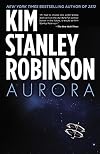
A spaceship containing around two thousand humans is engaged in multi-generational interstellar travel, a journey of 160 years, from Saturn to the Tau Ceti system. As the story opens, it is approaching its destination. The engineer, Devi, is trying to keep the ship running properly. She is fixing problems occurring due to the length of the trip, deficiencies in design, entropy, and mechanical stresses. Consumables are running low, and destabilizing forces (such as devolution and mutations) show more inhibit the ship’s ability to maintain a healthy balance of all compounds, nutrients, and lifeforms in the biomes. The deceleration and increased gravitational pull add to the stresses on both people and spaceship. Eventually, a landing party reaches Aurora, a moon in the Tau Ceti system. After this point, any further plot points would be spoilers.
The protagonists are Freya, Devi's daughter, and Ship, the spaceship’s Artificial Intelligence. Devi asks Ship to create a narrative about the trip. The spaceship’s computer is an emerging AI that needs specific instructions (has not yet learned everything it needs to create the narrative, almost like a human child). Ship gets only barebones guidance from Devi, since she has her hands full keeping the spaceship running.
Ship requests permission to focus the narrative on Freya, and Devi agrees, so the initial phases of the story are straight-forward, following Freya’s actions. Freya goes on an authorized “wander” to visit each of the twelve biomes. This construct has the benefit of giving the reader the needed details on the contents, environment, and structure of the spaceship. Ship occasionally inserts observations on its creation of the narrative. Over time, Ship assumes a unique personality of its own, and the narrative gets more complex. I particularly enjoyed the development of Ship.
Robinson examines themes such as the transferability of evolutionary advantages and the ability to terraform rapidly enough to support a colony. It is not a book about characters – they exist in service to the themes. It is more about the larger concept of social adaptation. It also covers psychological stresses, conflict resolution (and lack thereof), flawed human decision-making, and much more. If you enjoy lots of science in your science fiction (as I do), this is a great example. I will definitely be pondering the questions explored in this book for quite a while.
4.5 show less
The protagonists are Freya, Devi's daughter, and Ship, the spaceship’s Artificial Intelligence. Devi asks Ship to create a narrative about the trip. The spaceship’s computer is an emerging AI that needs specific instructions (has not yet learned everything it needs to create the narrative, almost like a human child). Ship gets only barebones guidance from Devi, since she has her hands full keeping the spaceship running.
Ship requests permission to focus the narrative on Freya, and Devi agrees, so the initial phases of the story are straight-forward, following Freya’s actions. Freya goes on an authorized “wander” to visit each of the twelve biomes. This construct has the benefit of giving the reader the needed details on the contents, environment, and structure of the spaceship. Ship occasionally inserts observations on its creation of the narrative. Over time, Ship assumes a unique personality of its own, and the narrative gets more complex. I particularly enjoyed the development of Ship.
Robinson examines themes such as the transferability of evolutionary advantages and the ability to terraform rapidly enough to support a colony. It is not a book about characters – they exist in service to the themes. It is more about the larger concept of social adaptation. It also covers psychological stresses, conflict resolution (and lack thereof), flawed human decision-making, and much more. If you enjoy lots of science in your science fiction (as I do), this is a great example. I will definitely be pondering the questions explored in this book for quite a while.
4.5 show less
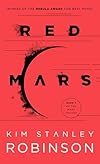
This is the first book in Kim Stanley Robinson’s epic Mars Trilogy. It imagines the initial human colonization of Mars, starting with a significant incident, then flashing back to relate the sequence of events that led up to that point. The narrative focuses on a handful of characters, primarily the pioneering men and women of the scientific community who are among the “first one hundred,” a mix of Americans, Russians, Arabs, and other international representatives. Eventually more show more people arrive from many different cultures, bringing with them different religions, beliefs, and customs.
The world-building is vivid, easy to picture. The technology is explained in detail. Beyond the scientific principles and world-building, I am impressed by the emphasis on the importance of human interactions and group dynamics. Each chapter is told from a different character’s point of view. The characters have their own personalities, agendas, jealousies, and ideas of how the new civilization should be organized. Differences in opinion will inevitably arise, requiring debates and decision-making. For example, imagine the different opinions on whether to terraform or not, and if so, to what extent. Should future arrivals, sponsored by corporations, be able to extract minerals and send them back to earth? What type of economics, politics, laws, and processes should be established? They split into factions based on opinions held in common.
I appreciate both the science and the emphasis on human foibles. It is almost overwhelming to imagine all the elements involved in starting from scratch to build a society, and the author does a masterful job. This book is almost sure to please fans of hard science fiction. I loved it! show less
The world-building is vivid, easy to picture. The technology is explained in detail. Beyond the scientific principles and world-building, I am impressed by the emphasis on the importance of human interactions and group dynamics. Each chapter is told from a different character’s point of view. The characters have their own personalities, agendas, jealousies, and ideas of how the new civilization should be organized. Differences in opinion will inevitably arise, requiring debates and decision-making. For example, imagine the different opinions on whether to terraform or not, and if so, to what extent. Should future arrivals, sponsored by corporations, be able to extract minerals and send them back to earth? What type of economics, politics, laws, and processes should be established? They split into factions based on opinions held in common.
I appreciate both the science and the emphasis on human foibles. It is almost overwhelming to imagine all the elements involved in starting from scratch to build a society, and the author does a masterful job. This book is almost sure to please fans of hard science fiction. I loved it! show less
Lists
Obama Reads (1)
al.vick-series (1)
io9 Book Club (1)
Best Dystopias (1)
Generation Ship (1)
Hurricane Books (1)
Best Beach Reads (1)
Urban Fiction (1)
Favourite Books (1)
Solar System (1)
Asia (1)
Favorite Series (1)
Climate Change (2)
Forced Exposure (2)
Read Next (2)
Nebula Award (3)
Read These Too (3)
Unread books (3)
Classic Sci-Fi (1)
Five star books (1)
Gimmicks (1)
Awards


You May Also Like


Associated Authors
Statistics
- Works
- 143
- Also by
- 124
- Members
- 49,337
- Popularity
- #317
- Rating
- 3.8
- Reviews
- 1,377
- ISBNs
- 608
- Languages
- 21
- Favorited
- 161

