
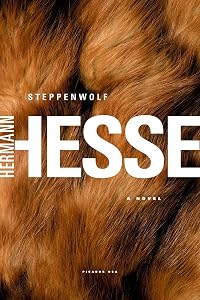
Steppenwolf
by Hermann Hesse
On This Page
Description
Harry Haller is a sad and lonely figure, a reclusive intellectual for whom life holds no joy. He struggles to reconcile the wild primeval wolf and the rational man within himself without surrendering to the bourgeois values he despises. His life changes dramatically when he meets a woman who is his opposite, the carefree and elusive Hermine. With its blend of Eastern mysticism and Western culture, Hesse's best-known and most autobiographical work, originally published in English in 1929, show more Steppenwolf continues to speak to our souls and is a classic of modern literature. show lessTags
Recommendations


























Member Recommendations
GaryPatella The protagonist in Nausea has a very similar personality to the protagonist in Steppenwolf. Both books have that same gloomy feel to them.
50
by roby72

paradoxosalpha Fight Club could be read as an updated rewriting of Steppenwolf, with Hermine replaced by Tyler Durden, and the dance hall transformed to the fight club. Maria becomes Marla, and the Magic Theater becomes Operation Mayhem.
21

Member Reviews
I read this book for the first time some 40 years ago in a Spanish translation. I didn't remember almost anything about it, except that it had made a great impression in my youth and that I had felt a great affinity for Harry Haller and his solitude. I bought this edition some ten years ago during one of my trips to Germany and it had been sitting on my shelves ever since. A few days ago I was rearranging some of my books and came across it, so I decided to finally read it again.
I had read "Knulp" in the original German before so I knew Hesse' prose was clear and to my level of fluency. This time around being older, the nihilism, the ennui and the Weltschmerz of Haller still leaves a profound impression, but this time I noticed that show more despite its darkness and the general perception about this novel being all about nihilism and suicide, in the end it's an affirmation of life and is misunderstood the same way that a lot of people misunderstand Nietzsche.
Harry's alienation from the world starts at an early age when conventional values are "beaten into him". His embrace of intellectual pursuits and high culture further alienates him from his inner wolf. The section where Hesse describes the duality of our civilized exterior and inner beast is brilliant. It's this inability to accept his duality, or more correctly the multiplicity of inner Harry's, that makes him fall into despair and contemplate suicide. Salvation comes from the acceptance of sensuality and "low culture" (jazz and dancing) and realizing, thanks to his conversation with Mozart during a drug induced hallucination, that he can have both.
On deeper level, Steppenwolf is an uncannily accurate description of the German soul during the 1920's and 30's. Behind the thin façade of high culture, intellectualism and deep romanticism lurks a murdering beast, ready to come out... and it did.
This is a short novel and definitely worth reading. show less
I had read "Knulp" in the original German before so I knew Hesse' prose was clear and to my level of fluency. This time around being older, the nihilism, the ennui and the Weltschmerz of Haller still leaves a profound impression, but this time I noticed that show more despite its darkness and the general perception about this novel being all about nihilism and suicide, in the end it's an affirmation of life and is misunderstood the same way that a lot of people misunderstand Nietzsche.
Harry's alienation from the world starts at an early age when conventional values are "beaten into him". His embrace of intellectual pursuits and high culture further alienates him from his inner wolf. The section where Hesse describes the duality of our civilized exterior and inner beast is brilliant. It's this inability to accept his duality, or more correctly the multiplicity of inner Harry's, that makes him fall into despair and contemplate suicide. Salvation comes from the acceptance of sensuality and "low culture" (jazz and dancing) and realizing, thanks to his conversation with Mozart during a drug induced hallucination, that he can have both.
On deeper level, Steppenwolf is an uncannily accurate description of the German soul during the 1920's and 30's. Behind the thin façade of high culture, intellectualism and deep romanticism lurks a murdering beast, ready to come out... and it did.
This is a short novel and definitely worth reading. show less
Harry Haller is a well-off man (not a wolf man) who has no need of employment but has been unlucky in love and in his opinions. Approaching fifty, he has become restless with undemanding contentment and aging. He is still longing for adventure, still in search of something that will stir his heart. He calls himself the steppenwolf because he is suspicious of the animal side of his nature - really just all the portions of himself he thrusts down and away from his sense of identity as a man of wisdom and learning. Hesse despaired of readers who only focused on the surface level of this novel, viewing it only as the story of a man sinking slowly into despair and madness. If it isn't that, then what is it?
To a degree it is what Hesse is show more always saying, about the sturdy slap intellectuals receive after becoming lost in themselves, when they are reminded about reality, and what impact for good or ill they can have upon its unfolding. It's a story about how we get so wrapped up in the narrow stories we tell about ourselves, built upon just a small handful of events in our lives that we replay in memory, we abandon and forget the thousand other shades that formed us and were also a part of that story. And it reminds us that work's, art's and leisure's effects upon our emotions and well-being is what counts most, more than their objective worth. It reminds us that identifying too closely with just one slice of ourselves, one interpretation, creates a fallacy whereby we can mistakenly underrate our worth to ourselves and to the world. And that even if the entire world seems bent on moving in the wrong direction, it does not change the fundamental laws of the universe that underlie everything, and all must straighten out again in time. Those laws are accessible in even the darkest times, thus we can celebrate them even in the midst of despair.
Or maybe it's just some old man getting high on drugs and not learning a whole lot in the end. You decide. show less
To a degree it is what Hesse is show more always saying, about the sturdy slap intellectuals receive after becoming lost in themselves, when they are reminded about reality, and what impact for good or ill they can have upon its unfolding. It's a story about how we get so wrapped up in the narrow stories we tell about ourselves, built upon just a small handful of events in our lives that we replay in memory, we abandon and forget the thousand other shades that formed us and were also a part of that story. And it reminds us that work's, art's and leisure's effects upon our emotions and well-being is what counts most, more than their objective worth. It reminds us that identifying too closely with just one slice of ourselves, one interpretation, creates a fallacy whereby we can mistakenly underrate our worth to ourselves and to the world. And that even if the entire world seems bent on moving in the wrong direction, it does not change the fundamental laws of the universe that underlie everything, and all must straighten out again in time. Those laws are accessible in even the darkest times, thus we can celebrate them even in the midst of despair.
Or maybe it's just some old man getting high on drugs and not learning a whole lot in the end. You decide. show less
I read this book at the very end of a very tumultuous stay and attempt at living life 'over' in Israel. It was discussed with a friend whom I had met in university and had become a brother to me as I had become to him, and he had recommended it to me for years. I had read Hesse's Siddhartha a few years previous, and I did like it very much, it was the most human telling of the soul's striving towards enlightenment that I'd read up until that point and up until now as well. But after a visit with my friend and brother in Estonia that, in many ways, served as a bookend to my Israel experience, my attempt, I read, or more devoured, the remainder of Steppenwolf I'd started in Israel.
And I'm glad, even further, I am changed because of it. I show more finished the book en route from Helsinki, Finland to New York, and when I reached the final line wherein Harry Haller the titular Steppenwolf loses 'the game' but is, paradoxically, stronger for being weaker, more whole for having been broken, and more stoic for having been forced to acknowledge the humor inherent in all tragedy and in all despair, and he is determined to do better the next time, I knew I hadn't so much as read the book as lived and breathed it in an ecstatic and agonizing panoply. I saw and felt the tortured mind and spirit and how it is cursed to be brought low to the deepest nadir of loss and pathetic tribulation but simultaneously its blessing in its potential to be elevated to the zenith of understanding and enlightenment that paradoxically again too few and too many can't understand either from fear, laziness, or simply contentment.
This is world class literature, this is necessary literature, this has to be read by everyone despite the repeated tagline and motif of it being 'not for everyone'. Along with the absrudism of Camus and the nihilism of Nietzsche and the anything of Kafka, this is a needed pain and an unexpected bliss. There are those out there who need to know that the life of the mind and the soul can, and often will, become much worse than it is now. But almost horribly, it is just as assured that it will become better, much better, so much so that you will hear the cold laughter and the eternal music of the immortals, and you will see, and maybe even believe in something as absurd and out of place as hope in the human soul. show less
And I'm glad, even further, I am changed because of it. I show more finished the book en route from Helsinki, Finland to New York, and when I reached the final line wherein Harry Haller the titular Steppenwolf loses 'the game' but is, paradoxically, stronger for being weaker, more whole for having been broken, and more stoic for having been forced to acknowledge the humor inherent in all tragedy and in all despair, and he is determined to do better the next time, I knew I hadn't so much as read the book as lived and breathed it in an ecstatic and agonizing panoply. I saw and felt the tortured mind and spirit and how it is cursed to be brought low to the deepest nadir of loss and pathetic tribulation but simultaneously its blessing in its potential to be elevated to the zenith of understanding and enlightenment that paradoxically again too few and too many can't understand either from fear, laziness, or simply contentment.
This is world class literature, this is necessary literature, this has to be read by everyone despite the repeated tagline and motif of it being 'not for everyone'. Along with the absrudism of Camus and the nihilism of Nietzsche and the anything of Kafka, this is a needed pain and an unexpected bliss. There are those out there who need to know that the life of the mind and the soul can, and often will, become much worse than it is now. But almost horribly, it is just as assured that it will become better, much better, so much so that you will hear the cold laughter and the eternal music of the immortals, and you will see, and maybe even believe in something as absurd and out of place as hope in the human soul. show less
When I mentioned to my Other Reader that I had begun reading this book, she said "re-reading, you mean?" When I said, no, reading for the first time, she said she felt shocked, betrayed even, that I had not read this book in my youth. Then, strangely enough, I read the 1961 "Author's Note," where Hesse speculates that much readerly misunderstanding of his intentions as a writer in this novel was "by reason of the fact that this book, written when I was fifty years old and dealing, as it does, with the problems of that age, often fell into the hands of very young readers." Having now read it myself, I feel the text justifies the idea that it was written by a man roughly my age, about a man roughly my age, and for men roughly my age.
This show more novel has a documentary conceit, according to which it is the "records" (journal) of Harry Haller, recovered and published by Haller's landlady's nephew. The primary effect of this framing is to allow some "objective" characterization of Haller from the nephew's perspective before the story begins in earnest. Haller is himself an alienated intellectual product of the bourgeoisie in interwar Germany. He is divorced, living alone, spending his time on literature and music without any evidence of productive employment.
The "Steppenwolf" of the title is at first a sort of nickname for Haller, which is later understood as his alter-ego or psychological shadow, and perhaps ultimately as his genius or instinctual spirit. But it may be that Haller's tutelary spirit is really figured by the girl Hermine, whom he meets when he is in a suicidal funk, and who grooms him to a new appreciation of life outside the blinkered cultural sphere he had inhabited. Hermine is, after all, the feminine of Hermann: Haller's author.
(Digression: Now it occurs to me that Palahniuk's Fight Club could be read as an updated rewriting of Steppenwolf, with Hermine replaced by Tyler Durden, and the dance hall transformed to the fight club. Maria becomes Marla, and the Magic Theater becomes Operation Mayhem. Fight Club is perhaps similarly vulnerable to misunderstanding by younger readers.)
Another key character is the musician Pablo, to whom Hermine introduces Haller. Despite Haller's initial dim view of this man, he appears to be in truth a saint or higher adept of an interior circle, and he presides over the Magic Theater where Haller's story culminates in a psychedelic initiatory ordeal. This ordeal might be glossed as the Adventure of the Abyss, in which the Tragedy of Man is to be dissolved into the Comedy of Pan.
My esoteric speculations aside, this short novel amply repays reading. It was seen as a notorious defect of Hesse's oeuvre when it was first published in the first half of the twentieth century, and then rehabilitated and valorized by the counter-culture of the second. Its relationship to our current social circumstance is not evident, yet its primary concern is not with society, but with the individual, and the nature of spiritual attainment and possibilities for self-redemption. show less
This show more novel has a documentary conceit, according to which it is the "records" (journal) of Harry Haller, recovered and published by Haller's landlady's nephew. The primary effect of this framing is to allow some "objective" characterization of Haller from the nephew's perspective before the story begins in earnest. Haller is himself an alienated intellectual product of the bourgeoisie in interwar Germany. He is divorced, living alone, spending his time on literature and music without any evidence of productive employment.
The "Steppenwolf" of the title is at first a sort of nickname for Haller, which is later understood as his alter-ego or psychological shadow, and perhaps ultimately as his genius or instinctual spirit. But it may be that Haller's tutelary spirit is really figured by the girl Hermine, whom he meets when he is in a suicidal funk, and who grooms him to a new appreciation of life outside the blinkered cultural sphere he had inhabited. Hermine is, after all, the feminine of Hermann: Haller's author.
(Digression: Now it occurs to me that Palahniuk's Fight Club could be read as an updated rewriting of Steppenwolf, with Hermine replaced by Tyler Durden, and the dance hall transformed to the fight club. Maria becomes Marla, and the Magic Theater becomes Operation Mayhem. Fight Club is perhaps similarly vulnerable to misunderstanding by younger readers.)
Another key character is the musician Pablo, to whom Hermine introduces Haller. Despite Haller's initial dim view of this man, he appears to be in truth a saint or higher adept of an interior circle, and he presides over the Magic Theater where Haller's story culminates in a psychedelic initiatory ordeal. This ordeal might be glossed as the Adventure of the Abyss, in which the Tragedy of Man is to be dissolved into the Comedy of Pan.
My esoteric speculations aside, this short novel amply repays reading. It was seen as a notorious defect of Hesse's oeuvre when it was first published in the first half of the twentieth century, and then rehabilitated and valorized by the counter-culture of the second. Its relationship to our current social circumstance is not evident, yet its primary concern is not with society, but with the individual, and the nature of spiritual attainment and possibilities for self-redemption. show less
A great existential novel begging the question of purpose within a "bourgeoisie" society. The dichotomy of a tamed man and wild beast is explored beautifully by Hesse. The novel focuses on the transcendence and healing of Harry as he, surprisingly, willingly tries to assimilate with the help of a mysterious lover.
There are so many layers of meaning in this timeless masterpiece, and so many threads, so intricately interwoven that writing about it would itself be a serious creative activity. At times, one can interpret it under the shadow of Nietzsche's Madman who is alone with himself in his emptiness, or Dostoevsky's underground man, but by the end, one can realize the true ingenuity of Hesse; however, one is able to understand why the work is so violently misunderstood.
I would stop myself from restricting a masterpiece to a particular interpretation, but would at least say that its up to us whether we feed the wolf or the human living inside us. Being humans, we perhaps believe too much in our ability to theorize, furnish ideas, reduce the show more whole macrocosm to some supposed singularity. In the process, we endlessly characterize life around us, build hierarchies, give ourselves a place in those chains of ideas, call it with beautiful names such as humanity, society, civilizations. But the wolf is always there, ready to break every structure, take all our cherished meaning away, ready to annihilate the world within, make it all absurd, supply us with only one answer: suicide.
I believe its extremely important to reflect upon Hesse's narrative around the so-called immortals, Mozart and Goethe. I am not sure if he is using them to build a chain of reconstruction and repair, but I would love to have a complete week with myself to let the text open itself to me really slow. I can only say that I absolutely loved it and I also know that I won't go through the text again. Not in a decade, if I live that long. show less
I would stop myself from restricting a masterpiece to a particular interpretation, but would at least say that its up to us whether we feed the wolf or the human living inside us. Being humans, we perhaps believe too much in our ability to theorize, furnish ideas, reduce the show more whole macrocosm to some supposed singularity. In the process, we endlessly characterize life around us, build hierarchies, give ourselves a place in those chains of ideas, call it with beautiful names such as humanity, society, civilizations. But the wolf is always there, ready to break every structure, take all our cherished meaning away, ready to annihilate the world within, make it all absurd, supply us with only one answer: suicide.
I believe its extremely important to reflect upon Hesse's narrative around the so-called immortals, Mozart and Goethe. I am not sure if he is using them to build a chain of reconstruction and repair, but I would love to have a complete week with myself to let the text open itself to me really slow. I can only say that I absolutely loved it and I also know that I won't go through the text again. Not in a decade, if I live that long. show less
...You have a picture of life within you, a faith, a challenge, and you were ready for deeds and sufferings and sacrifices, and then you became aware by degrees that the world asked no deeds and no sacrifices of you whatever, and that life is no poem of heroism with heroic parts to play and so on, but a comfortable room where people are quite content with eating and drinking, coffee and knitting, cards and wireless. And whoever wants more and has got it in him--the heroic and the beautiful, and the reverence for the great poets or for the saints--is a fool and a Don Quixote. Good. And it has been just the same for me, my friend...
Steppenwolf starts of as a heavy read and gets only more intense with time as you are introduced to the show more inner thoughts of the protagonist. It is about a journey of redemption, self-discovery, and exploration. Although it is dark and can even be emotionally tiring, in the end is simply about taking pleasure in one's life in the simplest of ways. It is about learning to love, laugh, dance and truly embrace life and the living.
So much about this book is paradoxical. It is a book about a man in his 50 and yet it has found most recognition and love by the younger audiences. It is gloomy and yet is about pursuit of joy. It reads like a fantasy and yet cannot be more grounded in real and raw struggle of a intellectually and emotionally tormented man. It is about an intellectual man with a love for all things classical and high-brow and yet he finds redemption in the company of a 'simple' woman (now how real is this woman and how much is she his own imagination is for the reader to decide). And I suppose this theme goes well in hand with Steppenwolf's misery of having two very opposing natures (that of a wolf vs of an intellectual man).
As we go through the book, the protagonist realizes his mistake in self-pitying his dual nature that causes him so much misery, when every person in the world is made of many layers and many facets that often may be opposing to each other. This is so wonderfully explored in the later part of the book where the protagonist seems to find himself in a 'Magic Theatre' where pieces of his personality scatter around him to be arranged and rearranged (so to speak). As I said, the book is so heavy on metaphor, and once you start finding meaning in them, it is a delight!
If you are looking for any existential answers in Steppenwolf through Hesse, you are not getting any. The book reads too honestly for that, it may only leave you with more questions. It may in fact confuse you further. You will be further lost if you don't understand and appreciate the various metaphorical prisms Hesse works with in Steppenwolf. No wonder it is often misinterpreted or can be a confusing read for many, including me. For this reason alone, after days of pondering over it, I am still unsure if I truly understand Hesse's intentions.
A man cannot live intensely except at the cost of the self.
There is so much going on in the book, I found so many themes I would have liked to talk more about, but I am still sort of framing my mind about it. Highly recommend it. show less
Members
- Recently Added By
Published Reviews
ThingScore 100
'Wat me nu opviel bij herlezing na dertig jaar was die durf van Hesse om alle registers open te trekken. Niet alleen stilistisch en structureel, maar ook door de meerdere lagen die op literair, psychologisch, seksueel, geschiedkundig en filosofisch vlak elkaar aanvullen en soms met elkaar contrasteren.'
added by nagel175
Lists

The Guardian's 1000 Novels Everyone Must Read
1,005 works; 550 members

1001 Books You Must Read Before You Die
1,448 works; 1,133 members

German Literature
518 works; 55 members

Magic Realism
371 works; 52 members

Top Five Books of 2013
1,562 works; 715 members
20th Century Literature
1,161 works; 55 members

Metafiction
84 works; 21 members

In and About the 1920s
181 works; 31 members

Philosophical Fiction
97 works; 27 members

Best Psychological Fiction
81 works; 16 members

Best Fantasy Novels
821 works; 361 members

Favourite Books
1,817 works; 316 members
Nobel Price Winners
222 works; 20 members
Canon de la narrativa universal del siglo XX
254 works; 6 members

Unread books
1,063 works; 87 members

Books Set in Germany
74 works; 12 members

Top Five Books of 2017
757 works; 230 members
LibraryThingers' 1001 Books You Must Read Before You Die
442 works; 29 members
Folio Society
831 works; 53 members

Blue Pyramid 1,276 Best Books of All Time
1,248 works; 32 members

Experimental Literature
141 works; 18 members

Modernism
140 works; 8 members
1,001 BYMRBYD Concensus
723 works; 27 members
1920s
141 works; 6 members

Recommended Philosophic Novels
26 works; 1 member

I Can't Finish This Book
189 works; 22 members

100 World Classics
99 works; 15 members

Mind Expanding Books by hackerkid
581 works; 8 members
Existentialism
90 works; 11 members

Books Read in 2016
4,666 works; 199 members

Literature which inspired Pop songs
85 works; 9 members

Books Read in 2017
4,249 works; 130 members

Books I Own But Haven't Read
144 works; 2 members

.
194 works; 2 members
el
1,139 works; 1 member
.
396 works; 1 member
Widely acclaimed, one book per year
105 works; 3 members

DigitalDreamDoor top 300
300 works; 4 members

Gen X Library
245 works; 4 members

Recommended Reading : 600 Classics Reviewed, Editors of Salem Press, 2015
634 works; 6 members
Canon de la narrativa universal del s. XX (cicutadry)
499 works; 3 members

Read with a Friend
17 works; 1 member
Book Recommendations Masterlist
28 works; 1 member

For Further Reading: A List of 160 Novels from 15 Literatures
160 works; 4 members

The Art of Manliness' 100+ Books Every Man Should Read
108 works; 2 members

Mensa for Kids Excellence in Reading Award Program (Grades 9-12)
116 works; 3 members

Books Read in 2019
4,052 works; 110 members
Mensa for Kids Excellence in Reading Award Program (Grades 9-12)
116 works; 5 members

Books Read in 2018
4,360 works; 110 members

The Books I've Read 2018
143 works; 1 member

The Books I Read in 2017
96 works; 1 member

CH-Autoren (Swiss Authors)
265 works; 9 members
Animals in the Title
498 works; 11 members

Books worth rereading
21 works; 1 member

100 knjiga
100 works; 1 member
Author Information

1,013+ Works 93,697 Members
Hermann Hesse (July 2, 1877 -- August 9, 1962) was a German poet, novelist, essayist and painter. His best-known works included Steppenwolf, Siddhartha, and The Glass Bead Game, each of which explores an individual's search for authenticity, self-knowledge and spirituality. In 1946, he received the Nobel Prize in Literature. Hess publicly show more announced his views on the savagery of World War I, and was considered a traitor. He moved to Switzerland where he eventually became a naturalized citizen. He warned of the advent of World War II, predicting that cultureless efficiency would destroy the modern world. His theme was usually the conflict between the elements of a person's dual nature and the problem of spiritual loneliness. His first novel, Peter Camenzind, was published in 1904. His masterpiece, Death and the Lover (1930), contrasts a scholarly abbot and his beloved pupil, who leaves the monastery for the adventurous world. Steppenwolf (1927), a European bestseller, was published when defeated Germany had begun to plan for another war. It is the story of Haller, who recognizes in himself the blend of the human and wolfish traits of the completely sterile scholarly project. During the 1960s Hesse became a favorite writer of the counter culture, especially in the United States, though his critical reputation has never equaled his popularity. Hermann Hesse died in 1962. (Bowker Author Biography) show less
Some Editions
Awards and Honors
Distinctions
Notable Lists
Series
Belongs to Publisher Series
Bibliothek Suhrkamp (869)
Bibliothek des 20. Jahrhunderts (Dt. Bücherbund) (Hesse, Hermann)
Proa Butxaca (22)
Punane raamat (7)
dtv (147)
suhrkamp taschenbuch (0175 / 4063 / 4355)
Penguin Modern Classics (2332)
Gli Oscar [Mondadori] (1063)
Modern Library (334)
Literaire reuzenpocket (319)
Work Relationships
Is contained in
International Collector's Library Classics 19 volumes: Crime & Punishment; Twenty Thousand Leagues Under the Sea; Mysterious Island; Magic Mountain; Around the World in 80 Days; Count of Monte Cristo; Camille; Quo Vadis; Hunchback of Notre Dame; Nana; Scaramouche; Pinocchio; Fernande; War and Peace; The Egyptian; From the Earth to the Moon; Candide; Treasure of Sierra Madre; Siddhartha/Steppenwolf by Jules Verne
Has the adaptation
Is abridged in
Inspired
Has as a reference guide/companion
Has as a study
Has as a student's study guide
Common Knowledge
- Canonical title
- Steppenwolf
- Original title
- Der Steppenwolf
- Original publication date
- 1927
- People/Characters
- Harry Haller; Hermine; Pablo; Rosa Kreisler; Wolfgang Amadeus Mozart; Maria (show all 11); Erica; Emil; Gustav; Attorney-General Loering; Dora
- Important places*
- Duitsland
- Related movies
- Steppenwolf (1974 | IMDb)
- First words
- This book contains the records left us by a man whom, according to the expression he often used himself, we called the Steppenwolf. == Basil Crieghton translation
- Quotations
- Ah, Harry, we have to stumble through so much dirt and humbug before we reach home. And we have no one to guide us. Our only guide is our homesickness.
I had the taste of blood and chocolate in my mouth, the one as hateful as the other.
But I would be happy if many of them were to realize that the story of the Steppenwolf pictures a disease and crisis-- but not one leading to death and destruction, on the contrary, to healing. == Author's Note -- 1961... (show all)i> - Last words
- (Click to show. Warning: May contain spoilers.)Pablo was waiting for me, and Mozart too. == Basil Crieghton translation
- Blurbers*
- Mann, Thomas
- Original language
- German
- Disambiguation notice
- 3518366750 1974 softcover German suhrkamp taschenbuch 175
3518460633 2009 softcover German suhrkamp taschenbuch 4063, st Großdruck
3518463551 2012 softcover German suhrkamp taschenbuch 4355 (Geschenkbuch)
3518736108... (show all)2011 ebook German suhrkamp
*Some information comes from Common Knowledge in other languages. Click "Edit" for more information.
Classifications
- Genres
- General Fiction, Fiction and Literature
- DDC/MDS
- 833.912 — Literature & rhetoric German & related literatures German fiction 1900- 1900-1990 1900-1945
- LCC
- PT2617 .E85 .S7 — Language and Literature German, Dutch and Scandinavian literatures German literature Individual authors or works 1860/70-1960
- BISAC
Statistics
- Members
- 15,212
- Popularity
- 465
- Reviews
- 215
- Rating
- (4.00)
- Languages
- 32 — Bosnian, Bulgarian, Catalan, Chinese, Czech, Danish, Dutch, English, Estonian, Finnish, French, German, Greek, Hungarian, Icelandic, Italian, Japanese, Korean, Latvian, Lithuanian, Norwegian (Bokmål), Polish, Romanian, Russian, Serbian, Croatian, Slovenian, Spanish, Swedish, Thai, Turkish, Portuguese (Portugal)
- Media
- Paper, Audiobook, Ebook
- ISBNs
- 303
- UPCs
- 2
- ASINs
- 161