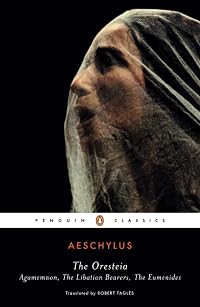
The Oresteia: Agamemnon, Women at the Graveside, Orestes in Athens
by Aeschylus
The Oresteia (Collections and Selections — 1-3)
On This Page
Description
Aeschylus here dramatizes the myth of the curse on the royal house of Argos. The action begins when King Agamemnon, returning victorious from the Trojan War, is treacherously slain by his wife. It ends with the trial of their son, Orestes, who slew his mother to avenge her treachery.Tags
Recommendations










Member Recommendations
Member Reviews
I enjoyed reading these plays, and imagining how they would be staged. The theme of revenge vs. justice is still a timely one today, and I thought the layers of old gods vs. new gods, and to a lesser extent, gender politics, added psychological depth to the story.
I can imagine the characters as actual people, with their messy motivations and emotions. Clytemnestra, left alone for over a decade as her husband is off at Troy, her oldest daughter killed by this same man. I honestly can't really blame her for wanting to kill Agamemnon herself, especially since he tricked both of them by saying he had found a husband for Iphigenia in order to get his daughter to come to where he was. To then turn a celebration into a murder is really evil. show more But "an eye for an eye" really does just cause an endless trail of tragedy.
It's fascinating to see the Furies turned into some kind of auxiliary for the Fates. I wonder why Aeschylus did that, or if that was already an accepted mythology that he capitalized on. It contains aspects of karma for me, the idea that these beings who demand payment for crimes should morph into beings who deal out destiny. So interesting. show less
I can imagine the characters as actual people, with their messy motivations and emotions. Clytemnestra, left alone for over a decade as her husband is off at Troy, her oldest daughter killed by this same man. I honestly can't really blame her for wanting to kill Agamemnon herself, especially since he tricked both of them by saying he had found a husband for Iphigenia in order to get his daughter to come to where he was. To then turn a celebration into a murder is really evil. show more But "an eye for an eye" really does just cause an endless trail of tragedy.
It's fascinating to see the Furies turned into some kind of auxiliary for the Fates. I wonder why Aeschylus did that, or if that was already an accepted mythology that he capitalized on. It contains aspects of karma for me, the idea that these beings who demand payment for crimes should morph into beings who deal out destiny. So interesting. show less
My edition had a 100 page introduction that was frankly a chore to get through. I feel bad because clearly Phillip Vellacott (the editor) was extremely passionate about the trilogy, but that was so much introduction.
The Orestia seeks to answer that time-honoured question: If your mum kills your dad, are you morally obligated to kill your mum?
In all seriousness, Orestes is in a no-win situation. He is honour-bound to avenge his father, but will be cursed forever if he kills his mother.
Aeschylus's answer to this is to illustrate the transition from an eternal vengeance-fuelled cycle of violence to a civilised justice system. At least one person I spoke to considered this a "cop-out" but I quite like it. It give the cycle a greater meaning show more and raises a mirror to our own ideas of justice and retribution.
My only prior experience with Aeschylus had been my study of Aristophanes' The Frogs in high school, in which Aeschylus is portrayed as an old-fashioned fuddy-duddy whose works nevertheless come out more worthy than later, more cynical playwrights.
I was surprised at the sophistication of the writing - all the characters have their own motives and perspectives. Although Clytaemnestra is portrayed as a villain, you can easily see how she ended up where she did.
Cassandra was my favourite character, perhaps because she was the only person involved who hadn't done anything wrong (unless you count offending Apollo!).
There are also very sophisticated layers of symbolism and intense, evocative imagery. I enjoyed the ominous imagery of the furies gathering on the roof, signifying the feminine fury soon to fill the house.
Here's some excerpts I particularly liked, this one because it's low key kinda hot:
An this one because I read it just as the 2024 US persedential election concluded:
Aristophanes concluded that it was Aeschylus Athens needed as its defeat loomed on the horizon. Perhaps it is Aeschylus we also need now, to remind us how we must suffer through violence and disaster and into true justice. show less
The Orestia seeks to answer that time-honoured question: If your mum kills your dad, are you morally obligated to kill your mum?
In all seriousness, Orestes is in a no-win situation. He is honour-bound to avenge his father, but will be cursed forever if he kills his mother.
Aeschylus's answer to this is to illustrate the transition from an eternal vengeance-fuelled cycle of violence to a civilised justice system. At least one person I spoke to considered this a "cop-out" but I quite like it. It give the cycle a greater meaning show more and raises a mirror to our own ideas of justice and retribution.
My only prior experience with Aeschylus had been my study of Aristophanes' The Frogs in high school, in which Aeschylus is portrayed as an old-fashioned fuddy-duddy whose works nevertheless come out more worthy than later, more cynical playwrights.
I was surprised at the sophistication of the writing - all the characters have their own motives and perspectives. Although Clytaemnestra is portrayed as a villain, you can easily see how she ended up where she did.
Cassandra was my favourite character, perhaps because she was the only person involved who hadn't done anything wrong (unless you count offending Apollo!).
There are also very sophisticated layers of symbolism and intense, evocative imagery. I enjoyed the ominous imagery of the furies gathering on the roof, signifying the feminine fury soon to fill the house.
Here's some excerpts I particularly liked, this one because it's low key kinda hot:
Oh but a man's high daring spirit,
who can account for that? Or woman's
desperate passion daring past all bounds?
She couples with every form of ruin known to mortals.
Woman, frenzied, driven wild with lust,
twists the dark, warm harness
of wedded love - tortures man and beast!
An this one because I read it just as the 2024 US persedential election concluded:
But ancient Violence longs to breed,
new violence comes
when its fatal hour comes, the demon comes
to take her toll - no war, no force no prayer
can hinder the midnight Fury stamped
with parent Fury moving through the house.
But justice shines in sooty hovels,
loves the decent life.
From proud halls crusted with gilt by filthy hands
she turns her eyes to find the pure in spirit -
spurning the wealth stamped counterfeit with praise,
she steers all things towards their destined end.
Aristophanes concluded that it was Aeschylus Athens needed as its defeat loomed on the horizon. Perhaps it is Aeschylus we also need now, to remind us how we must suffer through violence and disaster and into true justice. show less
This is pretty fantastic. I'm surprised. I think I like this old Greek trilogy of plays better than all the others that I've read. That's including Oedipus. :P
The translation is pretty awesome, the tragedy is beautiful, and the underlying theme of justice and the balance of power between men and women is stark and heavy.
But isn't it about murder and eye-for-an-eye taken to extremes? Yeah, but it's still more than that.
It's mainly about honoring your children and honoring your parents. It's not as twisted as some of the other Greek plays, but it is pretty horrific. Agamemnon kills his daughter, his wife kills him. Her son kills her. But wait! Apollo sanctions his killing. Alas, the Furies do not. So now we have the older gods versus the show more new. Parents and children at each other's throats again.
Totally beautiful.
And here we all thought that Zeus only caused chaos, too! To think that he'd welcome the Furies into his court as honored equals.
(Personally, I think it was just a political move. I'm pretty sure that the Furies scared him shitless, too. :)
Great stuff! show less
The translation is pretty awesome, the tragedy is beautiful, and the underlying theme of justice and the balance of power between men and women is stark and heavy.
But isn't it about murder and eye-for-an-eye taken to extremes? Yeah, but it's still more than that.
It's mainly about honoring your children and honoring your parents. It's not as twisted as some of the other Greek plays, but it is pretty horrific. Agamemnon kills his daughter, his wife kills him. Her son kills her. But wait! Apollo sanctions his killing. Alas, the Furies do not. So now we have the older gods versus the show more new. Parents and children at each other's throats again.
Totally beautiful.
And here we all thought that Zeus only caused chaos, too! To think that he'd welcome the Furies into his court as honored equals.
(Personally, I think it was just a political move. I'm pretty sure that the Furies scared him shitless, too. :)
Great stuff! show less
I am not here to review the Oresteia--the foundational text of Western drama hardly needs my praise--but instead to say a few words about the Richmond Lattimore translation which I read. Lattimore has an exalted reputation as a translator-poet, but I found this rendering fussy, wordy, often unclear, adhering pedantically to the dodecasyllabic meter of the original which (as Paul Roche has argued) works for the swift-moving Greek tongue but lumbers in consonant-rich English. As Pope wrote in the Essay on Criticism,
"Alexandrine" refers to a line written in iambic hexameter (twelve syllables, half of them stressed); the second line of Pope's show more couplet, in which he demonstrates how little suited such a meter is to English, reads uncannily like a parody of Lattimore's Oresteia in advance. Lattimore's twelve-syllable lines are cluttered with superfluous words whose apparent purpose is to fill out the meter and/or convey the alliterative music of the original. Check out these lines of Cassandra's (italics are mine):
Oh, how those wounded snakes drag their slow length along! Some of the redundancy may be in the Greek, but I blame Lattimore. I looked up these lines in the Fagles translation and found this:
The Fagles translation of these lines, which is metrically more flexible, is clear and energetic, and there is to my eye not a superfluous word. Fagles may miss out on the evocative "scent" but he also avoids the confusion of "running at my heels upon" and the redundancies that clog the flow of Lattimore's rendering.
Or check out Lattimore's adjective-overkill in these lines of Clytaemnestra's:
Here are the same lines as construed by Fagles:
Once more, Fagles' metrically more flexible rendering is clearer and more forceful: Fagles has no need to pad out the meter with superfluous verbal placeholders (and strained efforts to preserve the alliterative quality of the Greek: Lattimore's "down," "died," "dark red," "driven rain," "bitter," "blood"). Moreover, in Lattimore's translation, the image of spattering blood is inconsistent with the more laborious image of life "struggling" out of the dying Agamemnon. Fagles has "bursting," not "struggling," which makes more sense. Admittedly, I don't know the original Greek, but even supposing Lattimore is more faithful to Aeschylus in this instance, the fidelity is achieved at the expense of coherence and energy.
Sometimes Lattimore's translation is downright murky, like the Chorus's line in this exchange with Cassandra, where alliteration triumphs over intelligibility:
Again, I looked these lines up in the Fagles translation, where they make a lot more sense:
Even when Lattimore's translation avoids redundancy and needless obscurity, it is given to unnatural word order and stilted phrasing. Classical Greek is a dead language, but for Aeschylus and his audience it was living, breathing speech. Lattimore does not make Aeschylus' poetry live and breathe; he lovingly embalms it. I came away from this disappointing translation with only a muted sense of the touted majesty of these plays. show less
A needless alexandrine ends the song
That like a wounded snake, drags its slow length along.
"Alexandrine" refers to a line written in iambic hexameter (twelve syllables, half of them stressed); the second line of Pope's show more couplet, in which he demonstrates how little suited such a meter is to English, reads uncannily like a parody of Lattimore's Oresteia in advance. Lattimore's twelve-syllable lines are cluttered with superfluous words whose apparent purpose is to fill out the meter and/or convey the alliterative music of the original. Check out these lines of Cassandra's (italics are mine):
Now I will tell you plainly and from no cryptic speech;
bear me then witness, running at my heels upon
the scent of these old brutal things done long ago.
Oh, how those wounded snakes drag their slow length along! Some of the redundancy may be in the Greek, but I blame Lattimore. I looked up these lines in the Fagles translation and found this:
No more riddles. I will teach you.
Come, bear witness, run and hunt with me.
We trail the old barbaric works of slaughter.
The Fagles translation of these lines, which is metrically more flexible, is clear and energetic, and there is to my eye not a superfluous word. Fagles may miss out on the evocative "scent" but he also avoids the confusion of "running at my heels upon" and the redundancies that clog the flow of Lattimore's rendering.
Or check out Lattimore's adjective-overkill in these lines of Clytaemnestra's:
Thus he went down, and the life struggled out of him;
and as he died he spattered me with the dark red
and violent driven rain of bitter savored blood
Here are the same lines as construed by Fagles:
So he goes down, and the life is bursting out of him--
great sprays of blood, and the murderous shower
wounds me, dies me black. . .
Once more, Fagles' metrically more flexible rendering is clearer and more forceful: Fagles has no need to pad out the meter with superfluous verbal placeholders (and strained efforts to preserve the alliterative quality of the Greek: Lattimore's "down," "died," "dark red," "driven rain," "bitter," "blood"). Moreover, in Lattimore's translation, the image of spattering blood is inconsistent with the more laborious image of life "struggling" out of the dying Agamemnon. Fagles has "bursting," not "struggling," which makes more sense. Admittedly, I don't know the original Greek, but even supposing Lattimore is more faithful to Aeschylus in this instance, the fidelity is achieved at the expense of coherence and energy.
Sometimes Lattimore's translation is downright murky, like the Chorus's line in this exchange with Cassandra, where alliteration triumphs over intelligibility:
Cassandra: Friends, there is no escape for any longer time.
Chorus: Yet longest left in time is to be honored still.
Again, I looked these lines up in the Fagles translation, where they make a lot more sense:
Cassandra: No escape, my friends, not now.
Chorus:But the last hour should be savored.
Even when Lattimore's translation avoids redundancy and needless obscurity, it is given to unnatural word order and stilted phrasing. Classical Greek is a dead language, but for Aeschylus and his audience it was living, breathing speech. Lattimore does not make Aeschylus' poetry live and breathe; he lovingly embalms it. I came away from this disappointing translation with only a muted sense of the touted majesty of these plays. show less
I read Robert Fagles translation; it is accessible while retaining the powerful and subtle language and imagery of Aeschylus’ work. This (Penguin Classics) edition includes a well-written and very useful introductory essay, The Serpent and the Eagle – A Reading of 'The Oresteia', written in collaboration with W. B. Stanford (as are the notes). The introduction, about 75 pages long, gives a wealth of background information to complement the reading experience of the dramatic trilogy itself – this particular reading employs a Hegelian approach, though not too obtrusively. – "The Oresteia is our rite of passage from savagery to civilization," as Fagles/Stanford aptly puts it in the introduction. It is also one of the most show more fascinating works of drama I have ever read; impressive both in its breadth of scope and depth of detail. I wouldn't hesitate to call it a work of genius, and to my mind, here Aeschylus in many ways dwarfs even a younger giant such as Shakespeare. The fact that this is the only trilogy that has survived since antiquity, makes me mournful for all that has been lost – including the satyr play that originally accompanied the performances of this trilogy, Proteus. From the introductory essay: "For all its optimism [in the final part of the Oresteia], the Proteus may have reminded the Athenians that their lives were based on conflict, indeed that Athena had prevailed over Poseidon for possession of their city. So in the trilogy we reach an accommodation with the earth, but the sea, like Poseidon in the Odyssey, may remain to be placated." It's an intriguing thought - and for sure, I can easily see the use of a bit of comedy, as well as the presence of the more uncultivated and rustic satyrs, after the intense and bloody rite of passage - from a self-perpetuating cycle of vengeance to the rule of law - from chaos to order - of the Oresteia.
This work is licensed under a Creative Commons Attribution-NonCommercial-ShareAlike 3.0 Unported License. show less
This work is licensed under a Creative Commons Attribution-NonCommercial-ShareAlike 3.0 Unported License. show less
Umberto Eco once wrote in reference to literature translation that if you refer to a dictionary, exactitude is not one of the synonyms of faithfulness. In many of the comments that I've read on the Hughes translation of the Oresteia, it has been noted that Hughes is not true to the text. I feel that this is somewhat beside the point. This is a text that can capture an audience's attention with a story and world that is entirely alien to our own. As a reader, I was drawn deeply into the text, and often forgot that I was reading a translated work—a huge success for a translation between two vastly different languages. Of the three plays, I particularly enjoyed Agamemnon. The language is raw and often gut-wrenching, but it captivates the show more reader with drum-beat alliteration and an incessant pull forward. For example, when Clytemnestra describes the end of the Trojan war, she talks of:
"Troy on its hill / Cascades with blood, as under a downpour / Of bodies from heaven, / Shattered and entangled with each other / In every passage—mutilations, / Amputations, eviscerations. The woman / Are kneeling, shoulders heaving, with eyes hidden, / Over what were yesterday / Husbands, fathers, sons." (21)
This intensely visual language can be found throughout the text, and makes for a very powerful, moving translation. It may not be exactly true to the ancient Greek, but I'm sure it can affect audiences just as well as the original. I couldn't recommend it more. show less
"Troy on its hill / Cascades with blood, as under a downpour / Of bodies from heaven, / Shattered and entangled with each other / In every passage—mutilations, / Amputations, eviscerations. The woman / Are kneeling, shoulders heaving, with eyes hidden, / Over what were yesterday / Husbands, fathers, sons." (21)
This intensely visual language can be found throughout the text, and makes for a very powerful, moving translation. It may not be exactly true to the ancient Greek, but I'm sure it can affect audiences just as well as the original. I couldn't recommend it more. show less
I am not a classical scholar. Only a person who likes a good story. This is that. It has some of the most vivid language I've read in a long time. The Furies are absolutely terrifying. The rage and venom of Clytemnestra is touching and nauseating. I have very little to no sympathy for Agamemnon, and not much for Orestes. It is purported to be a wonderful example of the first show of justice and mercy in its day. Well, not so far as I can see. To me, it seems to say that the murder of a man is more important than that of a woman, and even the darkest avenging gods can be bought if you know their price. Still, a rattling good tale.
The presentation of this by the actors was very good. I liked hearing it more than reading it.
The presentation of this by the actors was very good. I liked hearing it more than reading it.
Members
- Recently Added By
Lists

Favourite Books
1,820 works; 308 members

Kilobook
19 works; 1 member

bound
100 works; 1 member

Abridged Western Canon
14 works; 1 member

.
396 works; 1 member

Books Read in 2025
4,128 works; 98 members

Recommend the 20 best books you've read in the last five years
2,168 works; 603 members

My Play Collection
769 works; 3 members

Books Read In 2009
43 works; 1 member

New Lifetime Reading Plan by Fadiman and Major
225 works; 5 members
How to Read a Book's Recommended Reading List
309 works; 10 members

Mustich's 1000 Books to Read Before You Die: A Life Changing List
1,001 works; 20 members

Greatest Books, allegedly
484 works; 9 members

Jones & Newman: Best Horror Books Further Recommended Reading
577 works; 4 members

A Reading List
100 works; 3 members

Tom's Bookstore
346 works; 2 members

Antigua Grecia
43 works; 2 members

Unread books
1,063 works; 87 members

Alberto Manguel's 100 Favorite Books
10 works; 1 member
Plays I Like
230 works; 31 members
Best family sagas
244 works; 34 members

100 Books to Read in a Lifetime (That Are Older Than 200 Years)
415 works; 176 members

Books I've Read More Than Once
602 works; 49 members

1001 Books You Must Read Before You Die
1,448 works; 1,137 members

CCE 100 Great Books List
145 works; 8 members

Literary Works Read in College
316 works; 15 members

Trinity College Booklist (1951): Class Eight, Classic Civilization
39 works; 3 members

Books to Read in 2015
13 works; 1 member

Philip Ward's Lifetime Reading Plan
592 works; 22 members
Truly old classics
63 works; 6 members
Harold Bloom - The Western Canon: A. The Theocratic Age
97 works; 13 members
Favourite Greek Books
97 works; 1 member

100 Most Recommended Works
100 works; 11 members

Lectuurlijst
63 works; 1 member
Author Information

322+ Works 22,999 Members
Aeschylus was born at Eleusis of a noble family. He fought at the Battle of Marathon (490 b.c.), where a small Greek band heroically defeated the invading Persians. At the time of his death in Sicily, Athens was in its golden age. In all of his extant works, his intense love of Greece and Athens finds expression. Of the nearly 90 plays attributed show more to him, only 7 survive. These are The Persians (produced in 472 b.c.), Seven against Thebes (467 b.c.), The Oresteia (458 b.c.)---which includes Agamemnon, Libation Bearers, and Eumenides (or Furies) --- Suppliants (463 b.c.), and Prometheus Bound (c.460 b.c.). Six of the seven present mythological stories. The ornate language creates a mood of tragedy and reinforces the already stylized character of the Greek theater. Aeschylus called his prodigious output "dry scraps from Homer's banquet," because his plots and solemn language are derived from the epic poet. But a more accurate summation of Aeschylus would emphasize his grandeur of mind and spirit and the tragic dignity of his language. Because of his patriotism and belief in divine providence, there is a profound moral order to his plays. Characters such as Clytemnestra, Orestes, and Prometheus personify a great passion or principle. As individuals they conflict with divine will, but, ultimately, justice prevails. Aeschylus's introduction of the second actor made real theater possible, because the two could address each other and act several roles. His successors imitated his costumes, dances, spectacular effects, long descriptions, choral refrains, invocations, and dialogue. Swinburne's (see Vol. 1) enthusiasm for The Oresteia sums up all praises of Aeschylus; he called it simply "the greatest achievement of the human mind." Because of his great achievements, Aeschylus might be considered the "father of tragedy." (Bowker Author Biography) show less
Some Editions
Awards and Honors
Notable Lists
Series

Belongs to Publisher Series
The Complete Greek Tragedies (Volume 1)
The Complete Greek Tragedies-Chicago 1960 (set v. 1, Aeschylus v. 1)
The Complete Greek Tragedies-Chicago 2013 (set v. 2, Aeschylus v. 2)
Bernat Metge (72)
Perpetua reeks (56)
Loeb Classical Library (146)
Insel-Bücherei (Nr. 961/1)
Penguin Classics (L067)
Work Relationships
Is contained in
De grekiska tragedierna : Aiskylos, Sofokles, Euripides ; i översättning av Tord Bæckström by Aischylos
Contains
Has the adaptation
Inspired
Has as a student's study guide
Common Knowledge
- Canonical title
- The Oresteia: Agamemnon / The Libation Bearers / The Eumenides; Aeschylus I: Oresteia: Agamemnon, The Libation Bearers, The Eumenides (The Complete Greek Tragedies) (The Complete Greek Tragedies); The Oresteia; Oresteia: Agamemnon, The Libation Bearers, The Eumenides; The Oresteia: Agamemnon, Women at the Graveside, Orestes in Athens
- Original title
- Ὀρέστεια; Ἀγαμέμνων; Χοηφóρoι; Εὐμενίδες
- Alternate titles
- Oresteia; The Oresteian Trilogy
- Original publication date
- 458 BC; 5th century BCE; 5th Century BC; 1979; 2018
- People/Characters
- Agamemnon; Aeschylus; Clytemnestra; Orestes; Aegisthus; Cassandra (show all 17); Cassandra (of Troy); Electra; Electra (Greek mythology); Pylades; Furies (Eumenides); Furies; Apollo (Deity); Athena; Athena (Deity); Apollo; Libation Bearers
- Important places
- Argos, Greece; Mycenae, Argos, Greece; Ancient Rome; Areopagus; Athens, Greece; Ancient Greece
- Related movies
- The Forgotten Pistolero (1969)
- Epigraph
- Now is the strong prayer folded in thine arms,
The serpent with the eagle in the boughs.
HART DAVIES, The Dance.
Penguin Classics edition (1977). - Dedication
- FOR MY MOTHER AND FATHER
Be like me! - amid the incessant flux
of appearences, eternally creating,
eternally driving into life, in this
rushing, whirling flux eternally seizing
satisfaction - I am the ... (show all)Great Mother!
NIETZSCHE, The birth of tragedy
Agememnon (Penguin Classics edition, 1977).
FOR MY WIFE
... in my heart there was a kind of fighting
That would not let me sleep. Methought I lay
Worse than the mutines in the bilboes. Rashly -
And prais'd be rashness for it; let us know,
Our in... (show all)discretion sometime serves us well
When our deep plots do pall; and that should learn us
There's a divinity that shapes our ends,
Rough-hew them how we will -
SHAKESPEARE, Hamlet
The libation bearers (Penguin Classics edition, 1977).
FOR MY DAUGHTERS
What climbs the stair?
Nothing that common women ponder on
If you are worth my hope! Neither Content
Nor satisfied Conscience, but that great family
Some ancient famous authors misrepr... (show all)esent,
The Proud Furies each with her torch on high.
W. B. YEATS, 'To Dorothy Wellesley'
The Eumenides (Penguin Classics edition, 1977). - First words
- My thanks to Aeschylus for his companionship, his rigours and his kindness. I found him a burly, eloquent ghost, with more human decency and strength than I could hope to equal.
Foreword (Robert Fagles, 1976).
Aeschylus was forty-five in 480 B.C. when the Persians sacked Athens and destroyed the shrines of the gods on the Acropolis.
Introduction ('A reading of 'The Oresteia', Robert Fagles & W. B. Stanford, 1977)... (show all).
I ask the gods some respite from the weariness / of this watchtime measured by years I lie awake / elbowed upon the Atreidaes' roof dogwise to mark / the grand processionals of all the stars of night / burdened with winter an... (show all)d again with heat for men, / dynasties in their shining blazoned on the air, / these stars, upon their wane and when the rest arise.
Agememnon (Lattimore translation, 1953).
WATCHMAN:
Dear gods, set me free from all the pain,
from the watch I keep, one whole year awake ...
propped on my arms, crouched on the roofs of Atreus
like a dog.
Agememnon (Fagles translation,... (show all) 1977).
Watchman:
Dear gods, set me free from all the pain,
the long watch I keep, one whole year awake..
propped on my arms, crouched on the roofs of Atreus
like a dog.
Agememnon (Fagles translation, 1... (show all)984).
ORESTES:
Hermes, lord of the dead, look down and guard
the fathers' power. Be my saviour, I beg you,
be my comrade now.
The libation bearers (Fagles translation, 1977).
PYTHIA:
First of the gods I honour in my prayer is Mother Earth,
the first of the gods to prophesy, and next I praise
Tradition, second to hold her Mother's mantic seat,
so legend says, and third by the lots o... (show all)f destiny,
by Tradition's free will - no force to bear her down -
another Titan, child of the Earth, took her seat
and Phoebe passed it on as a birthday fift to Phoebus,
Phoebus a name for clear pure light derived from hers.
The Eumenides (Fagles translation, 1977). - Last words
- (Click to show. Warning: May contain spoilers.)So as the eagles wheeled at the crossroads, Calchas clashed out the great good blessing mixed with doom for the halls of kings, and singing with our fate we cry, cry for the death, but good win out in glory in the end.
(Click to show. Warning: May contain spoilers.)The Eumenides: The Women of the City:
All-seeing Zeus and Fate embrace,
down they come to urge our union on -
Cry, cry, in triumph, carry on the dancing on and on!
[tr. Flagles 1984]
(Click to show. Warning: May contain spoilers.)The Eumenides (Chorus:
There shall be peace forever between these people
of Pallas and their guests. Zeus the all seeing
met with Destiny to confirm it.
Singing all follow our footsteps.
Exeunt omnes, in procession. [tr. R. Lattimore 1953] - Blurbers
- Levin, Bernard; Renault, Mary; Beye, Charles
- Original language
- Ancient Greek; Greek
- Canonical DDC/MDS
- 882.011
- Canonical LCC
- PA3827.A47
- Disambiguation notice
- This LT Work is the complete Oresteia trilogy of plays by Aeschylus, comprising:
Agamemnon,
Choephori (a/k/a, The Libation Bearers), and
Eumenides (a/k/a, The Furies).
Pl... (show all)ease do not combine this trilogy with any of the individual plays, or with any other collection. Specifically, do not combine this work with any edition that also includes Aeschylus' Prometheus Bound. Thank you.
Classifications
- Genre
- Fiction and Literature
- DDC/MDS
- 882.011 — Literature & rhetoric Classical & modern Greek literatures Classical Greek dramatic poetry and drama standard subdivisions; collections; history, description, critical appraisal; Specific periods Ancient period to ca. 499 Aeschylus
- LCC
- PA3827 .A47 — Language and Literature Greek language and literature. Latin language and literature Greek literature Individual authors Aeschylus
- BISAC
Statistics
- Members
- 11,780
- Popularity
- 759
- Reviews
- 87
- Rating
- (4.01)
- Languages
- 22 — Catalan, Chinese, Czech, Danish, Dutch, English, Finnish, French, German, Greek (Ancient), Greek, Hungarian, Italian, Japanese, Multiple languages, Norwegian (Bokmål), Polish, Russian, Serbian, Spanish, Swedish, Portuguese (Portugal)
- Media
- Paper, Audiobook, Ebook
- ISBNs
- 229
- UPCs
- 2
- ASINs
- 181