
Robert Atwan
Author of The Best American Essays of the Century
About the Author
Robert Atwan is the series editor of The Best American Essays. He recently edited Divine Inspiration, a volume of world poetry on the Gospels. (Publisher Provided)
Series
Works by Robert Atwan
Chapters into Verse: Poetry in English Inspired by the Bible : Genesis to Malachi (1993) — Editor — 131 copies, 2 reviews
Chapters into Verse: Poetry in English Inspired by the Bible: Volume 2: Gospels to Revelation (1993) — Editor — 131 copies, 2 reviews
Chapters into Verse: A Selection of Poetry in English Inspired by the Bible from Genesis through Revelation (2000) 72 copies, 1 review
Our Times 1 copy
Associated Works
I'll Tell You Mine: Thirty Years of Essays from the Iowa Nonfiction Writing Program (2015) — Introduction — 9 copies
Tagged
Common Knowledge
- Legal name
- Atwan, Robert G.
- Birthdate
- 1940-11-02
- Gender
- male
- Education
- Seton Hall University
Rutgers University - Occupations
- essayist
editor - Nationality
- USA
- Birthplace
- Paterson, New Jersey, USA
- Associated Place (for map)
- New Jersey, USA
Members
Reviews
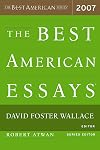
The foolish political analysts of the late aughts thought they were on the cusp of a precipitous descent into hell itself. (Whereas it's exactly this moment that is the cusp. No, rather this moment. Actually it's this moment...) In fact, the political briefs on the Iraq war (there are four of them) are all quite good, if at times alarmist(: 'if Bush is enthusiastic about the use of torture, which is in violation of the Geneva conventions, then we can expect his enthusiastic use of nuclear show more weapons which are not in violation of these conventions...' ) The disguised fiction/prose pieces aren't terrible either, but the mediocre essays outnumber the good, and none of them produce lasting insight.
Instead we have a collage of DFW's worst impulses, which point backward to his despair. It's one thing to 'lament the horrors of the modern age' while recognizing modern bane/boon are dialectical i.e. 'there is also good'. It's another thing to 'lament the horrors of the modern age' as an unsmiling social reactionary. DFW's perspective on our great 'social degeneration' is more or less: 'These are problems that have never existed before and are currently a major threat to the integrity of our society. We could solve all these problems if everyone listened to me.' Ahistorical at best. Which problems merit this alarm? Late 90s 'Political Correctness' scares in The Freedom to Offend, 'Sexual Degeneracy' panics in Afternoon of the Sex Children, Late 90s 'Liberal Idiocy' screeds in Loaded and Dragon Slayers, 'My-philoosphy-and-political-ideas-are-correct-and-everyone-would-agree-with-me-if-they-just-heard-my-argument' in Out From Xanadu, Apocalypse Now, and others. show less
Instead we have a collage of DFW's worst impulses, which point backward to his despair. It's one thing to 'lament the horrors of the modern age' while recognizing modern bane/boon are dialectical i.e. 'there is also good'. It's another thing to 'lament the horrors of the modern age' as an unsmiling social reactionary. DFW's perspective on our great 'social degeneration' is more or less: 'These are problems that have never existed before and are currently a major threat to the integrity of our society. We could solve all these problems if everyone listened to me.' Ahistorical at best. Which problems merit this alarm? Late 90s 'Political Correctness' scares in The Freedom to Offend, 'Sexual Degeneracy' panics in Afternoon of the Sex Children, Late 90s 'Liberal Idiocy' screeds in Loaded and Dragon Slayers, 'My-philoosphy-and-political-ideas-are-correct-and-everyone-would-agree-with-me-if-they-just-heard-my-argument' in Out From Xanadu, Apocalypse Now, and others. show less
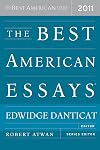
I've really enjoyed some of the many yearly "Best American" collections, especially the "Best American Science and Nature Writing", so when I came across this 2011 collection of essays at a library sale a while back, I figured I'd give it a go, too. I have to say, my feelings about this collection are a little more mixed than they usually are about the science and nature ones. The best of the essays here are excellent. (Bridget Potter's "Lucky Girl," about her experience attempting to obtain show more an abortion in 1962, particularly sticks in my mind.) The rest mostly range from okay to very good, with only one that I'd unhesitatingly call bad. (That would be Bernadette Esposito's "A-LOC," which was just incoherent, and filled with ridiculous New Age claptrap to boot.) And it features a gratifyingly diverse collection of many different kinds of voices.
But even many of the very well-written essays, taken one after another, started to feel a little unsatisfying to me. There is, perhaps, a limit to my appetite for random snippets of navel-gazing from strangers, and there is quite a bit of that here. Enough of it, in fact, that one of the pieces included -- Christy Vannoy's "A Personal Essay by a Personal Essay" -- itself acknowledges and satirizes both the self-indulgence of the whole exercise and the tendency of essayists to focus squarely on their personal suffering. Which, hoo boy, do the essays here do. It really is a cavalcade of depressing events: cancer, abuse, hospitalization, dementia, violence, and death. So it's sometimes an affecting or a thought-provoking read, but never a happy one. Mind you, the essays that I think work the very best are the ones that look outward as they look inward, ones that position the writers' negative experiences in some kind of larger context, even if only implicitly. And the essays that do that most effectively probably make the entire collection worthwhile. show less
But even many of the very well-written essays, taken one after another, started to feel a little unsatisfying to me. There is, perhaps, a limit to my appetite for random snippets of navel-gazing from strangers, and there is quite a bit of that here. Enough of it, in fact, that one of the pieces included -- Christy Vannoy's "A Personal Essay by a Personal Essay" -- itself acknowledges and satirizes both the self-indulgence of the whole exercise and the tendency of essayists to focus squarely on their personal suffering. Which, hoo boy, do the essays here do. It really is a cavalcade of depressing events: cancer, abuse, hospitalization, dementia, violence, and death. So it's sometimes an affecting or a thought-provoking read, but never a happy one. Mind you, the essays that I think work the very best are the ones that look outward as they look inward, ones that position the writers' negative experiences in some kind of larger context, even if only implicitly. And the essays that do that most effectively probably make the entire collection worthwhile. show less
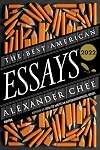
The Best American Essays 2022, edited by Alexander Chee, is an excellent collection of essays that speak to many of the things we all experience in life, but through distinctly personal lenses.
Because essays are personal accounts from very specific perspectives, I think readers are more likely to have a greater preference for or against certain ones as compared to short stories. A couple of these moved me quite deeply while a couple were just good reads (which isn't a bad thing).
I use such show more collections for times when I have limited time and don't want to try to get back into a longer work but I do want to read. These essays do very well for this, probably even better than most short story collections, because I find myself thinking about the essay as well as the essayist once I have finished. In this way it stays with me even when I have returned to whatever demands my time.
For anyone who enjoys the essay form I would highly recommend this collection. There wasn't quite the variety I would have expected but the quality is certainly here.
Reviewed from a copy made available by the publisher via NetGalley. show less
Because essays are personal accounts from very specific perspectives, I think readers are more likely to have a greater preference for or against certain ones as compared to short stories. A couple of these moved me quite deeply while a couple were just good reads (which isn't a bad thing).
I use such show more collections for times when I have limited time and don't want to try to get back into a longer work but I do want to read. These essays do very well for this, probably even better than most short story collections, because I find myself thinking about the essay as well as the essayist once I have finished. In this way it stays with me even when I have returned to whatever demands my time.
For anyone who enjoys the essay form I would highly recommend this collection. There wasn't quite the variety I would have expected but the quality is certainly here.
Reviewed from a copy made available by the publisher via NetGalley. show less
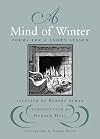
This small, lovely anthology contains thirty-two poems related somehow to winter*. It includes poems by thirty-two notable US poets from Longfellow to Jane Kenyon (both favorites of mine). The anthology is now twenty years old and it does come across as a bit old-fashioned; its list of poets doesn't really represent our multicultural community of today, and also the collection has a heavy Northeastern US presence (origins in NY and New England). Bearing that last in mind, I do live here in show more northern New England currently amidst the snow, and am a reader of poetry, so the anthology felt a bit like home (ok, except the Anne Sexton poem) show less
Lists
Awards

You May Also Like


Associated Authors
Statistics
- Works
- 77
- Also by
- 2
- Members
- 9,580
- Popularity
- #2,507
- Rating
- 3.8
- Reviews
- 90
- ISBNs
- 189
- Languages
- 1
- Favorited
- 1