
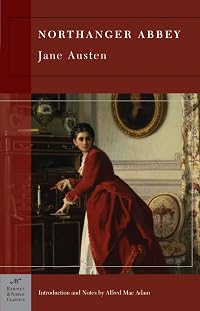
Northanger Abbey
by Jane Austen
On This Page
Description
Catherine, a seventeen year old girl, travels with her family to Bath and makes many new acquaintance, including two young men who pursue her. She is invited to visit the country estate of one, and makes the journey with high expectations of Gothic drama, her head being full of Mrs Radcliffe's The Mystery of Udolpho.This was the first novel completed by Austen, but was only published posthumously. It is a delightful, light-hearted comment by Austen on the reading and writing of novels.
.
Tags
Recommendations




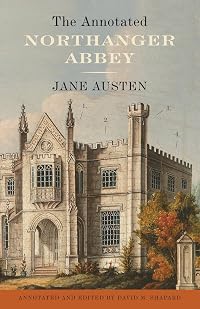


Member Recommendations

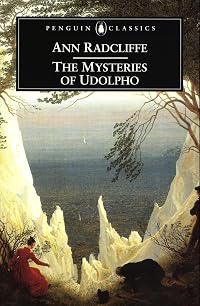
upstairsgirl This is the book that Austen's heroine is reading (and which Austen is wryly mocking) in Northanger Abbey. Fun to read with each other; Udolpho is possibly less fun on its own.
Also recommended by HollyMS
296




SomeGuyInVirginia Both satirize gothic gaspers.
33


TheLittlePhrase protagonists who struggle to differentiate between reality & the books that they read
22

Member Reviews
I know! It’s incomprehensible! A bibliophiliac such as myself, and a lover of Dickens and Bronte no less! But it’s true, I had never picked up Jane before this. And I’ve actually had this book in my collection for a few years, and only just now got around to i.
There is nothing shocking to reveal here. I didn’t discover a distaste for Austen or throw the book across the room in anger.
I thought it was wonderful. I wasn’t sure what to expect going in, and I was impressed with the hilariously scathing swipes at society life. I loved the discussion of novel reading within the novel. I loved Catherine’s flights of fancy and macabre. I was shocked at how things ended up with Isabella (I guess I should have known better, but I show more honestly thought she was genuine) and very taken with Eleanor. I absolutely loved the threads of female friendship that ran throughout the novel, and thought the romance was quite secondary in that respect.
I was a bit confused by nearly every summary I read of the story. They all mention how the story is about Catherine trying to uncover a dark secret at the Abbey. And in all, that storyline was perhaps 3 chapters of the whole book, and no where near the central plot. I’m unsure why it’s so heavily relied upon in summaries.
I loved this, my first foray into Austen, and I look forward to continuing! show less
There is nothing shocking to reveal here. I didn’t discover a distaste for Austen or throw the book across the room in anger.
I thought it was wonderful. I wasn’t sure what to expect going in, and I was impressed with the hilariously scathing swipes at society life. I loved the discussion of novel reading within the novel. I loved Catherine’s flights of fancy and macabre. I was shocked at how things ended up with Isabella (I guess I should have known better, but I show more honestly thought she was genuine) and very taken with Eleanor. I absolutely loved the threads of female friendship that ran throughout the novel, and thought the romance was quite secondary in that respect.
I was a bit confused by nearly every summary I read of the story. They all mention how the story is about Catherine trying to uncover a dark secret at the Abbey. And in all, that storyline was perhaps 3 chapters of the whole book, and no where near the central plot. I’m unsure why it’s so heavily relied upon in summaries.
I loved this, my first foray into Austen, and I look forward to continuing! show less
Spirited Catherine Morland, at 17, samples the delights of Bath society, along with the pressures and betrayals that go with it, mixing with those more wealthy and educated than she is. At times her imagination runs away with her (it all gets rather gothic), but at other times, she takes things at face value and doesn't see the obvious, which is part of her charm, both to the reader and some of the men she meets. The ending is much too abrupt, and personally I am not very keen on Austen's occasional asides to the reader, but otherwise, very enjoyable.
IN A NUTSHELL
This was a fun read, with a remarkably modern feel to it. It managed to be engaging, funny and sometimes dramatic while satirising Gothic Romances and their effects on impressionable teenage minds and highlighting the vulnerability of young women in a world run by predatory, self-regarding men.
Jane Austen completed 'Northanger Abbey' in 1799, when she was twenty-four years old. To me, it read like an exuberantly playful piece, written with wit and skill by someone very confident both of her abilities and of her opinions.'Northanger Abbey' is many things, but, above all, it is fun.
Jane Austen's authorial voice is so strong in the novel that I kept imagining it as a movie voice-over. Jane Austen speaks directly to her show more readers, not as one of her characters but as the author who created them, and invites them to consider: the ridiculous expectations placed upon heroines in Gothic Romances; the gap between the romantic ideal and the reality of a six-week-long visit to Bath to take part in society; the acceptance by sophisitcated people that what is said and what is meant need have very little in common; and the unpleasant ways in which men think about women.
Catherine Moreland, a seventeen-year-old girl whose experience of the world has hitherto been bounded primarily by her interactions with her loving parents and her nine younger siblings, is the perfect candidate for the role of Innocent Abroad. Jane Austen adds to her innocence and inexperience a tendency to hope to discover in the real world all the things she finds most thrilling in the Gothic Romances that have colonised her imagination.
Dropping Catherine into Bath society, unescorted except for a well-meaning but hapless neighbour, was bound to bring trouble. Bath, as Jane Austen knew it, was a place where those who could afford it went to do things that they could not do at home and would not want to be seen to be doing in London. This was the eighteenth-century version of a trip to Las Vegas.
TThe two things that I enjoyed most about the scenes in Bath were how well Jane Austen captured the intoxication that two young women forming a friendship in partyland can feel for each other, and the dialogue between Catherine and John Thorpe and Catherine and Henry Tilney.
I loved the scene where Catherine meets John Thorpe, Isabella Thorpe's brother and Catherine's brother's friend. It felt remarkably modern. John is a bore, obsessed with his own affairs and confident in both his opinions and his own worth. Hearing him engage Catherine in a one-sided, self-aggrandising conversation about how wonderful his gig is. He reminded me of those young men who talk endlessly about how wonderful their cars are.
The dialogue in the scene where Tilney first dances with Catherine could be from a modern RomCom. He is charming and witty. He engages here in a game that makes fun of the small talk expected on a first meeting and uses the game to build a level of intimacy and common feeling.
Jane Austen then moves the action to the Tilneys' home, Northanger Abbey, placing Catherine in an environment that she will perceive primarily through the filters fed to her imagination by the Gothic novels that she reads so voraciously. Much humout follows as reality constantly refuses to align with Catherine's expectations. I admired how Jane Austen used this to amuse the reader, debunk Gothic novels and establish Catherine as impressionable but good-hearted.
Another thing that felt very modern about the book was the late plot twist. Just when I was sure that Catherine had put her delusions behind her and was navigating her way towards a Happily Ever After ending, she is finally placed in real peril and by the very man whom her fantasies had demonised.
The ending is cute and satisfying. Jane Austen still uses her authorial voice to insert some practical reality into all the happiness and bliss, and bids farewell to the reader with a playful last line.
BUDDY READ NOTES
As this was a Buddy Read, I created the Master Post below to share my thoughts on each chapter of 'Northanger Abbey' as I read it. I'll added the most recent chapter read to the top of the post, so the chapters appear in reverse order.
Chapters 30 and 31: In which Catherine gets her HEA ending but not in the usual way of Romances
I'm not going to spoil the ending by giving a blow by blow aocount of these chapters except to say that Henry behaves well, Catherine is not foolish and the General's wrath is explained but not excused.
Jane Austen unfurled the plot at a perfectly controlled pace, demostrating good humour and granting her characters happiness. She also took a couple of final swipes at the gaps between Gothic Romances and the realities of life for English gentlefolk.
Two things made me smile. The first was Jaen Austen's extremely unromantic decription of Henry's love for Catherine. She wrote:
"for, though Henry was now sincerely attached to her, though he felt and delighted in all the excellencies of her character and truly loved her society, I must confess that his affection originated in nothing better than gratitude, or, in other words, that a persuasion of her partiality for him had been the only cause of giving her a serious thought. It is a new circumstance in romance, I acknowledge, and dreadfully derogatory of an heroine’s dignity; but if it be as new in common life, the credit of a wild imagination will at least be all my own."
The second was the mischievious way in which she ended the book. She grants Catherine happiness, despite the disapproval of General Tllney and ends with:
"I leave it to be settled, by whomsoever it may concern, whether the tendency of this work be altogether to recommend parental tyranny, or reward filial disobedience."
Chapters 28 and 29: in which our heroine is finally placed in real peril
What a wonderful twist, Just as I was preparing an unplifiting HEA ending, General Tilney inexplicably kicks Catherine out of the house, forcing her to travel alone by public post for twelve hours to reach her home. This was an extraordinary breach of hospitality, especially towards a single woman who is only seventeen years old.
The upside of the story was that Catherine managed the journey and was welcomed home by her large family, whose warmth and informatilty made the rigid regime of Northanger Abbey seem strange and unnatural.
I loved encountering a real crisis, especially so late in the book, and seeig Catherine deal with it without falling apart.
I also liked that I had no idea why the General had thrown Catherine out.
Chapters 25 to 27: in which our heroine is pleased to find she is still welcomed by the Tilney's and is shocked to learn of Isabella's inconstancy.
These chapters could have been subtitled: 'Catherine starts to grow up'. When Henry continues and his sister continue to be pleasant to her, Catherine resolves in future to judge and act "with the greatest good sense."
Austen takes a final jab at the Gothin novel by having Catherine reflect that:
"Charming as were all Mrs. Radcliffe’s works, and charming even as were the works of all her imitators, it was not in them perhaps that human nature, at least in the Midland counties of England, was to be looked for."
The next two chapters balance between building up a reasonable expectatin that Henry Tilney may propose to Catherine and showing Catherine, via the inconstency of Isabella's committment to Catherine's brother and her dalliance with Henry's brother, that not everyone behaves honourably.
Chapter 24: in which our heroine demonises her host, cannot resist the lure of a forbidden door, searches for evidence of dark deeds and finds only her own deep embarrassment
This was one of the chapters that I enjoyed most. It's beautifully done. It succeeds in the assumptions made in Gothic novels and in moving the plot and Catherine's personal devlopment along., all while delivering exciting scenes.
In the first half, the evil that Catherine assumes that her host, General Tilney, has done festers in her mind, arousing both her fear and her determination to unmask him. Catherine is so certain in her belief and so stalwart in her resolve to enter the one door in the house that has been forbidden to her that she becomes, for a few pages, the heroine of a Gothic novel.
Then everything explodes. She is discovered by Henry Tilney and made to understand that her fears are not only groundless and absurdly un-English but are also deeply insulting to her host. By the end of the chapter, Catherine is no longer a heroine but rather a foolish woman whose fevered imaginings have led her so far away from reality that she has trespassed on the goodwill of people who have been kind to her.
Chapters 21-23: in which our heroine succeeds in frightening herself, recovers, reproves herself and then convinces herself she has uncovered an evil secret at the heart of the Abbey.
These chapters were fun. I loved watching Catherine, primed by Henry Tilney's fabrications, getting herself worked up over the sinister nature of various objets: a chest that should have contained a body, not linen; old paper in a cabinet drawer that should have been a cry for help or a confession, not a laundry list; and a storm that should have been a sign of doom but wastn't.
Once she's recovered from surviving all these imagined threats, she convinces herself that her host, General Tilney, charming as he seems to be, is actually guilty of having killed or imprisoned his allegedly dead wife.
This fun thread is made more interesting by all the things that Catherine is not paying attention to. The General's behaviour towards his children speaks of long-held grief. His behaviour towards Catherine speaks of courtship. Faced with this complex reality, Catherine's obsession with fantasy seems childish.
Chapter 20: In which Henry Tilney demonstrates a talent for fashioning tales of Gothic horror.
This was the chapter that I've enjoyed most so far. The scene that stuck with me was when Henry Tilney was drivingCatherine through the countryside in his two-seater, open-topped curricle. She asks him questions about Northanger Abbey. Seeing that, in Catherine's mind, it is a place of mystery and excitement, Henry Tilney spins her a tale of what her accommodations at the Abbey will be, that sets her firmly in the role of endangered Gothic heroine. It's playful but beautifully done and pulls Catherine into a delightfully frightening fantasy. I was struck by how easily the gothic scenes Tilney created would fit into modern horror movies. It seems our plots haven't changed much. It made me wonder if a modern-day reincarnation of Jane Austen might not have made movies like 'Scream'.
Where times have changed are with regard to travel. The Tilney's break their journey north at Petty France, a distance of twenty miles, albeit that half of that is up hill, and rest their horses for two hours. The coaching inns at Petty France date back to the sixteenth century. These days, Petit France is a halfhour drive from town. Now I understand why the little village flourished, back in the day, when stops like this were necessary.
Chapters 17 - 19: In which Catherine is finally invited to Northanger Abbey and is so excited that she misses Isabella's hints at devious plans.
TThese three chapters might have been entitled Simplicity and Sophistication. In them, Catherine demonstrates her simplicity by her unaffected delight at being invited to Northanger Abbey, her romantic ideas about the Abbey itself and her complete lack of thought about what such an invitation signifies beyond a welcome expansion of friendship with Miss Tilney. Isobel demonstrates her sophistication by plotting ways to manipulate herself and her brother, John Thorpe, into what she believes to be profitable marriages, even though she is already engaged to Catherine's brother. She makes arch references to her plans that Catherine, in her simplicity, fails to understand until it becomes clear to her that Thorpe believes that Catherine has given tacit consent that a proposal from him would be welcome.
Catherine's simplicity does not extend to being blind to the impropriety of Isabella Thorpe's acceptanace of public attention from Captrain Tilney. When she raises her concerns with Henry Tilney, he demonstrates his own naivety by declaring:
"You have no doubt of the mutual attachment of your brother and your friend; depend upon it, therefore, that real jealousy never can exist between them; depend upon it that no disagreement between them can be of any duration. Their hearts are open to each other, as neither heart can be to you; they know exactly what is required and what can be borne; and you may be certain that one will never tease the other beyond what is known to be pleasant.”
At this point, I thought the book was going to move from gentle comedy into melodrama, as Isabella's plans ensnared Catherine. I was saved from that, both by Catherine's inability to perceive the threat and by her removal from Bath by the Tilneys.
I thought these chapters prefigured some of the themes that Austen would return to in later novels with a more serious intent. I was impressed by Austen's dexterous use of dialogue to build both character and suspense.
Chapters 15 and 16: in which Catherine is the naive foil to Tilney's humour and Isabella's machinations, and Miss Austen delivers some very quotable lines on how men think of women.
Catherine is so naive, so trusting, and so eager to please that watching her navigate society is like watching a puppy wander into the road to play with traffic. I'm finding the teenage angst very believable (even though the term teenager wasn't one Austen would have heard), but a little tedious. Still, at least the joys and anxieties Catherine experiences are all based on the realities of the manners of the day and her own inexperience rather than by the improbalbe star-crossed-lovers twists of fate beloved by Gothic novelists.
It's Austen's prose that keeps me reading. She doesn't waste a word. Everything that is said has an agenda. Mostly, she leaves the reader to work the agenda out, expecting them to be less naive than Catherine. Occasionally, she uses the authorial voice to gift her readers with a perfectly turned phrase or two. This time I found myself highlighting her damning descriptions of what men expect of women Ispoilet alert - they don't expect much). The first phrase that caught my eye was a comment that Catherine's shame in her own ignorance about the topics of Tilney's conversation was misplaced. She advises that:
"Where people wish to attach, they should always be ignorant. To come with a well-informed mind is to come with an inability of administering to the vanity of others, which a sensible person would always wish to avoid. A woman especially, if she have the misfortune of knowing anything, should conceal it as well as she can."
I love the bite of that last sentence.
Later, Austen comments on Catherine's lack of understanding of what might make her attractive to men. She says that men are…
"...too reasonable and too well informed themselves to desire anything more in woman than ignorance. But Catherine did not know her own advantages — did not know that a good-looking girl, with an affectionate heart and a very ignorant mind, cannot fail of attracting a clever young man, unless circumstances are particularly untoward. *
It seems to me that this line of thought might explain how Mr Bennet, in 'Pride and Prejudice' chose his bride.
Chapters 8-14: in which there are many small misunderstandings and I find out what kind of person a rattle is.
I've realised that I can't sustain the pace of commenting on each chapter individually. Partly that's because it slows my reading too much, but mostly it's because, now that the book is underway, the chapters continue with established themes and styles.
Chapters 8-14 are largely about a series of misunderstandings and frustrations that retard Catherine's progress in establishing a relationship with the Tilneys. Three things stood out for me about these chapters: firstly they avoid the Gothic novel norm of amplifying the consquences of misunderstandings by refusing to talk about them; secondly, that although the content is trivial and even silly, the writing is pitch perfect; and thirdly, how well Austen shows the heightened trauma that even the smallest upset or perceived slight can have on a teenage mind anxious for approval. I can easily imagine these chapters being translated to texts and WhatsApp messages, and all the trauma associated with them.
The silliness, while described with great accuracy, mostly had me rolling my eyes and waiting for the plot to move on. The one thing that caught my attention was the depiction of John Thorpe and the colloquial term that Jane Austen used to describe him. She called him a rattle. It's a term that I think needs to be given currency again. I can think of many a politician and at least one President to whom it applies.
John Thorpe is a rattle (possibly the politest term I would use to describe him). Jane Austen demonstrates this by having him make two back-to-back, vehement, but contradictory assertions about the state of the carriage in which Catherine's brother and Thorpe's sister are riding. Jane Austen attributes Catherine's confusion over Thorpe's statements to ignorance of the propensities of a rattle. Here's the text:
*Catherine listened with astonishment; she knew not how to reconcile two such very different accounts of the same thing; for she had not been brought up to understand the propensities of a rattle, nor to know to how many idle assertions and impudent falsehoods the excess of vanity will lead. Her own family were plain, matter-of-fact people who seldom aimed at wit of any kind; her father, at the utmost, being contented with a pun, and her mother with a proverb; they were not in the habit therefore of telling lies to increase their importance, or of asserting at one moment what they would contradict the next."
Chapter 7: in which Catherine and Isabella have a chance meeting with each other's brothers.
I loved the scene where Catherine meets John Thorpe, Isabella Thorpe's brother and Catherine's brother's friend. It felt remarkably modern. John is a bore, obsessed with his own affairs and confident in both his opinions and his own worth. Hearing him engage Catherine in a one-sided, self-aggrandising conversation about how wonderful his gig is. he reminded me of those young men who talk endlessly about how wonderful their cars are. John doubled down on his bore status by revealing that he has not read 'The Mystery of Udolfo' or 'Camilla', a fact which does not impinge on his willingness to disparage them authoritatively.
It would seem that Catherine should dislike John (I certainly did), but Austen explains how Catherine comes to persuade herself that the opposite is true. John's manner did not please Catherine but...
"...he was James’s friend and Isabella’s brother; and her judgment was further bought off by Isabella’s assuring her, when they withdrew to see the new hat, that John thought her the most charming girl in the world, and by John’s engaging her before they parted to dance with him that evening. Had she been older or vainer, such attacks might have done little; but, where youth and diffidence are united, it requires uncommon steadiness of reason to resist the attraction of being called the most charming girl in the world, and of being so very early engaged as a partner; and the consequence was that, when the two Morlands, after sitting an hour with the Thorpes, set off to walk together to Mr. Allen’s, and James, as the door was closed on them, said, “Well, Catherine, how do you like my friend Thorpe?” instead of answering, as she probably would have done, had there been no friendship and no flattery in the case, “I do not like him at all,” she directly replied, “I like him very much; he seems very agreeable.”
I loved that "it requires uncommon steadiness of reason to resist the attraction of being called the most charming girl in the world." line. It's a reminder of how vulnerable the young and previously unadmired are.
Chapter 6: in which Catherine and Isabella declare their fascination with 'The Mystery Of Udolfo' and demonstrate how intoxicated they are by each other's company.
This chapter was so sweet, it made my teeth ache but, as a picture of how intoxicated two teenage girls can become with one another's company in the first few days of acquaintance, especially when one is knowing and dominant and the other is naive and adoring, it works perfectly. It seems to me that nothing much has changed in this regard in the past 200 years.
Chapter 5: in which our author derides those who look down on novels
It rains in Bath so the two young ladies retire to read novels. The rest of the chapter is spent with Austen lambasting those who claim to look down on novels.
She passionately avers that she, as the author....
"...will not adopt that ungenerous and impolitic custom so common with novel-writers, of degrading by their contemptuous censure the very performances, to the number of which they are themselves adding — joining with their greatest enemies in bestowing the harshest epithets on such works, and scarcely ever permitting them to be read by their own heroine, who, if she accidentally take up a novel, is sure to turn over its insipid pages with disgust. Alas! If the heroine of one novel be not patronized by the heroine of another, from whom can she expect protection and regard? I cannot approve of it. Let us leave it to the reviewers to abuse such effusions of fancy at their leisure, and over every new novel to talk in threadbare strains of the trash with which the press now groans. Let us not desert one another; we are an injured body. Although our productions have afforded more extensive and unaffected pleasure than those of any other literary corporation in the world, no species of composition has been so much decried. From pride, ignorance, or fashion, our foes are almost as many as our readers."
Chapter 4: In which our heroine is finally introduced to an acquaintance in Bath
This could have been a charming chapter in which Catherine has the good fortune to strike up a new acquaintance with a young woman whom she admires and quickly develops an affection for. Except that, although that is what happened, it wasn't charming.
Although the tone of the prose was carefully inoffensive, there was something almost cruel, certainly something unkind, in the humour. The observations were painfully accurate, high on insight and low on empathy.
On the surface, Jane Austen is satirising the novels that spent many chapters relating mundane exchanges in a tediously detailed way. It seemed to me that, beneath the surface, there was a disdain not just for polite small talk but for those who enage in it with enthusiasm. I found myself wondering how many hours the young Jane Austen had had to spend in polite conversation with people she was bored by, able to predict every word that was to be said while valuing none of them.
Jane Austen sees every small vanity, every act of wilful self-delusion, as the people around her construct the narratives of their day. I wonder how much self-control it must have taken for her to work through all the tedious steps necessary to establish a friendship?
Chapter 3: In which our heroine meets the charming Mr Tilney
The first meeting between our seventeen-year-old heroine and the twenty-five-year-old Mr Tilney could, with no editing of the dialogue at all, have been a classic scene in a modern RomCom. The dialogue sparkles. I think any modern script writer would be delighted with it. Tilney turns the answering of the inevitable questions put to a new acquaintance in Bath into a game that gains him an intimacy that the questions themselves would not normally have elicited. He builds on this by playfully telling Catherine what she should write about him in her journal.
Tilney perhaps pushes his charm too far when he engages Mrs Allen in an extended conversation on Muslin, so that...
Catherine feared, as she listened to their discourse, that he indulged himself a little too much with the foibles of others.
I wonder how often Jane Aiusten had been accused of the same thing.
Chapter 2: In which our heroine arrives in Bath
I live in Bath, so it was fun to read about Catherine's entry into the city. I liked this description of Catherine's excitement:
They arrived at Bath. Catherine was all eager delight — her eyes were here, there, everywhere, as they approached its fine and striking environs, and afterwards drove through those streets which conducted them to the hotel. She was come to be happy, and she felt happy already.
I think that last sentence sums up the approach of a lot of the tourists who come to Bath.
This being Bath, the next thing to be done was to go shopping and then to go to The Assembly Rooms to be seen and perhaps to dance. I liked how unglamorous The Assembly Rooms were. It was too crowded to get close to the dance floor and, as they knew no one, Mrs Allen and Miss Morland were doomed to wandering the rooms in silence and mostly unregarded. This is not all The Assembly Room Experience of romance novels.
I found the chapter amusing, but one description was so acerbic it verged on cruelty.
Mrs. Allen was one of that numerous class of females, whose society can raise no other emotion than surprise at there being any men in the world who could like them well enough to marry them. She had neither beauty, genius, accomplishment, nor manner. The air of a gentlewoman, a great deal of quiet, inactive good temper, and a trifling turn of mind were all that could account for her being the choice of a sensible, intelligent man like Mr. Allen.
Chapter 1: In which we meet our heroine and her family
Jane Austen's tongue was clearly pushed deep into her cheek as she wrote this. Even without having read the Gothic Romances that she is satirising, I can feel the sting of this lampoon as she lists all the ways in which Catherine Morland lacks the attributes necessary to be "an heroine".
{I love that "an". I was taught that words starting with an H should be treated like words starting with a vowel and so got an "an" in front of them. Today, Grammerly wants me to "correct my article usage" and use "a" instead. I'm going to stick with the Jane Austen version.}
I like that Austen's portrait of the ten-year-old Catherine does more than satirise the image of a gothic heroine, it draws a picture of a lively, active, not particularly gifted, young girl whose parents allow her the freedom to have a good time. The message I took from this was that if Catherine is a real girl, then all those gothic heroines are the unreal imaginings of authors with little inclination to introduce reality into their narratives.
Yet Catherine is fated to be the heroine of this story, and so things must change. It begins when Catherine's perception of herself shifts. I love how Austen descibes the shift:
"At fifteen, appearances were mending; she began to curl her hair and long for balls; her complexion improved, her features were softened by plumpness and colour, her eyes gained more animation, and her figure more consequence. Her love of dirt gave way to an inclination for finery, and she grew clean as she grew smart; she had now the pleasure of sometimes hearing her father and mother remark on her personal improvement. “Catherine grows quite a good-looking girl — she is almost pretty today,” were words which caught her ears now and then; and how welcome were the sounds! To look almost pretty is an acquisition of higher delight to a girl who has been looking plain the first fifteen years of her life than a beauty from her cradle can ever receive."
I loved that '...almost pretty today" and its joyous reception.
Sadly, Catherine's evolution into an heroine is retarded by the lack of suitable men for her to fall in love with, so she spends two years living out of range of the male gaze.
I like the conspiratorial style in which this is written. Austen is speaking directly to the reader, confident of a shared perception of absurdity and appreciation of suble wit. Austen knows that the reader recognises that Catherine in on what the scriptwriters today are taught to think of as "The Hero's Journey" and so says:
"But when a young lady is to be a heroine, the perverseness of forty surrounding families cannot prevent her. Something must and will happen to throw a hero in her way."
So when Catherine is invited to go to Bath with some neighbours, we know her Hero's Journey has begun.
To me, this direct-to-camera style felt like a very modern approach, not something written in 1811. It's the sort of thing I'd see in a smart modern comedy that expects the audience to understand all the genre references and applaud the many ways in which they are being made fun of. I found myself imagining Jane Austen writing a satirical story lampooning Star Wars and Star Trek. show less
This was a fun read, with a remarkably modern feel to it. It managed to be engaging, funny and sometimes dramatic while satirising Gothic Romances and their effects on impressionable teenage minds and highlighting the vulnerability of young women in a world run by predatory, self-regarding men.
Jane Austen completed 'Northanger Abbey' in 1799, when she was twenty-four years old. To me, it read like an exuberantly playful piece, written with wit and skill by someone very confident both of her abilities and of her opinions.'Northanger Abbey' is many things, but, above all, it is fun.
Jane Austen's authorial voice is so strong in the novel that I kept imagining it as a movie voice-over. Jane Austen speaks directly to her show more readers, not as one of her characters but as the author who created them, and invites them to consider: the ridiculous expectations placed upon heroines in Gothic Romances; the gap between the romantic ideal and the reality of a six-week-long visit to Bath to take part in society; the acceptance by sophisitcated people that what is said and what is meant need have very little in common; and the unpleasant ways in which men think about women.
Catherine Moreland, a seventeen-year-old girl whose experience of the world has hitherto been bounded primarily by her interactions with her loving parents and her nine younger siblings, is the perfect candidate for the role of Innocent Abroad. Jane Austen adds to her innocence and inexperience a tendency to hope to discover in the real world all the things she finds most thrilling in the Gothic Romances that have colonised her imagination.
Dropping Catherine into Bath society, unescorted except for a well-meaning but hapless neighbour, was bound to bring trouble. Bath, as Jane Austen knew it, was a place where those who could afford it went to do things that they could not do at home and would not want to be seen to be doing in London. This was the eighteenth-century version of a trip to Las Vegas.
TThe two things that I enjoyed most about the scenes in Bath were how well Jane Austen captured the intoxication that two young women forming a friendship in partyland can feel for each other, and the dialogue between Catherine and John Thorpe and Catherine and Henry Tilney.
I loved the scene where Catherine meets John Thorpe, Isabella Thorpe's brother and Catherine's brother's friend. It felt remarkably modern. John is a bore, obsessed with his own affairs and confident in both his opinions and his own worth. Hearing him engage Catherine in a one-sided, self-aggrandising conversation about how wonderful his gig is. He reminded me of those young men who talk endlessly about how wonderful their cars are.
The dialogue in the scene where Tilney first dances with Catherine could be from a modern RomCom. He is charming and witty. He engages here in a game that makes fun of the small talk expected on a first meeting and uses the game to build a level of intimacy and common feeling.
Jane Austen then moves the action to the Tilneys' home, Northanger Abbey, placing Catherine in an environment that she will perceive primarily through the filters fed to her imagination by the Gothic novels that she reads so voraciously. Much humout follows as reality constantly refuses to align with Catherine's expectations. I admired how Jane Austen used this to amuse the reader, debunk Gothic novels and establish Catherine as impressionable but good-hearted.
Another thing that felt very modern about the book was the late plot twist. Just when I was sure that Catherine had put her delusions behind her and was navigating her way towards a Happily Ever After ending, she is finally placed in real peril and by the very man whom her fantasies had demonised.
The ending is cute and satisfying. Jane Austen still uses her authorial voice to insert some practical reality into all the happiness and bliss, and bids farewell to the reader with a playful last line.
BUDDY READ NOTES
As this was a Buddy Read, I created the Master Post below to share my thoughts on each chapter of 'Northanger Abbey' as I read it. I'll added the most recent chapter read to the top of the post, so the chapters appear in reverse order.
Chapters 30 and 31: In which Catherine gets her HEA ending but not in the usual way of Romances
I'm not going to spoil the ending by giving a blow by blow aocount of these chapters except to say that Henry behaves well, Catherine is not foolish and the General's wrath is explained but not excused.
Jane Austen unfurled the plot at a perfectly controlled pace, demostrating good humour and granting her characters happiness. She also took a couple of final swipes at the gaps between Gothic Romances and the realities of life for English gentlefolk.
Two things made me smile. The first was Jaen Austen's extremely unromantic decription of Henry's love for Catherine. She wrote:
"for, though Henry was now sincerely attached to her, though he felt and delighted in all the excellencies of her character and truly loved her society, I must confess that his affection originated in nothing better than gratitude, or, in other words, that a persuasion of her partiality for him had been the only cause of giving her a serious thought. It is a new circumstance in romance, I acknowledge, and dreadfully derogatory of an heroine’s dignity; but if it be as new in common life, the credit of a wild imagination will at least be all my own."
The second was the mischievious way in which she ended the book. She grants Catherine happiness, despite the disapproval of General Tllney and ends with:
"I leave it to be settled, by whomsoever it may concern, whether the tendency of this work be altogether to recommend parental tyranny, or reward filial disobedience."
Chapters 28 and 29: in which our heroine is finally placed in real peril
What a wonderful twist, Just as I was preparing an unplifiting HEA ending, General Tilney inexplicably kicks Catherine out of the house, forcing her to travel alone by public post for twelve hours to reach her home. This was an extraordinary breach of hospitality, especially towards a single woman who is only seventeen years old.
The upside of the story was that Catherine managed the journey and was welcomed home by her large family, whose warmth and informatilty made the rigid regime of Northanger Abbey seem strange and unnatural.
I loved encountering a real crisis, especially so late in the book, and seeig Catherine deal with it without falling apart.
I also liked that I had no idea why the General had thrown Catherine out.
Chapters 25 to 27: in which our heroine is pleased to find she is still welcomed by the Tilney's and is shocked to learn of Isabella's inconstancy.
These chapters could have been subtitled: 'Catherine starts to grow up'. When Henry continues and his sister continue to be pleasant to her, Catherine resolves in future to judge and act "with the greatest good sense."
Austen takes a final jab at the Gothin novel by having Catherine reflect that:
"Charming as were all Mrs. Radcliffe’s works, and charming even as were the works of all her imitators, it was not in them perhaps that human nature, at least in the Midland counties of England, was to be looked for."
The next two chapters balance between building up a reasonable expectatin that Henry Tilney may propose to Catherine and showing Catherine, via the inconstency of Isabella's committment to Catherine's brother and her dalliance with Henry's brother, that not everyone behaves honourably.
Chapter 24: in which our heroine demonises her host, cannot resist the lure of a forbidden door, searches for evidence of dark deeds and finds only her own deep embarrassment
This was one of the chapters that I enjoyed most. It's beautifully done. It succeeds in the assumptions made in Gothic novels and in moving the plot and Catherine's personal devlopment along., all while delivering exciting scenes.
In the first half, the evil that Catherine assumes that her host, General Tilney, has done festers in her mind, arousing both her fear and her determination to unmask him. Catherine is so certain in her belief and so stalwart in her resolve to enter the one door in the house that has been forbidden to her that she becomes, for a few pages, the heroine of a Gothic novel.
Then everything explodes. She is discovered by Henry Tilney and made to understand that her fears are not only groundless and absurdly un-English but are also deeply insulting to her host. By the end of the chapter, Catherine is no longer a heroine but rather a foolish woman whose fevered imaginings have led her so far away from reality that she has trespassed on the goodwill of people who have been kind to her.
Chapters 21-23: in which our heroine succeeds in frightening herself, recovers, reproves herself and then convinces herself she has uncovered an evil secret at the heart of the Abbey.
These chapters were fun. I loved watching Catherine, primed by Henry Tilney's fabrications, getting herself worked up over the sinister nature of various objets: a chest that should have contained a body, not linen; old paper in a cabinet drawer that should have been a cry for help or a confession, not a laundry list; and a storm that should have been a sign of doom but wastn't.
Once she's recovered from surviving all these imagined threats, she convinces herself that her host, General Tilney, charming as he seems to be, is actually guilty of having killed or imprisoned his allegedly dead wife.
This fun thread is made more interesting by all the things that Catherine is not paying attention to. The General's behaviour towards his children speaks of long-held grief. His behaviour towards Catherine speaks of courtship. Faced with this complex reality, Catherine's obsession with fantasy seems childish.
Chapter 20: In which Henry Tilney demonstrates a talent for fashioning tales of Gothic horror.
This was the chapter that I've enjoyed most so far. The scene that stuck with me was when Henry Tilney was drivingCatherine through the countryside in his two-seater, open-topped curricle. She asks him questions about Northanger Abbey. Seeing that, in Catherine's mind, it is a place of mystery and excitement, Henry Tilney spins her a tale of what her accommodations at the Abbey will be, that sets her firmly in the role of endangered Gothic heroine. It's playful but beautifully done and pulls Catherine into a delightfully frightening fantasy. I was struck by how easily the gothic scenes Tilney created would fit into modern horror movies. It seems our plots haven't changed much. It made me wonder if a modern-day reincarnation of Jane Austen might not have made movies like 'Scream'.
Where times have changed are with regard to travel. The Tilney's break their journey north at Petty France, a distance of twenty miles, albeit that half of that is up hill, and rest their horses for two hours. The coaching inns at Petty France date back to the sixteenth century. These days, Petit France is a halfhour drive from town. Now I understand why the little village flourished, back in the day, when stops like this were necessary.
Chapters 17 - 19: In which Catherine is finally invited to Northanger Abbey and is so excited that she misses Isabella's hints at devious plans.
TThese three chapters might have been entitled Simplicity and Sophistication. In them, Catherine demonstrates her simplicity by her unaffected delight at being invited to Northanger Abbey, her romantic ideas about the Abbey itself and her complete lack of thought about what such an invitation signifies beyond a welcome expansion of friendship with Miss Tilney. Isobel demonstrates her sophistication by plotting ways to manipulate herself and her brother, John Thorpe, into what she believes to be profitable marriages, even though she is already engaged to Catherine's brother. She makes arch references to her plans that Catherine, in her simplicity, fails to understand until it becomes clear to her that Thorpe believes that Catherine has given tacit consent that a proposal from him would be welcome.
Catherine's simplicity does not extend to being blind to the impropriety of Isabella Thorpe's acceptanace of public attention from Captrain Tilney. When she raises her concerns with Henry Tilney, he demonstrates his own naivety by declaring:
"You have no doubt of the mutual attachment of your brother and your friend; depend upon it, therefore, that real jealousy never can exist between them; depend upon it that no disagreement between them can be of any duration. Their hearts are open to each other, as neither heart can be to you; they know exactly what is required and what can be borne; and you may be certain that one will never tease the other beyond what is known to be pleasant.”
At this point, I thought the book was going to move from gentle comedy into melodrama, as Isabella's plans ensnared Catherine. I was saved from that, both by Catherine's inability to perceive the threat and by her removal from Bath by the Tilneys.
I thought these chapters prefigured some of the themes that Austen would return to in later novels with a more serious intent. I was impressed by Austen's dexterous use of dialogue to build both character and suspense.
Chapters 15 and 16: in which Catherine is the naive foil to Tilney's humour and Isabella's machinations, and Miss Austen delivers some very quotable lines on how men think of women.
Catherine is so naive, so trusting, and so eager to please that watching her navigate society is like watching a puppy wander into the road to play with traffic. I'm finding the teenage angst very believable (even though the term teenager wasn't one Austen would have heard), but a little tedious. Still, at least the joys and anxieties Catherine experiences are all based on the realities of the manners of the day and her own inexperience rather than by the improbalbe star-crossed-lovers twists of fate beloved by Gothic novelists.
It's Austen's prose that keeps me reading. She doesn't waste a word. Everything that is said has an agenda. Mostly, she leaves the reader to work the agenda out, expecting them to be less naive than Catherine. Occasionally, she uses the authorial voice to gift her readers with a perfectly turned phrase or two. This time I found myself highlighting her damning descriptions of what men expect of women Ispoilet alert - they don't expect much). The first phrase that caught my eye was a comment that Catherine's shame in her own ignorance about the topics of Tilney's conversation was misplaced. She advises that:
"Where people wish to attach, they should always be ignorant. To come with a well-informed mind is to come with an inability of administering to the vanity of others, which a sensible person would always wish to avoid. A woman especially, if she have the misfortune of knowing anything, should conceal it as well as she can."
I love the bite of that last sentence.
Later, Austen comments on Catherine's lack of understanding of what might make her attractive to men. She says that men are…
"...too reasonable and too well informed themselves to desire anything more in woman than ignorance. But Catherine did not know her own advantages — did not know that a good-looking girl, with an affectionate heart and a very ignorant mind, cannot fail of attracting a clever young man, unless circumstances are particularly untoward. *
It seems to me that this line of thought might explain how Mr Bennet, in 'Pride and Prejudice' chose his bride.
Chapters 8-14: in which there are many small misunderstandings and I find out what kind of person a rattle is.
I've realised that I can't sustain the pace of commenting on each chapter individually. Partly that's because it slows my reading too much, but mostly it's because, now that the book is underway, the chapters continue with established themes and styles.
Chapters 8-14 are largely about a series of misunderstandings and frustrations that retard Catherine's progress in establishing a relationship with the Tilneys. Three things stood out for me about these chapters: firstly they avoid the Gothic novel norm of amplifying the consquences of misunderstandings by refusing to talk about them; secondly, that although the content is trivial and even silly, the writing is pitch perfect; and thirdly, how well Austen shows the heightened trauma that even the smallest upset or perceived slight can have on a teenage mind anxious for approval. I can easily imagine these chapters being translated to texts and WhatsApp messages, and all the trauma associated with them.
The silliness, while described with great accuracy, mostly had me rolling my eyes and waiting for the plot to move on. The one thing that caught my attention was the depiction of John Thorpe and the colloquial term that Jane Austen used to describe him. She called him a rattle. It's a term that I think needs to be given currency again. I can think of many a politician and at least one President to whom it applies.
John Thorpe is a rattle (possibly the politest term I would use to describe him). Jane Austen demonstrates this by having him make two back-to-back, vehement, but contradictory assertions about the state of the carriage in which Catherine's brother and Thorpe's sister are riding. Jane Austen attributes Catherine's confusion over Thorpe's statements to ignorance of the propensities of a rattle. Here's the text:
*Catherine listened with astonishment; she knew not how to reconcile two such very different accounts of the same thing; for she had not been brought up to understand the propensities of a rattle, nor to know to how many idle assertions and impudent falsehoods the excess of vanity will lead. Her own family were plain, matter-of-fact people who seldom aimed at wit of any kind; her father, at the utmost, being contented with a pun, and her mother with a proverb; they were not in the habit therefore of telling lies to increase their importance, or of asserting at one moment what they would contradict the next."
Chapter 7: in which Catherine and Isabella have a chance meeting with each other's brothers.
I loved the scene where Catherine meets John Thorpe, Isabella Thorpe's brother and Catherine's brother's friend. It felt remarkably modern. John is a bore, obsessed with his own affairs and confident in both his opinions and his own worth. Hearing him engage Catherine in a one-sided, self-aggrandising conversation about how wonderful his gig is. he reminded me of those young men who talk endlessly about how wonderful their cars are. John doubled down on his bore status by revealing that he has not read 'The Mystery of Udolfo' or 'Camilla', a fact which does not impinge on his willingness to disparage them authoritatively.
It would seem that Catherine should dislike John (I certainly did), but Austen explains how Catherine comes to persuade herself that the opposite is true. John's manner did not please Catherine but...
"...he was James’s friend and Isabella’s brother; and her judgment was further bought off by Isabella’s assuring her, when they withdrew to see the new hat, that John thought her the most charming girl in the world, and by John’s engaging her before they parted to dance with him that evening. Had she been older or vainer, such attacks might have done little; but, where youth and diffidence are united, it requires uncommon steadiness of reason to resist the attraction of being called the most charming girl in the world, and of being so very early engaged as a partner; and the consequence was that, when the two Morlands, after sitting an hour with the Thorpes, set off to walk together to Mr. Allen’s, and James, as the door was closed on them, said, “Well, Catherine, how do you like my friend Thorpe?” instead of answering, as she probably would have done, had there been no friendship and no flattery in the case, “I do not like him at all,” she directly replied, “I like him very much; he seems very agreeable.”
I loved that "it requires uncommon steadiness of reason to resist the attraction of being called the most charming girl in the world." line. It's a reminder of how vulnerable the young and previously unadmired are.
Chapter 6: in which Catherine and Isabella declare their fascination with 'The Mystery Of Udolfo' and demonstrate how intoxicated they are by each other's company.
This chapter was so sweet, it made my teeth ache but, as a picture of how intoxicated two teenage girls can become with one another's company in the first few days of acquaintance, especially when one is knowing and dominant and the other is naive and adoring, it works perfectly. It seems to me that nothing much has changed in this regard in the past 200 years.
Chapter 5: in which our author derides those who look down on novels
It rains in Bath so the two young ladies retire to read novels. The rest of the chapter is spent with Austen lambasting those who claim to look down on novels.
She passionately avers that she, as the author....
"...will not adopt that ungenerous and impolitic custom so common with novel-writers, of degrading by their contemptuous censure the very performances, to the number of which they are themselves adding — joining with their greatest enemies in bestowing the harshest epithets on such works, and scarcely ever permitting them to be read by their own heroine, who, if she accidentally take up a novel, is sure to turn over its insipid pages with disgust. Alas! If the heroine of one novel be not patronized by the heroine of another, from whom can she expect protection and regard? I cannot approve of it. Let us leave it to the reviewers to abuse such effusions of fancy at their leisure, and over every new novel to talk in threadbare strains of the trash with which the press now groans. Let us not desert one another; we are an injured body. Although our productions have afforded more extensive and unaffected pleasure than those of any other literary corporation in the world, no species of composition has been so much decried. From pride, ignorance, or fashion, our foes are almost as many as our readers."
Chapter 4: In which our heroine is finally introduced to an acquaintance in Bath
This could have been a charming chapter in which Catherine has the good fortune to strike up a new acquaintance with a young woman whom she admires and quickly develops an affection for. Except that, although that is what happened, it wasn't charming.
Although the tone of the prose was carefully inoffensive, there was something almost cruel, certainly something unkind, in the humour. The observations were painfully accurate, high on insight and low on empathy.
On the surface, Jane Austen is satirising the novels that spent many chapters relating mundane exchanges in a tediously detailed way. It seemed to me that, beneath the surface, there was a disdain not just for polite small talk but for those who enage in it with enthusiasm. I found myself wondering how many hours the young Jane Austen had had to spend in polite conversation with people she was bored by, able to predict every word that was to be said while valuing none of them.
Jane Austen sees every small vanity, every act of wilful self-delusion, as the people around her construct the narratives of their day. I wonder how much self-control it must have taken for her to work through all the tedious steps necessary to establish a friendship?
Chapter 3: In which our heroine meets the charming Mr Tilney
The first meeting between our seventeen-year-old heroine and the twenty-five-year-old Mr Tilney could, with no editing of the dialogue at all, have been a classic scene in a modern RomCom. The dialogue sparkles. I think any modern script writer would be delighted with it. Tilney turns the answering of the inevitable questions put to a new acquaintance in Bath into a game that gains him an intimacy that the questions themselves would not normally have elicited. He builds on this by playfully telling Catherine what she should write about him in her journal.
Tilney perhaps pushes his charm too far when he engages Mrs Allen in an extended conversation on Muslin, so that...
Catherine feared, as she listened to their discourse, that he indulged himself a little too much with the foibles of others.
I wonder how often Jane Aiusten had been accused of the same thing.
Chapter 2: In which our heroine arrives in Bath
I live in Bath, so it was fun to read about Catherine's entry into the city. I liked this description of Catherine's excitement:
They arrived at Bath. Catherine was all eager delight — her eyes were here, there, everywhere, as they approached its fine and striking environs, and afterwards drove through those streets which conducted them to the hotel. She was come to be happy, and she felt happy already.
I think that last sentence sums up the approach of a lot of the tourists who come to Bath.
This being Bath, the next thing to be done was to go shopping and then to go to The Assembly Rooms to be seen and perhaps to dance. I liked how unglamorous The Assembly Rooms were. It was too crowded to get close to the dance floor and, as they knew no one, Mrs Allen and Miss Morland were doomed to wandering the rooms in silence and mostly unregarded. This is not all The Assembly Room Experience of romance novels.
I found the chapter amusing, but one description was so acerbic it verged on cruelty.
Mrs. Allen was one of that numerous class of females, whose society can raise no other emotion than surprise at there being any men in the world who could like them well enough to marry them. She had neither beauty, genius, accomplishment, nor manner. The air of a gentlewoman, a great deal of quiet, inactive good temper, and a trifling turn of mind were all that could account for her being the choice of a sensible, intelligent man like Mr. Allen.
Chapter 1: In which we meet our heroine and her family
Jane Austen's tongue was clearly pushed deep into her cheek as she wrote this. Even without having read the Gothic Romances that she is satirising, I can feel the sting of this lampoon as she lists all the ways in which Catherine Morland lacks the attributes necessary to be "an heroine".
{I love that "an". I was taught that words starting with an H should be treated like words starting with a vowel and so got an "an" in front of them. Today, Grammerly wants me to "correct my article usage" and use "a" instead. I'm going to stick with the Jane Austen version.}
I like that Austen's portrait of the ten-year-old Catherine does more than satirise the image of a gothic heroine, it draws a picture of a lively, active, not particularly gifted, young girl whose parents allow her the freedom to have a good time. The message I took from this was that if Catherine is a real girl, then all those gothic heroines are the unreal imaginings of authors with little inclination to introduce reality into their narratives.
Yet Catherine is fated to be the heroine of this story, and so things must change. It begins when Catherine's perception of herself shifts. I love how Austen descibes the shift:
"At fifteen, appearances were mending; she began to curl her hair and long for balls; her complexion improved, her features were softened by plumpness and colour, her eyes gained more animation, and her figure more consequence. Her love of dirt gave way to an inclination for finery, and she grew clean as she grew smart; she had now the pleasure of sometimes hearing her father and mother remark on her personal improvement. “Catherine grows quite a good-looking girl — she is almost pretty today,” were words which caught her ears now and then; and how welcome were the sounds! To look almost pretty is an acquisition of higher delight to a girl who has been looking plain the first fifteen years of her life than a beauty from her cradle can ever receive."
I loved that '...almost pretty today" and its joyous reception.
Sadly, Catherine's evolution into an heroine is retarded by the lack of suitable men for her to fall in love with, so she spends two years living out of range of the male gaze.
I like the conspiratorial style in which this is written. Austen is speaking directly to the reader, confident of a shared perception of absurdity and appreciation of suble wit. Austen knows that the reader recognises that Catherine in on what the scriptwriters today are taught to think of as "The Hero's Journey" and so says:
"But when a young lady is to be a heroine, the perverseness of forty surrounding families cannot prevent her. Something must and will happen to throw a hero in her way."
So when Catherine is invited to go to Bath with some neighbours, we know her Hero's Journey has begun.
To me, this direct-to-camera style felt like a very modern approach, not something written in 1811. It's the sort of thing I'd see in a smart modern comedy that expects the audience to understand all the genre references and applaud the many ways in which they are being made fun of. I found myself imagining Jane Austen writing a satirical story lampooning Star Wars and Star Trek. show less
This was a fun read, and I already know I'll be visiting the Abbey again in the future. But visiting the Abbey is only part of the fun when reading this novel.
I loved Austen's argument in defense of novels themselves, naming her own favorite works in tribute. It was also a lot of fun to follow along with her winking satire of the Gothic novels that were so popular at the time. Our heroine, 17 year old Cartherine Morland, has practically memorized their formula, and so is easily both enchanted and alarmed by Northanger Abbey when she has the opportunity to visit. Her vivid imagination has her torturing herself with all sorts of dark scenarios - after all, she reasons, it's an abbey!
I also enjoyed the banter between Mr. Tilney and his show more sister, Eleanor. When she challenges him to express his feelings on the understanding of women in general, for Catherine's benefit, we get this gem:
"Miss Morland, no one can think more highly of the understanding of women than I do. In my opinion, nature has given them so much, that they never find it necessary to use more than half."
Applause. There's much more, in typical Austen style, and we also have strong ancillary characters that move the story along.
Catherine is very young, gullible, but good-natured and charming, and I enjoyed reading her adventures as she is introduced to society. show less
I loved Austen's argument in defense of novels themselves, naming her own favorite works in tribute. It was also a lot of fun to follow along with her winking satire of the Gothic novels that were so popular at the time. Our heroine, 17 year old Cartherine Morland, has practically memorized their formula, and so is easily both enchanted and alarmed by Northanger Abbey when she has the opportunity to visit. Her vivid imagination has her torturing herself with all sorts of dark scenarios - after all, she reasons, it's an abbey!
I also enjoyed the banter between Mr. Tilney and his show more sister, Eleanor. When she challenges him to express his feelings on the understanding of women in general, for Catherine's benefit, we get this gem:
"Miss Morland, no one can think more highly of the understanding of women than I do. In my opinion, nature has given them so much, that they never find it necessary to use more than half."
Applause. There's much more, in typical Austen style, and we also have strong ancillary characters that move the story along.
Catherine is very young, gullible, but good-natured and charming, and I enjoyed reading her adventures as she is introduced to society. show less
One of the absolute best Austen books, and that is saying something, Northanger Abbey is a spoof of the Gothic fiction of Austen's day. Katherine Morland is a rather empty-headed, naive young girl ready for an adventure. Ready for romance and horror, she is on the lookout for gloomy, haunted castles, secret lairs and wives locked in the attic...but mainly discovers that cabinets contain papers, not decapitated heads, and spare rooms are woefully free of haunts and murdered wives. Brilliant, fun, and even profound at moments, Northanger Abbey is Austen's most lighthearted romp.
On a visit to Bath and then to friends at the titular house, Catherine Morland learns to tell the difference between fiction and reality.
Deservedly a classic. Too many people cannot tell the difference between the world as shown in the media they consume and the real world. Austen shows it is not a new problem but it is one that we can see is becoming more urgent.
Deservedly a classic. Too many people cannot tell the difference between the world as shown in the media they consume and the real world. Austen shows it is not a new problem but it is one that we can see is becoming more urgent.
This was my second attempt at reading this novel, the shortest written by Jane Austen. There were two main differences making me like this much more this time round. This Kindle book was much better formatted than the previous e-version, with proper paragraphing and a more attractive font. More importantly, I have since read and enjoyed Ann Radcliffe's Mysteries of Udolpho, which the heroine of Northanger Abbey has read and which influences her view of what she will encounter at the Abbey.
This novel is very witty and comes across as very modern in its exploration of themes such as the battle of the sexes, jealousy and simple uncertainties and lack of confidence in life and relationships. The central character Catherine Morland is very show more sympathetic and believable. Her fears about the dramatic and terrible events she thinks have happened at the Abbey are humourously melodramatic and delightfully misplaced. The novel also contains a great defence of the novel as an art form. 5/5 show less
This novel is very witty and comes across as very modern in its exploration of themes such as the battle of the sexes, jealousy and simple uncertainties and lack of confidence in life and relationships. The central character Catherine Morland is very show more sympathetic and believable. Her fears about the dramatic and terrible events she thinks have happened at the Abbey are humourously melodramatic and delightfully misplaced. The novel also contains a great defence of the novel as an art form. 5/5 show less
Members
- Recently Added By
Lists

The Guardian's 1000 Novels Everyone Must Read
1,005 works; 550 members

1001 Books You Must Read Before You Die
1,448 works; 1,131 members

Classics you know you should have read but probably haven't
421 works; 408 members

Favourite 19th century fiction
257 works; 62 members

Read the book and saw the movie
1,170 works; 195 members

Best books about books
209 works; 106 members
Best of British Literature
226 works; 41 members

Best Gothic Fiction
110 works; 31 members

Best Books about Readers
23 works; 14 members

Female Author
1,235 works; 66 members

Literature About Social Class
134 works; 19 members
Female Protagonist
1,056 works; 57 members

Recommend the 20 best books you've read in the last five years
2,168 works; 601 members
Favorite Coming of Age Novels.
164 works; 51 members
Best Satire
188 works; 29 members

Favourite Virago Modern Classics
183 works; 38 members
Folio Society
831 works; 48 members
Love and Marriage
93 works; 10 members
Books I've Read More Than Once
602 works; 48 members

Books Featured on Gilmore Girls
307 works; 21 members

Houses and Buildings as Characters in Fiction
182 works; 29 members

Western World's Greatest Books - Project Gutenberg
295 works; 15 members
Women's reading list
50 works; 7 members

Books Set in Great Britain
191 works; 13 members
Readable Classics
110 works; 15 members
Literature About Women and Girls
394 works; 39 members

Out of Copyright
244 works; 14 members

Global Reads: Books Set in the United Kingdom and Ireland
109 works; 5 members

Newark Public Library's 1904 List of a Thousand of the Best Novels
95 works; 5 members

Top Five Books of 2014
1,064 works; 397 members

Short and Sweet
245 works; 23 members

Books Read in 2014
2,343 works; 89 members

Books You Read During High School (For School)
301 works; 53 members

Rory Gilmore Book Club
193 works; 5 members

Lovecraft's 'Supernatural Horror in Literature' Reading List
216 works; 8 members

Summer Reads 2014
207 works; 70 members

Classic British Humor
41 works; 8 members

Jones and Newman's Horror: The 100 Best Books
100 works; 4 members
Stories Inspired by Other Fiction
127 works; 24 members

Allie's Favourite 150 Books
145 works; 3 members

Movie Adaptations
111 works; 4 members

Books Read in 2023
5,547 works; 145 members
Books tagged favorites
390 works; 30 members
Shannon's Read-Alikes List
71 works; 8 members
Bibliography for How to be a Heroine
148 works; 12 members

BBC Top Books
78 works; 3 members
Books Read in 2016
4,666 works; 197 members
Books Read in 2015
3,299 works; 127 members
Best Domestic Fiction
77 works; 6 members
Good, Smart, Clean Fiction
46 works; 4 members

Books on my Kindle
162 works; 3 members
United Kingdom
82 works; 5 members

SHOULD Read Books!
354 works; 9 members

Funny Classics
20 works; 2 members

Best Horror Mega-List
342 works; 6 members

University literature
145 works; 5 members

Catalog
41 works; 2 members
1800s (The decade, not the century)
3 works; 1 member

Books I've read
87 works; 2 members

SantaThing 2014 Gifts
299 works; 17 members

Generation Joshua
115 works; 3 members
Favourite Love Stories
53 works; 1 member
Books to Read in 2015
13 works; 1 member

Books Read in 2022
5,166 works; 114 members
Reading LIst
648 works; 1 member
Books You Read For University
184 works; 3 members

Gilmore Girls Complete Reading List
30 works; 1 member
Bookstore Deep Diving
10 works; 1 member

living room bookshelf
150 works; 1 member

Recommended Reading : 600 Classics Reviewed, Editors of Salem Press, 2015
634 works; 6 members

Books We Love to Reread
688 works; 296 members

Books Read in 2025
4,091 works; 97 members

Physical TBR List
68 works; 1 member

Books Read in 2012
816 works; 34 members
Books With Our Favorite First Lines
168 works; 104 members
The Complete Rory Gilmore Reading List
506 works; 5 members
el
1,139 works; 1 member

Top Five Books of 2025
954 works; 303 members
Books Featured in Jane Austen's Bookshelf
37 works; 7 members

Books Read in 2011
684 works; 20 members

Necessary & Exquisite
30 works; 4 members

Which house?
423 works; 16 members

Ambleside Books
459 works; 18 members
KayStJ's to-read list
1,616 works; 11 members

Literary Works Read in College
316 works; 15 members

Art of Reading
188 works; 5 members

I Could Live There
185 works; 12 members
Books referenced in A Very Great Profession: The Woman's Novel 1914-39
199 works; 6 members

Books Read in 2018
4,360 works; 110 members

Tagged 19th Century
104 works; 7 members
Books available on Open Library
171 works; 4 members
Mustich's 1000 Books to Read Before You Die: A Life Changing List
1,001 works; 19 members

20 books to cheer you up now.
20 works; 2 members
Books Mentioned in the A+ Autostraddle Pop Up Discords Nov 2022 & Dec 2022
223 works; 3 members
Favorite Romance Fiction
247 works; 115 members

AP Lit
363 works; 6 members

Books read in 1997
21 works; 1 member
Five star books
1,755 works; 108 members

Unread books
1,063 works; 82 members

Best of World Literature
432 works; 51 members
Talk Discussions
Past Discussions
Northanger Abbey by Jane Austen - lyzard tutoring SqueakyChu in 75 Books Challenge for 2012 (February 2016)
Austenathon 2011: Northanger Abbey (Spoiler Thread) in 75 Books Challenge for 2011 (November 2011)
Group Discussion - May 2008 - Northanger Abbey (Spoilers Possible) in I Love Jane Austen (June 2008)
The Northanger "horrid" novels in I Love Jane Austen (May 2008)
Author Information

701+ Works 316,875 Members
Jane Austen's life is striking for the contrast between the great works she wrote in secret and the outward appearance of being quite dull and ordinary. Austen was born in the small English town of Steventon in Hampshire, and educated at home by her clergyman father. She was deeply devoted to her family. For a short time, the Austens lived in the show more resort city of Bath, but when her father died, they returned to Steventon, where Austen lived until her death at the age of 41. Austen was drawn to literature early, she began writing novels that satirized both the writers and the manners of the 1790's. Her sharp sense of humor and keen eye for the ridiculous in human behavior gave her works lasting appeal. She is at her best in such books as Pride and Prejudice (1813), Mansfield Park (1814), and Emma (1816), in which she examines and often ridicules the behavior of small groups of middle-class characters. Austen relies heavily on conversations among her characters to reveal their personalities, and at times her novels read almost like plays. Several of them have, in fact, been made into films. She is considered to be one of the most beloved British authors. (Bowker Author Biography) show less
Some Editions
Awards and Honors
Notable Lists
Series
Belongs to Publisher Series
Penguin Clothbound Classics (2011)
Flipback (Classics 3)
Everyman's Library (25)
btb (72258)
Penguin English Library, 2012 series (2012-11)
Virago Modern Classics (346)
insel taschenbuch (931)
Work Relationships
Is contained in
Sense and Sensibility / Pride and Prejudice / Mansfield Park / Emma / Northanger Abbey / Persuasion / Lady Susan by Jane Austen
Sense and Sensibility / Pride and Prejudice / Mansfield Park / Emma / Northanger Abbey / Persuasion by Jane Austen
Emma / Mansfield Park / Northanger Abbey / Persuasion / Pride and Prejudice / Sense and Sensibility / Shorter Works by Jane Austen
Is retold in
Has the (non-series) sequel
Has the adaptation
Is abridged in
Is a parody of
Is parodied in
Is replied to in
Was inspired by
Inspired
Has as a supplement
Has as a commentary on the text
Has as a student's study guide
Common Knowledge
- Canonical title
- Northanger Abbey
- Original title
- Northanger Abbey
- Alternate titles*
- Caterina; Catherine Morland; Northanger Abbey
- Original publication date
- 1817-12-20
- People/Characters
- Catherine Morland; Richard Morland (reverend); Mrs. Morland; General Tilney; Frederick Tilney (captain); Henry Tilney (reverend) (show all 13); Eleanor Tilney; Isabella Thorpe; John Thorpe; Mrs. Thorpe; James Morland; Mrs. Allen; Mr. Allen
- Important places
- Bath, Somerset, England, UK; Fullerton, Wiltshire, England, UK; Northanger Abbey, Gloucestershire, England, UK; Wiltshire, England, UK; Gloucestershire, England, UK; Somerset, England, UK (show all 7); England, UK
- Related movies
- Novela: La abadía de Northanger (1968 | IMDb); Northanger Abbey (1986 | TV | IMDb); Wishbone: Pup Fiction (1998 | s2e49 | IMDb); Northanger Abbey (2007 | TV | IMDb)
- First words
- No one who ever had seen Catherine Morland in her infancy, would have supposed her born to be an heroine.
- Quotations
- "Oh! It is only a novel!" replies the young lady, while she lays down her book with affected indifference, or momentary shame. "It is only Cecilia, or Camilla, or Belinda"; or, in short, only some work in which the greatest p... (show all)owers of the mind are displayed, in which the most thorough knowledge of human nature, the happiest delineation of its varieties, the liveliest effusions of wit and humour, are conveyed to the world in the best-chosen language.
Friendship is certainly the finest balm for the pangs of disappointed love.
...but while I have Udolpho to read, I feel as if nobody could make me miserable.
Young people do not like to be always thwarted.
Give me but a little cheerful company, let me only have the company of the people I love, let me be where I like and with whom I like, and the devil may take the rest
But when a young lady is to be a heroine, the perverseness of forty surrounding families cannot prevent her. Something must and will happen to throw a hero in her way.
Mrs. Allen was one of that numerous class of females, whose society can raise no other emotion than surprise at there being any men in the world who could like them well enough to marry them.
...no young lady can be justified in falling in love before the gentleman's love is declared...
Yes, novels; for I will not adopt that ungenerous and impolitic custom so common with novel-writers, of degrading by their contemptuous censure the very performances, to the number of which they are themselves adding--joining... (show all) with their greatest enemies in bestowing the harshest epithets on such works, and scarcely ever permitting them to be read by their own heroine, who, if she accidentally take up a novel, is sure to turn over its insipid pages with disgust. Alas! If the heroine of one novel be not patronized by the heroine of another, from whom can she expect protection and regard?
There is nothing I would not do for those who are really my friends. I have no notion of loving people by halves; it is not my nature. My attachments are always excessively strong.
The person, be it gentleman or lady, who has not pleasure in a good novel, must be intolerably stupid.
The quarrels of popes and kings, with wars or pestilences, in every page; the men all so good for nothing, and hardly any women at all--it is very tiresome: and yet I often think it odd that it should be so dull, for a great ... (show all)deal of it must be invention. The speeches that are put into the heroes' mouths, their thoughts and designs--the chief of all this must be invention, and invention is what delights me in other books. [on reading history]
To come with a well-informed mind is to come with an inability of administering to the vanity of others, which a sensible person would always wish to avoid. A woman especially, if she have the misfortune of knowing anything, ... (show all)should conceal it as well as she can.
...if adventures will not befall a young lady in her own village, she must seek them abroad...
... why he should say one thing so positively, and mean another all the while, was most unaccountable! How were people, at that rate, to be understood?
But now you love a hyacinth. So much the better. You have gained a new source of enjoyment, and it is well to have as many holds upon happiness as possible.
The manuscript so wonderfully found, so wonderfully accomplishing the morning's prediction, how was it to be accounted for? What could it contain? To whom could it relate? By what means could it have been so long concealed? A... (show all)nd how singularly strange that it should fall to her lot to discover it! Till she had made herself mistress of its contents, however, she could have neither repose nor comfort; and with the sun's first rays she was determined to peruse it. But many were the tedious hours which must yet intervene. She shuddered, tossed about in her bed, and envied every quiet sleeper. … The housemaid's folding back her window-shutters at eight o'clock the next day was the sound which first roused Catherine; and she opened her eyes, wondering that they could ever have been closed, on objects of cheerfulness; her fire was already burning, and a bright morning had succeeded the tempest of the night. Instantaneously, with the consciousness of existence, returned her recollection of the manuscript; and springing from the bed in the very moment of the maid's going away, she eagerly collected every scattered sheet which had burst from the roll on its falling to the ground, and flew back to enjoy the luxury of their perusal on her pillow. She now plainly saw that she must not expect a manuscript of equal length with the generality of what she had shuddered over in books, for the roll, seeming to consist entirely of small disjointed sheets, was altogether but of trifling size, and much less than she had supposed it to be at first. Her greedy eye glanced rapidly over a page. She started at its import. Could it be possible, or did not her senses play her false? An inventory of linen, in coarse and modern characters, seemed all that was before her! If the evidence of sight might be trusted, she held a washing-bill in her hand. She seized another sheet, and saw the same articles with little variation; a third, a fourth, and a fifth presented nothing new. Shirts, stockings, cravats, and waistcoats faced her in each. Two others, penned by the same hand, marked an expenditure scarcely more interesting, in letters, hair-powder, shoe-string, and breeches-ball. And the larger sheet, which had enclosed the rest, seemed by its first cramp line, "To poultice chestnut mare"—a farrier's bill! Such was the collection of papers (left perhaps, as she could then suppose, by the negligence of a servant in the place whence she had taken them) which had filled her with expectation and alarm, and robbed her of half her night's rest! She felt humbled to the dust. - Last words
- (Click to show. Warning: May contain spoilers.)To begin perfect happiness at the respective ages of twenty-six and eighteen, is to do pretty well; and professing myself moreover convinced, that the General's unjust interference, so far from being really injurious to their felicity, was perhaps rather conducive to it, by improving their knowledge of each other, and adding strength to their attachment, I leave it to be settled by whomsoever it may concern, whether the tendency of this work be altogether to recommend parental tyranny, or reward filial disobedience.
- Original language
- English
- Disambiguation notice
- This LT work, Jane Austen's Northanger Abbey, is the original form of this novel. Jane Austen's Northanger Abbey [ISBN 1854598376] is a dramatization of this work by Tim Luscombe. Please do not combine the two; ... (show all)thank you.
*Some information comes from Common Knowledge in other languages. Click "Edit" for more information.
Classifications
Statistics
- Members
- 24,975
- Popularity
- 188
- Reviews
- 463
- Rating
- (3.83)
- Languages
- 24 — Amharic, Catalan, Chinese, Czech, Danish, Dutch, English, Estonian, Finnish, French, German, Galician, Greek, Hungarian, Italian, Lithuanian, Norwegian (Nynorsk), Farsi/Persian, Polish, Russian, Spanish, Swedish, Turkish, Portuguese (Portugal)
- Media
- Paper, Audiobook, Ebook
- ISBNs
- 869
- UPCs
- 8
- ASINs
- 305