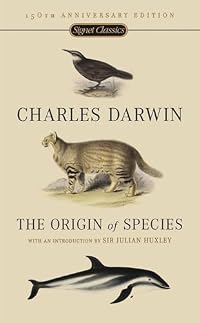
The Origin of Species
by Charles Darwin 
On This Page
Description
Science. Nonfiction. Biology. On December 27, 1831, the young naturalist Charles Darwin left Plymouth Harbor aboard the HMS Beagle. For the next five years, he conducted research on plants and animals from around the globe, amassing a body of evidence that would culminate in one of the greatest discoveries in the history of mankind-the theory of evolution. Darwin presented his stunning insights in a landmark book that forever altered the way human beings view themselves and the world they show more live in. In The Origin of Species, Darwin convincingly demonstrates the fact of evolution: that existing animals and plants cannot have appeared separately but must have slowly transformed from ancestral creatures. Most important, the book fully explains the mechanism that effects such a transformation: natural selection, the idea that made evolution scientifically intelligible for the first time. One of the few revolutionary works of science that is readily accessible to the nonscientist, The Origin of Species not only launched the science of modern biology but has also influenced virtually all subsequent literary, philosophical, and religious thinking. show lessTags
Recommendations








Member Recommendations
Noisy Things have moved on somewhat in the last one hundred and fifty years. These two books bear a re-read ahead of the bicentenary of Darwin's birth in 2009.

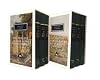
themulhern The books are similar in structure and not nearly as dry as most other science or history.
32
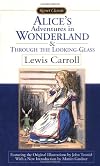
2below Carroll was one of many Victorian authors influenced by Darwin's work. Alice is rife with evolutionary thinking--a crazy world inhabited almost entirely by sentient animals, with a heavy focus on eating and being eaten.
37
Member Reviews
It's very discursive. You can almost hear Darwin pulling up a chair to the fireplace to discuss this idea he's had. And he's thought about it a lot.
It's also very cleverly written, starting with something the reader knows about (the human breeding of pigeons) then expanding slowly from that to the new stuff, but returning to that base whenever Darwin needs a clear, easy-to-understand example.
It's a complete refutation of the 'one great man makes a giant leap for human understanding' way of looking at scientific progress, with Darwin being very careful to say where and who he has got information from and whose ideas he's building on (even if he's retested as much of the info as he can and tested his theories as best as he can). He's also show more a lot nicer about his fellow scientists than a look of books today are.
I like that Darwin states the parts where his theory might not explain everything, and that he uses observation to try to plug those gaps.
He might have been able to cover more detail in the book if he stopped apologising for the amount of stuff he couldn't put in.
Looking backwards from what we know now, it's amazing how close Darwin gets to being right about most of it, and a lot of his uncertainties could only have been cleared up once genes and sequencing were discovered.
There's a couple of points where he wanders down paths that turned out to be dead ends (recapitulation theory is bunk) and we've still not got a 'how' of instincts, but given the information Darwin had to work with, he's right more than he's wrong.
It's pretty much a must read for scientists, and it's reasonably accessible to non-scientists, and a fairly straight-forward read once you've got used to certain Victorian writing quirks.
Definitely worth reading. show less
It's also very cleverly written, starting with something the reader knows about (the human breeding of pigeons) then expanding slowly from that to the new stuff, but returning to that base whenever Darwin needs a clear, easy-to-understand example.
It's a complete refutation of the 'one great man makes a giant leap for human understanding' way of looking at scientific progress, with Darwin being very careful to say where and who he has got information from and whose ideas he's building on (even if he's retested as much of the info as he can and tested his theories as best as he can). He's also show more a lot nicer about his fellow scientists than a look of books today are.
I like that Darwin states the parts where his theory might not explain everything, and that he uses observation to try to plug those gaps.
He might have been able to cover more detail in the book if he stopped apologising for the amount of stuff he couldn't put in.
Looking backwards from what we know now, it's amazing how close Darwin gets to being right about most of it, and a lot of his uncertainties could only have been cleared up once genes and sequencing were discovered.
There's a couple of points where he wanders down paths that turned out to be dead ends (recapitulation theory is bunk) and we've still not got a 'how' of instincts, but given the information Darwin had to work with, he's right more than he's wrong.
It's pretty much a must read for scientists, and it's reasonably accessible to non-scientists, and a fairly straight-forward read once you've got used to certain Victorian writing quirks.
Definitely worth reading. show less
(posted on my blog: davenichols.net)
Having found that I'm hopelessly addicted to popular science books, especially those dealing with evolution, natural selection, and other wonders of biology, I promised myself that I'd pick up this foundational classic at some point. So much of what I had known previously about Origin was from reading the works of Dawkins, Quammen, and others, and I felt it was vitally important to take up Darwin's masterpiece and see for myself what he had to say. It is quite safe to say it was an excellent decision, and Origin stands up just as well in 2009 as it did when it was published 150 years ago.
Darwin's enthusiasm for the natural world comes through strongly on every page. I can easily imagine him sitting in show more his workshop, encouraging me, the reader, to see what he sees, to notice the details he explains with such passion. And he does not skip the scientific data. Darwin's arguments are strongly based on observation, experimentation, and an amazing convergence of multiple disciplines. Throughout the book, the reader feels he might be sitting in a room while Darwin leads a fascinating exhibition with the help of eminent biologists, zoologists, geologists, anthropologists, naturalists, and others.
I especially loved reading Darwin's original words dealing with biogeography and the migration of life. It is stunning just how prescient he was in so many things which he admits freely are greatly educated guesses. Sure, there are places where his thoughts were later shown incomplete or erroneous, but the vast bulk of his thoughts showed keen insight that often took many decades of research to prove correct. Darwin was quite literally one of the very few fundamental thinkers to ever risk putting his thoughts into writing, and his work is even more impressive given how little was known about genetics at the time by anyone but the largely-unknown Gregor Mendel.
While the book is quite dense at times, it is well worth the reader's effort to push through and experience this book's amazing insights. Darwin's enthusiasm is infective, and I think any reader of science who is interested in reading the classics should take the time to read and enjoy this groundbreaking and fascinating work. Five big stars. show less
Having found that I'm hopelessly addicted to popular science books, especially those dealing with evolution, natural selection, and other wonders of biology, I promised myself that I'd pick up this foundational classic at some point. So much of what I had known previously about Origin was from reading the works of Dawkins, Quammen, and others, and I felt it was vitally important to take up Darwin's masterpiece and see for myself what he had to say. It is quite safe to say it was an excellent decision, and Origin stands up just as well in 2009 as it did when it was published 150 years ago.
Darwin's enthusiasm for the natural world comes through strongly on every page. I can easily imagine him sitting in show more his workshop, encouraging me, the reader, to see what he sees, to notice the details he explains with such passion. And he does not skip the scientific data. Darwin's arguments are strongly based on observation, experimentation, and an amazing convergence of multiple disciplines. Throughout the book, the reader feels he might be sitting in a room while Darwin leads a fascinating exhibition with the help of eminent biologists, zoologists, geologists, anthropologists, naturalists, and others.
I especially loved reading Darwin's original words dealing with biogeography and the migration of life. It is stunning just how prescient he was in so many things which he admits freely are greatly educated guesses. Sure, there are places where his thoughts were later shown incomplete or erroneous, but the vast bulk of his thoughts showed keen insight that often took many decades of research to prove correct. Darwin was quite literally one of the very few fundamental thinkers to ever risk putting his thoughts into writing, and his work is even more impressive given how little was known about genetics at the time by anyone but the largely-unknown Gregor Mendel.
While the book is quite dense at times, it is well worth the reader's effort to push through and experience this book's amazing insights. Darwin's enthusiasm is infective, and I think any reader of science who is interested in reading the classics should take the time to read and enjoy this groundbreaking and fascinating work. Five big stars. show less
http://nwhyte.livejournal.com/1376341.ht...
My recommendation to the casual reader would be to skip about half of it. Darwin basically has three startling ideas here, and the chapters where he talks about them are excellent, almost exciting, as he modestly challenges the received wisdom of the day. He wanders off topic, though, into areas like hybridism and geographical distribution, and I found those chapters much tougher going.
Darwin's three ideas are these:
1) Most fundamentally, that it is possible to come up with a scientific explanation of how species change. (This is actually the second argument in the book, but it is the most important.) Although most of the book is a massing of evidence in favour,he takes one or two moments to show more tilt against any idea that species originate through acts of supernatural creation. 'To admit this view is, as it seems to me, to reject a real for an unreal, or at least for an unknown ,cause. It makes the works of God a mere mockery and deception; I would almost as soon believe with the old and ignorant cosmogonists, that fossil shells had never lived, but had been created in stone so as to mock the shells now living on the sea-shore.'
2) Darwin works up to this gradually, reviewing in considerable detail how humans change domesticated species of both animals and plants through artificial selection. He is not in general as lucid a writer as Gould, or even Dawkins. But the first four chapters on their own set out a compelling case that the answer to the question posed by the book's title is that species generally originate by descent from other species with modification by natural selection. (The word 'evolution' is not used.)
3) The third new element introduced by Darwin is the enormity of geological time. Having proposed a very slow process of change, he needs long ages to have passed for it to operate. This also helps him with another difficulty - he needs the fossil record to be incomplete in order to account for the fact that we don't find many intermediate stages of species change (though there are other factors here). He is coy about the details but does propose that the Weald has taken 300 million years to erode to its present situation. I think today's estimate is more like 100 million years, but he's within an order of magnitude.
We are still hazy about some of the details on all of this - in particular, the development of genetics has bolstered the general argument while muddying some of the details. But basically Darwin was right on all three of his big ideas, and on all three of them he was challenging received wisdom - though of course he was not alone, and in an appendix lists other writers who had come to similar conclusions in recent years
It is worthing also noting what Darwin doesn't do. He doesn't use the word 'evolution'; he says little about God and nothing about the Bible; he has precisely one sentence about the relevance of this to humanity, saying that as a result of his book, 'Light will be thrown on the origin of man and his history.' But the implications are pretty clear. show less
My recommendation to the casual reader would be to skip about half of it. Darwin basically has three startling ideas here, and the chapters where he talks about them are excellent, almost exciting, as he modestly challenges the received wisdom of the day. He wanders off topic, though, into areas like hybridism and geographical distribution, and I found those chapters much tougher going.
Darwin's three ideas are these:
1) Most fundamentally, that it is possible to come up with a scientific explanation of how species change. (This is actually the second argument in the book, but it is the most important.) Although most of the book is a massing of evidence in favour,he takes one or two moments to show more tilt against any idea that species originate through acts of supernatural creation. 'To admit this view is, as it seems to me, to reject a real for an unreal, or at least for an unknown ,cause. It makes the works of God a mere mockery and deception; I would almost as soon believe with the old and ignorant cosmogonists, that fossil shells had never lived, but had been created in stone so as to mock the shells now living on the sea-shore.'
2) Darwin works up to this gradually, reviewing in considerable detail how humans change domesticated species of both animals and plants through artificial selection. He is not in general as lucid a writer as Gould, or even Dawkins. But the first four chapters on their own set out a compelling case that the answer to the question posed by the book's title is that species generally originate by descent from other species with modification by natural selection. (The word 'evolution' is not used.)
3) The third new element introduced by Darwin is the enormity of geological time. Having proposed a very slow process of change, he needs long ages to have passed for it to operate. This also helps him with another difficulty - he needs the fossil record to be incomplete in order to account for the fact that we don't find many intermediate stages of species change (though there are other factors here). He is coy about the details but does propose that the Weald has taken 300 million years to erode to its present situation. I think today's estimate is more like 100 million years, but he's within an order of magnitude.
We are still hazy about some of the details on all of this - in particular, the development of genetics has bolstered the general argument while muddying some of the details. But basically Darwin was right on all three of his big ideas, and on all three of them he was challenging received wisdom - though of course he was not alone, and in an appendix lists other writers who had come to similar conclusions in recent years
It is worthing also noting what Darwin doesn't do. He doesn't use the word 'evolution'; he says little about God and nothing about the Bible; he has precisely one sentence about the relevance of this to humanity, saying that as a result of his book, 'Light will be thrown on the origin of man and his history.' But the implications are pretty clear. show less
Do youself a favor and review or print out the Divergence of Taxa diagram. to know what Darwin is explaining, as he often refers to this image. As such, this is one of the reasons this technical work is actually a poor choice for an audiobook. Also, this particular narrator of the 2nd (1859) British edition has some unusual pronunciation mannerisms: "pupae" sound like excreta in the eye, "inference" has furry accent on an indentified second syllable, and "protean" is a homonym to "protein". Who knew!
Still, I like to listen to Darwin tell of his experiments in applying the scientific method to his theory: tickling aphids, floating seeds, picking at duck feet, and more. A lot here reminds of Sidereus Nuncius, or The Sidereal Messenger in show more the joy of being on the edge of science. The differences are Darwin is rushing to print and breathlessly touring us through his thought-cathedral as like-minded innovators are going to print with their independent discoveries. It just goes to show it was all "in the air" at the time. Darwin makes convincing arguments about the logical results of natural selection from his journeys to Tierra del Fuego and beyond as well as speaking in detail of the results of then contemporary paleontology (more advanced than I had realized, to study ahead and know your Silurian period from your Cretaceous) as well as strong, studied examples in homology, vestigal forms, and embryology. show less
Still, I like to listen to Darwin tell of his experiments in applying the scientific method to his theory: tickling aphids, floating seeds, picking at duck feet, and more. A lot here reminds of Sidereus Nuncius, or The Sidereal Messenger in show more the joy of being on the edge of science. The differences are Darwin is rushing to print and breathlessly touring us through his thought-cathedral as like-minded innovators are going to print with their independent discoveries. It just goes to show it was all "in the air" at the time. Darwin makes convincing arguments about the logical results of natural selection from his journeys to Tierra del Fuego and beyond as well as speaking in detail of the results of then contemporary paleontology (more advanced than I had realized, to study ahead and know your Silurian period from your Cretaceous) as well as strong, studied examples in homology, vestigal forms, and embryology. show less
Finally read after decades of good intentions. For a recondite classic it is full of surprises, mostly pleasant; its supposed impenetrability largely confined to parts we already knew were directed at specialists—I admit to slogging through the section on barnacles, for example. But Origins is highly readable, pleasurable even, almost in the way of an Edmund Wilson essay. Darwin proceeds deliberately through the mountain of evidence he collected over twenty years as he constructs a virtually unassailable intellectual structure. Freely recognizing arguments against natural selection—the central thread of the book—he gives his best arguments based on the knowledge of his day while carefully pointing out its limitations. I was not show more prepared for how well he anticipated later discoveries—Mendel’s pioneering work in genetics didn’t see publication until the early 20th century yet dovetails almost seamlessly into Origins exposition, as does the Modern Synthesis.
If you’re interested in any of the broad fields of biology-evolution, taxonomy, genetics—The Origin of Species is a must read. If you are a creationist, even in its deceptive guise of intelligent design, you are not intellectually honest if you have not read and honestly come to grips with this book; which gives the lie to the railings of a few misguided Christians and Muslims who seem to think it a product of their devil. Yet, so thoughtful and measured a book makes it clear any devils are in the eye of the beholder show less
If you’re interested in any of the broad fields of biology-evolution, taxonomy, genetics—The Origin of Species is a must read. If you are a creationist, even in its deceptive guise of intelligent design, you are not intellectually honest if you have not read and honestly come to grips with this book; which gives the lie to the railings of a few misguided Christians and Muslims who seem to think it a product of their devil. Yet, so thoughtful and measured a book makes it clear any devils are in the eye of the beholder show less
If you had an idea, perhaps one of the most important ideas of all time, but one that contradicted the established doctrine of a millennia old institution, how would you convince people your idea was right? And let's make no bones about the importance of Darwin's theory of evolution. As (the Russian Orthodox Christian) Theodosius Dobzhansky would famously put it over a century after Darwin's masterpiece was published: "Nothing in biology makes sense except in the light of evolution."
Looking at the modern online "debate" (and by using that word I stretch its definition well beyond its elastic limit) between the pro- and anti-evolution camps, it's a rather depressing scene. The anti- camp tends to get hung up on the meaning of the word show more "theory". I'm currently striving to make a career out of studying number theory. Given that the theory of numbers requires an abstraction of thought far more chimerical than any theory in the physical sciences, perhaps these masters of debate would suggest that numbers don't exist either and thus the Thomas More Legal Centre will start giving out millions of dollars to the needy — after all what is a million? No, seriously, what is a million? (Or in a more earthy example courtesy of Tim Minchin, maybe those who dismiss evolution as being "just a theory" feel the same away about the theory of gravity, and maybe they'll just float the fuck away.)
The pro-evolution camp fares little better to be honest; and by the pro- camp I'm not talking about the scientific community. Scientists know evolution is the basis of how life works, most of them are about as willing to have serious debates on it as I would be to debate the true value of pi. No, by the pro- camp I mean the youtube commenters and the such like whose responses to Creationists tend to invoke the promiscuity of the latter's mother.
Based on modern sentiments, then, to convince Victorian England that his theory of evolution was correct Darwin presumably launched a scathing attack on the Church and highlighted the fact that we must descend from smelly, hairy apes because he'd seen yo' momma. Zing.
So is that how he kicks off his treatise, with a rousing assault on the enemy? Not exactly. He talks about dogs. And chickens and goats. And Mr Blyth, who knows more about domesticated fowl than you or I ever will. Oh, and pigeons. There's a great deal about pigeons. The first chapter is in fact distinctly unrousing. "We know all this, Charles!" you feel like yelling, "Shut up about the God-forsaken pigeons already." Chapter two rolls around and the talk of pigeons ends. Praise be. What begins is Darwin's definition of "species". Given the work's title it seems fair enough that we should know what a species is, so Darwin defines one as being a collection of animals that can interbreed. He notes some empirical facts about the geographical distribution of genera and varieties and again the whole chapter is entirely unobjectionable.
Chapter three follows up by pointing out that exactly how one wishes to divide up living beings into groups is immaterial and will always be slightly artificial. What we can agree on is that within each grouping of alike animals or plants there is individual variation, as discussed in Chapter 2, and we know from domesticated animals and plants that living things tend to pass on certain characteristics to their offspring; and if we didn't know that when we started the book we do after the extensive discussion in Chapter 1. Finally, again from domesticated stock, we know that offspring inherit much from their parents, but will sometimes have quirks of their own. Spend enough time gardening or with an isolated group of animals and you won't be able to refute this. Thus, Darwin points out in Chapter 3, what happens if one of these distinct quirks the offspring develops is actually advantageous? Slightly better camouflage, say, or the ability to survive with less water, or seeds that are slightly more palatable to birds, or flowers that are more attractive to bees? By the definition of the word advantage this offspring would have a slightly better chance of surviving and producing offspring of its own. Only slightly better, yes, and still open to the whimsy of the environment, but better nonetheless. And if humans can turn wolves into Basset Hounds in a few hundred years, presumably over a few hundred thousand years these small statistical gains can add up to result in a living thing that is so far removed from its descendant that breeding would be impossible between the two of them. Thus we have: the origin of species.
Darwin, it should be pointed out, has nothing to say about your or anyone else's mother in The Origin of Species.
It's hard not to smile during the first few chapters of the book. Darwin lays out truths so self-evident that no one could refute them without losing all credibility. It's slow paced, sure, but only because Darwin is making sure that there can only be one inevitable conclusion. Even if you think your faith is irreconcilable with the conclusions he draws I think you'd be hard pressed to fault his logic. Indeed, most doubters of evolution seem to be Young Earth Creationists, those who believe that the Universe was created on Saturday 22nd October, 4004 BC, a remarkably specific date determined by the Irish Primate James Usher (not to be confused with rhythm and blues singer Usher Raymond IV who, to the best of my knowledge, hasn't made any attempt to calculate the exact age of the Earth). It's no coincidence that the Venn diagram of Christians and non-believers in evolution tends to intersect on this particular group: Darwin's theory requires hundreds of thousands of years for undirected evolution to work. A cat with laser eyes might have a massive advantage over its brethren but that advantage comes to naught if it gets ran over before it can make laser-kittens. Over many years, though, the chances of every laser cat that randomly appears being ran over tend to zero. Fortunately for Darwin, Victorian geologists aged the Earth at many millions of years old, ample time for laser-kittens.
As important as what is in the book is what isn't in the book. I smiled as I saw where Darwin was going with his argument. But oh how I cringed every time he tried to explain the mechanics of inheritance but couldn't because Mendel's theory of genetics wouldn't be widely publicised for another forty years. He also, wisely, doesn't apply his theory to humans, merely suggesting near the end of the final chapter that via evolution, "Light will be thrown on the origin of man and his history." By the 1870s and his publication of [b:The Descent of Man|185407|The Descent of Man|Charles Darwin|http://photo.goodreads.com/books/1311644193s/185407.jpg|728232] England had almost unanimously accepted evolution and was thus more willing to accept that man too had evolved from "lesser" lifeforms. Indeed, one of the more controversial aspects of Darwin's later work wasn't that we might have evolved from the same creature as did chimpanzees and orang-utans, but that the civilized English gentleman sipping his tea in the club was of the same species as the dark skinned, spear-carrying savages one heard of in fantastical books. That even this revelation was accepted by the majority of readers hopefully conveys the power of Darwin's arguments. And one more thing that doesn't appear in The Origin of Species is the woeful line that "we evolved from chimps". Few statements show a more feeble understanding of evolutionary theory than the notion that most extant species have been the same for hundreds of thousands of years while new species branch off. After all:
(Image by Matthew Bonnan as part of the Second annual Stick Science Cartoon Contest.)
Whatever your personal beliefs, it's hard to claim that The Origin of Species is anything short of a masterful argument. If, as Young Earth Creationists claim, God made the Earth look four and a half billion years old, hid fossils in the ground, and constantly tweaks species to better suit their environment but makes it all look like it's occurring naturally, then Darwin simply brought us all one step closer to understanding God. If on the other hand God either isn't there or doesn't care, then Darwin brought us one step closer to understanding the Universe itself, and I can think of no goal more sacred than that. show less
Looking at the modern online "debate" (and by using that word I stretch its definition well beyond its elastic limit) between the pro- and anti-evolution camps, it's a rather depressing scene. The anti- camp tends to get hung up on the meaning of the word show more "theory". I'm currently striving to make a career out of studying number theory. Given that the theory of numbers requires an abstraction of thought far more chimerical than any theory in the physical sciences, perhaps these masters of debate would suggest that numbers don't exist either and thus the Thomas More Legal Centre will start giving out millions of dollars to the needy — after all what is a million? No, seriously, what is a million? (Or in a more earthy example courtesy of Tim Minchin, maybe those who dismiss evolution as being "just a theory" feel the same away about the theory of gravity, and maybe they'll just float the fuck away.)
The pro-evolution camp fares little better to be honest; and by the pro- camp I'm not talking about the scientific community. Scientists know evolution is the basis of how life works, most of them are about as willing to have serious debates on it as I would be to debate the true value of pi. No, by the pro- camp I mean the youtube commenters and the such like whose responses to Creationists tend to invoke the promiscuity of the latter's mother.
Based on modern sentiments, then, to convince Victorian England that his theory of evolution was correct Darwin presumably launched a scathing attack on the Church and highlighted the fact that we must descend from smelly, hairy apes because he'd seen yo' momma. Zing.
So is that how he kicks off his treatise, with a rousing assault on the enemy? Not exactly. He talks about dogs. And chickens and goats. And Mr Blyth, who knows more about domesticated fowl than you or I ever will. Oh, and pigeons. There's a great deal about pigeons. The first chapter is in fact distinctly unrousing. "We know all this, Charles!" you feel like yelling, "Shut up about the God-forsaken pigeons already." Chapter two rolls around and the talk of pigeons ends. Praise be. What begins is Darwin's definition of "species". Given the work's title it seems fair enough that we should know what a species is, so Darwin defines one as being a collection of animals that can interbreed. He notes some empirical facts about the geographical distribution of genera and varieties and again the whole chapter is entirely unobjectionable.
Chapter three follows up by pointing out that exactly how one wishes to divide up living beings into groups is immaterial and will always be slightly artificial. What we can agree on is that within each grouping of alike animals or plants there is individual variation, as discussed in Chapter 2, and we know from domesticated animals and plants that living things tend to pass on certain characteristics to their offspring; and if we didn't know that when we started the book we do after the extensive discussion in Chapter 1. Finally, again from domesticated stock, we know that offspring inherit much from their parents, but will sometimes have quirks of their own. Spend enough time gardening or with an isolated group of animals and you won't be able to refute this. Thus, Darwin points out in Chapter 3, what happens if one of these distinct quirks the offspring develops is actually advantageous? Slightly better camouflage, say, or the ability to survive with less water, or seeds that are slightly more palatable to birds, or flowers that are more attractive to bees? By the definition of the word advantage this offspring would have a slightly better chance of surviving and producing offspring of its own. Only slightly better, yes, and still open to the whimsy of the environment, but better nonetheless. And if humans can turn wolves into Basset Hounds in a few hundred years, presumably over a few hundred thousand years these small statistical gains can add up to result in a living thing that is so far removed from its descendant that breeding would be impossible between the two of them. Thus we have: the origin of species.
Darwin, it should be pointed out, has nothing to say about your or anyone else's mother in The Origin of Species.
It's hard not to smile during the first few chapters of the book. Darwin lays out truths so self-evident that no one could refute them without losing all credibility. It's slow paced, sure, but only because Darwin is making sure that there can only be one inevitable conclusion. Even if you think your faith is irreconcilable with the conclusions he draws I think you'd be hard pressed to fault his logic. Indeed, most doubters of evolution seem to be Young Earth Creationists, those who believe that the Universe was created on Saturday 22nd October, 4004 BC, a remarkably specific date determined by the Irish Primate James Usher (not to be confused with rhythm and blues singer Usher Raymond IV who, to the best of my knowledge, hasn't made any attempt to calculate the exact age of the Earth). It's no coincidence that the Venn diagram of Christians and non-believers in evolution tends to intersect on this particular group: Darwin's theory requires hundreds of thousands of years for undirected evolution to work. A cat with laser eyes might have a massive advantage over its brethren but that advantage comes to naught if it gets ran over before it can make laser-kittens. Over many years, though, the chances of every laser cat that randomly appears being ran over tend to zero. Fortunately for Darwin, Victorian geologists aged the Earth at many millions of years old, ample time for laser-kittens.
As important as what is in the book is what isn't in the book. I smiled as I saw where Darwin was going with his argument. But oh how I cringed every time he tried to explain the mechanics of inheritance but couldn't because Mendel's theory of genetics wouldn't be widely publicised for another forty years. He also, wisely, doesn't apply his theory to humans, merely suggesting near the end of the final chapter that via evolution, "Light will be thrown on the origin of man and his history." By the 1870s and his publication of [b:The Descent of Man|185407|The Descent of Man|Charles Darwin|http://photo.goodreads.com/books/1311644193s/185407.jpg|728232] England had almost unanimously accepted evolution and was thus more willing to accept that man too had evolved from "lesser" lifeforms. Indeed, one of the more controversial aspects of Darwin's later work wasn't that we might have evolved from the same creature as did chimpanzees and orang-utans, but that the civilized English gentleman sipping his tea in the club was of the same species as the dark skinned, spear-carrying savages one heard of in fantastical books. That even this revelation was accepted by the majority of readers hopefully conveys the power of Darwin's arguments. And one more thing that doesn't appear in The Origin of Species is the woeful line that "we evolved from chimps". Few statements show a more feeble understanding of evolutionary theory than the notion that most extant species have been the same for hundreds of thousands of years while new species branch off. After all:
(Image by Matthew Bonnan as part of the Second annual Stick Science Cartoon Contest.)
Whatever your personal beliefs, it's hard to claim that The Origin of Species is anything short of a masterful argument. If, as Young Earth Creationists claim, God made the Earth look four and a half billion years old, hid fossils in the ground, and constantly tweaks species to better suit their environment but makes it all look like it's occurring naturally, then Darwin simply brought us all one step closer to understanding God. If on the other hand God either isn't there or doesn't care, then Darwin brought us one step closer to understanding the Universe itself, and I can think of no goal more sacred than that. show less
If you had an idea, perhaps one of the most important ideas of all time, but one that contradicted the established doctrine of a millennia old institution, how would you convince people your idea was right? And let's make no bones about the importance of Darwin's theory of evolution. As (the Russian Orthodox Christian) Theodosius Dobzhansky would famously put it over a century after Darwin's masterpiece was published: "Nothing in biology makes sense except in the light of evolution."
Looking at the modern online "debate" (and by using that word I stretch its definition well beyond its elastic limit) between the pro- and anti-evolution camps, it's a rather depressing scene. The anti- camp tends to get hung up on the meaning of the word show more "theory". I'm currently striving to make a career out of studying number theory. Given that the theory of numbers requires an abstraction of thought far more chimerical than any theory in the physical sciences, perhaps these masters of debate would suggest that numbers don't exist either and thus the Thomas More Legal Centre will start giving out millions of dollars to the needy — after all what is a million? No, seriously, what is a million? (Or in a more earthy example courtesy of Tim Minchin, maybe those who dismiss evolution as being "just a theory" feel the same away about the theory of gravity, and maybe they'll just float the fuck away.)
The pro-evolution camp fares little better to be honest; and by the pro- camp I'm not talking about the scientific community. Scientists know evolution is the basis of how life works, most of them are about as willing to have serious debates on it as I would be to debate the true value of pi. No, by the pro- camp I mean the youtube commenters and the such like whose responses to Creationists tend to invoke the promiscuity of the latter's mother.
Based on modern sentiments, then, to convince Victorian England that his theory of evolution was correct Darwin presumably launched a scathing attack on the Church and highlighted the fact that we must descend from smelly, hairy apes because he'd seen yo' momma. Zing.
So is that how he kicks off his treatise, with a rousing assault on the enemy? Not exactly. He talks about dogs. And chickens and goats. And Mr Blyth, who knows more about domesticated fowl than you or I ever will. Oh, and pigeons. There's a great deal about pigeons. The first chapter is in fact distinctly unrousing. "We know all this, Charles!" you feel like yelling, "Shut up about the God-forsaken pigeons already." Chapter two rolls around and the talk of pigeons ends. Praise be. What begins is Darwin's definition of "species". Given the work's title it seems fair enough that we should know what a species is, so Darwin defines one as being a collection of animals that can interbreed. He notes some empirical facts about the geographical distribution of genera and varieties and again the whole chapter is entirely unobjectionable.
Chapter three follows up by pointing out that exactly how one wishes to divide up living beings into groups is immaterial and will always be slightly artificial. What we can agree on is that within each grouping of alike animals or plants there is individual variation, as discussed in Chapter 2, and we know from domesticated animals and plants that living things tend to pass on certain characteristics to their offspring; and if we didn't know that when we started the book we do after the extensive discussion in Chapter 1. Finally, again from domesticated stock, we know that offspring inherit much from their parents, but will sometimes have quirks of their own. Spend enough time gardening or with an isolated group of animals and you won't be able to refute this. Thus, Darwin points out in Chapter 3, what happens if one of these distinct quirks the offspring develops is actually advantageous? Slightly better camouflage, say, or the ability to survive with less water, or seeds that are slightly more palatable to birds, or flowers that are more attractive to bees? By the definition of the word advantage this offspring would have a slightly better chance of surviving and producing offspring of its own. Only slightly better, yes, and still open to the whimsy of the environment, but better nonetheless. And if humans can turn wolves into Basset Hounds in a few hundred years, presumably over a few hundred thousand years these small statistical gains can add up to result in a living thing that is so far removed from its descendant that breeding would be impossible between the two of them. Thus we have: the origin of species.
Darwin, it should be pointed out, has nothing to say about your or anyone else's mother in The Origin of Species.
It's hard not to smile during the first few chapters of the book. Darwin lays out truths so self-evident that no one could refute them without losing all credibility. It's slow paced, sure, but only because Darwin is making sure that there can only be one inevitable conclusion. Even if you think your faith is irreconcilable with the conclusions he draws I think you'd be hard pressed to fault his logic. Indeed, most doubters of evolution seem to be Young Earth Creationists, those who believe that the Universe was created on Saturday 22nd October, 4004 BC, a remarkably specific date determined by the Irish Primate James Usher (not to be confused with rhythm and blues singer Usher Raymond IV who, to the best of my knowledge, hasn't made any attempt to calculate the exact age of the Earth). It's no coincidence that the Venn diagram of Christians and non-believers in evolution tends to intersect on this particular group: Darwin's theory requires hundreds of thousands of years for undirected evolution to work. A cat with laser eyes might have a massive advantage over its brethren but that advantage comes to naught if it gets ran over before it can make laser-kittens. Over many years, though, the chances of every laser cat that randomly appears being ran over tend to zero. Fortunately for Darwin, Victorian geologists aged the Earth at many millions of years old, ample time for laser-kittens.
As important as what is in the book is what isn't in the book. I smiled as I saw where Darwin was going with his argument. But oh how I cringed every time he tried to explain the mechanics of inheritance but couldn't because Mendel's theory of genetics wouldn't be widely publicised for another forty years. He also, wisely, doesn't apply his theory to humans, merely suggesting near the end of the final chapter that via evolution, "Light will be thrown on the origin of man and his history." By the 1870s and his publication of [b:The Descent of Man|185407|The Descent of Man|Charles Darwin|http://photo.goodreads.com/books/1311644193s/185407.jpg|728232] England had almost unanimously accepted evolution and was thus more willing to accept that man too had evolved from "lesser" lifeforms. Indeed, one of the more controversial aspects of Darwin's later work wasn't that we might have evolved from the same creature as did chimpanzees and orang-utans, but that the civilized English gentleman sipping his tea in the club was of the same species as the dark skinned, spear-carrying savages one heard of in fantastical books. That even this revelation was accepted by the majority of readers hopefully conveys the power of Darwin's arguments. And one more thing that doesn't appear in The Origin of Species is the woeful line that "we evolved from chimps". Few statements show a more feeble understanding of evolutionary theory than the notion that most extant species have been the same for hundreds of thousands of years while new species branch off. After all:
(Image by Matthew Bonnan as part of the Second annual Stick Science Cartoon Contest.)
Whatever your personal beliefs, it's hard to claim that The Origin of Species is anything short of a masterful argument. If, as Young Earth Creationists claim, God made the Earth look four and a half billion years old, hid fossils in the ground, and constantly tweaks species to better suit their environment but makes it all look like it's occurring naturally, then Darwin simply brought us all one step closer to understanding God. If on the other hand God either isn't there or doesn't care, then Darwin brought us one step closer to understanding the Universe itself, and I can think of no goal more sacred than that. show less
Looking at the modern online "debate" (and by using that word I stretch its definition well beyond its elastic limit) between the pro- and anti-evolution camps, it's a rather depressing scene. The anti- camp tends to get hung up on the meaning of the word show more "theory". I'm currently striving to make a career out of studying number theory. Given that the theory of numbers requires an abstraction of thought far more chimerical than any theory in the physical sciences, perhaps these masters of debate would suggest that numbers don't exist either and thus the Thomas More Legal Centre will start giving out millions of dollars to the needy — after all what is a million? No, seriously, what is a million? (Or in a more earthy example courtesy of Tim Minchin, maybe those who dismiss evolution as being "just a theory" feel the same away about the theory of gravity, and maybe they'll just float the fuck away.)
The pro-evolution camp fares little better to be honest; and by the pro- camp I'm not talking about the scientific community. Scientists know evolution is the basis of how life works, most of them are about as willing to have serious debates on it as I would be to debate the true value of pi. No, by the pro- camp I mean the youtube commenters and the such like whose responses to Creationists tend to invoke the promiscuity of the latter's mother.
Based on modern sentiments, then, to convince Victorian England that his theory of evolution was correct Darwin presumably launched a scathing attack on the Church and highlighted the fact that we must descend from smelly, hairy apes because he'd seen yo' momma. Zing.
So is that how he kicks off his treatise, with a rousing assault on the enemy? Not exactly. He talks about dogs. And chickens and goats. And Mr Blyth, who knows more about domesticated fowl than you or I ever will. Oh, and pigeons. There's a great deal about pigeons. The first chapter is in fact distinctly unrousing. "We know all this, Charles!" you feel like yelling, "Shut up about the God-forsaken pigeons already." Chapter two rolls around and the talk of pigeons ends. Praise be. What begins is Darwin's definition of "species". Given the work's title it seems fair enough that we should know what a species is, so Darwin defines one as being a collection of animals that can interbreed. He notes some empirical facts about the geographical distribution of genera and varieties and again the whole chapter is entirely unobjectionable.
Chapter three follows up by pointing out that exactly how one wishes to divide up living beings into groups is immaterial and will always be slightly artificial. What we can agree on is that within each grouping of alike animals or plants there is individual variation, as discussed in Chapter 2, and we know from domesticated animals and plants that living things tend to pass on certain characteristics to their offspring; and if we didn't know that when we started the book we do after the extensive discussion in Chapter 1. Finally, again from domesticated stock, we know that offspring inherit much from their parents, but will sometimes have quirks of their own. Spend enough time gardening or with an isolated group of animals and you won't be able to refute this. Thus, Darwin points out in Chapter 3, what happens if one of these distinct quirks the offspring develops is actually advantageous? Slightly better camouflage, say, or the ability to survive with less water, or seeds that are slightly more palatable to birds, or flowers that are more attractive to bees? By the definition of the word advantage this offspring would have a slightly better chance of surviving and producing offspring of its own. Only slightly better, yes, and still open to the whimsy of the environment, but better nonetheless. And if humans can turn wolves into Basset Hounds in a few hundred years, presumably over a few hundred thousand years these small statistical gains can add up to result in a living thing that is so far removed from its descendant that breeding would be impossible between the two of them. Thus we have: the origin of species.
Darwin, it should be pointed out, has nothing to say about your or anyone else's mother in The Origin of Species.
It's hard not to smile during the first few chapters of the book. Darwin lays out truths so self-evident that no one could refute them without losing all credibility. It's slow paced, sure, but only because Darwin is making sure that there can only be one inevitable conclusion. Even if you think your faith is irreconcilable with the conclusions he draws I think you'd be hard pressed to fault his logic. Indeed, most doubters of evolution seem to be Young Earth Creationists, those who believe that the Universe was created on Saturday 22nd October, 4004 BC, a remarkably specific date determined by the Irish Primate James Usher (not to be confused with rhythm and blues singer Usher Raymond IV who, to the best of my knowledge, hasn't made any attempt to calculate the exact age of the Earth). It's no coincidence that the Venn diagram of Christians and non-believers in evolution tends to intersect on this particular group: Darwin's theory requires hundreds of thousands of years for undirected evolution to work. A cat with laser eyes might have a massive advantage over its brethren but that advantage comes to naught if it gets ran over before it can make laser-kittens. Over many years, though, the chances of every laser cat that randomly appears being ran over tend to zero. Fortunately for Darwin, Victorian geologists aged the Earth at many millions of years old, ample time for laser-kittens.
As important as what is in the book is what isn't in the book. I smiled as I saw where Darwin was going with his argument. But oh how I cringed every time he tried to explain the mechanics of inheritance but couldn't because Mendel's theory of genetics wouldn't be widely publicised for another forty years. He also, wisely, doesn't apply his theory to humans, merely suggesting near the end of the final chapter that via evolution, "Light will be thrown on the origin of man and his history." By the 1870s and his publication of [b:The Descent of Man|185407|The Descent of Man|Charles Darwin|http://photo.goodreads.com/books/1311644193s/185407.jpg|728232] England had almost unanimously accepted evolution and was thus more willing to accept that man too had evolved from "lesser" lifeforms. Indeed, one of the more controversial aspects of Darwin's later work wasn't that we might have evolved from the same creature as did chimpanzees and orang-utans, but that the civilized English gentleman sipping his tea in the club was of the same species as the dark skinned, spear-carrying savages one heard of in fantastical books. That even this revelation was accepted by the majority of readers hopefully conveys the power of Darwin's arguments. And one more thing that doesn't appear in The Origin of Species is the woeful line that "we evolved from chimps". Few statements show a more feeble understanding of evolutionary theory than the notion that most extant species have been the same for hundreds of thousands of years while new species branch off. After all:
(Image by Matthew Bonnan as part of the Second annual Stick Science Cartoon Contest.)
Whatever your personal beliefs, it's hard to claim that The Origin of Species is anything short of a masterful argument. If, as Young Earth Creationists claim, God made the Earth look four and a half billion years old, hid fossils in the ground, and constantly tweaks species to better suit their environment but makes it all look like it's occurring naturally, then Darwin simply brought us all one step closer to understanding God. If on the other hand God either isn't there or doesn't care, then Darwin brought us one step closer to understanding the Universe itself, and I can think of no goal more sacred than that. show less
Members
- Recently Added By
Lists

Books that changed the world
67 works; 63 members

Best Science Books for Non-Scientists
113 works; 56 members

Recommended Nature Writing
346 works; 180 members

The Telegraph's 110 Best Books: The Perfect Library
101 works; 18 members

Newsweek's Top 100 Books: The Meta-List
100 works; 18 members

Unread books
1,063 works; 85 members

Best Books About Animals
143 works; 48 members

Best General History Books
50 works; 20 members

25 Greatest Science Books of All Time
33 works; 6 members
Philip Ward's Lifetime Reading Plan
592 works; 22 members
Banned Books Week 2014
268 works; 63 members
Non-Fiction Worth Reading
1,015 works; 256 members

Nature’s Nether Regions
4 works; 1 member
Big tags
15 works; 1 member

Robert B. Downs's Books that Changed the World
16 works; 1 member
Books That Changed Our Perspective
423 works; 168 members

New Lifetime Reading Plan by Fadiman and Major
225 works; 5 members

Books Referenced by Izetbegovic's Islam Between East and West
233 works; 2 members

Book Titles Mentioned In Newberry Medal And Honor Books
884 works; 3 members

Favorite Animal Non-Fiction
293 works; 144 members

BitLife
212 works; 4 members

The Well-Educated Mind, Susan Wise Bauer, 2016
179 works; 3 members

Books mentioned in The Diary of a Bookseller
26 works; 1 member

The Complete Rory Gilmore Reading List
506 works; 5 members

.
194 works; 2 members
Reading LIst
648 works; 1 member

Books in the Bibliography of Humans: A Monstrous History by Surekha Davies
346 works; 1 member
How to Read a Book's Recommended Reading List
309 works; 10 members

100
15 works; 1 member

.
396 works; 1 member

The Five Books That Represent Us
390 works; 147 members

Books in the Bibliography of The Mind in the Cave by David Lewis-Williams
257 works; 1 member

Books in the Bibliography of Freethinkers by Susan Jacoby
155 works; 1 member

In Our Time books
4,934 works; 2 members

Greatest Books, allegedly
484 works; 9 members
The Great Courses: The Darwinian Revolution
50 works; 1 member

The r/AskScience Reading List
159 works; 3 members
Trinity College Booklist (1951): Class One, Natural Science
98 works; 2 members
Folio Society
831 works; 53 members
Banned or Challenged Books
400 works; 41 members

GreatBooks Worldview Academy Lists
133 works; 4 members

CCE 100 Great Books List
145 works; 8 members

I Can't Finish This Book
189 works; 22 members

Books You Couldn't Finish
202 works; 32 members

Blue Pyramid 1,276 Best Books of All Time
1,248 works; 32 members

100 Most Recommended Works
100 works; 11 members
Works cited in Palimpsest: A History of the Written Word by Matthew Battles
79 works; 2 members

Books Read in 2021
5,361 works; 114 members
Favourite Books
1,817 works; 309 members
19th Century
190 works; 16 members

al.vick-parents books
301 works; 1 member

Books Read in 2016
4,666 works; 197 members

Five star books
1,755 works; 107 members
The Great Courses: The Great Ideas of Psychology
61 works; 1 member
The Great Courses: Earth at the Crossroads
48 works; 1 member

Books Read in 2020
4,379 works; 124 members

100 books that changed the world
31 works; 2 members

bound
100 works; 1 member

LT picks: Blue Books
197 works; 44 members
Talk Discussions
Past Discussions
New Charles Darwin's Origin of the Species LE in Folio Society Devotees (February 2024)
On the Origin of Species by Charles Darwin in 75 Books Challenge for 2012 (December 2013)
Author Information

Charles Robert Darwin, born in 1809, was an English naturalist who founded the theory of Darwinism, the belief in evolution as determined by natural selection. Although Darwin studied medicine at Edinburgh University, and then studied at Cambridge University to become a minister, he had been interested in natural history all his life. His show more grandfather, Erasmus Darwin, was a noted English poet, physician, and botanist who was interested in evolutionary development. Darwin's works have had an incalculable effect on all aspects of the modern thought. Darwin's most famous and influential work, On the Origin of Species, provoked immediate controversy. Darwin's other books include Zoology of the Voyage of the Beagle, The Variation of Animals and Plants Under Domestication, The Descent of Man, and Selection in Relation to Sex. Charles Darwin died in 1882. (Bowker Author Biography) show less
Charles Darwin has a Legacy Library. Legacy libraries are the personal libraries of famous readers, entered by LibraryThing members from the Legacy Libraries group.
Some Editions
Awards and Honors
Notable Lists
Series
Belongs to Publisher Series
Work Relationships
Is contained in
The Darwin Compendium: Voyage of the Beagle, The Origin of Species / Descent of Man and Selection in Relation to Sex / Expression of the Emotions in Humans and Animals / Autobiography by Charles Darwin
The Descent of Man; The Voyage of the H.M.S. Beagle; On the Origin of the Species; [and] The Autobiography [4-volume set] by Charles Darwin
Contains
Is retold in
Has the adaptation
Is abridged in
Is expanded in
Has as a reference guide/companion
Has as a study
Has as a commentary on the text
Has as a concordance
Common Knowledge
- Canonical title
- The Origin of Species
- Original title
- On the Origin of Species by Means of Natural Selection; or, The Preservation of Favoured Races in the Struggle for Life
- Alternate titles*
- Over het ontstaan van soorten
- Original publication date
- 1859
- People/Characters
- Charles Darwin
- Important places
- Galápagos Islands, Ecuador; Ecuador
- Important events
- Evolution; Theory of Evolution; Victorian Era; 19th century
- Related movies
- Creation (2009 | IMDb)
- First words
- Introduction
When on board H.M.S. 'Beagle,' as naturalist, I was much struck with certain facts in the distribution of the inhabitants of South America, and in the geological relations of the present to the past inhabitant... (show all)s of that continent.
Introduction
by David Quammen
On the Origin of Species is a surprising, peculiar work in many ways but among all its peculiarities my favorite is this: Seldom in the history of English prose has such a dangerous,... (show all) disruptive, consequential book been so modest and affable in tone. - Quotations
- "It may be difficult, but we ought to admire the savage instinctive hatred of the queen-bee, which urges her to destroy the young queens, her daughters, as soon as they are born, or to perish herself in the combat; for undoub... (show all)tedly this is for the good of the community; and maternal love or maternal hatred, though the latter fortunately is most rare, is all the same to the inexorable principles of natural selection."
Multiply, vary, let the strongest live and the weakest die. - Last words
- (Click to show. Warning: May contain spoilers.)There is grandeur in this view of life, with its several powers, having been originally breathed into a few forms or into one; and that, whilst this planet has gone cycling on according to the fixed law of gravity, from so simple a beginning endless forms most beautiful and most wonderful have been, and are being, evolved.
- Original language
- British English
- Canonical DDC/MDS
- 575.0162
- Disambiguation notice
- The Origin of Species was first published in 1859. In The World's Classics it was first published in 1902, and reprinted in 1902, 1904, 1907, 1914, 1919, 1923, and 1925. In 1929 it was reissued with a preface by the author's ... (show all)son, Major Leonard Darwin, with a table of differences between the first and the second, and the second and the sixth (finally revised) edition, compiled by Miss Irene Manton. This edition was reprinted in 1935, 1944, and 1947.
*Some information comes from Common Knowledge in other languages. Click "Edit" for more information.
Classifications
Statistics
- Members
- 16,563
- Popularity
- 405
- Reviews
- 133
- Rating
- (4.10)
- Languages
- 24 — Arabic, Catalan, Chinese, Czech, Danish, Dutch, English, Estonian, Finnish, French, German, Greek, Hungarian, Italian, Norwegian (Bokmål), Polish, Romanian, Russian, Serbian, Spanish, Swedish, Turkish, Portuguese (Portugal), Portuguese (Brazil)
- Media
- Paper, Audiobook, Ebook
- ISBNs
- 656
- UPCs
- 4
- ASINs
- 386