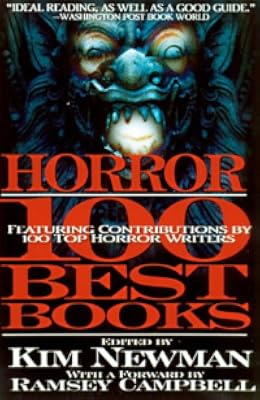
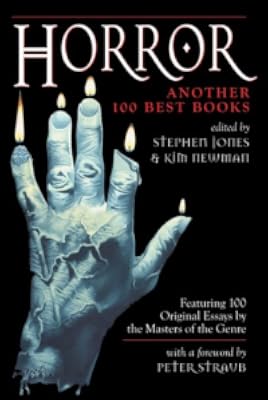
Horror: The 100 Best Books
by Stephen Jones (Editor), Kim Newman (Editor)
Horror: The 100 Best Books (1)
On This Page
Description
A collection of 100 essays by leading horror writers nominating their own choices for the best books in the genre.Tags
Recommendations



















Member Reviews
It's always fun to go back and look at these dated "Best" catalogs. First there are the contemporary or recent past books that are largely, and often justly now, forgotten. Then there are the contributors, that are largely, and often justly now, forgotten. Even so there is enough good here, especially in the older stuff, to make this a decent reference book.
Beware, the entries often give away too much about the books featured.
Far from a definitive list up to 1988, this is a good place to find some things you just might have overlooked.
Beware, the entries often give away too much about the books featured.
Far from a definitive list up to 1988, this is a good place to find some things you just might have overlooked.
Reread & I’d forgotten what a fabulous book this is. Compilation of reviews & commentaries by famous horror writers on other famous works. Favorite is still Poe’s review of Hawthorne but there’s reviews by HPL, Ligotti, de Lint, & scores more. Well worth your October reading
Amazon.com
First published in 1988, Horror: The 100 Best Books has remained the only book of its kind: a solid (and entertaining) annotated reading list spanning the range of horror fiction from the 16th to the 20th century. The device of asking 100 horror, fantasy,and science fiction writers to write about their favorite horror books might seem at first to capture an idiosyncratic sample, but through diplomacy and diligence, editors Stephen Jones and Kim Newman succeeded in obtaining short essays on most (if not all) of the well-known classics, as well as many more lesser-knowns that are well worth discovering. Readers who follow up on these recommendations will find tips about books by writers mostly known for other genres--such as show more Iain Banks, Robert Holdstock, Lisa Tuttle, and David Morrell.
Also valuable are write-ups on literary works not always acknowledged as horror, such as Kingsley Amis's The Green Man, Jerzy Kosinski's The Painted Bird, and John Gardner's Grendel. And the write-ups offer a fascinating peek into the minds of the contributors, who include just about all the top horror writers of the'60s-'80s. This 10th anniversary edition makes no changes in the list of 100 books, but updates the entries and includes a 9-page reading list of titles from 458 B.C. to 1997. --Fiona Webster
From Independent Publisher
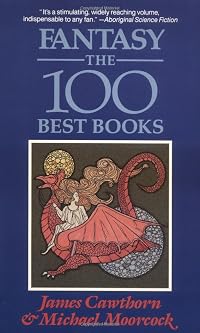
The continuing growth in popularity of speculative fiction (an all-encompassing term for horror, fantasy, and science fiction) has resulted in a recent spate of suggested reading lists. Strangely enough, these two collections, while possessing corresponding publishers, titles, and concepts, utilize vastly different approaches to compile their "best of' lists.Of the two, Jones' and Newman's entry is more interesting, as they have imbued their book with a bit of novelty by garnering the opinions of 100 authors, editors, and others in the genre. Each contributor offers a personal essay on why they made their selection. Contributors include the field's current bestselling authors (such as Stephen King, Clive Barker, and Robert McCammon) as well as deceased luminaries (such as Edgar Allen Poe, Robert Howard, and H.P. Lovecaft). Chronologically, the selections range from The Tragical History of Dr. Faustus (Christopher Marlowe, 1592) to Dark Feasts (Ramsey Campbell, 1987). By soliciting the opinions of so many varied voices, Jones and Newman avoid overloading the list with personal bias, and they achieve an eclectic touch that makes the choices extremely interesting. Acknowledging the potential quirky nature of such a selection process, a further recommended reading list is appended, giving the reader enough material to keep him or her busy into the next century. Taking a somewhat converse approach, Cawthorn and Moorcock simply list their personal selections for the 100 best books in the field of fantasy. While the editors' credentials are clearly topnotch, the uniform viewpoint doesn't measure up the variety offered in Jones' and Newman's collection. To their credit, the picks of Cawthorn and Moorcock are wide-ranging, spanning from Gulliver's Travels (Jonathan Swift, 1726) to Expecting Sonteone Taller (Tom Holt~ 1987) chronologically, and encompassing commensurate ground thematically. Indicative of the narrow, sometimes imperceptible boundary between definitions of fantasy and horror is the fact that fourteen works have achieved mention in both of these lists. Regardless of the dissimilar methods used in compiling these two listings, there's no question that both offer plenty of interesting and provocative suggestions for future reading.--This text refers to an out of print or unavailable edition of this title. show less
First published in 1988, Horror: The 100 Best Books has remained the only book of its kind: a solid (and entertaining) annotated reading list spanning the range of horror fiction from the 16th to the 20th century. The device of asking 100 horror, fantasy,and science fiction writers to write about their favorite horror books might seem at first to capture an idiosyncratic sample, but through diplomacy and diligence, editors Stephen Jones and Kim Newman succeeded in obtaining short essays on most (if not all) of the well-known classics, as well as many more lesser-knowns that are well worth discovering. Readers who follow up on these recommendations will find tips about books by writers mostly known for other genres--such as show more Iain Banks, Robert Holdstock, Lisa Tuttle, and David Morrell.
Also valuable are write-ups on literary works not always acknowledged as horror, such as Kingsley Amis's The Green Man, Jerzy Kosinski's The Painted Bird, and John Gardner's Grendel. And the write-ups offer a fascinating peek into the minds of the contributors, who include just about all the top horror writers of the'60s-'80s. This 10th anniversary edition makes no changes in the list of 100 books, but updates the entries and includes a 9-page reading list of titles from 458 B.C. to 1997. --Fiona Webster
From Independent Publisher
The continuing growth in popularity of speculative fiction (an all-encompassing term for horror, fantasy, and science fiction) has resulted in a recent spate of suggested reading lists. Strangely enough, these two collections, while possessing corresponding publishers, titles, and concepts, utilize vastly different approaches to compile their "best of' lists.Of the two, Jones' and Newman's entry is more interesting, as they have imbued their book with a bit of novelty by garnering the opinions of 100 authors, editors, and others in the genre. Each contributor offers a personal essay on why they made their selection. Contributors include the field's current bestselling authors (such as Stephen King, Clive Barker, and Robert McCammon) as well as deceased luminaries (such as Edgar Allen Poe, Robert Howard, and H.P. Lovecaft). Chronologically, the selections range from The Tragical History of Dr. Faustus (Christopher Marlowe, 1592) to Dark Feasts (Ramsey Campbell, 1987). By soliciting the opinions of so many varied voices, Jones and Newman avoid overloading the list with personal bias, and they achieve an eclectic touch that makes the choices extremely interesting. Acknowledging the potential quirky nature of such a selection process, a further recommended reading list is appended, giving the reader enough material to keep him or her busy into the next century. Taking a somewhat converse approach, Cawthorn and Moorcock simply list their personal selections for the 100 best books in the field of fantasy. While the editors' credentials are clearly topnotch, the uniform viewpoint doesn't measure up the variety offered in Jones' and Newman's collection. To their credit, the picks of Cawthorn and Moorcock are wide-ranging, spanning from Gulliver's Travels (Jonathan Swift, 1726) to Expecting Sonteone Taller (Tom Holt~ 1987) chronologically, and encompassing commensurate ground thematically. Indicative of the narrow, sometimes imperceptible boundary between definitions of fantasy and horror is the fact that fourteen works have achieved mention in both of these lists. Regardless of the dissimilar methods used in compiling these two listings, there's no question that both offer plenty of interesting and provocative suggestions for future reading.--This text refers to an out of print or unavailable edition of this title. show less
Ratings
Members
- Recently Added By
Lists

Bram Stoker Award
238 works; 5 members
Author Information


Kim Newman is a novelist, critic and broadcaster. His fiction has been translated into many languages and he is a past recipient of, among others, the International Horror Critics' Guild Award for Best Novel
All Editions
Awards and Honors
Awards
Series

Common Knowledge
- Original publication date
- 1988
- Dedication
- For Mum and Dad, for all their love
and continued support
—Steve
For Meg, much love
—Kim - First words
- Horror fiction is the branch of literature most often concerned with going too far. (Foreword)
There are plenty of critical guides clogging the shelves, particularly in the science fiction and fantasy categories. (Introduction) - Disambiguation notice
- This book was actually edited by two people: Stephen Jones and Kim Newman.
Classifications
Statistics
- Members
- 296
- Popularity
- 108,418
- Reviews
- 3
- Rating
- (4.14)
- Languages
- English
- Media
- Paper
- ISBNs
- 5
- ASINs
- 2