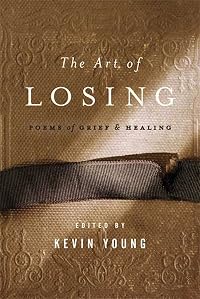
The Art of Losing
by Kevin Young (Editor)
On This Page
Description
Poems about the various stages of grief, with 150 selections from a variety of 20th-21st century poets.Tags
Recommendations



Member Reviews
This is a lovely and well-put-together volume. Kevin Young has written a thoughtful, personal, and reflective introduction in which he shares his own experience of bereavement and his belief that poetry can play a meaningful part in the grieving process.
Young has arranged the poems in sections that follow from the initial shock of grief through healing to some kind of (not necessarily religious) feeling of acceptance or transcendence: Reckoning - Regret - Remembrance - Ritual - Recovery - Redemption. In fact, many of the poems could fit multiple categories; this reader found the arrangement not very helpful, although I appreciated Young's care in selecting and arranging. (There is a useful subject index at the end of the book, listing show more poems appropriate for reading at funeral services, and categorizing poems based on the relationship to the deceased. If only there could also be an indexes for author and first line/title, this anthology might be perfect!)
In his introduction, Young describes his selections as "the best of our time" -- and I'm inclined to agree with him. This book includes not only some of the best English language poems about grief, but simply the best poems in the English language. I was chilled by Marie Howe's "How Some of It Happened"; drawn to and disturbed by Brenda Shaughnessy's "Ever"; and awed anew the strength and beauty in Roethke's "The Waking". There are Dylan Thomas, Emily Dickinson, and W. H. Auden, alongside Terrance Hayes, Natasha Tretheway, and Matthew Dickman. What surprised me is that poets with radically different aesthetics (say, Lucy Brock-Broido and Albert Goldbarth) appear together here and the juxtaposition not only isn't jarring, the stylistic differences seem to fade beneath the rich weight of the poems themselves. They are intense, deeply felt, probing, mysterious, and immensely real. The Art of Losing is the poetry anthology at its best. show less
Young has arranged the poems in sections that follow from the initial shock of grief through healing to some kind of (not necessarily religious) feeling of acceptance or transcendence: Reckoning - Regret - Remembrance - Ritual - Recovery - Redemption. In fact, many of the poems could fit multiple categories; this reader found the arrangement not very helpful, although I appreciated Young's care in selecting and arranging. (There is a useful subject index at the end of the book, listing show more poems appropriate for reading at funeral services, and categorizing poems based on the relationship to the deceased. If only there could also be an indexes for author and first line/title, this anthology might be perfect!)
In his introduction, Young describes his selections as "the best of our time" -- and I'm inclined to agree with him. This book includes not only some of the best English language poems about grief, but simply the best poems in the English language. I was chilled by Marie Howe's "How Some of It Happened"; drawn to and disturbed by Brenda Shaughnessy's "Ever"; and awed anew the strength and beauty in Roethke's "The Waking". There are Dylan Thomas, Emily Dickinson, and W. H. Auden, alongside Terrance Hayes, Natasha Tretheway, and Matthew Dickman. What surprised me is that poets with radically different aesthetics (say, Lucy Brock-Broido and Albert Goldbarth) appear together here and the juxtaposition not only isn't jarring, the stylistic differences seem to fade beneath the rich weight of the poems themselves. They are intense, deeply felt, probing, mysterious, and immensely real. The Art of Losing is the poetry anthology at its best. show less
 This review was written for LibraryThing Early Reviewers.
I received The Art of Losing: Poems of Grief and Healing through LibraryThing's Early Reviewers program, and I'm so so grateful that I did. Thank you to Bloomsbury and LT for the opportunity to read and review this book.
As I read the book, I marked the Table of Contents to indicate poems I particularly liked, or which echoed and articulated my own experiences of grief. Initially, I thought I might quote from a few of them in my review. But now I find I cannot choose, as I've marked about 80 poems. I also noted a handful of what I considered "classic" poems on grief, many of which have been widely anthologized already but surely belong here as well, including "Do Not Go Gentle into That Good Night" by Dylan Thomas, "Funeral Blues" by W. show more H. Auden, "Nothing Gold Can Stay" by Robert Frost, "After great pain, a formal feeling comes --" by Emily Dickinson, and "Elegy for Jane" by Theodore Roethke.
I was very impressed with the strength of the whole collection. Although I didn't love every poem (and with an anthology, it's likely no one does except the editor), my reactions are a reflection of my own tastes, not upon the quality of the poems. There really is "something for everyone," or at least for everyone familiar with grief, in this amazing collection. The editor, Kevin Young, is to be commended for bringing a great variety of voices and styles together to form a cohesive volume.
Having lost both of my own parents, my father-in-law, and both of my grandfathers -- and three of these five losses within the past two years -- The Art of Losing isn't merely a book I won through LibraryThing; it truly feels like a gift, one I will cherish for many years, and share with others who might find comfort within its pages. show less
As I read the book, I marked the Table of Contents to indicate poems I particularly liked, or which echoed and articulated my own experiences of grief. Initially, I thought I might quote from a few of them in my review. But now I find I cannot choose, as I've marked about 80 poems. I also noted a handful of what I considered "classic" poems on grief, many of which have been widely anthologized already but surely belong here as well, including "Do Not Go Gentle into That Good Night" by Dylan Thomas, "Funeral Blues" by W. show more H. Auden, "Nothing Gold Can Stay" by Robert Frost, "After great pain, a formal feeling comes --" by Emily Dickinson, and "Elegy for Jane" by Theodore Roethke.
I was very impressed with the strength of the whole collection. Although I didn't love every poem (and with an anthology, it's likely no one does except the editor), my reactions are a reflection of my own tastes, not upon the quality of the poems. There really is "something for everyone," or at least for everyone familiar with grief, in this amazing collection. The editor, Kevin Young, is to be commended for bringing a great variety of voices and styles together to form a cohesive volume.
Having lost both of my own parents, my father-in-law, and both of my grandfathers -- and three of these five losses within the past two years -- The Art of Losing isn't merely a book I won through LibraryThing; it truly feels like a gift, one I will cherish for many years, and share with others who might find comfort within its pages. show less
This review was written for LibraryThing Early Reviewers.I read less poetry than works of fiction or non-fiction, but I approach all reading pretty much the same way: look for a topic I’m generally interested in, and then judge whether I think the work treats that subject in an engaging or insightful way. One difference is that unlike novelists or essayists, there aren’t many poets I read based on their name alone.
So for me, the draw of The Art of Losing was the idea of collected verse revolving around a theme, in this case that of grief and loss. These poems are predominantly from the 20th century and are grouped according to the familiar stages of grieving (Reckoning – Regret – Remembrance – Ritual – Recovery – Redemption). While clearly thought was given to making the book show more useful for delivering a eulogy (a subject index, an in-spine ribbon bookmark for ease of reference at a lectern or gravesite), this collection is interesting as thoughtful reading and not merely as a reference.
Most poems here fit on one face of a page, the occasional longer poems arriving at comfortable intervals. Generally, the verse is given to imagery and evocation of feeling, rather than focusing on ideas or wordplay, so I could read a section (twenty poems?) in an hour or two. They also tend to the quotidian, describing an individual the poet knew personally, or detailing how someone’s specific loss interrupted a familiar routine, or established a new one. These poems arrive at universals by examining individual lives, and individual deaths, using language and imagery by turns lyrical and frank.
Young's arrangement is as impressive as his selection. Beyond the grouping by stage of grieving, poems with similar themes seem to comment on one another, and often are paired to make evident the connection. For instance: a pair of poems focusing on the clothes left behind by a deceased loved one; two poems on how life is like the music from an instrument and the body like the instrument itself; and in one case, a direct reference by one poet to the poem immediately preceding it in the anthology (Dylan Thomas's "A Refusal to Mourn ..."). A nice wry humour arising "between the lines" of the verse, and the volume overall revealing a character beyond that of the collected personalities of its poems.
My experience of loss isn’t primarily that of death, but these poems read true to my sense of loss and grief from that loss. Reading The Art of Losing reassures my sense of the world as a place of beauty – not in spite of, but inclusive of the loss and grief I find. My memories and who I am because of past experience reveals that beauty to me, and those memories found tribute in these poems. show less
So for me, the draw of The Art of Losing was the idea of collected verse revolving around a theme, in this case that of grief and loss. These poems are predominantly from the 20th century and are grouped according to the familiar stages of grieving (Reckoning – Regret – Remembrance – Ritual – Recovery – Redemption). While clearly thought was given to making the book show more useful for delivering a eulogy (a subject index, an in-spine ribbon bookmark for ease of reference at a lectern or gravesite), this collection is interesting as thoughtful reading and not merely as a reference.
Most poems here fit on one face of a page, the occasional longer poems arriving at comfortable intervals. Generally, the verse is given to imagery and evocation of feeling, rather than focusing on ideas or wordplay, so I could read a section (twenty poems?) in an hour or two. They also tend to the quotidian, describing an individual the poet knew personally, or detailing how someone’s specific loss interrupted a familiar routine, or established a new one. These poems arrive at universals by examining individual lives, and individual deaths, using language and imagery by turns lyrical and frank.
Young's arrangement is as impressive as his selection. Beyond the grouping by stage of grieving, poems with similar themes seem to comment on one another, and often are paired to make evident the connection. For instance: a pair of poems focusing on the clothes left behind by a deceased loved one; two poems on how life is like the music from an instrument and the body like the instrument itself; and in one case, a direct reference by one poet to the poem immediately preceding it in the anthology (Dylan Thomas's "A Refusal to Mourn ..."). A nice wry humour arising "between the lines" of the verse, and the volume overall revealing a character beyond that of the collected personalities of its poems.
My experience of loss isn’t primarily that of death, but these poems read true to my sense of loss and grief from that loss. Reading The Art of Losing reassures my sense of the world as a place of beauty – not in spite of, but inclusive of the loss and grief I find. My memories and who I am because of past experience reveals that beauty to me, and those memories found tribute in these poems. show less
This review was written for LibraryThing Early Reviewers.I don't read a lot of poetry, so finer points of craft or style may be lost on me, but though I may not be a student of poetry, I am a student of grief, as we all are.
Broadly divided into sections (Reckoning, Regret, Remembrance, Ritual, Recovery, Redemption) this well-selected anthology of poems covers as many different aspects of grief and mourning as the number of poets included. No two poems relate the same experience, but yet they are all familiar because no emotion is as multifaceted as grief.
There are poems about the death of loved ones old and young, well known and stranger, friends, enemies, and pets. In one poem, a man with his lawnmower accidentally kills a hedgehog who lived in his garden and felt strongly the show more responsibility of it:
There is regret for things said and unsaid, and things never heard. There is anger, fear and love.
Some remember too much, or can't remember as well as they want to.
Broadly divided into sections (Reckoning, Regret, Remembrance, Ritual, Recovery, Redemption) this well-selected anthology of poems covers as many different aspects of grief and mourning as the number of poets included. No two poems relate the same experience, but yet they are all familiar because no emotion is as multifaceted as grief.
There are poems about the death of loved ones old and young, well known and stranger, friends, enemies, and pets. In one poem, a man with his lawnmower accidentally kills a hedgehog who lived in his garden and felt strongly the show more responsibility of it:
Next morning I got up and it did not. / The first day after a death, the new absence / Is always the same; we should be careful / Of each other
There is regret for things said and unsaid, and things never heard. There is anger, fear and love.
Some remember too much, or can't remember as well as they want to.
Trying to remember you / is like carrying water / in my hands a long distance / across sand. Somewhere / people are waiting. / They have drunk nothing for days.show less
As someone who doesn't communicate well in words and who has experienced much grief of late, this book has been especially meaningful to me. I can say, "yes, that's it exactly!" to every poem as if I had expressed it myself. It is painful and cathartic and illustrates the communion we all share.
Highly recommended.
This review was written for LibraryThing Early Reviewers.A friend recommended this collection of poems about grief and healing, and I only picked it up hesitantly: who wants to read a whole book of death poems?
As it turns out, I do.
The selections range from raw, devastating laments to tender (or angry) remembrances to hopeful visions of recovery. Usually I could only read a handful at a time because of the weight of them, but I was always moved.
This is a book worth owning, even for folks who aren't typically into poetry. Grieving people need to know there is empathy for their journey and insight to pull them through, and these poems can provide both.
As it turns out, I do.
The selections range from raw, devastating laments to tender (or angry) remembrances to hopeful visions of recovery. Usually I could only read a handful at a time because of the weight of them, but I was always moved.
This is a book worth owning, even for folks who aren't typically into poetry. Grieving people need to know there is empathy for their journey and insight to pull them through, and these poems can provide both.
The Art of Losing: Poems of Grief & Healing, edited by Kevin Young seemed a likely selection since I lost my father in 2008. From the minute I opened the book and began to read, I realized how very lucky I am to have been selected to preview this insightful and touching collection of poetry - it is a revelation and a great gift. Kevin Young has compiled a loving, necessary and cathartic testament to those we have lost and those of us who live on.
The hard copy is beautiful, with an understated cover, and a fine brown ribbon that allows the reader to bookmark a poem or favorite passage. The table of contents groups the works by stages of grief, listing the authors and poems for easy reference. The subject index collates the works by the show more type of loss: father, child, sibling, lover. It is thoughtful in every conceivable way.
Kevin Young is a gifted editor, compiling contemporary and traditional poetry into chapters that parallel the grieving process. I assumed based on the passage of time that I was beyond the Reckoning phase and lingering somewhere in Regret, Rememberance and Ritual, and longing for Recovery and Redemption. I was surprised by the emotions I experienced reading the introduction and the first chapter. It appears I have just begun to reckon with death. The poems range from stunning, evocative, poignant, shocking, consoling to heartwrenching, and I could not stop reading as I found common ground, insight and truth. I tried to read the book without skipping around, but instead returned repeatedly to the contents, the index, seeking favorite authors or personal revelations. I was familiar with some of the traditional works like Dylan Thomas or Mary Oliver, and I was introduced to many new voices attempting to express the scope of loss. I was moved to tears by more than a few of the poems, and found many of them to linger in my memory. The book's editor is also a contributor, and Kevin Young's poems are as deep and touching as his introduction.
I found this collection to be unique, touching and transforming, and I wish I had this book to select a more fitting eulogy for my father last year, as well as to find comfort in the shared expressions of grief. I am sure I will return to this collection often as I move slowly through my grief process. I will give this book as a gift for others adrift in grief, in need of comfort, who struggle to regain balance amid loss. show less
The hard copy is beautiful, with an understated cover, and a fine brown ribbon that allows the reader to bookmark a poem or favorite passage. The table of contents groups the works by stages of grief, listing the authors and poems for easy reference. The subject index collates the works by the show more type of loss: father, child, sibling, lover. It is thoughtful in every conceivable way.
Kevin Young is a gifted editor, compiling contemporary and traditional poetry into chapters that parallel the grieving process. I assumed based on the passage of time that I was beyond the Reckoning phase and lingering somewhere in Regret, Rememberance and Ritual, and longing for Recovery and Redemption. I was surprised by the emotions I experienced reading the introduction and the first chapter. It appears I have just begun to reckon with death. The poems range from stunning, evocative, poignant, shocking, consoling to heartwrenching, and I could not stop reading as I found common ground, insight and truth. I tried to read the book without skipping around, but instead returned repeatedly to the contents, the index, seeking favorite authors or personal revelations. I was familiar with some of the traditional works like Dylan Thomas or Mary Oliver, and I was introduced to many new voices attempting to express the scope of loss. I was moved to tears by more than a few of the poems, and found many of them to linger in my memory. The book's editor is also a contributor, and Kevin Young's poems are as deep and touching as his introduction.
I found this collection to be unique, touching and transforming, and I wish I had this book to select a more fitting eulogy for my father last year, as well as to find comfort in the shared expressions of grief. I am sure I will return to this collection often as I move slowly through my grief process. I will give this book as a gift for others adrift in grief, in need of comfort, who struggle to regain balance amid loss. show less
This review was written for LibraryThing Early Reviewers.One of the better anthologies I've ever read, likely due to both the evocative nature of poetry on death & grieving, and the meticulous research and selection done by Kevin Young. Old classics sit side-by-side with modern stunners, formal sits alongside the more experimental, high diction next to the everyday vernacular, and never is there a jarring transition. While not all of the poems spoke to me (and when does this ever happen in an anthology?) there was nary a true dud in the bunch. There is so much here to sit with and think on and wrap around yourself. My only caveat is that so much reading of death can be overwhelming; I found myself having to take breaks, not just to let the better poems sink into me, but to handle the show more exquisitely heavy air of grief. show less
This review was written for LibraryThing Early Reviewers.Members
- Recently Added By
Lists

Deathreads
78 works; 2 members

Grief
15 works; 1 member
Author Information

Kevin Young is the author of a previous book of nonfiction, The Grey Album: On the Blackness of Blackness, which won the PEN Open Book Award, was recognized as a New York Times Notable Book, and named a finalist for the National Book Critics Circle Award for criticism. He is the author of eleven books of poetry, including Brown and Blue Laws: show more Selected Uncollected Poems 1995-2015. Young is the director of the Schomburg Center for Research in Black Culture and poetry editor for the New Yorker. show less
All Editions
Common Knowledge
- Canonical title
- The Art of Losing
- Original publication date
- 2010
- Epigraph
- O how shall I warble myself for the dead one there I loved?
And how shall I deck my song for the large sweet soul that has gone?
- Walt Whitman - Dedication
- for my father
- First words
- I have begun to believe in, and even to preach, a poetry of necessity.
- Last words
- (Click to show. Warning: May contain spoilers.)What will survive of us is love.
- Original language
- English
Classifications
Statistics
- Members
- 237
- Popularity
- 137,224
- Reviews
- 22
- Rating
- (4.10)
- Languages
- English
- Media
- Paper, Ebook
- ISBNs
- 3